
In This Article
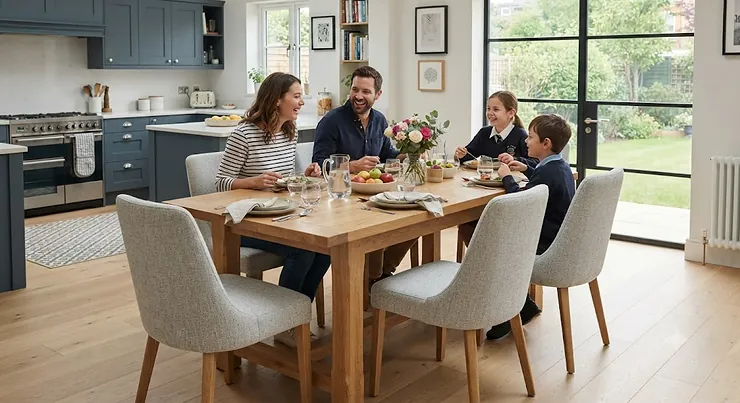
There’s a particular kind of chaos that happens when six people try to eat around a table built for four. Elbows collide. Someone’s chair leg ends up half in the hallway. The gravy boat becomes a hostage negotiation. If that scene sounds familiar, you’re exactly the reader this guide was written for, because a properly sized 6 seater dining table and chairs set solves a problem that no amount of clever place-setting can fix: not enough table.
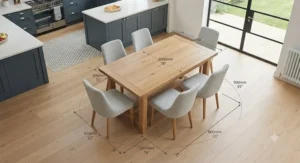
A 6 seater dining table and chairs set is, at its simplest, a table between roughly 150cm and 180cm long, paired with six matching chairs, designed to seat a family of that size comfortably rather than in a squeeze. It sits in the sweet spot between a cramped four-seater and an eight-seater that eats an entire room, which is exactly why it’s the most searched dining size in the UK. But “seats six” on a listing and “actually comfortable for six adults with elbow room” are two very different promises, and the gap between them is where most buyers get caught out.
This guide does the homework you’d otherwise do yourself across a dozen open browser tabs. We’ve pulled together seven real, currently available options from amazon.co.uk spanning budget glass-and-leather sets through to solid-oak pedestal tables, broken down what the spec sheets actually mean once the box is unpacked, and built in the kind of practical advice — assembly realities, maintenance, sizing for your room — that a product listing simply won’t give you. Every price mentioned is a range rather than an exact figure, because prices on Amazon shift by the week; always check the current price before buying. And in the interest of transparency, this article contains affiliate links, meaning we may earn a small commission if you buy through them, at no extra cost to you.
By the end, you should know not just which dining table for 6 suits your budget, but why — and that “why” is the part most buying guides skip entirely.
Quick Comparison Table
Before we get into the detail, here’s the shortlist at a glance. Full breakdowns follow in the next section.
| Product | Style | Table Material | Price Range | Best For |
|---|---|---|---|---|
| Julian Bowen Davenport | Classic pedestal | Oak veneer, MDF core | £350-£450 range | Traditional homes wanting fewer table legs |
| KOSY KOALA Grey Velvet Set | Contemporary velvet | Wood-effect MDF | Under £250 | Budget buyers who still want a soft-touch finish |
| Panana Glass & Leather Set | Modern glass | Tempered glass | Under £220 | Small budgets, light-filled rooms |
| Furniturebox Giovani & Milan | High gloss modern | High gloss MDF | £300-£400 range | Contemporary, low-maintenance households |
| Furniturebox Atlanta + Lorenzo | Chrome & gloss | High gloss MDF, chrome frame | £400-£500 range | Statement pieces in open-plan spaces |
| Furniturebox Imperia | Premium gloss | High gloss MDF, chrome legs | £450-£584.99 RRP range | Buyers wanting the most polished finish on test |
| Kosy Koala Two-Tone Gloss | Classic two-tone | High gloss MDF | £200-£300 range | Buyers wanting a timeless black-and-white look |
Looking across the table, the split isn’t really about who’s “best” — it’s about what each material trade-off costs you later. The glass and high-gloss options in the middle of the pack win on style-per-pound but ask more of you in upkeep, while the Julian Bowen Davenport trades a little visual drama for genuine longevity. If your household includes small children or you host often, that trade-off matters more than the price tag suggests.
💬 Just one click — help others make better buying decisions too!😊
Top 7 6 Seater Dining Table and Chairs Sets: Expert Analysis
We’ve deliberately spread this list across budget, mid-range and premium price bands, and across the three dominant UK dining styles — classic wood, high-gloss contemporary, and glass — so there’s a genuine option here whatever your dining room actually looks like.
1. Julian Bowen Davenport Dining Table & 6 Chairs — pedestal base means no corner legs to dodge
The standout here isn’t the finish, it’s the base. A single central pedestal replaces the usual four-legged frame, which sounds like a small detail until you’re the person sat at the end of a rectangular table trying not to kick a table leg all evening.
Julian Bowen is a name that’s been in UK furniture for more than three decades, and the Davenport reflects that: an ivory-painted frame paired with a light oak veneer tabletop, built from a combination of MDF and oak veneer rather than solid timber throughout. In practice, that construction means you get the warmth of real wood grain on the visible surfaces without the expansion and contraction issues that solid oak can develop in centrally heated UK homes. The six matching chairs share the ivory and oak treatment and use a simple frame that keeps the whole set visually light rather than heavy.
Who this suits: households who want a table that reads as “proper furniture” rather than flat-pack modern, and who value having one central leg instead of four corner ones — genuinely useful if your dining space doubles as a walkway. Buyers assembling it themselves should set aside a proper afternoon rather than an hour; pedestal tables typically take longer to construct than four-leg frames because the base itself is a multi-part assembly before the top even goes on.
Aggregated buyer sentiment for the Davenport is notably positive on ease of assembly and perceived value against equivalent high-street prices, with buyers commonly comparing it favourably to significantly pricier in-store alternatives. A recurring note in feedback is that the chairs feel sturdier than their price band would suggest, though as with any painted MDF finish, a small number of reviewers flag that the ivory paintwork can show marks over time if not wiped promptly.
Pros:
- ✅ Central pedestal base frees up legroom for six diners
- ✅ Established 30+ year UK brand with consistent stock availability
- ✅ Strong perceived value versus comparable high-street sets
Cons:
- ❌ Painted finish can show scuffs more readily than solid wood
- ❌ Longer assembly time than simpler four-leg table designs
At around £350-£450 range depending on retailer promotions, this sits in solid mid-range territory. For buyers who want their dining table for 6 to look and feel more expensive than it is, the Davenport earns its keep.
2. KOSY KOALA Dining Table and 6 Chairs Grey — tufted velvet chairs at a genuinely budget price
What jumps out immediately is the chair upholstery. Velvet dining chairs usually signal a premium price bracket, so finding six of them bundled with a table under the £250 mark is the standout feature worth mentioning first.
The table itself measures 140cm long by 80cm wide and 75cm tall, built from MDF with a grey “arrow” wood-effect melamine laminate finish — practically, that laminate surface means it wipes clean easily and resists the ring marks that raw or lightly lacquered wood can pick up from mugs and glasses. The six chairs stand 87cm tall with a 44cm seat height, upholstered in tufted grey velvet on metal legs with adjustable rubber feet, which matters more than it sounds: uneven feet are one of the most common causes of a wobbly dining chair on real-world (not showroom-flat) UK flooring.
Who this suits: renters, first-home buyers, and anyone furnishing a dining room for the first time who wants a set that photographs well without stretching the budget. This is a genuine own-brand small-business listing rather than an established heritage name, which is worth knowing going in — it affects long-term parts availability if a leg or foot ever needs replacing.
Real customer feedback for this KOSY KOALA range consistently praises the visual impact of the velvet chairs relative to price, with the grey tone described as working well in both warm and cool-toned rooms. The recurring critical theme across the brand’s velvet ranges is that fabric on the seat edges can show wear faster under daily heavy use than a faux leather equivalent would, which is a fair trade for the softer look and feel.
Pros:
- ✅ Velvet chair upholstery rarely seen at this price point
- ✅ Melamine laminate top wipes clean, resists ring marks
- ✅ Adjustable rubber feet reduce wobble on uneven floors
Cons:
- ❌ Velvet shows wear faster than faux leather under daily use
- ❌ Smaller brand means less certainty on long-term spare parts
Priced under £250 at the time of research, this is the set to consider if a dinner party seating upgrade needs to happen on a tight timeline and a tighter budget.
3. Panana Glass Dining Table Set and 6 Soft Black Leather Chairs — the lightest visual footprint of any set here
A glass tabletop does something no wood or gloss surface can: it makes a dining room feel bigger than it is, because your eye passes straight through the surface to the floor beneath.
The 120cm tempered glass top sits on a metal frame, paired with six faux leather chairs upholstered in black. Tempered glass is worth understanding here — it’s toughened through a heat treatment process that makes it several times stronger than standard glass and, crucially, means it shatters into small blunt fragments rather than sharp shards if it ever does break, which is the safety standard reputable UK dining glass should meet. The leather chairs use a simple frame and padded seat, giving a look that reads more expensive than the price tag suggests.
Who this suits: smaller or darker dining rooms where visual weight is the enemy, and households without very young children who might use the table edge to pull themselves up. Aggregated reviews for this Panana range are genuinely mixed rather than uniformly glowing, which is worth being upfront about: several buyers report the tabletop and assembly quality as excellent for the price, while others note the chair frames feel less robust than the table itself and that paint or coating on chair components can show wear at contact points during assembly. That split sentiment is common across budget glass-and-leather sets generally, so treat it as a fair representation of what you’re buying at this price rather than a red flag specific to this listing.
Pros:
- ✅ Tempered glass top visually opens up smaller dining rooms
- ✅ Faux leather chairs look more premium than the price suggests
- ✅ Genuinely budget entry point into a 6 seater dining table set
Cons:
- ❌ Reviewer sentiment on chair sturdiness is mixed, not uniform
- ❌ Glass surfaces show fingerprints and dust more than wood or gloss
At under £220 range, this is the most accessible glass option on the list, and a sensible pick if light-filled, low-clutter is the look you’re chasing.
4. Furniturebox UK Giovani & Milan 6-Seater Dining Set — the high-gloss modern look without the premium price tier
Furniturebox UK has built its reputation specifically around this look: high-gloss MDF tables paired with faux leather chairs, and the Giovani & Milan combination is one of the brand’s most consistently stocked pairings.
The grey high-gloss table uses an MDF core with a lacquered gloss top coat — the gloss finish is what gives it that reflective, almost wet-look surface, and practically speaking that means it needs a microfibre cloth rather than an abrasive sponge to keep it looking new, since gloss coatings scratch more visibly than matte ones even though the underlying material is just as durable. The Milan chairs use grey faux leather over a padded seat with simple metal or wood-effect legs depending on the specific listing variant.
Who this suits: households who want the contemporary showroom look — the kind you’d see in a new-build show home — without paying premium designer prices. Grouped customer sentiment across Furniturebox’s Giovani & Milan listings is generally strong on first-impressions value, with reviewers frequently describing the gloss finish as looking noticeably more expensive than the price paid. The most consistent constructive note across the brand’s high-gloss ranges is that assembly instructions can be light on detail for less confident DIYers, so budgeting extra time (or a second pair of hands) for setup is sensible.
Pros:
- ✅ High-gloss finish gives a contemporary showroom aesthetic
- ✅ Strong value perception relative to the visual impact
- ✅ Faux leather chairs are easy to wipe clean after meals
Cons:
- ❌ Gloss surfaces scratch more visibly than matte finishes
- ❌ Assembly instructions can lack detail for first-time flat-packers
In the £300-£400 range, this set earns its place as the benchmark mid-tier modern option most UK buyers land on when researching a dining table for 6.
5. Furniturebox UK Atlanta Rectangle Chrome Metal Table + 6 Elephant Grey Lorenzo Chairs — the most architectural silhouette on this list
Where most of the sets here lean traditional-with-a-twist, the Atlanta leans hard into a chrome-and-gloss aesthetic that reads more restaurant-chic than family kitchen.
The rectangular high-gloss white top sits on a chrome metal frame rather than a wooden or MDF base — chrome legs distribute weight differently to wooden legs, generally giving a lighter visual footprint but requiring the floor-contact points to be checked and tightened periodically, since metal-to-floor fixings can loosen slightly over months of use in a way solid wood legs rarely do. The six Lorenzo chairs, upholstered here in “elephant grey” luxury faux leather, bring warmth back into what could otherwise be a cold-looking set.
Who this suits: open-plan kitchen-diners and buyers actively trying to avoid the “brown wood dining set” look that dominated the previous decade. Aggregated review sentiment for the Atlanta plus Lorenzo pairing highlights the visual statement it makes in photographs and in person, with buyers commonly noting it looks like a considerably pricier designer piece. The main constructive theme worth flagging honestly is that chrome furniture shows fingerprints and smudges more readily than painted or matte metal, so households with young children touching the frame constantly may find themselves polishing it more often than they’d like.
Pros:
- ✅ Chrome frame gives a lighter, more architectural look
- ✅ Elephant grey Lorenzo chairs balance a modern colour palette
- ✅ Strong “looks pricier than it is” reviewer sentiment
Cons:
- ❌ Chrome shows fingerprints and smudges more than painted metal
- ❌ Floor-contact fittings need occasional tightening over time
Sitting in the £400-£500 range, the Atlanta is the pick for buyers who want their dining room centrepiece to double as a genuine style statement.

6. Furniturebox UK Imperia White High Gloss Table & 6 Cappuccino Grey Lorenzo Chairs — the most polished finish across the whole shortlist
If there’s a “flagship” set in this line-up, it’s the Imperia. The white high-gloss tabletop paired with chrome cantilever chair legs is Furniturebox’s premium positioning within its own range, and it shows in the finer construction details.
Cantilever legs — the kind that curve rather than sit as a straight vertical support — are worth understanding in real-world terms: they add a small amount of controlled flex when you lean or sit down, which many people find more comfortable over a long meal than a rigid straight-legged chair, at the cost of slightly less structural rigidity than a four-square frame. The Cappuccino Grey Lorenzo chairs continue the faux leather theme seen elsewhere in the range, offering a warmer neutral than the starker greys used on some sibling listings.
Who this suits: buyers who’ve already decided on the Furniturebox high-gloss aesthetic and want the top-tier execution of it, particularly for a dining room that also functions as an entertaining space. Grouped customer sentiment here skews strongly positive on perceived quality and finish compared to the brand’s entry-level listings, with the RRP-to-sale-price gap frequently highlighted by buyers as making it feel like a genuine deal when purchased below the £694.99 RRP some retailers list. As with any cantilever chair design, a small number of reviewers note the chairs feel less rigid under very heavy use than a four-leg frame, which is the honest trade-off for the added comfort flex.
Pros:
- ✅ Cantilever chair legs add comfort flex over long meals
- ✅ Premium finish tier within the Furniturebox high-gloss range
- ✅ Frequently discounted well below its listed RRP
Cons:
- ❌ Cantilever legs feel less rigid than four-square chair frames
- ❌ Among the pricier options on this list even at sale price
Typically priced in the £450-£584.99 RRP range depending on current promotions, this is the set to shortlist if your dining room needs to double as the household’s dinner party seating showpiece.
7. Kosy Koala White and Black Wood Dining Table with 6 Metal Black Faux Leather Chairs — the classic two-tone look that won’t date
Black and white as a colour pairing has stayed in fashion for decades for a reason: it’s genuinely hard to clash with, whatever else is happening in your dining room’s decor.
The table measures the same 140cm by 80cm footprint as its sibling KOSY KOALA listings, built from MDF with a white high-gloss surface interrupted by a black stripe running down the centre — a UV-painted detail that catches light differently to the surrounding white and adds visual interest without needing patterned fabric or bold colour elsewhere in the room. The six chairs use black faux leather over metal frames with a slightly curved backrest designed to follow the natural curve of your spine more closely than a flat-backed alternative.
Who this suits: buyers who want a timeless look that won’t feel dated in five years, and who prefer black faux leather’s practicality over fabric upholstery — leather-look surfaces wipe clean of spilled red wine or ketchup in seconds, where velvet or woven fabric would need proper cleaning. Aggregated review sentiment across Kosy Koala’s high-gloss two-tone range describes the black-and-white contrast as photographing particularly well and suiting both traditional and modern room styles equally. The consistent constructive note, shared with the brand’s other MDF gloss listings, is that the surface benefits from placemats and coasters as standard practice, since high-gloss finishes mark more visibly than a matte wood alternative if hot dishes are placed directly on them.
Pros:
- ✅ Black-and-white contrast suits both modern and traditional rooms
- ✅ Faux leather chairs wipe clean of spills instantly
- ✅ Curved chair backrests add comfort for longer meals
Cons:
- ❌ Gloss surface needs placemats to avoid heat marking
- ❌ Table dimensions are fixed with no extending option
At a typical £200-£300 range, this closes out the list as the value pick for buyers set on the classic monochrome look.
Practical Usage Guide: Setup, First Month & Long-Term Care
Getting a flat-pack dining table for 6 from cardboard box to family-ready centrepiece is where a lot of the real value — or real frustration — actually happens, and it’s the part Amazon listings almost never cover properly.
Start with the room, not the box. Before assembly begins, clear a space roughly double the footprint of the finished table; you’ll need room to manoeuvre the tabletop while attaching legs, and pedestal designs like the Julian Bowen Davenport in particular need the base fully secured on a flat surface before the top goes anywhere near it. Lay down an old blanket or the packaging cardboard itself to protect both your flooring and the underside of a gloss or glass tabletop while you work.
Assembly order matters more than most instructions make clear. Build the chair frames first while you’re fresh, since six identical chairs assembled back-to-back is genuinely the most repetitive part of the job and best tackled before fatigue sets in. Attach table legs or the pedestal base second, checking every fixing is properly tightened rather than just started — a leg that feels solid when you first stand the table up can develop a wobble within weeks if a bolt was only hand-tightened rather than properly torqued with the supplied Allen key.
In the first 30 days, avoid dragging the table across flooring even a short distance; lift it instead, ideally with two people. This single habit prevents the vast majority of loosened joints and scuffed floors that generate frustrated reviews in month one. It’s also worth revisiting every fixing bolt roughly two weeks after first use — flat-pack furniture settles slightly under real weight, and a five-minute tightening pass at that point noticeably extends the working life of the joints.
For ongoing maintenance, the material dictates the routine. Gloss and painted MDF surfaces (the Furniturebox and Kosy Koala ranges above) want a soft microfibre cloth and, ideally, a specific gloss-furniture polish every few weeks rather than general household spray cleaners, which can dull the sheen over time. Glass tabletops like the Panana set benefit from a proper glass cleaner rather than furniture polish, applied and buffed off immediately to avoid streaking. Oak veneer surfaces such as the Julian Bowen Davenport should be wiped promptly after spills and occasionally treated with a wood-appropriate cream to keep the veneer from drying out, particularly in centrally heated UK homes over winter.
Real-World Scenarios: Which Set Actually Fits Your Life
Specs on a page are one thing; matching a table to an actual household is another. Here are three genuinely common UK buyer profiles and the reasoning behind matching each to a specific pick from the list above.
The young family upgrading from a kitchen table. Budget sits around £200-£300, the dining room doubles as homework-and-crafts space on weekdays, and durability against scuffs matters more than showroom polish. Here, the KOSY KOALA Grey Velvet Set or the Kosy Koala Two-Tone Gloss set both make sense — the former for softness underfoot in a room children also play in, the latter for wipe-clean practicality if mess is the bigger daily concern than comfort.
The couple who host monthly dinner parties. Budget is more flexible, typically £400-£500+, and the priority is a table that photographs and performs well when guests are round rather than one built purely for daily durability. The Furniturebox Imperia or Atlanta sets fit this brief precisely: both were built with visual statement as the primary design goal, and the faux leather chairs in each wipe clean quickly between courses without needing a full clean-up pause mid-evening.
The buyer furnishing a first home on a tight budget who still wants it to look intentional. This is where the Panana Glass Set earns its place — under £220 range, but visually light enough that it doesn’t read as a compromise, particularly in a smaller first-home dining space where a heavier wood table would dominate the room.
How to Choose a 6 Seater Dining Table and Chairs Set
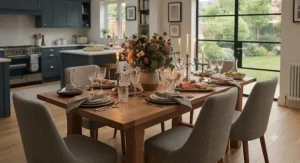
- Measure the room before the table, not after. Allow roughly 90cm of clearance between the table edge and the nearest wall or furniture so chairs can be pulled out fully; in a walkway, increase that to 120cm.
- Decide table material before chair style. Glass, high-gloss MDF and oak veneer each carry different maintenance demands, and picking the material first narrows the field faster than starting with colour or chair shape.
- Check chair weight rating if anyone in the household is over 18 stone. Faux leather and velvet chairs on this list are generally rated for standard adult use, but it’s worth confirming on the specific listing rather than assuming.
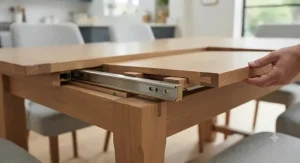
- Consider extendable versus fixed length if your guest count varies. A fixed 6 seater dining table is simpler and typically sturdier, but an extending version buys flexibility for occasional larger gatherings without permanently sacrificing daily floor space.
- Factor in assembly time realistically, not optimistically. Pedestal and cantilever-leg designs generally take longer than simple four-leg frames — budget an afternoon, not an hour, particularly for a first-time flat-pack build.
- Match the finish to your actual cleaning habits, not your aspirational ones. If placemats and coasters aren’t realistically going to happen every meal, a matte or veneer finish will show far less wear over time than a high-gloss surface.
- Read aggregated review themes, not star ratings alone. A 4.2-star average tells you less than knowing whether the recurring complaint is about assembly, sturdiness, or fabric wear — check which pattern applies before you buy.
Common Mistakes When Buying a Dining Table for 6
The single most frequent mistake is sizing the table to the number of chairs rather than the room. A 180cm table technically seats six, but in a dining space under roughly 3.3m by 2.5m, that length leaves almost no circulation room once chairs are pulled out — a 150cm option with slightly closer seating is often more livable in a typical UK terrace or new-build dining room.
A second common error is underestimating gloss and glass maintenance before buying. These finishes photograph beautifully in a listing image, but buyers who don’t already have a habit of using placemats and coasters often find themselves disappointed within months when heat rings or scratches appear that a matte or veneer surface would have hidden or resisted.
Third, buyers frequently skip checking chair seat height against table clearance, particularly when mixing a table from one range with chairs from another. Standard UK dining tables sit around 75cm high with a seat height of roughly 44-48cm on matching chairs — enough for comfortable knee clearance — but a mismatched pairing can leave taller adults with their knees hitting the underside of the table.
Finally, many buyers focus entirely on the “before delivery” decision and give no thought to how the set will be disposed of or passed on eventually. If you’re replacing existing furniture as part of this purchase, British Heart Foundation’s free furniture collection service will collect a still-usable old dining set and sell it on to fund cardiac research, which is worth factoring into your moving day plan rather than an afterthought.
6 Seater Dining Table vs 4 Seater and 8 Seater: Which Fits Your Home?
The seating-size decision comes down to two questions: how many people eat together on a normal Tuesday, and how many do you need to fit on the occasions that matter most.
A 4-seater dining table, typically 120cm by 80cm, suits couples and small families comfortably but starts to feel genuinely cramped the moment a third guest arrives regularly. An 8-seater, usually 200cm-plus in length, comfortably hosts larger gatherings but can dominate a standard UK dining room to the point where daily circulation space suffers — that extra 20-40cm of table length has an outsized effect on how a room feels to move around in day to day.
A 6 seater dining table and chairs set is, for the vast majority of UK households, the genuine middle ground: enough length (150-180cm) to seat three people comfortably per side with proper elbow room, while still fitting realistically into a typical semi-detached or new-build dining space without eating the whole room. It’s also worth noting that most 6-seater rectangular tables can informally squeeze in seven or eight for occasional big occasions like Christmas, by tightening the spacing and adding a chair at each end — something a fixed 4-seater simply can’t do regardless of how the chairs are arranged.
The practical takeaway: if your household regularly sits five or more for meals, or hosts more than twice a month, a 6-seater earns its keep daily. If it’s genuinely just two of you with occasional guests, the extra length of a 6-seater may cost you more in usable floor space than it gives back in flexibility.
What to Expect: Real-World Performance
Specs describe a table on day one; real-world performance is what happens after eighteen months of actual family life, and it’s worth being honest about the difference.
High-gloss MDF surfaces, across every brand in this list, perform beautifully for the first several months and then genuinely reward whoever maintains the microfibre-cloth habit — those who don’t will notice fine scratches accumulating from cutlery and rougher placemats within the first year. Glass tabletops hold up structurally very well when tempered (as all the sets here are), but fingerprints and dust show constantly compared to a matte surface, meaning a “just tidied” look requires more frequent wiping than buyers expect going in.
Faux leather chairs, which dominate five of the seven sets above, wear at contact points first — the front edge of the seat where legs brush against it daily, and the top of the backrest where hands grip to pull the chair in. Expect the first visible wear in these spots somewhere between year two and three of regular use, faster in households with pets that use dining chairs as a resting spot. Velvet, as used on the KOSY KOALA grey set, wears differently: less prone to cracking or peeling, more prone to visible flattening or shine at the seat centre with heavy daily use, which some buyers find preferable and others don’t.
Solid pedestal and oak-veneer construction, represented here by the Julian Bowen Davenport, generally shows its age most gracefully of anything on this list — light surface marks blend into the wood grain rather than standing out starkly against a flat gloss finish, which is the practical reason “classic wood” dining sets remain popular in family homes despite costing more upfront than an equivalent gloss alternative.
Mid-Size Family Furniture: Why 6 Seaters Hit the Sweet Spot
Furnishing a family home involves a constant balancing act between “big enough for how we actually live” and “not so big it swallows the room,” and dining furniture is where that tension shows up most clearly.
As genuinely mid-size family furniture, a 6-seater dining table earns its place because it scales with a household’s real trajectory rather than a single snapshot moment. A couple starting a family rarely stays a two- or three-person household for long; a 6-seater absorbs the addition of children, occasional grandparents at Sunday lunch, and a child’s friend staying for tea without needing to be replaced within a few years, unlike a 4-seater that’s often outgrown surprisingly fast.
It also does double duty beyond mealtimes in a way an oversized 8-seater rarely needs to justify. A 150-180cm table comfortably becomes a homework station, a craft table, a spot for wrapping presents at Christmas, or a temporary desk — flexible enough to earn its floor space on non-dining days, which matters in the average UK home where a separate dedicated dining room is increasingly a luxury rather than a given.
Dinner Party Seating: Getting the Layout Right
Six is, by most hosting wisdom, the number where conversation stays genuinely shared rather than splitting into separate pockets — small enough that everyone can hear the table’s main conversation, large enough that it doesn’t feel like an intimate two-person dinner with spectators.
Getting dinner party seating right at a 6-seater starts with the chairs themselves rather than the table. Armless dining chairs, used across most of the sets in this list, generally allow tighter spacing than armchairs when you need to squeeze in an extra guest occasionally, since there’s no arm width to account for between seats. If your chosen set does include arms, plan on genuinely needing the full 60cm-per-person spacing rather than trying to compress it for a bigger gathering.
Consider mixed seating for larger occasional gatherings too: several buyers of the sets above mention adding a bench or two extra chairs at the table ends for Christmas or birthdays, effectively turning a 6-seater into temporary seating for eight without a permanent extra-large table taking up daily floor space. This is where a simpler four-leg or two-pedestal table design (rather than a single central pedestal) tends to work better for squeezing in an end seat, since corner legs on the shortest ends can occasionally interfere with an additional chair.
Lighting and centrepiece height matter more to a successful dinner party than most hosts plan for in advance — a tall centrepiece blocks sightlines exactly where six-person conversation depends on eye contact across the table, so keep anything decorative below eye level when seated.
Dining Room Centrepiece: Styling Your Table Beyond Mealtimes
A dining table spends most of its life not being eaten at, which makes its role as a genuine dining room centrepiece just as important as its performance during meals themselves.
For the high-gloss and glass sets in this list, styling leans naturally minimal — a single vase, a stack of coffee-table books, or a simple runner reads well against a reflective surface without competing with it. Overloading a glossy or glass tabletop with too many decorative pieces tends to visually clutter a surface whose whole appeal is its clean reflectivity, so restraint genuinely pays off here.
The Julian Bowen Davenport’s oak veneer and ivory finish, by contrast, carries texture and warmth that supports a fuller centrepiece — a runner, seasonal foliage, or a collection of candles reads as considered rather than cluttered against a wood-toned surface in a way it wouldn’t against gloss.
Whatever the finish, the most consistent styling mistake across dining room centrepiece attempts is forgetting the table needs to reset quickly for an actual meal. A centrepiece that takes ten minutes to clear away before dinner defeats its own purpose; a shallow tray or bowl that lifts off in one motion works far better in daily family life than individually placed decorative objects.
Long-Term Cost & Maintenance
Sticker price only tells part of the story on any dining set; total cost of ownership is where budget and premium options can end up closer together than the initial price gap suggests.
At the budget end, sets like the Panana Glass Set and KOSY KOALA Grey Velvet Set carry lower upfront cost but may need chair replacement or reupholstery sooner under heavy daily use, particularly the velvet seat centres or the leather-look finishes at high-contact points. Realistically budgeting a small allowance for a chair repair or a set of seat pad replacements within years three to five is sensible for any budget-tier faux leather or fabric option, this list included.
Mid-range gloss options from Furniturebox generally hold their finish well with routine microfibre care, and the main long-term cost consideration is simply the polish or gloss-specific cleaner rather than any structural repair, keeping total cost of ownership genuinely low if the maintenance habit sticks.
The Julian Bowen Davenport‘s oak veneer and MDF construction sits in an interesting middle position: higher upfront cost than the budget glass or velvet options, but veneer surfaces can be lightly refreshed with wood cream rather than needing full replacement, extending genuinely useful life well beyond the five-year mark many budget sets are realistically built around. When a set does eventually reach end of life still in usable condition, donating it — for instance through the British Heart Foundation’s furniture collection service — is both the most sustainable option and one that supports ongoing UK medical research, rather than the set ending up as landfill.
Features That Actually Matter (And Those That Don’t)
Marketing copy on dining furniture listings leans heavily on words like “luxury” and “premium” that carry surprisingly little functional weight, so it’s worth separating genuine performance features from decorative language.
Actually matters: chair seat height relative to table clearance (comfort every single meal), the underlying core material of a gloss or veneer top (MDF versus genuine solid timber affects long-term durability and weight capacity), adjustable feet on chair legs (the single biggest factor in whether a set wobbles on real UK flooring), and whether fixings are metal bolts versus plastic cam locks (metal generally holds tighter over years of tightening and loosening during moves).
Matters less than the listing suggests: the specific named “designer” of a chair style within a mass-market range, the precise shade name of a faux leather colour (lighting in your specific room affects perceived colour far more than the name on the listing), and claimed weight capacity figures well above any realistic household use case, which tend to be a marketing reassurance rather than a genuinely differentiating spec between competing sets.
The genuinely useful signal buried in most listings is the aggregated review theme rather than any individual spec line — when multiple independent buyers flag the same sturdiness or finish issue, that pattern is far more reliable than a single five-star review or a single one-star complaint in isolation.
Safety, Regulations & Compliance: What UK Buyers Should Know
Dining chairs with any upholstered element — faux leather, velvet, or padded fabric seats, which covers every chair across the seven sets in this guide — fall under the UK’s furniture fire safety framework, and it’s worth knowing what that actually guarantees you as a buyer.
The Furniture and Furnishings (Fire) (Safety) Regulations 1988 set flammability requirements for filling and cover materials used in domestic upholstered furniture sold in the UK, based on ignition testing standards, and require compliant items to carry a fire safety label at the point of sale. In practice, this means the upholstered chairs in any legitimately sold UK dining set have been tested against open-flame ignition standards before reaching a warehouse, which is a meaningful baseline safety guarantee that’s easy to overlook when comparing purely on style and price.
It’s also worth knowing these regulations were recently updated: the Furniture and Furnishings (Fire) (Safety) (Amendment) Regulations 2025 came into force in October 2025, adjusting some labelling and enforcement requirements while keeping the core fire-testing framework intact. For buyers, the practical takeaway is simple: stick to established UK-registered sellers and brands (all seven products in this guide qualify) rather than unverified international listings, since fire safety compliance is one area where a cheaper unofficial import can genuinely cut corners that aren’t visible in a product photo.
Beyond fire safety, general good practice applies to any dining furniture with glass elements specifically: confirm tempered rather than standard glass (all glass surfaces referenced in this guide are tempered), and periodically check chair leg fixings and floor-contact feet, particularly on chrome-framed sets, since loose fittings are a far more common real-world safety issue in dining furniture than any material defect.
Frequently Asked Questions
❓ What size table do I need for 6 people?
❓ Is a glass or wood dining table better for a family with children?
❓ How much clearance do I need around a 6 seater dining table?
❓ Can a 6-seater dining table fit 8 people occasionally?
❓ How long does it take to assemble a flat-pack dining table and 6 chairs?
Conclusion
Choosing between these seven sets ultimately comes down to matching material and maintenance style to how your household actually lives, rather than chasing the single “best” option in the abstract. If longevity and a classic look matter most, the Julian Bowen Davenport‘s pedestal design and oak veneer earn the higher price. If budget is the primary constraint, the KOSY KOALA Grey Velvet Set or Panana Glass Set deliver a genuinely presentable dining table for 6 without the premium spend. And if your dining room needs to double as a dinner party seating showpiece, the Furniturebox Imperia or Atlanta ranges deliver the most visual impact per pound.
Whichever you land on, the sizing and clearance rules covered above matter more than any single spec on a listing page — a beautifully finished table that’s genuinely too long for your room will frustrate you daily in a way no amount of gloss or velvet upholstery makes up for. Measure first, then shop the shortlist above with real confidence.
Recommended for You
- Dining Table and 4 Chairs Set: 7 Best UK Picks for 2026
- Dining Table for 2: 7 Best Compact Picks for UK Couples 2026
- Butterfly Leaf Dining Table: 7 Best Picks for UK Homes 2026
Disclaimer: This article contains affiliate links. As an Amazon Associate, I earn from qualifying purchases. If you purchase products through these links, we may earn a small commission at no additional cost to you.
✨ Found this helpful? Share it with your friends! 💬🤗
