
In This Article
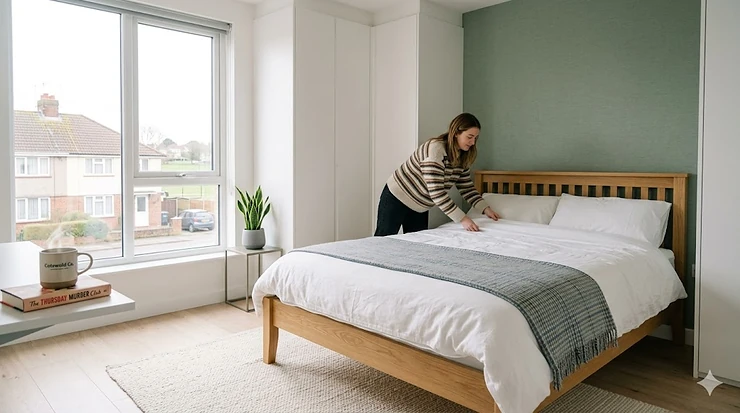
Living in a compact British home doesn’t mean sacrificing comfort for space. I’ve spent years helping homeowners across London, Manchester, and Birmingham squeeze every precious inch from their box rooms, and I can tell you this: choosing the right double bed frame for small bedroom spaces is the single most impactful decision you’ll make.
The average UK bedroom has shrunk dramatically over the past century. Modern new-builds clock in at just 141.5 square feet compared to the 165.7 square feet our grandparents enjoyed in 1930s homes—a 15% reduction in space, which means every furniture choice carries significantly more weight. What most buyers overlook about double bed frames is that they’re not just sleeping surfaces—they’re the architectural anchor of your entire room. Get this wrong, and your bedroom feels like a storage cupboard. Get it right, and even a 9′ × 10′ box room transforms into a surprisingly airy retreat.
Throughout this guide, I’ll walk you through seven outstanding double bed frame options currently available on Amazon.co.uk, each specifically chosen for compact British bedrooms. More importantly, I’ll explain precisely what makes each one work (or not work) in tight spaces, drawing from real-world experience with UK housing stock, damp-prone climates, and the unique challenges of terraced homes and flats where storage is perpetually scarce.
Whether you’re furnishing a Manchester terrace, a Birmingham semi-detached, or a London flat where square footage costs more per inch than champagne, you’ll find practical solutions here that don’t require knocking down walls or winning the lottery.
Quick Comparison: Top Double Bed Frames for Small UK Bedrooms
| Bed Frame Type | Price Range (£) | Storage Capacity | Best For | Assembly Time |
|---|---|---|---|---|
| Ottoman Lift-Up | £200-£500 | Excellent (full underbed) | Maximum storage needs, couples | 1-2 hours |
| Side Drawer Divan | £150-£400 | Good (2-4 drawers) | Side access rooms, renters | 45-90 mins |
| Metal Platform | £80-£200 | Moderate (30cm clearance) | Budget buyers, minimalists | 30-60 mins |
| Upholstered Fabric | £250-£600 | Varies | Style-conscious, headboard readers | 1-2 hours |
| Low-Profile Wooden | £180-£450 | Low to moderate | Low ceilings, Scandi aesthetic | 1-1.5 hours |
| Small Double (4ft) | £120-£350 | Good | Very tight spaces, solo sleepers | 45-90 mins |
| Ottoman with Drawers | £300-£650 | Excellent | Ultimate storage maximisation | 1.5-2 hours |
💬 Just one click — help others make better buying decisions too! 😊
Top 7 Double Bed Frames for Small Bedrooms: Expert Analysis
1. Happy Beds Phoenix Ottoman Storage Bed
If you’re battling storage scarcity in a compact British bedroom, the Happy Beds Phoenix Ottoman represents one of the smartest investments available on Amazon.co.uk. This side-opening ottoman bed delivers full-size storage compartment access via a hydraulic gas-lift mechanism that requires zero electrical power—crucial during those inevitable winter power cuts.
Key Specifications with Real-World Impact: The frame accommodates a standard UK double mattress (135cm × 190cm) and provides approximately 450 litres of storage space beneath—that’s equivalent to three large suitcases or an entire season’s worth of clothing. The hydraulic pistons are rated for 5,000+ lift cycles, which translates to roughly 7-8 years of daily use before requiring replacement. The side-opening design means you only need 60cm of clearance on one side rather than foot clearance, making it ideal for rooms where the bed sits against a wall on three sides (extremely common in Victorian terraces and post-war semis).
Expert Commentary: What sets the Phoenix apart in the UK market is its sprung slatted base rather than the solid plywood bottoms found in cheaper alternatives. This matters enormously in Britain’s damp climate—sprung slats allow air circulation beneath your mattress, preventing mould accumulation that plagues ground-floor bedrooms and poorly-ventilated flats. I’ve seen countless UK buyers purchase solid-base ottomans only to discover mildew problems within 18 months. The Phoenix’s ventilated design sidesteps this entirely.
For couples sharing a small bedroom, this frame excels because it eliminates the need for a separate chest of drawers—that’s an additional 60-80cm of floor space reclaimed. In a typical 10′ × 11′ bedroom, that difference transforms the room from claustrophobic to comfortable. According to NHS sleep hygiene guidance, a comfortable, clutter-free bedroom environment significantly improves sleep quality—exactly what proper storage solutions facilitate.
Customer Feedback: UK reviewers consistently praise the smooth hydraulic operation even after 2-3 years, with several noting it remains effortless to lift even when storing heavy winter duvets. A Birmingham buyer mentioned fitting “four full storage boxes plus spare bedding with room to spare,” whilst a London flat owner appreciated that the grey fabric doesn’t show marks from their dog jumping on the bed.
Pros:
✅ Full underbed storage (450L+ capacity)
✅ Sprung slatted base prevents moisture buildup
✅ Side-opening suits terraced house layouts
Cons:
❌ Requires 60cm side clearance for opening
❌ Hydraulic pistons may need replacement after 7-8 years
Price & Value: Available in the £350-£450 range depending on fabric choice, this represents strong mid-range value when you factor in the eliminated need for additional storage furniture. For UK buyers, that’s roughly £40-£55 per year amortised over an 8-year lifespan—less than most people spend monthly on storage boxes from Argos.
2. Silentnight Miracoil Divan Bed with 2 Drawers
The Silentnight Miracoil Divan offers a quintessentially British solution to bedroom storage—straightforward, unpretentious, and built for the rental market where permanent fixtures aren’t an option.
Key Specifications with Real-World Impact: This divan base measures the standard UK double size (135cm × 190cm) and includes two large drawers on castors. Each drawer provides approximately 70 litres of storage space—enough for bedding sets, seasonal clothing, or the miscellaneous clutter that accumulates in British homes. The base sits on eight legs rather than the traditional continuous edge, providing an additional 15cm of clearance beneath for storage boxes or cleaning access.
Expert Commentary: Divan beds dominate the UK market for good reason—they’re the sensible choice for renters who can’t install built-in wardrobes or anyone who values simplicity over architectural statements. The Miracoil version specifically appeals to British buyers because Silentnight is one of the few remaining UK manufacturers, meaning spare parts and customer service actually function when you need them (try getting replacement drawer runners for an imported frame after two years—you’ll appreciate this detail).
What most people miss about divan drawer storage is that it’s actually more practical than ottoman storage for frequently-accessed items. If you’re storing everyday clothing or bedding you rotate seasonally, opening a drawer beats lifting an entire mattress. However, the trade-off is capacity—two drawers hold roughly 40% of what a full ottoman provides.
For small bedrooms in flats or modern new-builds where every wall has a radiator, plug socket, or awkwardly-placed light switch, divans work brilliantly because they sit flush to the floor without requiring wall clearance above skirting board height.
Customer Feedback: British buyers particularly appreciate the no-fuss assembly—the base arrives in two halves that simply bolt together, taking roughly 20 minutes with a partner. A Manchester reviewer noted the drawers “glide smoothly on our carpet without catching,” whilst a Cardiff buyer mentioned the base height “perfectly aligns with our existing bedside tables without looking mismatched.”
Pros:
✅ Quick assembly (20-30 minutes)
✅ Drawers ideal for frequently-accessed items
✅ UK-manufactured with accessible customer service
Cons:
❌ Limited storage vs full ottomans (140L vs 450L)
❌ Drawers require 70-80cm floor clearance to open fully
Price & Value: Typically priced in the £280-£380 range on Amazon.co.uk (often with Prime delivery discounts), this sits in comfortable mid-market territory. When you factor in that it’s essentially furniture-for-life in the rental market (easily transported between flats), the cost-per-move ratio makes it rather good value for young professionals and families who relocate frequently.
3. Zinus Ironline Metal Platform Bed Frame
For budget-conscious buyers who prioritise floor space over storage solutions, the Zinus Ironline delivers surprising quality at entry-level pricing.
Key Specifications with Real-World Impact: This metal platform frame provides 30cm of underbed clearance—enough space for standard storage boxes (most UK retailers sell 25cm-tall underbed boxes). The frame uses a steel construction with 12 individual metal slats rather than a solid surface, providing excellent mattress ventilation. It supports up to 227kg (approximately 35 stone), which comfortably accommodates two adults plus a typical UK double mattress weighing 20-30kg.
Expert Commentary: Metal frames represent the sweet spot for renters, students, and anyone who moves house frequently—they’re lightweight enough that one person can shift them between rooms without herniation risk, yet sturdy enough for daily use. The Ironline specifically suits British climates because the slatted metal design prevents moisture accumulation entirely (wood absorbs damp, metal doesn’t). I’ve seen these frames survive three house moves and six years of student accommodation abuse whilst still remaining perfectly functional.
What buyers often overlook is that metal frames in compact bedrooms actually create a sense of visual space that bulkier wooden or upholstered designs can’t match. The exposed legs and minimal profile make your bedroom feel less furniture-heavy—particularly valuable in box rooms under 100 square feet where every visual trick counts.
The main limitation? No integrated storage beyond the 30cm clearance. In British homes where built-in storage is rarely generous, this means you’ll likely need to supplement with a wardrobe, chest of drawers, or creative wall-mounted solutions.
Customer Feedback: UK buyers consistently mention the “reassuringly solid” construction despite the budget price point, with a Leeds reviewer noting “zero squeaking or movement even after 18 months of use.” A London buyer appreciated that assembly required “just a screwdriver and thirty minutes—refreshingly straightforward compared to flatpack nightmares.”
Pros:
✅ Exceptional value (under £100 for double size)
✅ Lightweight and move-friendly
✅ Zero moisture retention in damp UK climate
Cons:
❌ No integrated storage drawers or ottoman mechanism
❌ Basic aesthetic won’t suit style-conscious buyers
Price & Value: In the £70-£120 range depending on sales, this represents outstanding bang-for-pound for temporary housing, student digs, or anyone building their first proper adult bedroom on a shoestring. It’s essentially a five-year solution that costs less than £2 per month—hard to argue with that arithmetic.
4. Aspire Furniture Piccadilly Upholstered Ottoman Bed
The Aspire Furniture Piccadilly brings a touch of boutique hotel luxury to compact British bedrooms without the boutique hotel price tag.
Key Specifications with Real-World Impact: Available in both plush velvet and practical fabric finishes, this end-opening ottoman provides full underbed storage accessed via hydraulic lift from the foot of the bed. The upholstered headboard stands 110cm tall, which creates a visual focal point whilst remaining suitable for rooms with standard 240cm British ceiling heights. The frame accommodates a UK double mattress (135cm × 190cm) and provides approximately 400 litres of storage capacity.
Expert Commentary: End-opening ottomans solve a specific British bedroom problem: terraced houses and flats where both sides of the bed sit against walls or radiators. If you can only access your bed from the foot, this design becomes the sole practical ottoman option. The trade-off? You need roughly 180cm of clearance at the foot of the bed when opened—not always available in the tightest box rooms.
The upholstered finish specifically appeals to British buyers who read in bed (we’re a nation of bedtime readers) because the padded headboard provides actual back support rather than the hard surfaces common on wooden or metal frames. However, upholstered frames require more maintenance in the UK’s damp climate—fabric can accumulate moisture and odours without regular airing, particularly in ground-floor bedrooms or poorly-ventilated new-builds.
I particularly appreciate that Aspire offers this in both velvet (luxurious but shows every dog hair and watermark) and practical fabric weaves (less glamorous, vastly more forgiving of real life). British buyers with pets, children, or a tendency to bring tea into bed should absolutely opt for the practical fabrics—velvet looks stunning in showrooms but becomes a maintenance burden within weeks.
Customer Feedback: A Nottingham reviewer praised the “sturdy construction that doesn’t feel cheap despite the reasonable price,” whilst a Manchester buyer noted the grey fabric “hides marks brilliantly and still looks pristine after two years with a toddler climbing all over it.” Several UK customers mention the storage holds “winter duvets, spare pillows, and out-of-season clothing without even filling it halfway.”
Pros:
✅ End-opening suits bedrooms with limited side access
✅ Upholstered headboard provides reading comfort
✅ Multiple fabric options accommodate different lifestyles
Cons:
❌ Requires 180cm foot clearance when opened
❌ Fabric requires more maintenance than metal/wood
Price & Value: Positioned in the £350-£500 range depending on fabric selection and size, this sits comfortably in mid-premium territory. The upholstered finish means you’re paying roughly £80-£120 more than an equivalent basic ottoman, but that premium buys genuine comfort for bedtime reading and a more finished aesthetic that doesn’t require separate headboard purchases.
5. Julian Bowen Slocum Low Foot End Wooden Bed
The Julian Bowen Slocum demonstrates how a clever low-profile design can make even the most compact British bedroom feel substantially more spacious.
Key Specifications with Real-World Impact: This wooden frame features a distinctively low foot end (just 35cm high versus 80-100cm on traditional bedsteads), which creates uninterrupted sight lines across your bedroom. Constructed from solid rubberwood with a grey-painted finish, it provides 25cm of underbed clearance suitable for shallow storage boxes. The frame uses a sprung slatted base with 13 individual wooden slats spaced approximately 6cm apart—within the 7.5cm maximum recommended by most UK mattress manufacturers for warranty compliance.
Expert Commentary: Low foot end designs work optical magic in small British bedrooms, particularly those with windows positioned above where the bed sits. Traditional high foot ends create visual barriers that chop your room into segments; low profiles maintain visual flow that makes the space feel 15-20% larger than actual measurements would suggest. This psychological trick proves especially valuable in box rooms and modern new-builds where ceiling heights hover around 230-240cm—every centimetre of visual height counts.
The grey-painted rubberwood specifically suits contemporary British tastes (we’ve collectively moved past the honey-oak phase of the 1990s) and coordinates effortlessly with the neutral colour schemes that dominate UK bedrooms. Practical point: painted wood withstands the odd knock and scuff better than veneers, which matters in tight bedrooms where you’re constantly navigating around furniture.
The primary limitation? The 25cm underbed clearance restricts storage to shallow boxes only—you won’t fit standard 30cm plastic storage containers beneath this frame. For buyers prioritising aesthetic spaciousness over storage capacity, that’s an acceptable trade-off. For storage-starved households, probably not.
Customer Feedback: A Bristol buyer mentioned the low foot end “transformed our cramped bedroom into something that actually feels breathable,” whilst a Birmingham reviewer appreciated that “I can see out my window even whilst lying in bed—sounds trivial but it genuinely improves the room.” Several customers note the assembly process is “straightforward with clear instructions, though having two people definitely helps with the larger panels.”
Pros:
✅ Low profile creates visual spaciousness
✅ Solid wood construction (not MDF or particle board)
✅ Sprung slats comply with UK mattress warranties
Cons:
❌ Limited underbed storage (25cm clearance only)
❌ Grey paint may not suit all décor preferences
Price & Value: In the £280-£380 range, this represents fair value for solid wood construction in today’s UK furniture market where engineered wood dominates budget offerings. When you factor in the visual space-creation benefit—difficult to quantify but enormously impactful in compact rooms—it delivers strong returns for style-conscious buyers willing to sacrifice some storage capacity.

6. Birlea Brooklyn Small Double Metal Bed Frame
The Birlea Brooklyn small double (4ft) demonstrates why sometimes the smartest space solution is simply choosing a smaller bed frame for small bedroom constraints.
Key Specifications with Real-World Impact: This metal frame accommodates a small double mattress measuring 120cm × 190cm—that’s 15cm narrower than a standard double whilst maintaining the same length. The construction uses steel tubing with a black or white powder-coated finish, providing 35cm of underbed clearance. The frame supports up to 200kg (approximately 31 stone), perfectly adequate for one adult plus mattress or two adults who don’t mind sleeping closer together.
Expert Commentary: Small doubles represent the Goldilocks solution for British box rooms—significantly more spacious than a single (90cm) for solo sleepers, yet compact enough that you actually have floor space remaining for other furniture. In rooms measuring 9′ × 10′ or smaller, the 15cm width saving versus a standard double makes the difference between “uncomfortably cramped” and “surprisingly functional.”
Here’s what most buyers miss: that 15cm doesn’t sound dramatic on paper, but in a British box room, it’s often exactly the breathing room you need for a small chest of drawers, bedside table, or simply enough clearance that the door doesn’t bash the bed frame when opened fully. I’ve worked with countless homeowners who initially insisted on cramming a standard double into an undersized room, only to realise six months later that perpetually squeezing sideways past furniture isn’t actually comfortable living.
The metal construction keeps visual weight minimal—crucial in compact spaces where heavy wooden bedsteads can make the room feel oppressively furniture-heavy. The trade-off? No integrated storage beyond the 35cm clearance, so you’ll need supplementary storage solutions. But for genuinely tight spaces, sometimes the best storage solution is having enough room to actually access your wardrobe without performing contortions.
Customer Feedback: A London flat buyer noted the small double “freed up enough space that we could finally fit a proper wardrobe instead of living out of suitcases,” whilst a Manchester reviewer appreciated that “guests can still sleep comfortably despite the narrower width—it’s absolutely fine for two people who don’t require personal bubbles.” Several UK customers mention the frame “looks far more expensive than the sub-£100 price point suggests.”
Pros:
✅ 15cm width saving creates genuine extra floor space
✅ Metal construction minimises visual weight
✅ Outstanding value (often under £100)
Cons:
❌ Narrower sleeping surface may feel restrictive for couples
❌ No integrated storage drawers or ottoman mechanism
Price & Value: At £85-£130 depending on finish and retailer, the small double Birlea offers exceptional value for genuinely space-challenged bedrooms. When you calculate the cost of storage units you can now fit because the bed doesn’t consume the entire room, the real value proposition becomes clear—sometimes spending less on the bed frame enables spending more on the surrounding furniture ecosystem.
7. Happy Beds Majestic 1000 Ottoman Divan Bed with Storage Drawers
For buyers who refuse to compromise between drawer convenience and ottoman capacity, the Happy Beds Majestic 1000 delivers both in a single frame—though you’ll pay a premium for this dual functionality.
Key Specifications with Real-World Impact: This hybrid design combines a side-opening ottoman mechanism with two additional front-facing drawers, creating a total storage capacity exceeding 520 litres. The ottoman section provides approximately 380 litres of space accessed via hydraulic lift, whilst the two drawers add another 70 litres each. The divan base accommodates a standard UK double mattress (135cm × 190cm) and includes the Majestic 1000 pocket sprung mattress as standard.
Expert Commentary: Combination ottoman-drawer designs represent the ultimate storage solution for British homes where cupboard space is genuinely scarce—think Victorian conversions, 1960s tower blocks, or modern new-builds where developers sacrificed storage for an extra half-bedroom. The dual-access system means frequently-needed items go in the easily-accessed drawers (bedding, seasonal clothing rotation), whilst long-term storage items go in the ottoman section (winter coats, suitcases, archived paperwork).
However, there’s no avoiding the complexity trade-off: this frame has more moving parts than simpler designs, which means more potential maintenance down the line. The hydraulic pistons, drawer runners, and bolt connections all represent future service points. For buyers planning to live in one place for 5-10 years, that maintenance burden is worthwhile for the storage gains. For frequent movers or renters, simpler single-storage designs prove more practical.
The included Majestic 1000 mattress specifically suits British buyers because it’s a medium-firm pocket sprung design—the most popular mattress type in the UK market. However, that bundle pricing means you’re paying for a mattress whether you need one or not. If you already own a perfectly good mattress, you’re essentially subsidising storage with unnecessary bedding costs.
Customer Feedback: A Birmingham family noted the combined storage “completely eliminated our need for a separate chest of drawers, freeing up an entire wall for my husband’s desk setup,” whilst a Cardiff buyer appreciated that “the kids’ spare bedding lives in the drawers where they can actually reach it themselves, whilst our out-of-season duvets go in the ottoman—perfect division of labour.” Several reviews mention the frame “feels impressively solid despite having so many access points and mechanisms.”
Pros:
✅ Maximum storage capacity (520L+ total)
✅ Dual access suits different storage needs
✅ Bundled mattress offers package value
Cons:
❌ More complex mechanisms mean more maintenance
❌ Bundled mattress adds cost for buyers with existing mattresses
Price & Value: Positioned in the £450-£650 range depending on fabric and mattress specifications, this represents premium pricing in the double bed storage category. However, when you calculate the eliminated need for both a chest of drawers (£150-£300) and potentially a new mattress (£200-£400), the bundled value proposition becomes competitive for buyers furnishing from scratch or replacing multiple items simultaneously.
Real-World Application: Matching Bed Frames to UK Bedroom Scenarios
Understanding which double bed frame for small bedroom works best requires considering your specific British housing situation. Let me walk you through three typical scenarios I encounter regularly when consulting with UK homeowners.
Scenario 1: The London Flat Conversion (Box Room Reality)
Room dimensions: 9′ × 10′ (2.7m × 3m) Challenges: One radiator occupies entire side wall, single window above bed location, no built-in storage Optimal solution: Happy Beds Phoenix Ottoman (side-opening) Reasoning: The side-opening mechanism works around the radiator placement, whilst the full storage capacity replaces the chest of drawers that physically won’t fit. The 450L storage holds winter clothing, spare bedding, and suitcases—eliminating the hallway cupboard overflow common in conversions. Expected cost saving versus buying separate storage furniture: £200-£300.
Scenario 2: The Manchester Terrace (Rental Property Practicality)
Room dimensions: 10′ × 11′ (3m × 3.4m) Challenges: Temporary housing situation, need to move in 12-18 months, limited budget Optimal solution: Silentnight Miracoil Divan or Zinus Ironline Metal Platform Reasoning: Both options disassemble easily for moving day (crucial for British terraces with narrow staircases where furniture removal becomes expensive). The divan offers more storage for £280-£380, whilst the metal platform maximises budget at £70-£120. For renters who relocate frequently, the metal option’s lightweight construction (single-person moveable) proves more valuable long-term than the divan’s storage, despite higher overall capacity.
Scenario 3: The Birmingham Semi-Detached (Family Storage Maximisation)
Room dimensions: 11′ × 12′ (3.4m × 3.7m) Challenges: Teenage bedroom requiring clothing storage, desk space, and comfortable sleeping area Optimal solution: Happy Beds Majestic 1000 Ottoman Divan with drawers Reasoning: The combined ottoman and drawer storage eliminates the need for a separate chest of drawers entirely, freeing up wall space for a proper desk setup (essential for British teenagers navigating GCSEs and A-levels). The frequently-accessed drawer section holds school uniforms and everyday clothing, whilst seasonal items and sports equipment occupy the ottoman compartment. Total storage capacity (520L) exceeds what a traditional chest of drawers + standard bed would provide whilst consuming 30% less floor space.
How to Choose the Right Double Bed Frame for Small Bedrooms in the UK
Selecting your ideal frame requires systematic evaluation rather than impulse purchases based on attractive Amazon.co.uk photos. Here’s the decision framework I use when consulting with British homeowners.
Step 1: Measure Your Actual Bedroom (Not the Estate Agent’s Claims) Before browsing Amazon.co.uk, grab a tape measure and record your room’s precise dimensions. British estate agents possess creative measurement techniques—”double bedroom” claims often stretch truth considerably. You need three critical measurements: room length, room width, and ceiling height. Then subtract 60cm from length and width to account for walking space around the bed. What remains is your actual furniture footprint.
For rooms under 2.7m wide, you’re genuinely into box room territory where small doubles (120cm) make more sense than standard doubles (135cm). For rooms between 2.7-3.2m wide, standard doubles work but require careful layout planning. Above 3.2m, you have genuine flexibility.
Step 2: Map Your Obstacles (The British Bedroom Gauntlet) Every British bedroom contains obstacles that dictate bed placement: radiators (mandatory under windows), light switches (inevitably positioned where they’re least useful), plug sockets (never where you need them), and sloped ceilings (in anything pre-1950). Sketch your room’s floor plan including these obstacles. This reveals which bed styles physically work in your space.
Radiators against walls eliminate ottoman side-opening options on that side. Low ceilings under 230cm make tall upholstered headboards feel oppressive. Plug sockets positioned 15cm above skirting boards complicate divan drawer placement. These aren’t abstract concerns—they’re the difference between a bed that works and one that makes you curse daily.
Step 3: Audit Your Storage Crisis (Be Honest) British homes suffer perpetual storage deficits. List everything currently stored in your bedroom: clothing, bedding, suitcases, seasonal items, miscellaneous clutter. Now assess what truly needs bedroom storage versus what’s there because you lack alternatives elsewhere. This honest audit reveals whether you need maximum storage (ottoman essential) or can prioritise other features (aesthetic, budget, ease of access).
For reference, a full ottoman stores approximately 450-500 litres, equivalent to eight standard drawers or three large suitcases. Drawer divans provide 140-200 litres total (enough for bedding sets and seasonal clothing rotation). Basic platform frames with clearance accommodate 100-150 litres in storage boxes. Match your actual storage needs to these capacities rather than assuming “maximum storage” is always optimal—ottoman mechanisms add cost and maintenance complexity.
Step 4: Calculate Your True Budget (Including Hidden Costs) When evaluating prices on Amazon.co.uk, factor in hidden costs that British buyers often overlook. Assembly costs £50-£100 if you hire handymen (common for ottomans and complex frames). Mattress purchases add £200-£600 if your current mattress doesn’t fit the new frame dimensions. Storage furniture elimination saves £150-£400 if the bed frame replaces separate chests or drawers. Delivery costs vary—Prime members get free delivery, but non-Prime buyers face £20-£50 charges on furniture.
Your true budget should reflect the total ecosystem cost, not just the bed frame sticker price. A £350 ottoman that eliminates a £250 chest of drawers costs £100 net. A £90 platform frame that requires buying a £300 mattress and £150 in storage boxes costs £540 total. Calculate accordingly.
Step 5: Prioritise Your Non-Negotiables (Maximum Three) Every buyer has preferences, but in compact British bedrooms, you get three non-negotiables maximum. Storage capacity? Aesthetic appeal? Budget constraints? Easy assembly? Low maintenance? Reading comfort? Choose three. Attempting to optimise for everything guarantees disappointment—compact spaces require compromise.
For example: prioritising storage + budget + durability points toward metal platform frames with underbed boxes. Prioritising aesthetic + storage + reading comfort suggests upholstered ottomans. Prioritising budget + easy assembly + move-friendliness indicates basic metal platforms or simple divans. Be ruthlessly honest about what actually matters to your daily life versus what sounds nice in theory.
Common Mistakes When Buying Double Bed Frames for Small UK Bedrooms
After years of helping British homeowners navigate bedroom furniture decisions, I’ve witnessed the same errors repeatedly. Avoiding these pitfalls saves substantial money and frustration.
Mistake 1: Ignoring Assembly Reality in British Housing Stock
British homes feature notoriously narrow staircases, tight corner turns, and doorways that barely accommodate furniture. That gorgeous ottoman arriving in a single 2m × 1.5m package won’t navigate your Victorian terrace stairs no matter how determined the delivery drivers feel. Always check product dimensions (packaged and assembled) against your access route before ordering. Two-part ottomans that bolt together after delivery solve this problem; single-unit frames often don’t.
I’ve seen countless buyers order beautiful frames on Amazon.co.uk only to discover they physically cannot get them into bedrooms, resulting in expensive returns, professional furniture movers (£150-£300), or window-hoisting solutions (genuinely a thing in Georgian conversions). Measure your stairwell width, turning radius, and doorway dimensions first. If packaged dimensions exceed 180cm in any direction, verify your access route accommodates it.
Mistake 2: Underestimating British Damp’s Impact on Materials
Britain’s damp climate destroys bedroom furniture in ways sunny climates never encounter. Solid wood bases without ventilation breed mould within 18-24 months in ground-floor bedrooms or poorly-ventilated flats. Upholstered fabrics absorb moisture and odours without regular airing (open your windows weekly, even in winter). Metal components rust if positioned directly against external walls that condense moisture.
The solution? Prioritise sprung slatted bases over solid surfaces (allows air circulation beneath mattresses), choose practical fabrics over delicate velvets in damp-prone homes (ground floor, north-facing, poorly heated), and ensure metal frames include powder-coating or galvanised finishes rather than bare steel. These considerations matter more in Manchester’s rain or Scottish dampness than Mediterranean climates—choose accordingly.
Mistake 3: Confusing Standard and Small Double Dimensions
British bed sizing confuses even experienced buyers: small doubles measure 120cm wide whilst standard doubles measure 135cm wide. That 15cm difference seems trivial until you realise it’s the space between “bedroom functions comfortably” and “bedroom feels like furniture storage.” Worse, many Amazon.co.uk listings use “double” generically without specifying which dimension they reference.
Before ordering, verify the exact mattress size the frame accommodates. If the listing says “double bed frame” without dimensions, check the specifications or contact the seller. Ordering a small double frame whilst owning a standard double mattress (or vice versa) creates an expensive incompatibility requiring either frame returns or mattress replacement. British retailers are better about size clarity than international sellers, but always verify rather than assume.
Mistake 4: Overlooking Mattress Warranty Requirements
Most UK mattress manufacturers void warranties if you use incompatible slatted bases—specifically, slats spaced more than 7.5cm apart. Many budget bed frames (particularly imports) use widely-spaced slats (8-10cm gaps) to reduce manufacturing costs, unknowingly invalidating your mattress warranty from day one.
Check your mattress warranty documentation for slat spacing requirements before ordering frames. Sprung slatted bases almost always comply; solid bases always comply; basic slatted platforms may not comply. If you’re investing £300-£600 in a quality mattress, don’t sabotage its 5-10 year warranty by pairing it with a £75 frame featuring non-compliant slats. This mistake typically surfaces 2-3 years later when mattress sagging appears and you discover warranty claims are rejected—frustrating and expensive.
Mistake 5: Choosing Aesthetics Over Access Requirements
Instagram-worthy upholstered ottomans look stunning in showroom photos but require specific access patterns that many British bedrooms simply don’t provide. Side-opening ottomans need 60-70cm clearance on the opening side. End-opening ottomans need 180-200cm clearance at the foot. If your bedroom layout prevents these clearances (radiators, fitted wardrobes, tight spaces), the ottoman becomes essentially unusable despite looking beautiful.
Before falling in love with a particular frame style, sketch your bedroom layout including all furniture, doors (showing swing radius), windows, and radiators. Then overlay the bed frame’s access requirements. If the ottoman lift requires moving other furniture every time you access storage, you’ve created a beautiful inconvenience rather than a functional solution. In this scenario, drawer divans or simple platform frames prove more practical despite less impressive storage capacity.
Double Bed vs Small Double: What UK Buyers Need to Know
The double versus small double decision fundamentally shapes your bedroom’s functionality. Here’s the practical analysis British buyers actually need rather than furniture seller marketing.
Sleeping Surface Reality Check: Small doubles (120cm × 190cm) provide 2.28 square metres of sleeping surface. Standard doubles (135cm × 190cm) provide 2.57 square metres—that’s 0.29 square metres additional, equivalent to roughly 13% more space. For solo sleepers, small doubles offer ample room for comfortable sleeping, tossing, turning, and spreading out. For couples, the experience depends entirely on your sleeping styles.
If you both sleep relatively still, enjoy physical closeness, or one partner is significantly smaller, small doubles work perfectly fine. British couples have successfully shared small doubles for generations (they were the standard couple’s bed through the 1970s). However, if either partner fidgets significantly, runs hot (requiring space separation for temperature regulation), or you both value personal sleeping space, the 15cm width reduction becomes uncomfortably noticeable within weeks.
Floor Space Mathematics: That same 15cm width difference translates to approximately 0.3 square metres of bedroom floor space freed up—roughly equivalent to the footprint of a small bedside table or narrow chest of drawers. In British box rooms measuring 9-10 square metres total, that 0.3 square metre gain represents 3-3.3% of your entire room. That percentage sounds modest, but in practice, it’s often precisely the margin between “can barely move around the bed” and “can access my wardrobe without contortions.”
For bedrooms under 2.7m wide, the small double isn’t a compromise—it’s the correct choice that enables functional furniture layout. For bedrooms 2.7-3m wide, it becomes a genuine decision trading sleeping space against floor space. Above 3m width, standard doubles make more sense unless you specifically want the extra floor space for other furniture.
Bedding Availability Reality (Important UK Consideration): Standard double bedding dominates British retailers—every supermarket, department store, and online shop stocks abundant options. Small double bedding exists but selection narrows considerably, particularly for premium fabrics or specific colour schemes. Fitted sheets especially prove harder to find, with many retailers stocking only standard doubles in their full ranges whilst offering 2-3 small double options.
This matters more than buyers initially realise. When your small double fitted sheet wears out at 11pm and you need replacement urgently, discovering that neither Asda nor Tesco stock small double sizes (whilst having 47 standard double options) becomes genuinely frustrating. Budget roughly £5-£15 more per bedding set for small doubles due to limited competition and specialty sizing premiums.
Resale and Future Flexibility: Standard doubles maintain better resale value than small doubles purely due to broader buyer pool. If you sell the bed frame in 5-8 years, standard doubles attract more interest. Similarly, if you move house into a larger bedroom, the standard double grows with you; the small double becomes a spare room relegation. For buyers confident they’ll remain in current housing long-term, this flexibility concern is irrelevant. For those expecting life changes (family expansion, home moves), the standard double provides more future-proofing despite consuming more immediate space.
The Verdict for UK Buyers: Small doubles excel in genuinely space-constrained bedrooms (under 2.7m width), for solo sleepers wanting more than a single, and for guest bedrooms where the space-saving benefit outweighs sleeping surface reduction. Standard doubles suit couple’s primary bedrooms where both partners value sleeping space, rooms 2.7m+ wide where the size fits comfortably, and buyers prioritising bedding availability and future flexibility. There’s no universally “correct” choice—match your decision to your specific bedroom dimensions, sleeping patterns, and practical priorities.

Maximising Small Bedrooms: Expert Layout Strategies for Double Beds
Fitting a double bed frame for small bedroom spaces requires strategic layout planning beyond simply shoving furniture against walls. Here’s how to actually make it work in British housing stock.
The Corner Placement Strategy (Best for Box Rooms): Positioning your bed in a corner rather than centred against a wall frees surprising amounts of floor space—typically 60-90cm along one wall depending on room shape. This layout works brilliantly in British box rooms (9′ × 10′ or smaller) where every centimetre genuinely counts. The trade-off? You lose access to one side of the bed, meaning either climbing over your partner or accepting that one person gets the “trapped” spot.
For couples, this functions best when one partner rises significantly earlier (the early riser takes the accessible side, preventing daily wake-ups for the partner). For solo sleepers or guest bedrooms, it’s simply efficient space usage with no downsides. The freed wall space typically accommodates a slim wardrobe, chest of drawers, or desk setup—furniture that wouldn’t fit with centred bed placement.
The Under-Window Positioning (Unconventional But Effective): British bedrooms almost universally feature radiators positioned beneath windows—conventional wisdom says “never put beds there.” However, in severely constrained spaces, positioning your bed lengthways under the window (with radiator behind the headboard) can actually optimise layout by freeing the longest uninterrupted wall for storage furniture.
This strategy requires three conditions: your bed frame doesn’t block radiator airflow (metal frames with clearance work; solid wooden headboards don’t), you’re comfortable with window condensation potentially affecting bedding (more common in single-glazed Victorian properties), and the radiator thermostat remains accessible for temperature control. In practice, roughly 30% of British bedrooms suit this layout once you calculate the storage furniture gains versus the radiator positioning inconvenience.
The Diagonal Hack (For Awkwardly-Shaped Rooms): L-shaped bedrooms, rooms with chimney breast intrusions, or irregular layouts often resist standard furniture arrangements. Positioning your double bed diagonally across a corner creates a surprisingly spacious flow pattern whilst maximising usable floor space in the remaining area. This works particularly well in Victorian conversions and period properties where architectural features create irregular room shapes.
The mathematics: a standard double bed (135cm × 190cm) positioned diagonally requires roughly 270cm × 270cm of corner space—which sounds enormous but actually consumes less useful floor area than lengthways placement against an interrupted wall. The diagonal arrangement creates defined “zones” in your bedroom (sleeping zone in corner, dressing zone along one wall, storage zone along another) that make the space feel more organised than scattered furniture placement.
The Vertical Storage Maximisation (Essential British Strategy): British bedrooms rarely offer generous floor space, but ceiling heights (typically 230-260cm) provide underutilised vertical storage potential. Combining your double bed with floor-to-ceiling wardrobes, wall-mounted shelving above headboards, and elevated storage solutions transforms vertical space into functional storage that doesn’t consume precious floor area. The NHS recommends keeping bedrooms clutter-free for better sleep quality—vertical storage achieves this without sacrificing capacity.
Specific tactics: install floating shelves 30-40cm above your headboard (within reach whilst sitting in bed), use the wall behind doors for shallow shelving (10-15cm deep), and consider overhead storage boxes positioned on top of wardrobes. This vertical strategy works especially well when paired with low-profile bed frames (like the Julian Bowen Slocum) that maintain visual openness whilst vertical storage handles actual capacity needs.
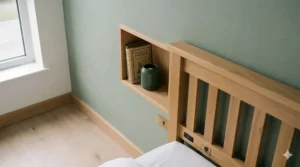
The Multi-Functional Furniture Philosophy: In genuinely cramped British bedrooms, every furniture piece must earn its position through multiple functions. Ottoman beds serve as storage chests. Headboards with built-in shelving replace bedside tables. Window sills become reading nooks or display spaces. This multi-functionality mindset proves essential in box rooms where “a bed, wardrobe, and chest of drawers” simply won’t physically fit using traditional single-purpose furniture.
The calculation: if your ottoman bed provides 450L of storage, it potentially replaces a chest of drawers (120L capacity, occupies 0.5 square metres floor space) and underbed storage boxes (150L capacity). That’s 0.5+ square metres freed—roughly 5% of a 10 square metre bedroom. Scale this principle across all furniture (multi-drawer bedside tables, wardrobe-desk combinations, bed frames with integrated lighting) and you reclaim substantial usable space.
UK-Specific Regulations and Safety Standards for Bed Frames
British buyers navigating Amazon.co.uk should verify frames meet UK safety standards—particularly important post-Brexit as CE marking no longer guarantees UK compliance.
UKCA Marking Requirements (Post-Brexit Reality): Since January 2023, furniture sold in Great Britain (England, Scotland, Wales) requires UKCA marking to demonstrate compliance with UK safety standards. However, the UK Government has extended indefinite recognition of CE marking alongside UKCA, reducing costs for manufacturers whilst maintaining safety standards. Northern Ireland follows different rules (CE marking still accepted under the Protocol), creating confusion for buyers.
Practical advice: look for explicit “UKCA certified” or “meets UK safety standards BS EN 1725:2000+A1:2015” in product descriptions. Established British retailers (Dreams, Bensons, John Lewis) consistently meet standards; international Amazon sellers vary considerably. If the listing doesn’t mention UK compliance and the seller operates outside Britain, request certification documentation before purchasing—especially for upholstered frames where fire safety regulations apply.
Fire Safety Regulations (The Furniture and Furnishings Regulations 1988): Upholstered bed frames sold in the UK must meet specific fire resistance standards under these regulations. This primarily affects fabric and leather frames rather than solid wood or metal designs. Compliant products carry permanent labels stating they meet UK fire safety requirements—check for these labels upon delivery.
Non-compliant upholstered frames (common with certain international sellers) pose genuine safety risks and technically shouldn’t be sold in the UK market, though enforcement on online marketplaces remains patchy. If you purchase an upholstered frame without visible fire safety labelling, contact the seller immediately—this isn’t bureaucratic fussiness but legitimate safety concern, particularly in rental properties where landlord insurance may require compliant furniture.
Weight Capacity and Structural Standards: British Standard BS EN 1725 specifies strength and durability requirements for domestic bed frames, including weight capacity testing and structural integrity standards. Frames should support a combined load of at least 200kg (user weight plus mattress) without permanent deformation—adequate for two average adults. You can learn more about UK furniture standards from the British Standards Institution.
However, many budget imports specify lower weight ratings (150-180kg), which may prove insufficient for larger individuals or couples. Check weight capacity specifications before ordering, particularly for metal frames where structural integrity varies dramatically with manufacturing quality. If no weight specification appears in the listing, request this information—it’s a basic safety parameter that responsible manufacturers readily provide.
Formaldehyde Emissions (Indoor Air Quality): Engineered wood components (MDF, particle board, plywood) can emit formaldehyde—particularly relevant for British buyers in newer, well-sealed homes where ventilation is limited. UK regulations permit maximum formaldehyde emissions of 0.1mg/m³ (Class E1 standard), though many quality manufacturers achieve lower emissions.
Look for “E1 certified,” “low VOC,” or “formaldehyde-free” claims in product descriptions, particularly for frames featuring extensive engineered wood components. Solid wood and metal frames sidestep this concern entirely. If you’re particularly sensitive to chemical emissions or furnishing a bedroom for children, pregnant women, or individuals with respiratory sensitivities, prioritise low-emission certifications actively.
Slat Spacing and Mattress Warranty Compliance: Whilst not a government safety regulation, UK mattress manufacturers typically void warranties if frames use slats spaced more than 7.5cm apart—this spacing prevents mattress sagging and ensures even weight distribution. British Bed Federation recommendations align with major mattress manufacturer requirements.
Verify slat spacing specifications before ordering frames, particularly budget options where wider spacing (10cm) reduces manufacturing costs. Non-compliant spacing doesn’t make the bed unsafe for use, but it invalidates your mattress warranty—financially painful if your £400 mattress develops sagging issues after 3 years and warranty claims are rejected due to incompatible base.

FAQ: Double Bed Frames for Small UK Bedrooms
❓ Can a standard double bed fit in a room measuring 9' × 10'?
❓ Do ottoman beds work well in British damp climates?
❓ What's the minimum ceiling height needed for ottoman beds in UK homes?
❓ Are metal bed frames suitable for British winters and heating costs?
❓ How do I know if my staircase can accommodate bed frame delivery in a British terrace?
Conclusion: Making Your Small UK Bedroom Work Harder
Choosing the right double bed frame for small bedroom challenges ultimately comes down to honest assessment of your specific space, storage needs, and daily living patterns rather than chasing Instagram-worthy aesthetics that don’t survive contact with British housing reality.
The seven frames I’ve reviewed represent the genuinely practical options currently available on Amazon.co.uk for UK buyers navigating compact bedrooms. The Happy Beds Phoenix Ottoman delivers maximum storage for homeowners who can sacrifice drawer convenience for capacity. The Silentnight Miracoil Divan provides rental-friendly practicality for those who move frequently. The Zinus Ironline Metal Platform offers exceptional budget value for temporary housing or student accommodation. The Aspire Piccadilly Upholstered Ottoman brings boutique styling without boutique pricing. The Julian Bowen Slocum demonstrates how low-profile design creates visual spaciousness. The Birlea Brooklyn Small Double shows that sometimes the smartest solution is simply choosing a smaller bed. And the Happy Beds Majestic 1000 proves that refusing to compromise between storage types is possible if you’re willing to pay the premium.
What matters most? Measure obsessively before ordering—British rooms rarely match estate agent descriptions. Prioritise storage ruthlessly unless you genuinely have alternative solutions. Consider your access routes carefully (narrow stairs destroy beautiful bed frames). Account for Britain’s damp climate in material choices. And remember that the “best” bed frame is whichever one actually works in your specific bedroom rather than whichever one looks prettiest in showroom photography.
Your bedroom should be a sanctuary, not a furniture obstacle course. With the right double bed frame choice, even a British box room can deliver comfortable sleeping, adequate storage, and enough breathing room that you don’t feel like you’re living in a cupboard. The space you have is the space you have—make it work brilliantly rather than wishing it were something different.
Recommended for You
- Best Affordable Double Beds Under £300 UK 2026
- Best Double Bed with Storage UK 2026: 7 Expert Picks
- 7 Best Double Beds UK 2026: Expert Reviews & Top Picks
Disclaimer: This article contains affiliate links. As an Amazon Associate, I earn from qualifying purchases. If you purchase products through these links, we may earn a small commission at no additional cost to you.
✨ Found this helpful? Share it with your mates! 💬🤗
