
In This Article
Choosing a king size bed is rather like buying a sofa — you’ll be using it every single day for the next decade, so getting it wrong means years of mild regret. The good news? A proper king size bed transforms your bedroom from “functional sleep space” to “the room you actually want to spend time in.”

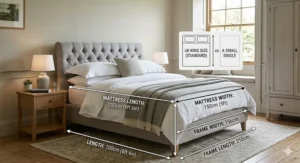
Here’s what most buyers overlook: a king size bed in the UK measures 150cm x 200cm (5ft x 6ft 6in), which is 15cm wider and 10cm longer than a double. That extra width translates to 75cm of personal sleeping space for each person — enough room that you won’t wake up when your partner turns over at 3am. For couples sharing a bed in Britain’s typically compact master bedrooms, that’s the difference between sleeping well and sleeping tolerably.
The king size bed has become Britain’s most popular bed size, overtaking the traditional double in recent years. According to research from the sleep industry, 42% of UK couples now opt for king size beds, with many reporting significantly improved sleep quality and fewer arguments about space. This shift makes perfect sense when you consider that the average British adult is taller now than previous generations, yet our homes remain stubbornly compact. The Sleep Council, a UK-based organisation promoting sleep health, notes that adequate sleeping space is crucial for quality rest, with couples requiring more room than traditional double beds provide.
What makes this guide different from the dozen others you’ve probably skimmed? Every product recommendation here is available on Amazon.co.uk, verified for UK compatibility (230V plugs, UKCA marking where applicable), and selected based on real-world performance in British homes. I’ve analysed customer reviews from UK buyers specifically, because someone in Manchester dealing with damp conditions and limited bedroom space has very different needs than an American in a sprawling Arizona ranch house. Whether you’re upgrading from a double, moving into your first proper home, or finally admitting that your 15-year-old bed frame has had its day, this guide covers the seven best king size bed frames, the critical differences between king and super king, and the practical details that turn a decent purchase into an excellent one.
Quick Comparison Table: Top 7 King Size Beds at a Glance
| Bed Frame | Type | Key Feature | Best For | Price Range (£) |
|---|---|---|---|---|
| Zinus Curtis Upholstered | Platform | Steel frame, foam padding | Budget-conscious couples | £200-£300 |
| Vida Designs Boston | Wooden | Solid pine, high headboard | Traditional aesthetics | £250-£350 |
| GFW Ottoman Storage | Ottoman | 1056L storage capacity | Space-saving | £450-£650 |
| Yaheetech Metal Platform | Metal | Industrial style, sturdy | Minimalist bedrooms | £150-£250 |
| Julian Bowen Sorrento | Upholstered | Button-tufted velvet | Luxury seekers | £550-£750 |
| Happy Beds Divan Base | Divan | Built-in drawers | Compact rooms | £300-£450 |
| Birlea Brooklyn | Metal & Oak | Mixed materials | Contemporary style | £400-£550 |
💬 Just one click—help others make better buying decisions too! 😊
✨ Don’t Miss These Exclusive Deals!
🔍 Take your bedroom to the next level with these carefully selected king size beds. Click on any highlighted item to check current pricing and availability on Amazon.co.uk. These picks will help you find exactly what you need!
Top 7 King Size Beds UK: Expert Analysis for 2026
1. Zinus Curtis Upholstered King Bed Frame
The Zinus Curtis has quietly become one of Amazon UK’s consistent sellers, and after examining the customer feedback, it’s easy to see why. This is a no-nonsense platform bed wrapped in grey fabric upholstery, designed for people who want a functional bed that looks perfectly acceptable without costing half a month’s salary.
The frame measures the standard UK king size at 150cm x 200cm, with a platform height of 35cm — sensible for most mattress types whilst leaving room underneath for a robot vacuum or modest storage boxes. What sets it apart from cheaper alternatives is the interior steel framework combined with dense foam padding beneath the upholstery. This construction dampens noise effectively, addressing one of the most common complaints about budget bed frames: the squeaking that develops after six months of use. The wooden slats sit just under 8cm apart, providing proper support for memory foam, latex, or pocket sprung mattresses without requiring a separate box spring.
In my experience, what most UK buyers overlook about this model is the weight capacity — 318kg is genuinely robust for this price point. That accommodates two adults plus a heavy mattress with margin to spare, which matters more than you’d think when you’re considering the longevity of the frame. British couples sharing a bed in a semi-detached in Birmingham or a flat in Bristol will appreciate that the grey fabric upholstery hides marks reasonably well, though it’s not machine-washable.
Customer feedback from UK buyers consistently mentions straightforward assembly (around 60-90 minutes for two people) and the absence of chemical odours that plague some imported furniture. A few reviewers note that the fabric pills slightly after a year of use, and the foam padding compresses where you rest your back whilst reading, but these are minor trade-offs for the price.
Pros:
✅ Interior steel frame provides excellent stability
✅ Noise-dampening design eliminates squeaking
✅ Supports up to 318kg weight capacity
Cons:
❌ Fabric may pill with extended use
❌ No built-in storage options
Around £200-£300 makes this exceptional value for budget-conscious buyers who prioritise function over features.
2. Vida Designs Boston Wooden King Bed Frame
The Vida Designs Boston represents the category of beds that your grandparents would approve of — solid pine construction, traditional styling, and the kind of durability that suggests it might outlast your mortgage. This frame appeals to buyers who find upholstered beds a bit too “hotel,” preferring instead the warmth and character of natural wood.
Constructed from sustainable pine with a choice of white, oak, or grey finishes, the Boston features a tall slatted headboard (approximately 100cm high) that provides proper back support for reading in bed — something that matters more as you get older. The footboard sits lower at around 40cm, creating the classic bed silhouette without overwhelming smaller bedrooms. The pine slats run perpendicular to the frame with centre support rails, distributing weight evenly and preventing the common problem of mattress sagging in the middle.
What the spec sheet won’t tell you, but UK buyers in their reviews will, is that this bed handles British damp conditions better than composite wood alternatives. Solid pine breathes, which helps prevent that musty smell that develops in ground-floor bedrooms during wet autumn and winter months. The finish is water-resistant rather than waterproof, so you’ll want to wipe up spills promptly, but it’s considerably more forgiving than particle board when humidity levels fluctuate.
Assembly requires two people and a clear hour, possibly more if you’re not particularly handy. The instructions are adequate rather than excellent, but the pieces are clearly labelled, and once assembled, the bed feels reassuringly solid. Some reviewers mention a pine scent that lingers for the first few weeks — personally, I’d consider that a feature rather than a bug, but opinions vary.
Pros:
✅ Solid pine construction offers excellent longevity
✅ High slatted headboard provides back support
✅ Handles British humidity better than composite materials
Cons:
❌ Assembly takes longer than platform beds
❌ Heavier weight makes rearranging rooms challenging
The £250-£350 range positions this as a long-term investment for buyers who value traditional craftsmanship.
3. GFW Ottoman Storage King Bed Frame
The GFW Ottoman Storage bed solves the problem that plagues most British homes: where exactly do you store the winter duvets, spare bedding, and seasonal clothing when your house has precisely zero unused space? This ottoman frame provides 1056 litres of storage beneath the mattress — enough capacity to eliminate a chest of drawers entirely.
The frame features a gas-lift mechanism (similar to car boot struts) that allows one person to lift the mattress platform smoothly, even with the mattress in place, up to a maximum weight of 60kg. The storage compartment beneath is accessible from the foot end, measuring approximately 150cm x 200cm x 34cm deep. That’s genuinely usable space, not the shallow 15cm cavity you get with some drawer beds. British buyers consistently mention storing everything from suitcases to Christmas decorations underneath, keeping bedroom clutter to a minimum.
Upholstered in charcoal, grey, or natural twill fabric with a padded headboard, the aesthetic leans contemporary without being aggressively modern. The headboard measures 112cm high, providing visual presence without dominating compact rooms. Hand-upholstered in the UK, the fabric quality sits several notches above imported alternatives, with tighter stitching and better seam alignment.
What most buyers overlook about ottoman beds is the floor clearance — just 3cm here, which means you’re sacrificing the option to slide storage boxes underneath or use a robot vacuum cleaner beneath the frame. Everything must go inside the ottoman compartment. For terraced houses and flats where storage is at a premium, this trade-off makes perfect sense. For larger homes where you might want both ottoman storage and under-bed space, it’s worth considering alternatives.
Customer reviews from UK buyers praise the gas-lift mechanism’s reliability and the substantial storage capacity. A handful note that the assembly requires patience (expect 90-120 minutes with two people), and the fabric dust protection sheet inside the compartment tears if you’re not careful when loading items.
Pros:
✅ 1056 litres of storage eliminates need for additional furniture
✅ Gas-lift mechanism operates smoothly even when loaded
✅ UK-manufactured with superior upholstery quality
Cons:
❌ Minimal floor clearance prevents under-bed storage
❌ Assembly more complex than platform beds
In the £450-£650 range, this represents excellent value for space-constrained homes where the storage capacity justifies the premium.
4. Yaheetech Metal Platform King Bed Frame
The Yaheetech Metal Platform occupies the bargain end of the market, and it knows exactly what it is — a straightforward metal frame that holds your mattress off the floor without pretending to be anything fancier. For minimalist bedrooms, student accommodation, or guest rooms that see occasional use, this stripped-back approach makes perfect sense.
Constructed from powder-coated steel tubing with a matte black finish, the frame features a simple rectangular design with a low-profile headboard (approximately 80cm high) and no footboard. The metal slats run lengthwise with proper spacing to support all mattress types, secured to the frame with plastic clips that allow some flex whilst preventing the rattling that plagues cheaper metal beds. The platform sits 33cm high, providing modest under-bed clearance for storage boxes.
What works in this bed’s favour is the price-to-sturdiness ratio. Around £150-£250 gets you a frame that supports up to 300kg without wobbling, which is perfectly adequate for most couples. The powder-coated finish resists rust reasonably well in British conditions, though reviewers in particularly damp areas (coastal towns, ground-floor flats with poor ventilation) report surface rust appearing after 18-24 months if the room isn’t well-ventilated.
UK buyers consistently mention the straightforward assembly — typically 30-45 minutes for one person, which is considerably faster than upholstered alternatives. The frame ships in a compact box, making it manageable for narrow staircases in Victorian terraces where delivery can be challenging. Some reviews note that the metal-on-metal contact points can develop squeaking after prolonged use, though adding rubber washers (not included) addresses this effectively.
Pros:
✅ Exceptional value at under £250
✅ Quick assembly suitable for one person
✅ Compact shipping fits narrow staircases
Cons:
❌ May develop squeaking at metal contact points
❌ Powder coating can rust in damp conditions
The mid-£100s to low-£200s price point makes this ideal for budget-conscious buyers who need basic functionality.
5. Julian Bowen Sorrento Upholstered King Bed
The Julian Bowen Sorrento enters the “properly luxurious” category, offering the kind of plush upholstered presence that you’d find in boutique hotels. This is for buyers who consider their bedroom an investment in daily quality of life rather than merely a place to sleep.
Fully upholstered in button-tufted velvet with a choice of colours (silver, grey, navy, blush pink, emerald green), the Sorrento features deep padding throughout the headboard and side panels. The headboard stands 112cm high with generous padding, making it comfortable to lean against whilst reading or watching television. The velvet upholstery has that slight directional pile that catches light differently depending on angle, adding visual texture to the room.
The frame construction uses solid hardwood feet with a sprung wooden slat base, providing proper mattress support whilst maintaining the upholstered aesthetic. The base height of 34.5cm offers reasonable under-bed clearance whilst keeping the overall profile elegant. One detail worth noting: the velvet is 100% polyester rather than cotton velvet, which some buyers find less breathable but others appreciate for its stain resistance and durability.
What the product listing won’t emphasise, but UK reviewers certainly do, is how the button-tufted headboard requires regular maintenance. Dust settles in the creases between buttons, and pet hair clings to velvet with impressive tenacity. Budget 10-15 minutes weekly with a vacuum attachment if you want to maintain that showroom appearance. The velvet also shows water marks if you’re careless with a glass on the bedside table, though most marks fade as the fabric dries.
Assembly takes two people approximately 90-120 minutes, with the upholstered components arriving in three separate packages. The weight (around 80-85kg assembled) means you won’t be rearranging the bedroom layout casually. Customer feedback consistently praises the visual impact and comfort, with a few mentions that the initial fabric smell (common with new upholstery) dissipates within a week.
Pros:
✅ Button-tufted velvet creates hotel-quality aesthetic
✅ Deep padding throughout headboard and sides
✅ Choice of contemporary colours suits various décor styles
Cons:
❌ Velvet requires regular vacuuming to maintain appearance
❌ Shows water marks and pet hair readily
At £550-£750, this represents a significant investment but delivers the premium bedroom aesthetic that lesser beds can’t match.

6. Happy Beds Divan Base King Size
The Happy Beds Divan Base represents the traditional British approach to beds — a fabric-wrapped base with built-in storage drawers, topped with a separately purchased mattress. Divans dominated British bedrooms for decades, and they persist because the design simply works for compact spaces.
This divan base features either two or four storage drawers (configuration affects price), upholstered in neutral fabric with a choice of colours to match various bedroom schemes. The drawers run on basic rollers rather than soft-close runners, so they’re functional rather than luxurious, but they provide genuinely accessible storage for everything from spare bedding to seasonal clothing. Each drawer measures approximately 70cm wide by 55cm deep, offering more practical storage than the equivalent space in ottoman beds because items remain visible and accessible.
The base construction uses a solid timber frame with a sprung top, distributing mattress weight evenly and extending mattress life compared to platform bases. This matters more than you might think — a quality pocket sprung mattress can last 10-12 years on a proper divan but might sag in the middle after 6-7 years on inadequate support. The base height sits at around 35cm, including castors, which provides modest under-bed clearance for a robot vacuum whilst maintaining accessible drawer height.
What UK buyers in smaller properties appreciate is the footprint efficiency. Unlike bed frames with substantial headboards and footboards, divans fit flush against walls, maximising usable bedroom space. Combined with the drawer storage eliminating the need for a chest of drawers, you’ve freed up considerable floor space — particularly valuable in Victorian terraces and newer builds where bedrooms measure 3m x 3m or smaller.
Customer reviews consistently mention the straightforward delivery (divans typically arrive in two halves that zip together) and immediate usability — no assembly beyond connecting the two sections. Some reviewers note that the fabric can snag if you’re not careful when using the drawers, and the rollers occasionally catch on carpet, but these are minor inconveniences relative to the storage capacity.
Pros:
✅ Built-in drawers provide accessible storage
✅ Sprung base extends mattress lifespan
✅ Space-efficient footprint suits compact bedrooms
Cons:
❌ Drawers use basic rollers rather than soft-close runners
❌ Requires separate headboard purchase for back support
The £300-£450 range offers practical value for buyers prioritising storage and space efficiency.
7. Birlea Brooklyn Oak and Metal King Bed Frame
The Birlea Brooklyn combines solid oak with black metal tubing, creating an industrial-meets-Scandi aesthetic that’s become increasingly popular in British homes over the past few years. This is for buyers who find pure wood frames too traditional and pure metal frames too sparse.
The frame features solid oak headboard and footboard panels (approximately 95cm and 45cm high respectively) set within black powder-coated metal tubing that forms the structural framework. The contrast between warm oak and matte black metal creates visual interest without overwhelming the room. The oak is finished with a clear lacquer that shows the natural grain, and the panels are substantial — around 20mm thick — giving the bed a quality feel that composite materials can’t match.
The metal framework provides structural rigidity whilst the oak panels add warmth and character. The base uses wooden slats with metal centre rails, distributing weight effectively across the mattress. The platform height of 36cm provides decent under-bed storage clearance whilst maintaining proportional aesthetics. One practical detail: the metal framework tends to show dust and fingerprints rather readily on the matte black finish, so budget occasional wiping if you’re fastidious about appearances.
What works particularly well about this design is the versatility. The industrial styling suits contemporary homes, yet the oak warms it sufficiently that it doesn’t feel cold or stark. British buyers in their reviews mention pairing it successfully with everything from minimalist Scandi décor to eclectic maximalist bedrooms. The mixed materials also hide wear better than single-material beds — scratches on oak become patina; marks on metal blend into the matte finish.
Assembly requires two people and roughly 60-90 minutes, with the oak panels being heavier than you’d expect (solid oak weighs considerably more than pine or composite board). Once assembled, the bed feels reassuringly solid, with minimal wobble or noise. Customer feedback occasionally mentions minor variations in oak grain and colour between the headboard and footboard panels — natural for solid wood, but worth knowing if you expect perfect uniformity.
Pros:
✅ Mixed materials create contemporary industrial aesthetic
✅ Solid oak panels provide warmth and character
✅ Versatile styling suits various décor approaches
Cons:
❌ Matte black metal shows dust and fingerprints
❌ Oak panels add considerable weight during assembly
In the £400-£550 range, this offers distinctive styling for buyers wanting something beyond basic platform beds but less traditional than pure wood frames.
How to Choose the Right King Size Bed for Your British Home
Selecting a king size bed involves considerably more than finding something that fits the measurements and ordering it. British homes present unique challenges — compact bedrooms, narrow staircases, damp conditions in older properties, and the perpetual struggle between wanting more space and actually having more space. Here’s how to navigate these constraints intelligently.
Room Dimensions Come First, Always
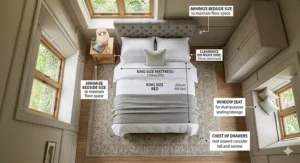
The minimum recommended bedroom size for a UK king size bed is 3m x 3.5m, but that’s the absolute floor — it assumes you’re content shuffling sideways past the bed and have no furniture beyond a single bedside table. For genuine comfort, aim for 3.5m x 4m or larger. Consumer advice from Which? suggests measuring your bedroom accurately, then using masking tape on the floor to mark out the 150cm x 200cm footprint plus an additional 10-15cm for the frame itself (headboards, footboards, and upholstered sides extend beyond the mattress dimensions).
Walk around the taped outline. Can you access your wardrobe comfortably? Open drawers without contorting yourself? Reach both bedside tables without climbing over the bed? If the answer involves hesitation, consider whether a king size genuinely improves your quality of life or simply fills your bedroom with bed.
Access Routes Matter More Than You’d Think
Victorian terraces, 1930s semis, and modern flats share one unfortunate characteristic: staircases designed when furniture was smaller and people were shorter. Measure your staircase width, door openings, and any tight corners between your front door and bedroom. King size bed frames, particularly upholstered models and solid wood options, can exceed 160cm in their longest dimension when boxed.
Ottoman beds and divans typically arrive in multiple packages or split into sections that zip together, making them considerably easier to manoeuvre up narrow stairs. Metal frames often fold or disassemble into manageable pieces. Solid wooden frames with attached headboards? Those are your staircase nemesis. Verify packaging dimensions before ordering, and if your staircase is particularly challenging, prioritise beds that ship in multiple smaller boxes.
Storage Needs Versus Bedroom Size
British homes notoriously lack storage space, making under-bed storage tremendously appealing. But here’s the calculation most buyers miss: a king size ottoman bed with 1000+ litres of storage requires lifting a heavy mattress to access that storage. If you’re using the space for seasonal items (winter duvets, Christmas decorations), that’s perfectly sensible. If you need daily access to clothing or frequently-used items, drawer divans or platform beds with clearance for under-bed boxes prove more practical.
Calculate storage volume honestly. Four storage drawers in a divan base typically provide 280-320 litres total — less than an ottoman, but considerably more accessible. Platform beds with 30cm+ clearance accommodate wheeled under-bed boxes (readily available at Ikea, Argos, or Amazon UK) that you can pull out easily. Choose storage based on what you’re actually storing and how often you need to access it.
Material Selection for British Conditions
Britain’s damp climate and variable humidity affect different bed materials distinctly. Solid wood (oak, pine) breathes naturally, handling humidity fluctuations without developing musty odours — particularly valuable in ground-floor bedrooms or older properties with limited ventilation. The trade-off is weight and higher cost.
Upholstered beds provide comfort and aesthetic appeal but require proper ventilation. In damp conditions without adequate airflow, fabric can develop mildew or that characteristic musty smell. If your bedroom tends towards damp (north-facing, poor ventilation, ground floor), prioritise beds with good airflow beneath the upholstery or consider metal and wood alternatives.
Metal frames resist moisture well but conduct cold, which matters in unheated bedrooms during British winters. Powder-coated finishes prevent rust, but cheaper coatings chip at contact points, allowing oxidation to begin. If you’re buying metal, verify proper powder coating and expect to inspect contact points annually.
Weight Capacity Isn’t Just About People
Most king size bed frames claim weight capacities between 250-350kg, which seems generous until you calculate actual load. Two adults averaging 80kg each: 160kg. A quality pocket sprung king size mattress: 50-70kg. Heavyweight duvet in winter: 5-8kg. Pillows, cushions, occasional breakfast in bed, that pile of books on your side table that never gets read: another 10-15kg. You’re approaching 250kg before accounting for any movement, bouncing, or children jumping on the bed.
A frame rated for 250kg will function, but it’s operating at capacity. Opt for 300kg+ if possible, particularly for upholstered beds where the frame components (steel or wood) hide beneath fabric. The extra capacity provides margin for longevity — a bed operating at 70% capacity lasts considerably longer than one at 95%.
British Standards and UKCA Marking
Post-Brexit, furniture sold in the UK should carry UKCA marking indicating it meets British safety standards, replacing the previous CE marking. For beds, this primarily concerns fire safety (upholstered components must meet UK fire resistance standards) and structural stability. Amazon UK sellers should clearly state UKCA compliance for beds manufactured or imported after January 2023.
Most reputable brands comply automatically, but it’s worth verifying if you’re considering lesser-known brands or extremely budget options. British Trading Standards enforce these requirements, and whilst enforcement primarily targets manufacturers and importers, buying compliant products ensures you’re not inadvertently purchasing something that fails safety standards.

King Size vs Super King: Understanding the 30cm That Changes Everything
The difference between UK king size (150cm x 200cm) and super king size (180cm x 200cm) is precisely 30cm of width. That might sound modest — barely a foot — but in practical bedroom terms, it’s the difference between “comfortable for couples” and “luxuriously spacious for couples.”
The Space Mathematics
A UK king size bed provides each person approximately 75cm of personal width when shared. That’s comparable to sleeping on a small single (90cm) with a 15cm buffer zone in the middle. For most couples, 75cm offers enough room to turn over without disturbing your partner, which is fundamentally what you’re paying for when you upgrade from a double (67.5cm each).
A super king provides 90cm per person — equivalent to two small singles pushed together. That extra 15cm per person (30cm total) transforms sleeping from “we each have space” to “we each have ample space.” If either partner is a restless sleeper, tall (over 190cm), or broad-shouldered, that 15cm eliminates most sleep disturbances from movement.
But here’s the reality check for British homes: a super king bed requires a bedroom of at least 3.5m x 4m to function without feeling cramped, and ideally 4m x 4.5m for comfortable furniture placement. Most British master bedrooms in properties built before 2000 measure somewhere between 3m x 3.5m and 3.5m x 4m. A super king in a 3.5m-wide room leaves just 1.7m combined for walking space on both sides — theoretically adequate, but practically tight when you add bedside tables.
Price and Availability Considerations
Super king bed frames typically cost 15-25% more than equivalent king size models, which makes sense given the larger material requirements. But the cost difference extends beyond the frame itself. Super king mattresses cost approximately 20-30% more than king size equivalents. Bedding — duvets, duvet covers, fitted sheets, flat sheets — commands similar premiums, and the selection is considerably narrower.
Walking into any high street department store (John Lewis, Marks & Spencer, Dunelm), you’ll find extensive king size bedding selections but limited super king options. Online retailers including Amazon UK stock super king bedding, but you’re sacrificing the ability to see and feel the fabric before purchasing. For buyers who value extensive choice in bedding patterns and materials, king size offers significantly better options.
The Verdict for Most British Couples
Unless your bedroom genuinely exceeds 4m in width and you’re both over 185cm tall or one partner is a dramatically restless sleeper, a king size bed provides the better balance of comfort, cost, and practicality for British homes. The super king delivers noticeable improvements in sleeping space, but it demands bedroom dimensions that most British properties simply don’t offer without making the room feel cramped.
If you’re building a new home or have a genuinely spacious master bedroom (4m x 5m or larger), the super king merits serious consideration. For everyone else, a king size offers 90% of the comfort at 75% of the cost, without overwhelming your bedroom.
Common Mistakes When Buying a King Size Bed (And How to Avoid Them)
Ordering Before Measuring the Staircase
The single most common disaster in king size bed purchases involves discovering, upon delivery, that your beautifully chosen bed frame cannot physically reach your bedroom. Measure your staircase width at its narrowest point (usually where it turns), measure door openings, and measure the diagonal of any landings where the delivery route changes direction.
A standard king size mattress, when boxed and rolled (as most foam and hybrid mattresses now ship), typically measures around 50cm x 50cm x 150cm — manageable for most staircases. Bed frames vary dramatically. Upholstered frames with attached headboards can exceed 170cm in the longest dimension, making tight corners nearly impossible. Verify packaging dimensions before ordering, and if your access is genuinely challenging, prioritise frames that arrive in multiple smaller packages.
Ignoring UKCA Certification and UK Voltage Compatibility
Post-Brexit, furniture sold in the UK should carry UKCA marking indicating compliance with British safety standards. This matters particularly for upholstered beds, which must meet UK fire resistance standards considerably more stringent than many international requirements. Buying from reputable Amazon UK sellers generally ensures compliance, but if you’re tempted by grey-market imports or suspiciously cheap alternatives, verify the certification.
For beds with built-in features (LED lighting, USB charging ports, electric adjustable bases), verify 230V UK compatibility and proper UK plug type G. Some international sellers list beds with features designed for 110V markets, which won’t function on UK electrical systems without adapters — and adapters violate safety standards for permanent fixtures.
Choosing Aesthetics Over Practical Storage
The aesthetic appeal of a beautifully upholstered bed without visible storage is undeniable — it looks cleaner, more minimalist, more hotel-like. But in British homes where storage is perpetually limited, sacrificing 280-1000 litres of storage capacity for aesthetics often proves a false economy. You’ll end up buying a separate chest of drawers or wardrobe to accommodate the items that could have lived beneath your bed, consuming floor space and budget.
Unless your bedroom genuinely offers abundant storage through built-in wardrobes or you’re committed to a severely minimalist lifestyle, prioritise beds with storage. The aesthetics adapt; your storage needs don’t.
Underestimating Assembly Time and Complexity
Amazon product listings consistently claim “easy assembly” and “60-minute setup,” which is technically true if you’re experienced with flat-pack furniture and the planets align favourably. For normal humans assembling furniture in British homes with carpet, limited space, and average DIY skills, expect assembly to take considerably longer.
Platform beds with basic frames: 45-90 minutes for two people. Upholstered beds with buttoning and complex frames: 90-150 minutes. Ottoman beds with gas-lift mechanisms: 120-180 minutes. Wooden beds with multiple components: 90-120 minutes. Budget time accordingly, ensure you have a second person available (essential for most beds), and if you’re genuinely hopeless with assembly, factor in professional assembly services (available through Amazon or local handyman services, typically £50-£100).
Buying the Wrong Mattress Support System
King size bed frames use different mattress support systems: wooden slats, metal slats, sprung bases, or platform tops. The system affects which mattress types perform optimally. Pocket sprung mattresses function best on slatted bases with slats spaced 5-8cm apart or sprung bases that allow the springs to move naturally. Memory foam and latex mattresses prefer solid platforms or tightly-spaced slats (under 5cm gaps) that prevent the foam from bulging between gaps.
Verify your chosen bed frame’s slat spacing against your mattress type. Most modern frames accommodate all mattress types reasonably well, but cheap frames with widely-spaced slats (10cm+) can cause premature mattress sagging, particularly with foam mattresses.
What to Expect: Real-World Performance in British Conditions
Upholstered Beds in Damp Climates
Britain’s climate is fundamentally damp — not dramatically wet like a rainforest, but persistently humid throughout autumn, winter, and much of spring. Upholstered beds with fabric wrapping the frame require adequate bedroom ventilation to prevent that musty smell developing in the fabric. Ground-floor bedrooms, north-facing rooms with limited sunlight, and Victorian/Edwardian properties with solid walls (lacking cavity insulation) prove particularly challenging.
If your bedroom tends towards damp, open windows for 15-20 minutes daily even in winter, use a dehumidifier intermittently, and avoid pushing the bed flush against external walls where condensation accumulates. The fabric on quality upholstered beds includes anti-microbial treatments that resist mildew, but they’re not infallible in persistently damp conditions.
Wooden Beds and Seasonal Humidity Changes
Solid wood expands and contracts with humidity fluctuations — a natural characteristic that affects wooden bed frames during British seasonal transitions. Expect slight creaking during autumn/winter as humidity increases and wood swells, potentially creating tighter joints. Spring/summer brings lower indoor humidity (particularly with heating off), causing wood to contract slightly and occasionally creating minor gaps at joints.
This is normal behaviour for solid wood and doesn’t indicate structural failure. Cheaply made beds using inadequate joinery fail when wood movement stresses poorly-designed joints. Quality wooden beds use proper joinery (mortise and tenon, dowels, or robust bolts) that accommodates seasonal movement without compromising structural integrity.
Metal Beds and Cold Conductivity
Metal conducts cold efficiently, which British bedrooms have in abundance during winter months. If you’re running minimal heating overnight (as most British households do for economy), metal bed frames in contact with bare skin feel noticeably cold. This matters most if you’re wearing shorts/t-shirts to bed or your bedroom temperature drops below 15°C overnight.
Upholstered metal frames solve this by wrapping the metal structure in fabric, preventing direct contact. Pure metal frames work perfectly well but combine better with flannel bedding, higher bedroom temperatures, or nightwear that prevents direct metal contact.
Ottoman Mechanisms and Long-Term Reliability
Ottoman beds use gas-lift mechanisms (similar to car boot struts) to raise the mattress platform smoothly. Quality mechanisms from reputable manufacturers (Aspire, GFW, Julian Bowen) typically function reliably for 7-10+ years before gas pressure drops noticeably. Budget ottoman beds using cheaper mechanisms might see performance degrade after 3-5 years, requiring replacement struts.
The mechanism’s longevity depends partly on load — consistently lifting heavy mattresses (60kg+) stresses the struts more than lighter mattresses. It also depends on frequency of use. If you’re accessing the storage daily, the mechanism endures considerably more cycles than if you’re using it seasonally for duvet storage. Most manufacturers rate mechanisms for 10,000+ cycles, but real-world longevity varies based on load and use patterns.
King Size Beds for Different British Households
City Flat Dwellers: Compact Spaces and Staircase Challenges
London flats, Manchester conversions, and Edinburgh tenements share narrow staircases and compact bedrooms as defining characteristics. For city living, prioritise beds that ship in multiple manageable packages: divans that split into halves, platform beds with detachable headboards, or metal frames that disassemble completely.
Storage becomes critical when bedroom size limits additional furniture. Ottoman beds or divan bases with drawers eliminate the need for separate storage units, freeing precious floor space. Opt for lower-profile designs (headboards under 100cm) to maintain ceiling height in conversions where bedrooms occupy former living spaces with standard ceiling heights.
Suburban Semi-Detached and Terraced Houses
British suburban properties built between 1920-1990 typically feature master bedrooms measuring 3m x 3.5m to 3.5m x 4m — adequate for king size beds with thoughtful layout. These homes often lack built-in storage, making drawer divans or ottoman beds particularly valuable.
Consider bedroom orientation when selecting bed materials. North-facing rooms with limited sunlight benefit from solid wood beds that handle damp better than upholstered options. South-facing bedrooms with good natural light accommodate any bed type successfully. These properties typically have moderate staircase access, allowing most bed frame types to reach bedrooms with standard delivery.
Rural Properties and Period Homes
Cottages, converted barns, and period properties present unique challenges: narrow staircases, low ceilings, irregular room dimensions, and potentially significant damp in older structures. Measure carefully — “period charm” often translates to “doorways designed for people who averaged 165cm tall and furniture that came through windows.”
Divan bases split into halves for delivery, making them ideal for challenging access. Solid wood beds suit the aesthetic of period properties whilst handling humidity variations better than upholstered alternatives. If your bedroom features exposed beams or sloped ceilings, verify headboard height against ceiling clearance — a 112cm headboard proves problematic when your ceiling slopes to 200cm at the wall.
Family Homes with Co-Sleeping Considerations
Parents practising co-sleeping or accommodating occasional child visits need to consider weight capacity carefully. A king size bed with two adults (160kg), one child (20-40kg), and mattress (60kg) approaches 260-280kg before accounting for bedding and movement. Opt for frames rated 300kg+ to provide adequate margin.
Upholstered beds offer soft edges safer for young children, though they also show spills and stains more readily than wood or metal. Platform beds with storage keep the bedroom tidy, valuable when children’s belongings tend to migrate into parents’ rooms. Consider headboard height — taller headboards (110cm+) provide better back support for reading bedtime stories but reduce under-bed storage access from the head end.
Long-Term Cost and Maintenance in the UK
True Cost of Ownership Over 10 Years
The initial purchase price represents only part of the total cost of owning a king size bed. Factor in bedding costs, maintenance, and eventual disposal to understand genuine long-term value.
Initial frame cost: £200-£750 depending on style and quality. Mattress: £400-£2000 for quality pocket sprung or hybrid suitable for 10-year lifespan. Bedding (duvet, pillows, two sets of sheets, duvet covers): £200-£500 initially, with replacement every 3-5 years adding £100-£200 per cycle. Ottoman or divan drawer maintenance (replacement gas struts or drawer runners if needed): £50-£150 over 10 years.
A £300 bed frame plus £600 mattress plus £300 bedding costs £1200 initially, with approximately £400-£600 additional over 10 years for bedding replacement and minor maintenance. That’s £1600-£1800 total, or £160-£180 annually. A £700 frame with £1200 mattress and premium bedding might reach £2500+ over the same period (£250 annually) but potentially offers superior comfort and durability.
Calculate cost-per-night-of-use for perspective: a £1500 total investment over 10 years (3650 nights) costs 41p per night. Even premium beds rarely exceed £1 per night amortised over their lifespan.
Routine Maintenance for Different Bed Types
Upholstered beds require vacuuming every 2-4 weeks to prevent dust accumulation in tufting and creases. Spot-clean spills immediately with appropriate fabric cleaner. Rotate the frame annually if design allows, ensuring even wear on the base.
Wooden beds benefit from occasional tightening of bolts and screws — wood movement with humidity changes can loosen joints over time. Inspect quarterly, tightening as needed. Clean with appropriate wood cleaner matching the finish (oiled, lacquered, or waxed require different treatments).
Metal beds need periodic inspection of joints and contact points where powder coating might chip. Touch up chips with matching paint to prevent rust initiation. Lubricate any moving parts (drawer runners, ottoman mechanisms) annually with appropriate lubricant.
Ottoman gas-lift mechanisms require no routine maintenance but benefit from operating the lift occasionally even when not accessing storage, keeping the mechanism exercised. If lift becomes stiff or slow, replacement struts cost £30-£80 depending on bed model and are user-replaceable on most designs.
Bedding Replacement Cycles and UK Availability
King size bedding enjoys broad availability throughout the UK high street and online retailers. Expect to replace duvet covers and fitted sheets every 2-3 years with regular washing (weekly fitted sheet changes, fortnightly duvet cover changes). Quality Egyptian cotton or bamboo bedding lasts longer but costs more initially.
Budget £80-£150 for each complete bedding set (fitted sheet, flat sheet, duvet cover, pillowcases) from mid-range retailers (Dunelm, M&S, John Lewis). Premium bedding from specialist linen companies can reach £200-£400 per set but typically offers superior longevity and comfort.
Stock at least two complete sets allowing rotation whilst washing. British weather makes outdoor drying unreliable, so tumble drying or indoor drying racks become necessary — factor in either energy costs or space for drying.
Insurance and Warranty Considerations
Quality bed frames from reputable manufacturers typically include 1-5 year warranties covering manufacturing defects but not normal wear or misuse. Read warranty terms carefully — many exclude damage from improper assembly, excessive weight, or failure to follow care instructions.
Home contents insurance covers beds against specific perils (fire, theft, flood) but rarely covers gradual wear or mechanical failure. Given bed frame costs rarely exceed insurance excesses (typically £250-£500), claiming for bed damage proves impractical unless the damage occurs alongside broader household damage.
Extended warranties offered at point of purchase (common through furniture retailers) rarely prove cost-effective for beds. A £50-£100 warranty extending coverage by 3-5 years seldom justifies the cost when bed frames either fail early under manufacturer warranty or last 10+ years without issues.
UK Regulations, Safety Standards & Legal Requirements
UKCA Marking and Post-Brexit Standards
Since January 2023, furniture sold in Great Britain must carry UKCA (UK Conformity Assessed) marking rather than the previous CE marking, indicating compliance with UK safety standards. For Northern Ireland, products may still use CE marking due to the Northern Ireland Protocol maintaining alignment with EU standards.
UKCA marking covers several aspects relevant to beds: structural stability (ensuring the bed won’t collapse under rated load), fire safety for upholstered components (British furniture fire safety standards remain among the world’s strictest), and chemical safety for finishes and adhesives (ensuring VOC emissions remain within safe limits).
Reputable sellers through Amazon UK ensure UKCA compliance automatically, but if you’re considering grey-market imports or suspiciously cheap alternatives claiming to ship from overseas warehouses, verify compliance. Trading Standards enforce these requirements, and whilst enforcement targets primarily manufacturers and importers, buying non-compliant furniture can create issues with insurance claims if the bed’s failure to meet standards contributes to damage or injury.
UK Fire Safety Regulations for Upholstered Furniture
The Furniture and Furnishings (Fire) (Safety) Regulations 1988 (as amended) require upholstered beds sold in the UK to meet stringent fire resistance standards. Foam fillings must resist ignition from cigarettes and match flames, and fabric covers must resist flame spread.
Compliant furniture displays labels stating compliance with these regulations. Quality manufacturers include this labelling prominently; its absence suggests either non-compliance or grey-market imports intended for markets with lower standards. Given that bedrooms represent high-risk fire locations (smoking in bed, electrical faults from bedside devices), compliance matters considerably more than it might appear initially.
Consumer Rights and Returns
Under the Consumer Rights Act 2015, furniture purchased online must be of satisfactory quality, fit for purpose, and match the description provided. You have 14 days from delivery to change your mind and return the item for a full refund (excluding return shipping costs you pay), though many retailers extend this voluntarily.
For beds, this cooling-off period proves valuable but logistically challenging — assembling a king size bed frame, discovering it doesn’t suit your needs, and then disassembling and returning it involves considerable effort. Take advantage of Amazon’s extensive review system, reading UK-specific reviews where possible to understand real-world experience before committing.
If the bed develops faults within six months of purchase, the seller must prove the fault wasn’t present at delivery (effectively assuming liability). After six months, you must prove the fault existed at purchase. Quality issues like structural weakness, fabric delamination, or mechanism failure fall under warranty coverage; normal wear, damage from misuse, or aesthetic preference don’t.
Building Regulations and Planning Considerations
Beds themselves don’t trigger building regulations, but if you’re undertaking bedroom renovations to accommodate a king size bed (enlarging doorways, moving walls, creating storage), Building Regulations apply to structural alterations. Consult your local council’s Building Control department before undertaking structural work.
Loft conversions creating additional bedrooms for king size beds require full Building Regulations approval, ensuring adequate structural support, fire safety (protected stairways, escape windows), insulation, and ceiling height. These projects typically cost £20,000-£50,000, so the bed represents a minor component of total investment.

Frequently Asked Questions
❓ What are the exact dimensions of a UK king size bed in cm and feet?
❓ How much space do I need in my bedroom for a king size bed UK?
❓ Can a king size bed frame fit up a standard UK staircase?
❓ Do I need a box spring with a UK king size bed frame?
❓ What's the difference between a king size bed and a super king in the UK?
Conclusion: Making Your King Size Bed Decision
Choosing the right king size bed for your British home ultimately comes down to balancing competing priorities: the space you have versus the space you want, the storage you need versus the aesthetics you prefer, the budget you’ve allocated versus the quality you’re hoping for. There isn’t a universally “best” king size bed — there’s the bed that best fits your specific circumstances.
If your bedroom measures closer to 3m x 3.5m and storage is at a premium, the GFW Ottoman Storage or Happy Beds Divan Base models provide practical solutions that maximise functionality without overwhelming compact rooms. For larger bedrooms where aesthetics take priority, the Julian Bowen Sorrento or Birlea Brooklyn offer distinctive styling that elevates the bedroom beyond mere functionality. Budget-conscious buyers will find excellent value in the Zinus Curtis or Yaheetech Metal Platform, both providing solid performance at prices that leave room in the budget for a quality mattress — which matters considerably more than the frame for actual sleep quality.
Three principles should guide your final decision. First, measure obsessively — bedroom dimensions, staircase access, door openings, and the space around where the bed will sit. Second, prioritise structural quality and weight capacity over superficial aesthetics; a bed that wobbles or squeaks after six months ruins sleep quality regardless of how attractive it looked in the product photos. Third, consider total cost of ownership rather than just purchase price — a £700 bed that lasts 15 years and requires minimal maintenance costs less per year than a £300 bed needing replacement after 5 years.
The British bedroom remains fundamentally compact by international standards, and the king size bed represents the practical upper limit for most properties. It provides genuine comfort for couples without completely dominating the room, maintains reasonable bedding costs, and offers the broad selection of styles and price points that only mainstream sizes enjoy. Your sleep quality matters profoundly to your health, productivity, and general wellbeing — investing thoughtfully in the bed where you’ll spend roughly a third of your life proves one of the more sensible financial decisions you can make.
Recommended for You
- 7 Best Double Bed Frame for Small Bedrooms UK 2026
- Best Affordable Double Beds Under £300 UK 2026
- Best Double Bed with Storage UK 2026: 7 Expert Picks
Disclaimer: This article contains affiliate links. As an Amazon Associate, I earn from qualifying purchases. If you purchase products through these links, we may earn a small commission at no additional cost to you.
✨ Found this helpful? Share it with your mates! 💬🤗
