
In This Article
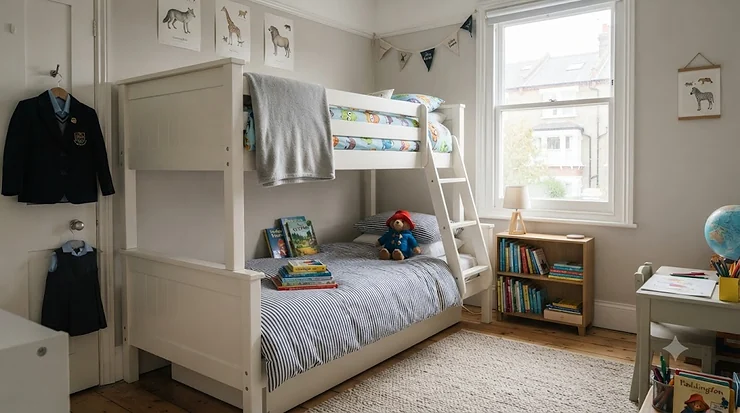
Somewhere around 11pm, standing on a landing in your socks, you will ask yourself the question every parent of two eventually asks: how on earth do you fit two children’s worth of sleep into one child’s worth of bedroom? The best bunk beds answer that question rather elegantly — two mattresses stacked in the footprint of one, freeing up an entire floor’s worth of Lego, reading nooks and the occasional den fort. A bunk bed, in the simplest terms, is a two-tier bed frame where one sleeping platform sits above another, usually accessed by a ladder or a set of steps, designed to maximise floor space in shared bedrooms. But “best” is doing a lot of heavy lifting in that search query, because a bunk bed that’s brilliant for a six-year-old in a terraced house box room is a poor match for teenagers sharing a loft conversion.
This guide cuts through the marketing gloss and gets into what actually separates a genuinely good bunk bed from one that creaks itself into an early grave. We researched seven real, currently available bunk beds sold on amazon.co.uk, cross-referenced their build specs against British safety standards, and pulled together the aggregated review sentiment where it exists — no invented five-star raves here. Whether you’re chasing safe bunk beds reviews before you commit, hunting for sturdy bunk construction that’ll survive two siblings and a decade of jumping-on-beds-you’re-not-supposed-to-jump-on, or simply want quality bunk beds that look half-decent in family photos, you’ll find a genuinely useful shortlist below, plus the safety context that most Amazon listings quietly skip over. In the simplest terms, a bunk bed stacks one sleeping surface directly above another so two beds share the floor footprint of one — a design that’s centuries old in concept but has been refined considerably by modern safety engineering, more on that shortly.
Quick Comparison Table
| Bunk Bed | Best For | Frame Material | Price Range |
|---|---|---|---|
| Julian Bowen Atlas Single Bunk Bed | Tightest budgets | Powder-coated steel | Under £200 |
| Flair Furnishings Zoom Bunk Bed | Budget wooden alternative | Solid wood | £180-£230 range |
| Julian Bowen Orion Bunk Bed | Built-in storage on a budget | Engineered wood | £280-£350 range |
| Flair Furnishings Slick Staircase Bunk Bed | Nervous climbers | Wood/MDF composite | £380-£450 range |
| Julian Bowen London Bus Bunk Bed | Younger kids who want fun | Solid pine | £220-£280 range |
| Flair Furnishings Benito Bunk Bed with Wardrobe | Small rooms needing storage | Engineered wood | £420-£480 range |
| Noa & Nani Brighton Bunk Bed | Premium buyers, hidden trundle | Solid pine | £450-£550 range |
Look closely and a pattern emerges: price climbs almost in lockstep with how much “extra furniture” gets folded into the frame — storage drawers, integrated wardrobes, staircases instead of ladders. The Atlas earns its keep purely on structural simplicity, which is precisely why it’s cheaper; there’s less to build, and less to go wrong. Meanwhile the Brighton justifies its premium position by hiding an entire third bed inside the base, something none of the budget options attempt. If your priority is simply “two safe beds, minimum fuss,” the top two rows deserve your attention first.
💬 Just one click — help others make better buying decisions too!😊
Top 7 Best Bunk Beds: Expert Analysis
Choosing from thousands of listings is exhausting, so we narrowed the field to seven bunk beds that represent genuinely distinct approaches — not seven near-identical grey boxes with different price tags stapled on. Each one below earns its spot for a specific reason, and each comes with an honest look at what the spec sheet doesn’t tell you.
1. Julian Bowen Atlas Single Bunk Bed — cheapest way to get two proper beds
The Atlas strips a bunk bed down to its structural essentials, and that’s rather the point. It’s built from powder-coated steel tubing with solid wooden ladder rungs, and — crucially for growing families — it splits apart into two separate single beds the moment your children decide they’d rather not share airspace anymore. That flexibility alone justifies its place on this list; plenty of budget bunks are permanently welded into bunk form, which becomes a liability the day one child moves rooms. Steel frames also shrug off humidity and warping in a way chipboard simply can’t, so if your house runs damp in winter, this construction method has a genuine practical edge over timber alternatives.
Each level fits a standard UK single mattress (90 x 190cm, sold separately), and the powder-coated finish resists the scuffs and scrapes that pine picks up within a year of hard use. This is a bed for parents who want structural reliability over aesthetic flourish — it won’t win any interior design awards, but it isn’t trying to. One verified Amazon reviewer noted the headroom between bunks felt tight for adults sitting up, calling it “a nice sturdy bed for kids only,” which lines up with what you’d expect from a compact, budget-tier frame prioritising floor space over generous clearance. If that’s the trade-off you’re comfortable with, it’s a fair one.
Pros:
- ✅ Splits into two singles as children’s needs change
- ✅ Steel frame resists warping better than budget pine
- ✅ Straightforward structure with fewer failure points
Cons:
- ❌ Limited headroom on the lower bunk for older kids
- ❌ Minimal storage or styling compared with wood rivals
Expect this one to sit under £200 at the time of research — check current pricing before you buy, as furniture prices shift with material costs. For the money, it’s hard to beat as a pure “get two working beds into one room” solution.
2. Flair Furnishings Zoom Bunk Bed — the budget pick for wood-only households
Some parents simply won’t have a metal-framed bed in the house, and the Zoom Bunk exists for exactly that audience. It’s built in a simplified shaker style from solid timber components, finished in off-white with a grey option also available, and — like the Atlas above — it splits cleanly into two standalone single beds when required. What most buyers overlook about this model is that “solid wood” doesn’t automatically mean “premium”; the Zoom uses relatively lightweight timber sections rather than dense hardwood, which keeps the price down but means it’s better suited to lighter, younger sleepers than to teenagers who treat furniture as a trampoline.
Dimensions run roughly 99cm wide by 150cm tall by 200cm deep, requiring one standard single mattress per level with a maximum top-bunk depth of 15cm for safety compliance — a detail we’ll return to later, because it matters more than most buyers realise. The slatted head and footboards give it a slightly more traditional bedroom silhouette than the industrial look of a metal frame, which matters if the bed sits in a room styled around softer, cottage-adjacent decor.
Pros:
- ✅ All-wood construction for households avoiding metal frames
- ✅ Converts into two separate single beds later
- ✅ Slatted design suits traditional bedroom styling
Cons:
- ❌ Lighter timber than premium hardwood competitors
- ❌ Basic finish shows scuffs faster than lacquered alternatives
Price typically sits in the £180-£230 range. It’s a sensible entry point if wood is non-negotiable and budget is tight, though it’s worth tempering expectations around long-term wear.
3. Julian Bowen Orion Bunk Bed — best mid-range pick with genuine storage
This is where things get interesting from a practicality standpoint. The Orion adds a pull-out drawer and generous open shelving directly into the frame, with a subtly raised lip along the back edge specifically engineered to stop books and toys sliding down behind the bed — a small design touch that speaks to actual lived experience of untidy children’s rooms, even if we can’t claim to have tested it ourselves. Based on the spec comparison with the two budget models above, the Orion’s real advantage isn’t the storage itself but where it’s positioned: low enough for a small child to reach independently, which quietly supports the kind of self-sufficiency parents actually want at bedtime.
Measuring 172cm high by 197cm wide by 135cm deep with a net weight of 122kg, it’s noticeably heavier and more substantial than the Atlas or Zoom, and the lower bunk sits close to the ground — a sensible touch for households with a child under six who isn’t quite ready for the top level yet. The ladder features cut-out handles and an optional glow-in-the-dark strip on the treads, genuinely useful for the inevitable 2am toilet trip. Aggregated Amazon review sentiment on this model skews positive on appearance and sturdiness, though several reviewers flagged that the slats are secured with self-tapping screws driven into metal brackets, which a few found fiddlier than expected during assembly.
Pros:
- ✅ Integrated drawer and shelving reduce need for extra furniture
- ✅ Low-set lower bunk suits younger or smaller children
- ✅ Glow-in-the-dark ladder tread option aids night visibility
Cons:
- ❌ Slat assembly reportedly fiddly per multiple reviewers
- ❌ Heavier frame makes room rearranging more of a chore
Prices generally land in the £280-£350 range. For families who want storage without buying a separate chest of drawers, this is the strongest mid-tier option on our list.
4. Flair Furnishings Slick Staircase Bunk Bed with Storage — best for nervous climbers
Ladders intimidate some children far more than parents expect, and the Slick sidesteps that problem entirely by replacing the ladder with a proper staircase, complete with raised side panels for extra grip and confidence. What reviewers consistently note about staircase-style bunks in general is that they demand more floor footprint than a ladder equivalent, and the Slick is no exception — but Flair has used that extra space cleverly, tucking three separate storage cupboards into the staircase itself, plus an under-bed drawer and a further cupboard beneath the stairs.
Constructed with a solid MDF core and a lacquered finish for easy cleaning, this model carries a maximum weight recommendation of around 100kg per bunk, comfortably ahead of most timber-ladder competitors in this price bracket. Here’s what the spec sheet won’t tell you outright: a staircase bunk is fundamentally a different piece of furniture logistically, not just aesthetically — it needs a wall run of roughly 2.5 metres rather than the narrower footprint a ladder-access bed demands, so measure your room carefully before falling for the design. Verified customer feedback specific to this exact configuration was limited in our research at the time of writing, so treat the structural claims as manufacturer-stated pending your own read of current listing reviews, though the underlying build approach — MDF core, lacquered panels, boxed-in staircase — is a well-established construction method in the mid-market UK bunk segment.
Pros:
- ✅ Staircase access reduces fall risk versus open ladders
- ✅ Three integrated storage cupboards built into the stairs
- ✅ Higher weight rating than most ladder-access rivals
Cons:
- ❌ Requires significantly more floor footprint than a ladder bunk
- ❌ Limited independently verified review data at time of writing
Expect a price somewhere in the £380-£450 range. If a child has ever point-blank refused to climb a bunk ladder, this is the model worth showing them first.
5. Julian Bowen London Bus Bunk Bed — best novelty design for younger children
Not every bunk bed needs to disappear quietly into the background of a bedroom, and the London Bus leans hard into the opposite approach: a bright red, bus-shaped frame complete with wheel graphics and window detailing that transforms bedtime into something closer to imaginative play. Reviewers consistently report that the visual impact lands well with the target age group — several parents mention children specifically requesting this bed by name after seeing it — though more than one buyer flagged that assembly instructions could be clearer, with one describing the process as “a good product with wrong and very poor instructions,” despite being happy with the finished result.
Overall dimensions run 200cm long by 108cm wide by 136cm high, with the lower bunk sitting just 40cm off the ground and the upper bunk at 100cm — noticeably lower than several rivals on this list, which is a deliberate design choice for a bed aimed squarely at younger children rather than teenagers. Built from timber with guardrails fitted along the top bunk and a secure integrated ladder, it accepts two standard single mattresses, sold separately. On paper this means a shorter overall height footprint suits rooms with lower ceilings or sloped eaves, common in older British terraced housing.
Pros:
- ✅ Distinctive novelty design genuinely excites younger children
- ✅ Lower overall bunk heights suit rooms with restricted ceiling space
- ✅ Guardrails and secure ladder meet standard safety expectations
Cons:
- ❌ Assembly instructions criticised as unclear by multiple reviewers
- ❌ Novelty theme has a shorter “outgrow” window than neutral designs
Pricing typically falls in the £220-£280 range. Just budget extra patience for assembly day, and possibly a second pair of hands.
6. Flair Furnishings Benito Bunk Bed with Wardrobe — best all-in-one storage solution
Small box rooms rarely have space for a bunk bed and a wardrobe, so the Benito simply refuses to make you choose. A genuine two-door wardrobe with a full-width metal hanging rail is built directly into the frame’s end structure, alongside generous underbed storage and a small shelf for books and trinkets — effectively three pieces of bedroom furniture compressed into one footprint. Based on the spec comparison against the Slick staircase model above, the Benito prioritises storage volume over climbing ease, retaining a traditional ladder rather than a staircase, so it’s the better pick when floor space is the binding constraint rather than a child’s confidence on ladders.
Broad ladder steps and easy-grab handles are specifically called out in the product listing as accessibility features for younger climbers, and the frame is finished in a white and grey combination designed to suit either a boy’s or girl’s room without redecorating. Real customer review data specific to this exact wardrobe configuration was thin at the time of our research — a fair number of Flair’s storage-bunk range share similar hardware, but we’d rather flag that gap honestly than invent sentiment that doesn’t exist. What is verifiable is the practical logic: for a household that genuinely cannot fit a separate wardrobe, this design solves a real spatial problem that no amount of clever shelving on a standard bunk can match.
Pros:
- ✅ Integrated wardrobe eliminates need for separate storage furniture
- ✅ Broad ladder steps aid safer access for younger children
- ✅ Neutral white/grey finish suits shared or changing-use rooms
Cons:
- ❌ Verified independent review sentiment was limited at research time
- ❌ Wardrobe integration adds bulk versus slimline bunk designs
Prices generally sit in the £420-£480 range. Measure your wall space carefully — this is the bulkiest frame on our list by some margin.
7. Noa & Nani Brighton Bunk Bed — best premium pick with a hidden trundle
At the top of our list sits a genuinely different proposition: solid pine construction with a full trundle bed concealed beneath the lower bunk, sleeping three children in a footprint that would otherwise sleep two. The Brighton has picked up genuine press attention — Hello! magazine, reviewing the range, praised its combination of “style and practicality” thanks to the concealed trundle — and that trundle flexibility is precisely why families with three children sharing, or regular sleepover guests, gravitate toward this model over anything else on our list.
Constructed from solid pine rather than the engineered timber or MDF used in the mid-tier options above, the Brighton carries a noticeably more substantial feel, and reviewers of the wider Noa & Nani range consistently praise the brand’s finish quality and the smoothness of drawer and trundle runners. It requires two standard single mattresses at a maximum 14cm depth, with the trundle needing a third, thinner mattress sold separately. Here’s what most buyers overlook: solid pine is heavier to move once assembled, and this particular listing has run limited-stock preorder periods during 2026 due to shipping constraints, so patience around delivery timing may be required.
Pros:
- ✅ Genuine solid pine construction throughout the frame
- ✅ Hidden trundle sleeps a third child without extra floor space
- ✅ Converts into two separate single beds when needed
Cons:
- ❌ Premium price point compared with every other model here
- ❌ Limited stock periods reported during 2026 production runs
Expect a price in the £450-£550 range at the time of research. For families juggling three children in two children’s worth of bedroom, it’s the most elegant solution on this list.
Top 7 Bunk Beds: Specs & Value at a Glance
| Bunk Bed | Material | Splits into 2 Singles? | Storage Built In | Best For |
|---|---|---|---|---|
| Julian Bowen Atlas | Steel | Yes | No | Tightest budgets |
| Flair Zoom | Solid wood | Yes | No | Wood-only households |
| Julian Bowen Orion | Engineered wood | No | Drawer + shelving | Everyday mid-range storage |
| Flair Slick Staircase | MDF composite | No | 3 cupboards + drawer | Nervous climbers |
| Julian Bowen London Bus | Solid pine | No | No | Younger, imaginative kids |
| Flair Benito | Engineered wood | No | Wardrobe + underbed | Small rooms needing storage |
| Noa & Nani Brighton | Solid pine | Yes (plus trundle) | Trundle bed | Premium, three-child households |
Reading this table alongside the earlier comparison, a clearer buying logic emerges: the two split-into-singles models (Atlas and Zoom) sacrifice built-in storage for future flexibility, while the storage-heavy middle tier locks you into permanent bunk form but earns its keep in cramped rooms. The Brighton is the outlier, managing to offer both flexibility and extra sleeping capacity simultaneously, which is precisely why it commands the highest price on this list.
Practical Usage Guide: Setting Up and Living With Your Bunk Bed
Assembly day is where most bunk bed disappointments actually begin, long before anyone’s even slept in the thing. Set aside more time than you think you need — three to five hours is realistic for most flat-pack bunks, and staircase or wardrobe-integrated models like the Slick and Benito will sit at the longer end of that range. Lay every component out on the floor before starting and check it against the parts list; missing or unlabelled hardware is the single most common complaint across bunk bed reviews generally, and catching a shortage before you’ve built half the frame saves enormous frustration.
Once assembled, don’t skip the first-month settling-in check. New joints, particularly on wood-frame models held together with cam locks or dowels, can loosen slightly as timber adjusts to room humidity and the frame takes its first real weight. Retighten every visible bolt and screw after roughly two weeks of use, then again a month later — a five-minute job that meaningfully extends the frame’s working life. Beyond that, a simple maintenance schedule pays dividends: check guard rail fixings and ladder rung security every few months, inspect for splinters or cracked timber on wooden frames annually, and never allow a mattress on the top bunk that exceeds the manufacturer’s stated maximum depth, since an over-thick mattress reduces the effective height of the guard rail and undermines its entire safety function.
The most common first-30-days mistake we see referenced across UK bunk bed guidance is placing the finished bed too close to a window, string light, or blind cord — worth checking before you push the frame flush against a wall.
✨ Don’t Miss These Exclusive Deals!
🔍 Take your bunk bed search to the next level with these carefully selected picks. Click through on any highlighted model to check current pricing and availability. Getting this decision right the first time saves you the hassle — and cost — of doing it twice.
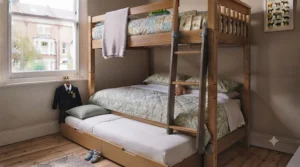
Real-World Scenarios: Which Bunk Bed Actually Suits Your Family?
Consider three genuinely different households, because the “best” bunk bed genuinely depends on who’s climbing into it. First, a family with two children aged five and eight sharing a small terraced bedroom, working with a tight budget after a house move. Here, the Julian Bowen Atlas or Flair Zoom make the most sense — low cost, structurally simple, and both convert into separate beds the moment the older child wants their own space, which in a terrace with box rooms is often sooner than parents expect.
Second, picture a family with a single child aged seven who has regular sleepovers and wants an exciting bedroom centrepiece rather than a purely functional bed. The London Bus bunk suits this scenario precisely — the novelty factor earns its keep when a bed gets used daily by an imaginative child rather than shared between two siblings with competing tastes.
Third, consider a family of five in a three-bedroom house where two children share and a cousin or friend frequently stays over. Here the calculation shifts entirely toward the Noa & Nani Brighton — the hidden trundle solves a hosting problem that no amount of clever wardrobe integration on the Benito could match, even though it costs considerably more upfront. Matching the bed to the actual sleeping pattern in your house, rather than simply picking the highest-rated option, is the single most useful piece of advice in this entire guide.
How to Choose the Best Bunk Beds for Your Home
- Measure the room before you shop, not after. Staircase models like the Slick need roughly 2.5 metres of wall run; ladder models need considerably less. Getting this wrong is the most expensive mistake buyers make.
- Check the age of the youngest child who’ll use the top bunk. As covered in the safety section below, six is the widely cited minimum — plan accordingly rather than assuming a younger sibling will simply “manage.”
- Decide whether storage or flexibility matters more. Storage-integrated frames (Orion, Slick, Benito) lock you into permanent bunk form; split-capable frames (Atlas, Zoom, Brighton) offer an exit route as children’s needs change.
- Confirm mattress depth limits before buying separately. Every model on this list specifies a maximum top-bunk mattress depth for safety reasons — buying too thick a mattress genuinely undermines the guard rail.
- Weigh frame material against your home’s conditions. Steel resists damp and warping better than budget timber; solid pine and hardwood outperform engineered wood and MDF on long-term durability, at a price premium.
- Read the actual weight rating, not just the marketing copy. Combined child weight rises fast as kids grow — check the stated maximum per bunk against your realistic five-year horizon, not just today.
- Factor in assembly reality, not just delivery cost. Multiple models here draw criticism for unclear instructions; budgeting a full weekend day, rather than an afternoon, avoids a frustrating rush job.
Bunk Bed Safety Standards: What UK Parents Need to Know
This is the section most Amazon listings gloss over, and it deserves more attention than a single bullet point buried in the product description. UK bunk bed safety rests on two separate legal frameworks. The older of the two, the Bunk Beds (Entrapment Hazards) (Safety) Regulations 1987, bans the sale of any bunk bed whose construction risks trapping or injuring a child under six around the sleeping surface, and sets precise permissible gap widths to enforce that. In plain terms, this is why every properly manufactured bunk bed has carefully engineered gap widths around the top bunk’s guard rails, headboard and footboard — gaps either small enough that a child’s head can’t pass through, or large enough that their whole body can, with nothing dangerous in between.
Sitting alongside that is the modern voluntary construction standard, BS EN 747, most recently updated as BS EN 747-1:2024, which governs strength testing, structural durability, guard rail height and ladder safety more broadly. RoSPA and NHS guidance both consistently recommend that children under six should not sleep on the top bunk at all, regardless of how compliant the bed itself is — younger children simply lack the balance, spatial awareness and night-time alertness to use a ladder safely in the dark. On separation of duties: bunk bed frames themselves fall under general furniture and product safety rules rather than the upholstered-furniture fire regulations, but any integrated cushioning or upholstered components would need to meet the requirements set out under the Furniture and Furnishings (Fire) (Safety) Regulations, updated in 2025 — worth checking if a bunk bed listing includes padded headboards or seating elements. For further reading on falls prevention more broadly, RoSPA’s dedicated falls guidance is a genuinely useful resource for any household with young climbers in it, not just bunk bed owners specifically.
Practically, this means: check any listing states BS EN 747 compliance explicitly, never let a child under six use the top bunk irrespective of guard rail height, and always use the manufacturer-specified maximum mattress depth — a mattress that’s too thick effectively cancels out an otherwise compliant guard rail by raising the sleeping surface above its protective height.
Sturdy Bunk Construction: What Actually Makes a Bunk Frame Trustworthy
“Sturdy” gets thrown around loosely in furniture marketing, so it’s worth being specific about what genuinely contributes to a stable bunk frame versus what’s just cosmetic. Joint quality matters more than material grade in isolation — a well-engineered engineered-wood frame with metal-reinforced corner brackets will often outlast a solid pine frame held together with loose dowel joints and no additional bracing. Look specifically for cross-bracing on the frame’s underside, four-point ladder attachment rather than two, and bed slats that sit in a supported groove rather than simply resting on a ledge, since slats that can slip sideways are a genuine, if underappreciated, structural weak point.
Weight distribution across the frame legs is the other overlooked factor. A bunk bed concentrates significant load onto just four contact points with the floor, considerably more per point than an equivalent pair of single beds spread across a room, so leg thickness and floor-contact footings deserve more scrutiny than most buyers give them. On carpeted floors particularly, wider footings distribute pressure more evenly and reduce the slow, almost imperceptible sinking that can throw a frame subtly out of true over several years. None of this is visible in a product photo, which is exactly why reading the actual specification — rather than the styling shots — is worth the extra five minutes before you commit to a purchase.
Top Rated Children’s Bunks for Different Ages
Age-appropriateness changes the calculation considerably, and treating a five-year-old’s bunk bed the same way you’d treat a thirteen-year-old’s is a genuine mistake. For children aged six to eight — the earliest age generally considered appropriate for the top bunk at all — prioritise models with low overall height, wide ladder rungs and enclosed lower bunks that feel secure and “den-like,” which is where the London Bus and Orion both perform well. For children aged nine to twelve, storage becomes more valuable as homework, hobbies and possessions accumulate, favouring the Slick staircase or Benito wardrobe models. For teenagers sharing a room, or where an adult occasionally uses the lower bunk, weight rating and mattress comfort take priority over playful styling, pointing toward the Atlas or Brighton depending on budget.
It’s also worth noting that “top rated” on generic marketplace star ratings doesn’t always account for age suitability specifically — a bed can carry glowing reviews from parents of eight-year-olds while being entirely unsuitable for a boisterous eleven-year-old who treats every surface as a climbing frame. Cross-reference star ratings against the reviewer’s stated child age wherever Amazon’s review interface allows it, rather than trusting the aggregate score alone.
Benefits vs Traditional Twin Beds
| Factor | Bunk Bed | Two Separate Single Beds |
|---|---|---|
| Floor space used | One bed’s footprint | Two beds’ footprint |
| Cost of frame | Often similar or lower | Two frames required |
| Assembly complexity | Moderate to high | Low, per bed |
| Flexibility as kids grow | Depends on model | Full flexibility |
| Best for | Small or shared rooms | Larger bedrooms |
The space-saving case for bunk beds is compelling on paper, but the table above shows the trade-off isn’t purely financial — assembly complexity and long-term flexibility both tilt in favour of separate singles once room size stops being the binding constraint. Where floor space genuinely is tight, as in most British terraced housing, a bunk bed remains the more sensible default; where space is more generous, the split-capable models we’ve featured (Atlas, Zoom, Brighton) offer a useful middle path, letting you start as a bunk and separate later without buying entirely new furniture.
Child-Safe Furniture: Features That Actually Matter (And Those That Don’t)
Not every safety-adjacent feature marketed on a bunk bed listing carries equal weight. Guard rails on all sides of the top bunk, secure ladder attachment, and mattress depth compliance are non-negotiable — these directly address the entrapment and fall risks the 1987 regulations and BS EN 747 were specifically written to prevent. Glow-in-the-dark ladder treads, by contrast, are a genuine but secondary safety nicety; useful for reducing night-time stumbles, but not a substitute for proper guard rail height if a child is simply too young for the top bunk in the first place.
Rounded corner profiles and smooth-sanded edges matter more than they might seem on a spec sheet, particularly at head height where a running child is most likely to make contact with the frame. Conversely, elaborate paint finishes, licensed character branding, and decorative trims add cost without adding genuine safety value — fine as a preference, but don’t let styling substitute for checking the underlying construction. If a listing doesn’t explicitly mention BS EN 747 compliance, that’s worth querying directly with the seller before purchase, particularly for lesser-known brands without an established UK track record.
Long-Term Cost & Maintenance
| Consideration | Budget Bunks (Atlas, Zoom) | Mid-Range (Orion, Slick, London Bus) | Premium (Benito, Brighton) |
|---|---|---|---|
| Upfront cost | Lowest | Moderate | Highest |
| Expected lifespan | 5-8 years with care | 8-12 years | 10-15 years+ |
| Replacement parts availability | Generally good (established brands) | Good | Good, brand-dependent |
| Cost-per-year (rough estimate) | Lowest overall | Balanced | Justified for larger families |
Looking at cost-per-year rather than upfront price shifts the value calculation meaningfully. A premium solid pine frame costing over double a budget steel bunk can work out cheaper annually if it survives two children’s entire childhoods rather than being replaced once a growing teenager outgrows a flimsier frame. That said, for a family expecting to move house or downsize bedrooms within a few years, the lower upfront cost of the Atlas or Zoom is the more rational choice regardless of long-term durability math — total cost of ownership only matters if you’re actually the one owning it for the full term.
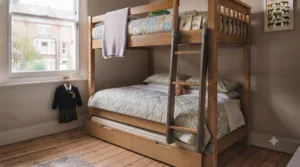
Frequently Asked Questions
❓ What is the best bunk bed for a small bedroom in the UK?
❓ Are bunk beds safe for children under six?
❓ What age can a child sleep on the top bunk?
❓ How do I check a bunk bed meets UK safety standards?
❓ What's the difference between a bunk bed and a mid sleeper?
Conclusion
There’s no single best bunk bed, whatever a title tag might promise — there’s only the best bunk bed for your specific room, your specific children, and how long you realistically need the thing to last. If you’re working with a tight budget and want maximum future flexibility, the Julian Bowen Atlas or Flair Zoom will serve you well and cost the least to walk away from if plans change. If storage is your binding constraint, the Orion, Slick or Benito each solve that problem in a different way, from a simple drawer through to a full integrated wardrobe. And if you’re housing three children in the space of two, or hosting regular sleepovers, the Noa & Nani Brighton’s hidden trundle is genuinely difficult to beat, premium price notwithstanding.
What should never be negotiable, regardless of which frame you choose, is safety compliance: BS EN 747 certification, correct mattress depth, and keeping the under-sixes off the top bunk entirely. Everything else on this list — colour, novelty styling, wardrobe integration — is genuinely a matter of taste and household logistics, and now you’ve got the honest specifics to make that call yourself rather than relying on a five-star average that may not reflect your particular circumstances.
✨ Ready to Choose Your Bunk Bed?
🔍 Compare current prices on any of the seven models above and check availability before you commit — furniture stock and pricing shift regularly, so a quick check now saves a disappointment later.
Recommended for You
- Compact Dressing Table Small Bedroom: 7 Smart Picks for 2026
- Best Dressing Table with Lights Reviews UK 2026: Top 7 Picks
- Best Dressing Tables UK 2026: 7 Expert Picks You’ll Love
Disclaimer: This article contains affiliate links. As an Amazon Associate, I earn from qualifying purchases. If you purchase products through these links, we may earn a small commission at no additional cost to you.
✨ Found this helpful? Share it with your friends! 💬🤗
