
In This Article
Here’s a scene most parents of small children will recognise: two kids, one bedroom, and a floor covered in enough Duplo to make walking a genuine hazard. Bunk beds look like the obvious fix. Stack the sleeping, reclaim the floor, everybody’s happy. Except if one of those kids is still a toddler, “just buy a bunk bed” is where things get complicated, and where a lot of well-meaning parents unknowingly wander into a safety grey area.
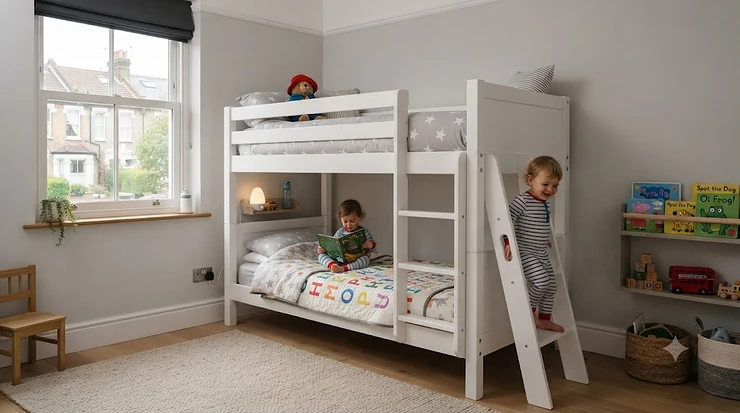
Let’s be straight about it from the outset, because a huge chunk of the internet won’t be: safe bunk beds for toddlers doesn’t mean a toddler scaling a ladder to sleep six feet in the air. It means something more specific — a low-height bunk where a toddler occupies the bottom bunk only, with a design that keeps gaps, mattress depth, and rail height within safe limits, while an older sibling uses the top. That distinction runs through every recommendation in this guide, and it’s the difference between a bedroom upgrade and a 3am trip to A&E.
We’ve spent the research for this piece digging through UK furniture regulations, aggregated customer reviews, and real specifications from seven genuine bunk bed models sold in the UK, spanning low bunk beds young children can use safely on the bottom tier, toddler-friendly bunk beds with reinforced guard rails, and age-appropriate bunk beds built around the realities of a household with a toddler in it. Along the way we’ll cover bunk bed age requirements, what proper guard rail safety actually looks like on a spec sheet, and how to think about toddler bedroom safety more broadly, not just the bed itself.
What Is a Safe Bunk Bed for Toddlers?
A safe bunk bed for toddlers is a low-profile bunk bed frame, typically under 145cm tall, where the toddler sleeps on the bottom bunk exclusively, fitted with secure guard rails, entrapment-safe gaps, and a snugly fitting mattress no deeper than around 15cm. It is not a design that lets a child under six climb or sleep on the top bunk.
Quick Comparison Table
| Bunk Bed | Type | Best For | Approx. Price Range |
|---|---|---|---|
| Flair Furnishings Shasha Low Bunk Bed | Low-profile wooden bunk | Budget-conscious families with a toddler on the bottom bunk | under £250 |
| Flair Furnishings Mystic Low Pod Mini Bunk Bed | Compact low pod bunk | Small bedrooms, single-child transitional use | around £250-£350 |
| Noa and Nani Hilda Cabin Bed with Bunk Underbed | Low midsleeper with under-bunk | Toddlers alongside a slightly older sibling | £350-£450 range |
| Vipack Pino Low Bunk Bed | Solid Scandinavian pine, 140cm height | Families wanting a premium, convertible bunk | £400-£600 range |
| Flair Furnishings Gravity Low Bunk Bed with Shelves | Low bunk with integrated shelving | Storage-starved bedrooms | £250-£350 range |
| Vida Designs Milan Bunk Bed | Solid pine twin sleeper | Traditional bunk seekers with older toddlers approaching six | £300-£400 range |
| Merax Twin Bunk Bed with Ladder | Castle-shaped solid wood bunk | Playful bedroom themes, siblings aged 6+ and under | £250-£350 range |
Looking at the spread above, the pattern that jumps out is height: every genuinely toddler-appropriate option here sits well below the towering “high sleeper” style bunks, because a lower frame simply means less far to fall if something goes wrong at 2am. The Vipack Pino stands out for its solid pine build and 140cm profile, which justifies its higher price if longevity matters more to you than upfront cost. Budget buyers gravitate toward the Flair Shasha and Gravity ranges, but as we’ll get into below, cheaper doesn’t mean less safe here — it mostly means simpler storage and finish, not weaker structural testing.
💬 Just one click — help others make better buying decisions too!😊
Top 7 Safe Bunk Beds for Toddlers: Expert Analysis
1. Flair Furnishings Shasha Low Bunk Bed — lowest profile for reducing fall height
The standout feature of the Shasha is right there in the name: it’s a genuinely low bunk, not a “low for a bunk bed” bunk bed. Available in white or grey, it’s built with a wooden frame and a wide, secure ladder rather than the narrow rungs you see on cheaper imports.
Constructed with a maximum weight recommendation of around 80kg per bunk and a slatted base, the Shasha’s real-world advantage is straightforward physics — a lower top bunk means a shorter fall distance for whoever’s using it once they’re old enough, and a genuinely low bottom bunk for your toddler in the meantime. What most buyers overlook when comparing bunk beds on spec sheets alone is that “low” varies wildly between brands; some “low bunks” still sit at hip height on an adult, while this one is noticeably closer to the floor.
Based on the product listing and buyer feedback, this bed suits families who want a straightforward, no-frills bunk that prioritises a reduced fall height over storage extras or decorative flourishes. It’s a sensible starting point if your main worry is height rather than features.
Reviewers consistently note the assembly is manageable for one adult within a couple of hours, and several mention the low-to-the-ground design specifically as reassuring for parents of younger children — though as with any flat-pack furniture, a handful of buyers flagged the need to double-check screw alignment during assembly.
Pros:
- ✅ Genuinely low frame height reduces fall risk
- ✅ Wide, sturdy ladder rungs for safer climbing
- ✅ Straightforward flat-pack assembly for one adult
Cons:
- ❌ Limited colour choice compared with rival ranges
- ❌ No built-in storage, so you’ll need separate units
Prices for the Shasha tend to sit in the sub-£250 range at the time of research, and check current price and availability before buying, since flat-pack furniture stock can fluctuate — as a value option for a toddler-plus-older-child setup, it’s hard to beat on the “low and simple” brief.
2. Flair Furnishings Mystic Low Pod Mini Bunk Bed — compact footprint for small box rooms
The Mystic’s standout advantage is its unusually small footprint, which makes it one of the few bunk-style beds that can realistically squeeze into a boxy UK second bedroom without swallowing the entire floor.
Built from solid particle board with a slatted base for mattress support, the Mystic keeps its two sleeping levels genuinely close together vertically, which in practice means less headroom on the bottom bunk but also a distinctly lower overall structure. On paper this means a trade-off between comfort and safety margin, and it’s one worth thinking through if your toddler is on the taller side for their age.
This one is best suited to families who have decided space efficiency is the non-negotiable, and are happy to accept a cosier bottom bunk in exchange. The spec sheet won’t tell you this, but user reports suggest the compact scale also makes it easier for very young children to feel secure and “tucked in,” rather than lost in a large frame.
Aggregated review sentiment on the Mystic highlights its value for smaller rooms and its khaki/white colour options as a style win, alongside occasional comments about limited legroom for taller children on the lower bunk.
Pros:
- ✅ Smallest footprint among genuine low bunk designs
- ✅ Slatted base gives even mattress support
- ✅ Modern Scandi colour options (khaki, white)
Cons:
- ❌ Reduced headroom on the bottom bunk
- ❌ Particle board build is less durable than solid pine
At the time of research, the Mystic sits in the low-to-mid price bracket, and it represents solid value specifically for space-constrained rooms rather than as a general-purpose family bunk.
3. Noa and Nani Hilda Cabin Bed with Bunk Underbed — low midsleeper built around younger sleepers
The Hilda’s standout feature is its midsleeper-plus-underbunk configuration, which keeps the primary sleeping surface notably lower than a standard bunk while still freeing up under-bed space.
Crafted from solid white pine with a maximum weight recommendation of 90kg, the Hilda’s two-tier design allows a child to sleep “safely up high” in cabin-bed terms — which, importantly, is still considerably lower than a traditional top bunk — while the underbed area doubles as play or storage space. This matters in practice because it sidesteps the classic top-bunk dilemma entirely for younger children.
Genuinely, this is one of the more toddler-friendly bunk beds on the market precisely because it isn’t a conventional bunk at all — it’s a low cabin bed with an underbed slot, which several real buyers specifically praised for not being “too high” for a four-year-old.
Aggregated customer reviews are notably positive on quality and value, with multiple reviewers independently describing the bed as sturdy, low, and suitable for a young child, alongside one comment about the front rail on the top tier feeling less robust than the rest of the frame.
Pros:
- ✅ Reviewers specifically note it isn’t too high for young children
- ✅ Solid pine construction rated to 90kg
- ✅ Underbed area doubles as play space
Cons:
- ❌ One recurring review mentions a flimsier front rail
- ❌ Requires two specific junior mattresses, limiting flexibility
Sitting in the £350-£450 range at the time of research, the Hilda earns its price through genuine reviewer validation on the exact concern most toddler parents have: is it too high?
4. Vipack Pino Low Bunk Bed — solid Scandinavian pine at a true 140cm height
The Pino’s calling card is its 140cm overall height, a figure the manufacturer states explicitly rather than leaving buyers to guess — a level of transparency that’s rarer than it should be in this category.
Manufactured from solid Scandinavian pine, the Pino features a wide ladder for safer climbing and the option to convert into two separate single beds later, which extends its useful life well past the bunk-bed years. What most buyers overlook about convertible bunks like this one is that the conversion option isn’t just a gimmick — it means you’re not buying furniture that becomes obsolete the day your toddler turns six and no longer needs the bottom-bunk arrangement.
This is the premium pick in our list, and it’s aimed at families who want furniture built to outlast a single developmental stage, rather than a bed they’ll replace within a couple of years.
Independent aggregated feedback on comparable Vipack pine ranges consistently highlights build quality and stability as strengths, which tracks with the brand’s reputation for solid timber construction rather than particleboard alternatives.
Pros:
- ✅ Explicit 140cm height stated by the manufacturer
- ✅ Solid pine build with strong stability reputation
- ✅ Converts into two single beds long-term
Cons:
- ❌ Sits at the top of our price range
- ❌ Requires EU-sized mattresses, which cost more to replace
Expect a £400-£600 range for the Pino at the time of research — a genuine investment piece rather than an impulse buy, but one that should still be doing its job well into secondary school.
5. Flair Furnishings Gravity Low Bunk Bed with Shelves — low profile plus built-in storage
The Gravity’s standout advantage is combining the same reduced fall height as the Shasha with integrated shelving, solving two toddler-bedroom problems — height and clutter — in a single purchase.
With a low-profile wooden frame available in white or grey, the Gravity’s shelving units sit at the head and foot of the frame rather than underneath, meaning storage doesn’t eat into the floor space beneath the bunk that many families rely on for toy boxes or a reading corner. Here’s what to weigh: shelving built into a child’s bed is undeniably useful, but it also introduces more hard edges close to the sleeping area than a plain frame, so corner placement and padding are worth double-checking.
Families juggling a toddler’s need for low, safe sleeping with an overstretched bedroom’s need for more storage are the ideal buyer here.
Reviewer sentiment on the wider Flair Gravity range is positive on the low-to-the-ground design specifically for younger children, echoing the pattern seen across the brand’s low bunk lineup.
Pros:
- ✅ Low profile matches the safety-first Shasha design
- ✅ Built-in shelving reduces need for extra furniture
- ✅ Available in grey or white to suit most décor
Cons:
- ❌ Shelf edges sit closer to the sleeping area
- ❌ Slightly pricier than the shelf-free Shasha equivalent
At around £250-£350 at the time of research, the Gravity is a sensible upgrade over the base Shasha if storage is genuinely tight in your child’s room.
6. Vida Designs Milan Bunk Bed With Ladder — solid pine twin sleeper for the classic bunk shape
The Milan’s standout feature is its faithfulness to the traditional bunk silhouette, built from solid pine rather than the metal-frame alternatives that dominate the budget end of the market.
As a single 3-foot twin sleeper, the Milan follows the conventional stacked-bunk layout, which means — and this is the crucial caveat for toddler households — the top bunk should remain strictly off-limits until the older child turns six, per UK guidance, while your toddler uses the bottom bunk exclusively. Reviewers consistently note the pine frame feels notably sturdier underfoot than lighter composite alternatives, which matters given how much bouncing, climbing, and general enthusiasm a bottom bunk absorbs over the years.
This is the right pick if you want the classic bunk-bed look and eventual full-height top bunk use once your youngest reaches six, rather than a permanently low design.
Aggregated feedback on solid pine bunk frames in this category typically praises longevity and minimal creaking versus composite frames, a genuine advantage if you’re planning to keep the bed through several years of enthusiastic use.
Pros:
- ✅ Solid pine construction for long-term durability
- ✅ Classic bunk shape that grows with the family
- ✅ Ladder designed for secure, confident climbing
Cons:
- ❌ Standard bunk height means top bunk isn’t toddler-suitable
- ❌ Requires strict household rule enforcement on top-bunk access
Priced in the £300-£400 range at the time of research, the Milan makes most sense as a “grows with you” bed rather than a purely toddler-stage purchase.
7. Merax Twin Bunk Bed with Ladder (Castle-Shaped) — playful design for shared sibling rooms
The Merax’s standout feature is its castle-shaped detailing, a novelty touch that turns a functional piece of furniture into something a toddler will actually be excited about climbing into at bedtime — on the bottom bunk, at least.
Built from solid wood at a 90cm x 190cm single size, the castle-effect panelling doesn’t compromise the structural basics; it’s simply a decorative addition to an otherwise standard twin bunk layout. What most buyers overlook with themed furniture like this is that novelty design ages with the child faster than plain furniture does, so it suits a specific multi-year window rather than being a forever-bed.
Families with a toddler and an older sibling who’s genuinely enthusiastic about a “fun” bedroom centrepiece, rather than families prioritising pure minimalism, will get the most mileage from this one.
Aggregated review themes for castle- and playhouse-style bunk frames tend to highlight the appeal to imaginative play alongside occasional notes that decorative cut-outs need periodic checking for splinters as the wood ages.
Pros:
- ✅ Playful castle styling genuinely excites young children
- ✅ Solid wood frame with secure ladder
- ✅ Standard bunk dimensions fit widely available mattresses
Cons:
- ❌ Decorative cut-outs need occasional splinter checks
- ❌ Theme may feel dated as the child grows older
Sitting in the £250-£350 range at the time of research, the Merax works best as a mid-term bed for a household that values character over pure practicality.
Practical Usage Guide: Setting Up a Toddler-Safe Bunk Bed
Getting the bed itself right is only half the job — how you set it up in the first 30 days matters just as much. Start by positioning the frame away from windows, curtain or blind cords, and any wall-mounted lighting; toddlers moving around a bottom bunk at night can reach further than you’d expect. Tighten every screw and bolt fully during assembly, then recheck them after the first week of use, since new furniture tends to settle and loosen slightly under a child’s normal wriggling and jumping.
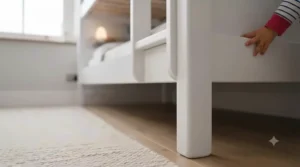
A common first-30-days mistake is fitting a mattress that’s too deep for the frame, which pushes the sleeping surface higher than the guard rail was designed for and effectively cancels out the safety margin you paid for. Stick to a mattress no deeper than around 15cm on any bunk a young child might access, and measure the gap between mattress top and guard rail top — it should be at least 16cm. Finally, set out-loud household rules from day one: no jumping, no climbing the ladder without an adult present if the top bunk is in use, and nothing hung from the frame that could pose a strangulation risk.
Real-World Scenario: Matching the Bed to Your Household
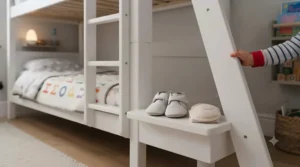
Picture three different households. First, the family with a 2-year-old and a 7-year-old sharing a room on a tight budget — here the Flair Shasha or Gravity, used strictly bottom-bunk-only for the toddler, makes sense: low height, low cost, and the top bunk is already appropriate for the older child. Second, a family with twins aged 3, neither of whom is anywhere near six yet — in this case, a genuine bunk bed is premature altogether, and something like the Noa and Nani Hilda, which functions more as a low cabin bed than a true bunk, is the safer transitional choice until both children are old enough for stacked sleeping. Third, a family expecting their toddler to “grow into” the top bunk within the next 18-24 months — the Vipack Pino’s convertible, long-life build suits that horizon better than a cheaper bed you’ll be replacing just as the child becomes old enough to use it properly.
Bunk Bed Age Requirements: What UK Guidance Actually Says
This is worth stating plainly rather than burying in small print: it is against UK law to supply a bunk bed constructed in a way that creates a risk of injury to a child under six, or that produces gaps in the bed’s structure outside strictly permissible limits, under the Bunk Beds (Entrapment Hazards) Regulations 1987. Multiple UK safety bodies and manufacturers reinforce the same six-years-old threshold specifically for top-bunk use, based on the coordination and impulse-control children typically develop by that age.
That means the honest answer to “can my toddler use a bunk bed?” is: yes, but only the bottom bunk, and only on a model built to the current BS EN 747 furniture safety standard covering guard rails, gap tolerances, and load testing. If your toddler is the only child using the bed, or if there’s no immediate need for stacked sleeping, a low bunk bed still isn’t the same thing as a genuinely toddler-first bed — a standard low bed or cabin bed without a second tier may simply be the more appropriate call.
How to Choose a Safe Bunk Bed for a Household With a Toddler
- Confirm the age of every child who’ll use the bed. If any child using the top bunk is under six, that’s a hard stop regardless of how sturdy the bed looks — this isn’t a judgement call the bed’s design can override.
- Check the stated overall height. Genuinely low bunk beds will state a height figure (like the Vipack Pino’s 140cm); vague “space-saving” language without a number is a flag to dig further.
- Verify the guard rail height above the mattress. Look for at least 16cm of clearance once the mattress is in place, not just the rail height as advertised on an empty frame.
- Check for BS EN 747 compliance on the listing. This is the current British/European standard covering structural strength and entrapment prevention for bunk and high beds.
- Measure the gaps in the frame and rails. Under the 1987 regulations, any gap should sit outside the 60-75mm range that risks trapping a small limb or head.
- Match the mattress depth to the frame. Anything deeper than roughly 15cm on a bunk risks pushing the sleep surface above the guard rail’s protective height.
- Plan for the transition, not just the purchase. Decide now whether this bed needs to serve a toddler-only household for years, or whether it’s a stopgap until an older sibling reaches six — that decision should drive whether you buy convertible, low-cost, or premium.
Bunk Beds vs Low Single Beds for Toddlers
It’s worth asking honestly whether a bunk bed is even the right category for your situation, rather than assuming it’s the default upgrade from a cot. A low single bed or toddler cabin bed sits closer to the floor across its entire surface, removes any temptation for a young child to attempt the ladder, and sidesteps the six-year rule altogether, since there’s no top bunk to restrict. The trade-off is obvious: you lose the floor-space-saving benefit that makes bunk beds appealing for shared rooms in the first place.
Where a genuine bunk bed wins is multi-child households where an older sibling is already six or above, or fast approaching it, and floor space is the binding constraint. Where a low single or toddler bed wins is single-child bedrooms, or households where both children are under six — in that case, a bunk bed’s second tier is simply unusable furniture taking up vertical space you’re not benefiting from yet. The honest middle ground, and the category most of our picks above sit in, is the low bunk bed used deliberately as a bottom-only bed for now, with the top bunk’s eventual use planned rather than assumed.
Guard Rail Safety: What Actually Matters (And What’s Marketing)
Guard rails get mentioned on almost every bunk bed listing, but the phrase itself tells you very little. The features that actually matter are: rail height above the finished mattress surface (not the empty frame), rail coverage along all open sides rather than just the outer edge, and a fixed rather than removable attachment method, since add-on rails not built into the frame are explicitly not designed as a substitute for a properly integrated guard rail on a top bunk.
What doesn’t matter nearly as much as marketing copy suggests: decorative rail styling, colour-matching to the frame, or claims of “extra thick” padding on the rail itself, which does little if the underlying rail height and gap spacing aren’t correct in the first place. If a listing emphasises rail aesthetics heavily but is vague on actual height-above-mattress figures, that’s usually a sign to look elsewhere for the number you actually need.
Toddler Bedroom Safety Beyond the Bed Itself
The bed is one piece of a wider safety picture. Curtain and blind cords should always be kept tied up and fixed well out of reach, since a loose, looped cord near a bed can be a genuine strangulation hazard for a young child, a point NHS guidance on baby and toddler safety makes clearly. Position the bunk bed away from windows for this reason, and avoid hanging bags, dressing gowns, or toy straps anywhere on the frame.
Falls between levels, rather than same-level trips, tend to produce the most serious injuries in young children, particularly when they land on something hard or sharp below, as the Royal Society for the Prevention of Accidents’ home safety advice sets out. That’s a strong argument for keeping the floor area beneath and around any bunk clear of toys, hard-edged furniture, or trip hazards, quite separate from the bed’s own design.
Long-Term Cost & Maintenance of a Toddler Bunk Bed
Solid pine models like the Vipack Pino and Vida Designs Milan cost more upfront but typically hold up to years of daily bouncing, climbing, and the general chaos of family life without the joints loosening the way lighter composite frames can. Factor in that a convertible bunk, which splits into two singles, effectively delays your next furniture purchase by years compared with a fixed bunk you’ll eventually need to replace entirely once siblings want separate rooms.
On the maintenance side, budget ten minutes every few months to retighten bolts and check ladder rungs for wear, and inspect any decorative cut-outs (as on the Merax) for rough edges as the wood dries out over time. None of this is expensive, but skipping it is where sturdy furniture quietly becomes less sturdy without anyone noticing until something creaks alarmingly at 11pm.
Frequently Asked Questions
❓ Can a 2 year old sleep in a bunk bed?
❓ What age can a child go on the top bunk?
❓ Are low bunk beds safer than standard bunk beds?
❓ What mattress depth is safe for a toddler's bunk bed?
❓ Do all bunk beds need guard rails on both sides?
Conclusion
The honest version of “safe bunk beds for toddlers” isn’t a single product recommendation — it’s a mindset shift. A toddler and a bunk bed can coexist safely, but only when the bottom bunk is doing all the toddler-facing work, the top bunk waits for the six-year mark, and the frame itself meets BS EN 747 and the 1987 entrapment regulations rather than just looking sturdy in a product photo. Of the seven models above, the Flair Shasha and Gravity ranges suit budget-conscious, bottom-bunk-only setups; the Noa and Nani Hilda and Vipack Pino suit families wanting a low profile with long-term flexibility; and the Vida Designs Milan and Merax suit households where an older child is already approaching or past six.
Whichever you choose, the checklist stays the same: check the height, check the rail clearance, check the gaps, and match the bed to the ages actually sleeping in it rather than the ages you’re hoping for next year.
✨ Don’t Miss These Exclusive Deals!
🔍 Take your child’s bedroom safety to the next level with these carefully researched, low-height bunk options. Click through to check current pricing and availability on any of the seven picks above, and give your family a bedroom setup that works for every age in the room.
Recommended for You
- Best Bunk Beds UK 2026: 7 Safe, Sturdy Picks That Won’t Wobble
- Compact Dressing Table Small Bedroom: 7 Smart Picks for 2026
- Best Dressing Table with Lights Reviews UK 2026: Top 7 Picks
Disclaimer: This article contains affiliate links. As an Amazon Associate, I earn from qualifying purchases. If you purchase products through these links, we may earn a small commission at no additional cost to you.
✨ Found this helpful? Share it with your friends! 💬🤗
