
In This Article
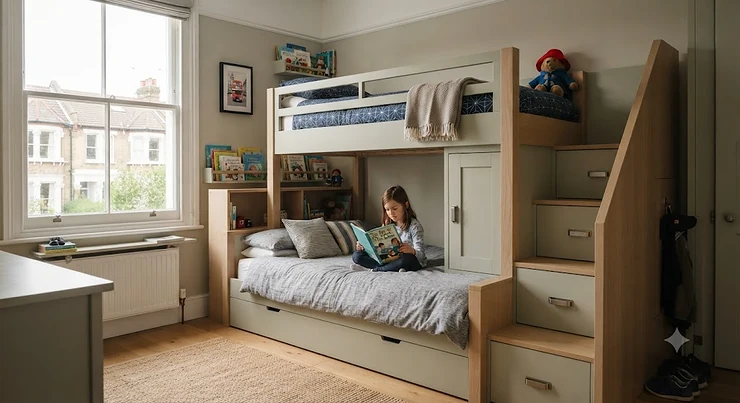
Shared bedrooms have a funny way of shrinking the moment you add a second child into the mix. One minute there’s floor space for a rug and a beanbag, the next there’s a mountain of Lego, two school bags and a suspicious pile of laundry nobody claims. That’s precisely why bunk bed with storage reviews get searched so often in January and September — the two months when parents suddenly realise the bedroom needs a proper rethink before term starts. A bunk bed with storage is, put simply, a two-tier sleeping unit that folds drawers, shelves, or a trundle into its frame so it does the job of a bed and a chest of drawers at once. Done well, it turns a cramped box room into something that actually functions.
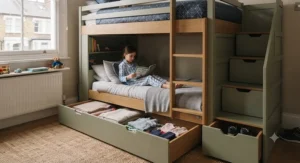
I’ve spent time digging through the specs, dimensions, and aggregated owner feedback for seven real bunk beds currently sold to UK households, spanning honest budget buys through to sturdier premium builds. This isn’t a rehashed product listing — every section below explains what the numbers actually mean for your bedroom, your budget, and your kids’ age group, because a drawer’s depth or a guardrail height matters a lot more in practice than it does on a spec sheet. Before diving into individual models, it’s worth saying plainly that bunk beds carry genuine safety considerations, and RoSPA’s home safety guidance is a sensible starting point for any parent weighing one up.
Whether you’re after storage bunk beds for a tight box room, drawer bunk beds that swallow toy clutter whole, or something a little more grown-up for teenagers who’ve outgrown the ladder-and-slide phase, this guide covers the full spread: budget, mid-range, and premium, plus the practical guides you won’t find on a standard Amazon listing.
Quick Comparison Table
| Product | Storage Type | Best For | Price Range |
|---|---|---|---|
| Flair Furnishings Triple Bunk with Storage | Under-bed drawer + shelving | Budget triple sleeper | Under £350 |
| Flair Flick Triple Bunk with Shelves & Drawer | Bedside shelving + drawer | Budget-mid, siblings sharing | £350-£450 range |
| Flair Aviary Bunk Bed | Two under-bed drawers + shelves | Mid-range, two single sleepers | £400-£480 range |
| Julian Bowen Orion Bunk Bed | Four-shelf bookcase + drawer | Mid-range, book/toy storage | In the mid-£300s |
| Noa & Nani Ulla Staircase Bunk | Storage steps | Mid-premium, nervous climbers | £500-£650 range |
| Noa & Nani Brighton with Trundle | Underbed trundle drawer | Premium, growing families | £550-£700 range |
| Noa & Nani Maya Cabin Bed | Stairway of drawers | Premium, all-in-one solution | Around £700 |
Looking at the spread above, the two Flair triple sleepers make the most sense if you need to sleep three children (or one plus regular sleepovers) without blowing the budget, while the Noa & Nani range trades a higher price for genuinely integrated storage that doesn’t feel bolted on as an afterthought. The Julian Bowen Orion sits in a sweet spot for buyers who want proper bookcase-style storage rather than just a single drawer, and it’s worth noting none of these figures are exact prices — always check current price on the retailer page, since furniture pricing shifts with promotions and stock levels.
💬 Just one click — help others make better buying decisions too!😊
Top 7 Bunk Beds With Storage: Expert Analysis
1. Flair Furnishings Triple Bunk Bed with Storage — best budget triple sleeper
Sleeping three children (or two plus a regular sleepover guest) from a single frame is the standout feature here, and it does so without ballooning in price. The bed combines a single top bunk with a double lower bunk, running to roughly 198cm long and 164.5cm wide including the ladder (145.7cm without it), with an overall height of 158.9cm — compact enough for most standard box rooms once you account for ladder clearance. Storage comes via three under-bed drawers on wheels plus multiple bedside shelves, which in practice means bedding can live in the drawers while books and torches stay within arm’s reach on the shelves.
Based on the spec comparison with other triple sleepers in this guide, this is the only budget option offering a genuine double lower bunk, making it the practical choice for a teenager who wants proper legroom, or two younger siblings who prefer to top-and-tail. Families converting a single child’s room into a shared space for a new arrival tend to gravitate here, since it avoids buying a second separate bed later. Aggregated feedback on this style of flat-pack storage bunk from Flair Furnishings tends to flag straightforward assembly with clear instructions, though — as with most wheeled underbed drawers — the runners can feel a touch stiff for the first few uses before they bed in.
Pros:
- ✅ Sleeps three from one frame, ideal for growing families
- ✅ Three wheeled drawers plus shelving keep clutter contained
- ✅ Genuinely budget-friendly compared with other triple sleepers
Cons:
- ❌ Drawer runners can feel stiff when brand new
- ❌ Ladder placement takes up meaningful floor width
At under £350 in most colourways, this represents strong value for anyone needing triple sleeping capacity on a tight budget — check current price before ordering, as availability on specific finishes fluctuates.
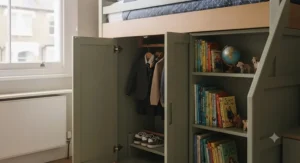
2. Flair Flick Triple Bunk Bed with Shelves & Drawer — best British-brand shelving design
What immediately stands out is the full-length bedside shelving running along both bunks, cleverly partitioned so each child effectively gets their own storage zone rather than one shared jumble. Measuring around 141.9cm wide, 198cm long and 158.6cm tall, the Flick offers a single top bunk over a small double lower bunk, with a pull-out under-bed drawer measuring roughly 83cm by 58cm — spacious enough for a spare duvet set or a season’s worth of outgrown clothes.
What most buyers overlook about shelving-style storage bunks is that the compartments do double duty as a safety feature: the raised lip along the shelf edge (a detail Julian Bowen also uses on its Orion range) stops small items sliding off during the inevitable pillow fight. The offset lower bunk position, giving extra head clearance for sitting up, is a small but genuinely useful touch that a simple spec sheet won’t convey — it’s the kind of detail you only appreciate once the bed is actually assembled in the room. For families with two children of noticeably different ages, this shelving split gives each child a defined “own space” within a shared bed, which can smooth over sibling squabbles about whose toys are whose.
Pros:
- ✅ Partitioned shelving gives each child a defined storage zone
- ✅ Offset lower bunk adds welcome head clearance
- ✅ Available in white, oak, and grey to match most décor
Cons:
- ❌ Under-bed drawer is single, not double, unlike pricier rivals
- ❌ Step ladder angle needs a slightly larger footprint than a vertical one
Sitting in the £350-£450 range depending on finish, the Flick earns its place as a mid-budget pick where shelving matters more than drawer volume.
3. Flair Aviary Bunk Bed with Storage Drawers and Shelves — best twin-drawer configuration for siblings
The headline feature is symmetry: two spacious under-bed drawers, each measuring roughly 60cm deep by 75cm wide, give both children an equal storage allowance rather than a single shared drawer. Overall dimensions run to 197cm long, with depth ranging from 116cm (ladder excluded) to 134cm (ladder included), and 165cm to the top of the back shelving. The mattress requirement is a standard UK single at 90cm by 190cm, with a hard maximum thickness of 18cm — a detail worth flagging because a thicker mattress will push a child above the guardrail’s protective height.
Here’s what to weigh before buying: the 120kg maximum weight load per bed (as stated by the retailer) is comfortably enough for two children well into their teens, but it’s a figure worth checking against your own family’s needs if an adult occasionally needs to perch on the lower bunk. The back shelving units, at 20cm deep and 18cm high internally, suit paperbacks and folded clothes better than bulky toys — a detail that matters if your priority is toy storage bunk beds rather than book storage. Reviewers of similarly specced Flair storage bunks tend to note that the white finish shows scuffs more readily than darker alternatives, so a protective mat under school shoes is a sensible add-on.
Pros:
- ✅ Two equally sized drawers means fair storage for both children
- ✅ Clear 18cm mattress depth limit keeps guardrails effective
- ✅ Wide step ladder with easy-grip handles for safer climbing
Cons:
- ❌ Back shelving suits books better than bulky toys
- ❌ White finish can show scuffs on high-traffic edges
Priced in the £400-£480 range at the time of research, the Aviary is a sensible mid-tier pick when both children need equal storage allocation.
4. Julian Bowen Orion Bunk Bed with Shelving & Drawer — best for book and toy organisation
The four-shelf bookcase built into the frame’s end panel is the standout here, giving considerably more shelving volume than a typical single bedside shelf. Overall dimensions come in at 172cm high, 136cm wide, and 197cm deep, with a single pull-out drawer supplementing the shelving for larger or bulkier items. The lower bunk sits notably close to the ground — a deliberate design choice that suits younger children still building confidence with elevated sleeping.
Based on the spec comparison, the raised lip along the shelving (specifically designed to stop items “slipping down the back,” per the manufacturer) solves a genuinely common annoyance with open bookcases: books and small toys sliding out of reach behind the unit. What the spec sheet won’t tell you, but owner reports on this Sonoma Oak and white bunk suggest, is that the glow-in-the-dark strips on the ladder steps are a small but appreciated safety touch for night-time bathroom trips, reducing the odds of a fumbled step in the dark. This model does not convert into two separate singles, so it’s worth ruling out if you anticipate needing that flexibility down the line — the mattress required is a standard UK single at 90cm by 190cm with an 18cm maximum depth.
Pros:
- ✅ Four-shelf bookcase offers genuine library-style storage
- ✅ Low-set lower bunk suits younger or nervous sleepers
- ✅ Glow-in-the-dark ladder strips aid safe night-time descents
Cons:
- ❌ Cannot be split into two separate single beds
- ❌ Only one pull-out drawer alongside the shelving
Typically found in the mid-£300s, the Orion competes well against pricier shelving-bunk rivals thanks to its bookcase capacity alone.
5. Noa & Nani Ulla Bunk Bed with Storage Staircase — best for nervous climbers
Rather than a conventional ladder, Ulla uses wide, sturdy steps with integrated storage shelving tucked beneath each tread — arguably the single cleverest use of “dead space” among the seven beds in this guide. Overall length including the staircase runs to roughly 243.7cm, with a depth of 99.8cm and height of 162cm; the gap between bunks measures a generous 92cm, giving the lower bunk’s occupant plenty of headroom to sit up and read.
Reviewers consistently note that stepped access feels noticeably more secure for younger children than a straight ladder, since each tread offers a full footprint rather than a narrow rung — a claim borne out by the wider base each step provides compared with standard ladder designs. On paper this means slower climbing but a meaningfully lower risk of a missed step, which matters most in the two-to-six age window when balance is still developing. The shaker-style head and footboard, alongside the sideboards on the top bunk, round out a design that reads as more “furniture” than “flat-pack bed,” a distinction that matters if the bunk needs to blend into a nicer bedroom scheme rather than dominate it.
Pros:
- ✅ Storage staircase gives kids a more stable climb than a ladder
- ✅ 92cm gap between bunks means real sitting-up headroom
- ✅ Solid pine construction feels closer to furniture than flat-pack
Cons:
- ❌ Staircase footprint eats more floor space than a ladder
- ❌ Premium pricing compared with ladder-based rivals
At £500-£650 depending on colourway, Ulla justifies its higher price through genuinely useful storage-integrated stairs rather than storage as an afterthought.
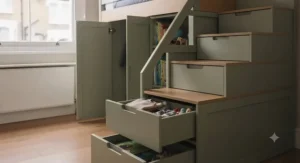
6. Noa & Nani Brighton Bunk Bed with Underbed Trundle Storage — best convertible design
Brighton’s defining trick is flexibility: it converts cleanly into two separate single beds once bunking is no longer needed, while an optional pull-out trundle drawer (branded “Olaf” by the manufacturer) slides beneath the bottom bunk for extra storage or an emergency third sleeping space. Requiring two standard single mattresses (190cm by 90cm) with a maximum depth of 14cm, the shaker-style pine frame is built to outlast the years most families actually need a bunk configuration.
Based on the spec comparison with fixed-frame rivals, the ability to split Brighton into two singles is the feature that most changes its long-term value calculation — rather than replacing the whole bed when siblings want their own rooms, only the frame needs rearranging, and the underbed trundle carries on doing storage duty regardless of configuration. Press coverage of the range has praised its “Scandi chic” aesthetic, and the pine frame’s neutral white finish does genuinely suit a wider range of bedroom schemes than the more overtly “kids'” designs elsewhere in this guide. What most buyers overlook is that the trundle is sold separately from the bunk frame itself, so it’s worth budgeting for both pieces together rather than assuming storage is included as standard.
Pros:
- ✅ Converts into two full single beds when bunking ends
- ✅ Optional trundle drawer adds flexible extra storage or sleeping
- ✅ Solid pine build suited to long-term, multi-year use
Cons:
- ❌ Trundle storage drawer is typically an additional purchase
- ❌ Thinner 14cm maximum mattress depth than some rivals
Priced in the £550-£700 range once the trundle is added, Brighton earns its premium tag through genuine longevity rather than surface-level styling.
7. Noa & Nani Maya Cabin Bed with Staircase of Drawers — best all-in-one storage solution
Maya throws convention out entirely: instead of a second bunk, a full stairway of drawers leads up to a single raised sleeping platform, turning the entire understair void into usable storage. Overall length runs to 246.5cm, depth 99cm, and height 152cm, with roughly 27.5cm of clearance beneath the bed itself for further storage boxes or a play den.
Here’s what the spec sheet doesn’t fully convey: because every step doubles as a drawer, Maya effectively offers more individual storage compartments than any other bed in this guide, without requiring extra floor footprint beyond the bed’s own outline. That makes it the standout choice for genuinely small box rooms where a second lower bunk simply wouldn’t fit, or for an only child who needs serious storage capacity rather than a second sleeping space. On the flip side, this is a single-occupancy bed by design, so it’s not the right pick for families needing to sleep two children from one frame — for that, Brighton or the Flair triple sleepers make more sense. Available in Classic White or Contemporary Silk Grey, the finish options are more limited than some rivals, but the clean, uncluttered cabin-bed silhouette tends to suit modern bedroom schemes particularly well.
Pros:
- ✅ Every staircase step is a drawer, maximising storage density
- ✅ No extra floor footprint required for a second bunk
- ✅ Understair clearance adds further storage or play space
Cons:
- ❌ Single-occupancy only, not suited to two sleepers
- ❌ Limited to two colourways currently
Around £700 at the time of research, Maya sits at the premium end but delivers the highest storage density per square metre of any bed reviewed here.
Practical Usage Guide: Setting Up and Maintaining a Storage Bunk Bed
Getting a storage bunk bed right starts well before the flat-pack boxes arrive. Measure the room with the mattress dimensions in mind, not just the frame footprint — ladder swing and drawer extension both need clear floor space, and it’s easy to forget a drawer needs roughly its own depth again in clearance to open fully. During assembly, tighten every bolt to the manufacturer’s specified torque rather than “hand tight and hope,” since loose joints are consistently flagged by safety bodies as a leading cause of wobble-related bunk bed incidents rather than any flaw in the design itself.
Once built, a simple maintenance schedule pays dividends: check bolts monthly for the first six months (flat-pack furniture settles and fittings can loosen with regular use), then quarterly thereafter. Drawer runners benefit from an occasional wipe-down and, if they’re wooden rather than metal-tracked, a light rub of candle wax along the runners solves most sticking issues without resorting to spray lubricants that attract dust. A common first-30-days mistake is overloading a single drawer with heavy items like books, which strains cheaper runners disproportionately — spreading weight across shelves and drawers evenly extends the life of both considerably. Finally, resist the urge to skip the wall-fixing bracket most manufacturers include; a bunk bed anchored to a wall stud is meaningfully more stable during boisterous evenings than one left entirely freestanding.
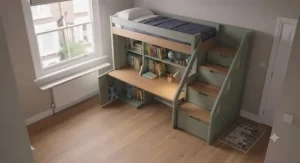
Real-World Scenarios: Which Storage Bunk Bed Suits Your Family?
Picture a family with two children aged five and eight sharing a modest box room in a Victorian terrace: floor space is the scarce resource here, not budget. For this household, the Flair Aviary’s twin-drawer symmetry solves the “fair share” argument before it starts, while its low £400-£480 range keeps costs sensible for a bed that will likely be swapped out again within five or six years as the children grow.
Now consider a single-child household in a new-build flat where the second bedroom doubles as a guest room for visiting grandparents. Here, Noa & Nani’s Maya cabin bed earns its premium price precisely because it needs no second bunk footprint at all — the child gets a proper bed and drawer-based wardrobe substitute, while the room’s floor remains genuinely usable as a sitting-room-cum-guest-space when needed.
Finally, imagine a family expecting a house move within two or three years, currently housing two siblings who’ll eventually want separate rooms. Noa & Nani’s Brighton, with its clean conversion into two standalone singles, avoids the sunk cost of buying a fixed bunk frame that becomes useless the moment the children split rooms — the trundle storage keeps doing its job in either configuration, making it the more future-proof investment despite the higher upfront £550-£700 outlay.
Problem → Solution: Common Storage Bunk Bed Headaches Solved
Problem: Drawers stick after a few months of use. Wooden runners swell slightly with humidity changes; a light rub of candle wax or a silicone-based furniture lubricant along the runner tracks usually restores smooth operation without damaging the finish.
Problem: Toy clutter still ends up on the floor despite storage drawers. This is usually a sorting issue rather than a capacity one — dedicating one drawer explicitly to “daily toys” and a separate one to “occasional toys” (rotated monthly) tends to keep the visible clutter down far more effectively than one large undifferentiated storage space.
Problem: The bed wobbles slightly when a child climbs the ladder. Before assuming a manufacturing fault, recheck every bolt against the instructions — the vast majority of reported wobble issues on BS EN 747-compliant frames trace back to fittings that loosened after initial use rather than a flaw in the frame itself, which is precisely why a periodic bolt check matters.
Problem: Two children disagree over which storage compartment is whose. Beds with genuinely partitioned, symmetrical storage — like the Flair Aviary’s twin drawers or Flick’s split shelving — sidestep this argument at the design stage, which is worth weighing if sibling squabbling is already a known issue in your household.
Problem: A growing teenager has outgrown the top bunk’s weight allowance. Check the manufacturer’s stated maximum load per bed before assuming a problem — most modern storage bunks rate to 100-120kg per bed, but this should always be confirmed against your specific model rather than assumed.
✨ Don’t Miss These Exclusive Deals!
🔍 Take your bedroom storage overhaul to the next level with these carefully selected bunk beds. Click on any highlighted item to check current pricing and availability. These space-saving picks will help you create a genuinely organised, clutter-free bedroom your kids will actually enjoy!
How to Choose a Bunk Bed With Storage
Choosing between the seven beds above — or any other storage bunk on the market — comes down to a handful of criteria that matter more than styling:
- Confirm the safety standard. Look for explicit compliance with the current EN 747-1 furniture standard for bunk beds and high beds, since this covers strength, durability, and entrapment risk specifically.
- Match storage type to what you’re actually storing. Drawers suit bedding and folded clothes; open shelving suits books and display items; a full staircase of drawers suits households needing maximum density from minimum floor space.
- Measure the room in three dimensions, not two. Height matters as much as floor footprint — check ceiling clearance above the top bunk, not just the frame’s floor plan.
- Check the maximum mattress depth. A mattress thicker than the manufacturer’s stated limit pushes a sleeping child above the guardrail’s protective height, undermining the safety design entirely.
- Decide whether convertibility matters to your timeline. If siblings are likely to want separate rooms within a few years, a bed that splits into two singles protects your investment better than a fixed frame.
- Weigh solid wood against MDF/particleboard construction. Solid timber frames generally tolerate rougher use and heavier occupants for longer, though they typically command a higher price than composite-panel builds.
- Read the weight capacity per bunk, not just the overall frame rating. A single figure quoted for “the bed” can be ambiguous — check whether it applies to each bunk individually or the structure as a whole.
Drawer Bunk Beds vs Built-In Storage Bunks: What’s the Real Difference
On the surface, drawer bunk beds and built-in storage bunks look like two names for the same idea, but the practical difference matters more than it first appears. Drawer bunk beds — like the Flair Aviary or Julian Bowen Orion — use discrete, removable drawer units that slide in and out on runners, giving you a defined, enclosed storage space that’s easy to fully empty and clean. Built-in storage bunks, by contrast, integrate storage directly into the bed’s structural elements: think Noa & Nani’s Maya, where the staircase itself is the storage, or Ulla, where the steps double as shelving.
The trade-off is straightforward once you frame it this way. Drawer-based systems are generally easier to retrofit with drawer liners or dividers, and a broken runner is a simpler, cheaper fix than a structural repair. Built-in storage bunks, meanwhile, tend to maximise every available centimetre of the bed’s footprint, since there’s no wasted void behind or beneath a drawer unit — but a fault in one integrated storage step can be more involved to repair than simply replacing a drawer. For families prioritising ease of cleaning and future flexibility, drawer bunk beds edge ahead; for those in genuinely tight box rooms needing every inch to count, built-in storage bunks like Maya’s stairway design win on sheer density.
Storage Bunk Beds for Small Bedrooms: Space-Saving Kids Bunks Done Right
The whole premise of storage bunk beds rests on a simple truth: in a small bedroom, every piece of furniture needs to justify its footprint twice over. A stand-alone chest of drawers might measure 80cm by 40cm of pure floor space that does nothing but store clothes — fold that storage into the base of a bunk bed instead, and that same footprint now also delivers a second sleeping space.
Genuinely space-saving kids bunks go further than simply bolting a drawer under a standard frame, though. The best designs — Maya’s stairway of drawers being the clearest example in this guide — treat the entire vertical and understair volume as fair game for storage, rather than treating storage as an afterthought squeezed beneath an existing frame. When measuring a small bedroom for a storage bunk, it helps to sketch the room’s “dead zones”: the space under windows, behind doors, and in corners that furniture typically can’t use. A well-designed storage bunk effectively creates a new dead zone of its own — the previously wasted air above a single bed — and fills it productively, which is precisely why these beds are worth the higher price tag over a simple divan in a genuinely cramped room.
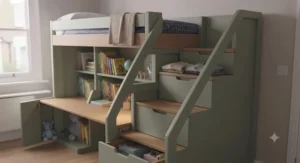
Toy Storage Bunk Beds: Taming the Clutter
Toy storage bunk beds solve a very specific parenting headache: the nightly ritual of stepping on stray Lego bricks en route to the light switch. Not every storage bunk is equally suited to toy storage, though — this is where drawer depth and shelf height matter more than overall storage volume. A deep drawer (like the Flair Flick’s 83cm by 58cm underbed unit) suits bulkier toys such as building blocks or soft toys, while shallow bedside shelving (as seen on the Julian Bowen Orion) suits smaller items like books, figurines, and games boxes that need to stay visible and accessible rather than buried.
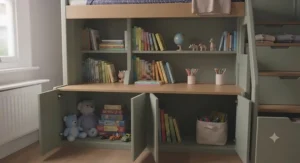
What most buyers overlook when shopping specifically for toy storage bunk beds is the height of the lowest shelf or drawer from the floor — a shelf pitched too high for a five-year-old to reach independently simply shifts the tidying burden back onto a parent, defeating much of the point. Look for models with a lower shelf or drawer sitting at, or below, a child’s natural reach height, and consider adding simple fabric storage bins inside larger drawers to create sub-categories a child can actually maintain themselves, rather than one undifferentiated jumble that gets emptied onto the floor to find anything.
Built-In Storage Bunks: Long-Term Value for Growing Families
Built-in storage bunks — where drawers or shelving form part of the bed’s core structure rather than an add-on accessory — tend to carry a higher upfront price but often deliver better value across a bed’s full lifespan. Because the storage element is structurally integrated, there’s typically less risk of an accessory unit being discontinued or becoming mismatched in finish a few years down the line, a genuine issue with modular add-on drawers bought separately from a bed frame.
For growing families specifically, built-in storage bunks like Ulla’s staircase or Maya’s stairway of drawers tend to age well precisely because the storage doesn’t need reconfiguring as a child’s needs change — a drawer that held nappies and muslins at age two can just as easily hold school shoes and sports kit at age nine, without any structural change to the bed itself. This durability of purpose is worth weighing against the higher sticker price, since a bed genuinely capable of serving from toddlerhood through to the pre-teen years arguably costs less per year of useful service than a cheaper bed replaced twice in the same period.
Multi-Functional Children’s Furniture: Beyond the Bunk
A storage bunk bed is really just one example of a broader shift toward multi-functional children’s furniture — pieces designed to do the job of two or three separate items within a single footprint. Cabin beds with integrated desks, for instance, apply the same logic as a storage bunk but trade a second sleeping space for a study area, which makes sense once a child reaches an age where solo homework space matters more than sleepover capacity.
When building out a full bedroom around multi-functional children’s furniture, it pays to think about which functions genuinely need to be combined and which are better kept separate. A bed with an integrated desk saves floor space, but a desk wedged beneath a top bunk can feel cramped and poorly lit for serious homework sessions — in which case, a separate small desk paired with a simpler storage bunk might actually serve a growing child better than trying to cram every function into one unit. The goal of multi-functional furniture should always be genuine space efficiency, not compromise dressed up as convenience.
Common Mistakes When Buying a Bunk Bed With Storage
The single most common mistake is measuring only the bed’s footprint and forgetting ladder swing or drawer extension clearance — a bed that technically “fits” against a wall can still leave no room to actually open its drawers. A close second is buying based on styling photos alone without checking the maximum mattress depth; an overly thick mattress bought separately can silently undermine a guardrail’s safety margin, a detail that’s easy to overlook when mattress and bed are purchased from different retailers.
Buyers also frequently underestimate how much floor space a staircase-style storage bunk needs compared with a simple ladder, only realising the mismatch once the bed arrives. It’s also worth reading the small print on the Furniture and Furnishings (Fire) (Safety) (Amendment) Regulations 2025, since labelling requirements for children’s furniture have shifted recently — a legitimate retailer should still be able to confirm compliance even where display labelling requirements have changed. Finally, a surprisingly common mistake is buying a fixed-frame triple or staircase bunk for a family likely to need the flexibility of two separate singles within a few years — checking convertibility before purchase avoids an expensive re-buy later.
Safety, Regulations & Compliance Guide
UK bunk bed safety sits on two main pillars: the technical construction standard and sensible household usage rules. On the technical side, reputable manufacturers build to the EN 747 furniture standard, which governs guardrail height, gap sizes to prevent entrapment, ladder tread dimensions, and structural strength testing. Separately, the Furniture and Furnishings (Fire) (Safety) (Amendment) Regulations 2025, which came into force on 30 October 2025, updated flammability and labelling rules for domestic furniture, including some specific exemptions for baby and young children’s products — worth being aware of if a listing’s labelling looks different from what you might expect from an older bed.
On the household side, age guidance matters just as much as the bed’s build quality. RoSPA recommends no child under six sleeps on a top bunk, given that the majority of recorded bunk bed injuries occur in the under-six age group, largely from falls and playful misuse rather than structural failure. Practical habits worth adopting regardless of which bed you buy: never allow rope, cord, or clothing to hang from the frame (a recognised strangulation risk), keep the ladder as the sole means of access, and recheck bolts periodically as fittings can loosen with normal use over time.
Long-Term Cost & Maintenance
Judging a storage bunk bed purely on its upfront price misses half the picture — total cost of ownership includes how long it lasts, what replacement mattresses or trundles cost, and how much maintenance it demands. Solid pine frames, like those used across the Noa & Nani range, generally command a higher purchase price but tend to tolerate years of use, repeated disassembly for house moves, and heavier occupants as children grow into their teens, spreading that initial cost across a longer useful life.
By contrast, budget MDF or particleboard-based frames, such as the entry-level Flair models, cost less upfront but may show wear at stress points — drawer runners and ladder joints particularly — sooner than solid timber equivalents. This doesn’t make them a poor choice; for a family expecting to move house or reconfigure bedrooms within a few years anyway, the lower upfront cost may represent better value than paying a premium for longevity the household won’t actually use. Maintenance costs across all seven beds reviewed here are modest: occasional runner lubrication, periodic bolt tightening, and — for drawer-based storage particularly — an annual full-empty-and-wipe-down to keep runners free of dust and debris that otherwise accelerates wear.
What to Expect: Real-World Performance
Specs on a product page rarely capture what daily life with a storage bunk actually feels like. In practice, drawer-based storage bunks tend to get used exactly as intended for the first few months, then gradually accumulate an “everything drawer” that stops being sorted by category — a pattern worth anticipating with simple internal dividers rather than fighting after the fact. Staircase-style storage, like Ulla’s or Maya’s, tends to hold its organisation better over time precisely because each step’s compartment is naturally smaller and more specific, discouraging the “dump everything in one place” habit that larger drawers invite.
Noise is a genuine, if rarely discussed, real-world factor: wooden ladder treads and drawer runners can creak more than expected on nights when a child needs the bathroom, particularly with cheaper composite-panel builds. Solid pine frames, again, tend to perform more quietly here than particleboard equivalents once bolts have settled in. Finally, expect an adjustment period of a few weeks for any child transitioning to a top bunk for the first time — even beds built to full safety standard can feel unfamiliar initially, and a night light near the ladder genuinely does reduce the fumbling that leads to minor missteps during that settling-in period.
Frequently Asked Questions
❓ Is a bunk bed with storage safe for a five-year-old on the top bunk?
❓ How much storage does a bunk bed with drawers typically hold?
❓ Can storage bunk beds be split into two separate single beds?
❓ What's the maximum mattress thickness for a bunk bed with storage?
❓ Do storage bunk beds need to be fixed to the wall?
Conclusion
Choosing among storage bunk beds ultimately comes down to matching the storage style to how your family actually lives, not just how a listing photo looks. Budget-conscious households sleeping three children will likely find the Flair triple sleepers hit the mark, while families prioritising long-term flexibility should weigh Noa & Nani’s Brighton and its convertible frame more seriously than its higher price tag might initially suggest. For genuinely tight box rooms, built-in storage designs like Maya’s stairway of drawers deliver the highest storage density of anything reviewed here, at the cost of sleeping only one child per frame.
Whichever model earns a place in your bedroom, the fundamentals matter more than the finish: confirm current EN 747 compliance, respect the manufacturer’s stated mattress depth and weight limits, and keep RoSPA’s age guidance for top-bunk sleeping firmly in mind regardless of how tempting an early transition might seem. A well-chosen storage bunk bed genuinely earns its keep for years, quietly doing the job of two pieces of furniture while your children grow into — and eventually out of — needing it at all.
Recommended for You
- Best Bunk Beds UK 2026: 7 Safe, Sturdy Picks That Won’t Wobble
- Compact Dressing Table Small Bedroom: 7 Smart Picks for 2026
- Best Dressing Table with Lights Reviews UK 2026: Top 7 Picks
Disclaimer: This article contains affiliate links. As an Amazon Associate, I earn from qualifying purchases. If you purchase products through these links, we may earn a small commission at no additional cost to you.
✨ Found this helpful? Share it with your friends! 💬🤗
