
In This Article
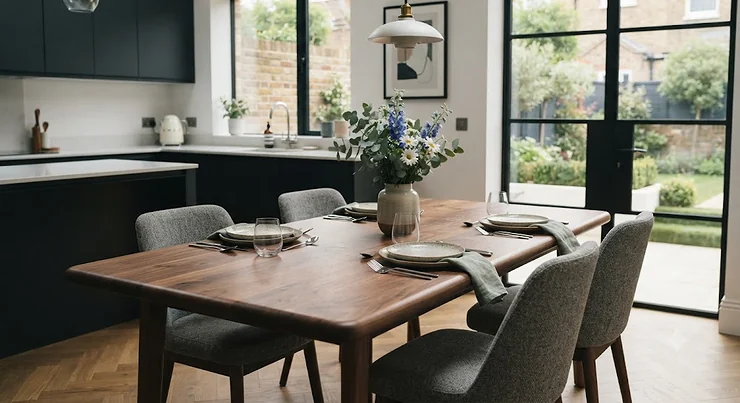
A solid walnut dining table is, in a word, an investment — the kind of purchase that outlives three sofas, two kitchen renovations and probably one relationship argument about whether round or rectangular is “more practical.” A solid walnut dining table is a dining table with a top made from genuine walnut hardwood (rather than veneer or MDF), prized for its chocolate-brown tone, swirling grain, and ability to age gracefully rather than simply wear out. That’s the textbook definition. What it doesn’t tell you is how much confusion sits behind the word “walnut” itself in furniture listings — a confusion this guide is going to clear up properly.
Here’s the thing nobody at the furniture shop tells you while you’re running your hand across a display table: an enormous number of products marketed as “walnut” are actually a cheaper timber (usually rubberwood, beech, or engineered board) wearing a walnut-coloured lacquer or veneer. That’s not necessarily a bad table — some of them are genuinely excellent for the money — but it is a different product, at a different price point, with a different lifespan. Getting this distinction straight before you spend anything is, frankly, the single most useful thing this article can do for you.
Below, we’ve dug through seven real, currently listed dining tables sold in the UK — spanning honest budget veneer options through to a genuinely solid walnut set — and broken down exactly what you’re getting, who each one suits, and where the compromises actually bite. Alongside the tables themselves, you’ll find a practical buying framework, a maintenance guide nobody bothers to write, and a blunt look at which “premium hardwood finish” claims hold up under scrutiny. Prices below are approximate and checked at the time of research; always verify current pricing before you buy, since retailer pricing shifts constantly.
Quick Comparison Table
| Table | Best For | Material | Approx. Price |
|---|---|---|---|
| Habitat Loxley Corner Dining Set | Genuine solid walnut on a budget-conscious premium buy | Solid walnut | £600-£750 range |
| Julian Bowen Kensington | Households that need to extend for guests | Walnut-finish veneer | £250-£350 range |
| Julian Bowen Berkeley | A classic rectangular centrepiece | Walnut-finish lacquer | £280-£380 range |
| Julian Bowen Cayman | First-time buyers on a tight budget | Walnut-finish veneer | Under £250 |
| VASAGLE Dining Table | Fast, farmhouse-style flat-pack | Engineered wood, walnut-effect | Under £200 |
| Vida Designs Walnut Dining Table | Industrial-style small kitchens | Walnut-effect melamine, metal legs | Under £200 |
| Julian Bowen Farringdon | Compact circular dining for two to four | Beech with walnut finish | Under £250 |
Looking across the table, the split is stark: only the Habitat Loxley Corner Dining Set here is genuinely solid walnut, and it sits in a different price bracket entirely from the six walnut-finish alternatives around it. That’s not a flaw in this list — it’s an honest reflection of the UK market, where true solid walnut furniture typically starts well north of £500 and climbs fast, while “walnut” veneer and effect finishes dominate the sub-£300 shelf. If your budget caps out under £300, go in expecting a veneer or lacquered finish rather than the timber itself, and judge the table on its own construction merits instead.
💬 Just one click — help others make better buying decisions too!😊
Top 7 Solid Walnut Dining Tables: Expert Analysis
1. Julian Bowen Farringdon — affordable circular table for small dining spaces
The Julian Bowen Farringdon opens this list because it’s the most space-conscious option here, and honestly, most UK dining rooms could use a bit more circular thinking. At 120cm in diameter and 76cm tall, it’s built from beech wood finished in a rich walnut lacquer rather than solid walnut timber — the listing is upfront about this, which is more than can be said for some competitors. Tapered legs give it a period-appropriate silhouette that leans mid-century without committing fully to it, and the circular top comfortably seats four without the corner-bumping that rectangular tables inflict on smaller rooms.
Based on the spec comparison with similar circular tables in this bracket, the Farringdon’s advantage is proportion: a 120cm circle needs roughly the same floor footprint as a compact rectangular four-seater but feels considerably less cramped because nobody’s knee is fighting a table leg. Reviewers on the retailer’s own listing consistently flag straightforward flat-pack assembly and a finish that photographs better than it initially reads on paper — a genuinely useful table if your dining area moonlights as a home office desk. What most buyers overlook is that a circular table this size struggles the moment you need to seat six for Christmas; there’s no extension mechanism, so this is a permanent four-person commitment.
Pros:
- ✅ Compact footprint suits flats and smaller dining rooms
- ✅ Tapered leg design gives a genuine mid-century look
- ✅ Straightforward flat-pack assembly reported by buyers
Cons:
- ❌ Beech with walnut finish, not solid walnut timber
- ❌ Fixed size — no extension option for larger gatherings
At under £250 at the time of research, the Julian Bowen Farringdon represents solid value for anyone furnishing a compact dining nook rather than a formal dining room — just don’t expect solid hardwood durability at this price.
2. Julian Bowen Cayman — simple lacquered walnut table for tight budgets
The Julian Bowen Cayman is the no-frills entry on this list, and there’s honesty in that simplicity. At 150cm long, it’s sized for a rectangular four-to-six seat arrangement without venturing into extending-table territory, finished in the same walnut lacquer treatment Julian Bowen applies across much of its dining range. The construction leans on straight, unfussy legs rather than a design statement, which — depending on your existing décor — is either its biggest strength or its most obvious limitation.
On paper this means the Cayman is essentially a blank canvas: neutral enough to sit under almost any chair style, from upholstered dining chairs to simple wooden ones, without visually competing with either. Aggregated buyer feedback for tables in this range tends to praise ease of assembly and a finish that resists everyday scuffing reasonably well for a lacquered surface, while noting — as with most veneered and lacquered walnut-effect tables — that heat rings and deep scratches show up more readily than they would on solid timber. If you’re a renter or first-flat buyer who needs a dining table now and plans to upgrade in five years rather than fifty, this is a sensible stopgap rather than a compromise you’ll regret.
Pros:
- ✅ Straightforward, neutral design fits most dining chair styles
- ✅ Budget-friendly entry point under £250
- ✅ Reasonably scuff-resistant lacquered surface for daily use
Cons:
- ❌ Not solid walnut — veneer/lacquer finish over base timber
- ❌ Limited design flair compared with tapered-leg alternatives
The Julian Bowen Cayman is best thought of as a starter table: honest about what it is, priced accordingly, and perfectly serviceable for its intended lifespan.
3. Vida Designs Walnut Dining Table — industrial-look table on a shoestring budget
Where the two Julian Bowen tables above lean traditional, the Vida Designs Walnut Dining Table goes industrial, pairing a walnut-effect tabletop with X-shaped black metal legs. It’s a design choice that instantly reads more contemporary and, frankly, more Instagram-friendly than a straight-legged lacquered table — which matters more than furniture reviewers like to admit, since a huge share of dining table purchases are driven by how a room photographs, not just how it functions.
Here’s what the spec sheet won’t tell you outright: the metal-leg construction on tables like this tends to be considerably more rigid under lateral wobble than four separate wooden legs, because the crossed-metal frame distributes load differently. That’s a genuine practical upside for households with boisterous kids leaning on the table edge. Vida Designs’ comparable range carries user ratings clustered in the 4.4-to-4.8-star range on major retail platforms, with buyers repeatedly noting easy self-assembly and a look that punches above its price. The trade-off, unsurprisingly, is the tabletop material itself — this is walnut-effect surfacing over an engineered core, not timber, so it inherits all the same heat- and moisture-sensitivity concerns as any budget veneered product.
Pros:
- ✅ Sturdy X-frame metal legs resist wobble well
- ✅ Contemporary industrial look at a genuinely low price
- ✅ Strong buyer satisfaction ratings across the Vida Designs range
Cons:
- ❌ Walnut-effect surface, not solid or veneered hardwood
- ❌ Metal legs can mark hard flooring if not protected
Under £200 in most listings, the Vida Designs Walnut Dining Table is arguably the best style-per-pound pick on this list for a small kitchen or first home.
4. VASAGLE Dining Table — quick-assembly farmhouse table with two-tone finish
The VASAGLE Dining Table (model UKDT100K02V2) takes a different tack entirely, mixing a natural walnut-toned top with ink-black legs for a farmhouse-meets-Scandi look that’s proven popular across VASAGLE’s wider furniture catalogue. At roughly 140cm by 75cm, it’s built for four-to-six diners and, per the manufacturer’s own listing, features a heat-resistant tabletop coating — a small but genuinely practical detail that most budget tables skip entirely.
Based on the spec comparison with similarly priced farmhouse-style tables, the heat-resistant surface is the standout feature here: it means you can set down a hot dish for a moment without instantly regretting it, which is not something you can say for lacquered finishes generally. Reviewers consistently note quick assembly times — often cited around the 20-to-30-minute mark for two people working together — and a sturdy feel once fully built, despite the engineered-wood construction underneath the walnut-effect surface. What buyers overlook until delivery day is the sheer number of small parts and screws typical of flat-pack farmhouse tables; budget a proper hour rather than the “quick assembly” marketing suggests if you’re doing it solo.
Pros:
- ✅ Genuinely heat-resistant tabletop coating, unusual at this price
- ✅ Fast two-tone farmhouse styling suits Scandi-leaning kitchens
- ✅ Reasonably quick self-assembly for two people
Cons:
- ❌ Engineered wood core, not solid or veneered walnut hardwood
- ❌ Assembly solo takes noticeably longer than advertised
Priced under £200 in most UK listings, the VASAGLE Dining Table earns its spot as the practical, heat-tolerant pick for busy family kitchens.
5. Julian Bowen Berkeley — statement rectangular table with elegant lacquer
Stepping up the range, the Julian Bowen Berkeley is a 180cm rectangular table built from timber with a lacquered walnut finish, designed as a genuine dining-room centrepiece rather than a kitchen-table stand-in. The larger footprint comfortably seats six, and the lacquer finish carries a noticeably glossier, more formal sheen than the matte-leaning Cayman further down Julian Bowen’s own range — a deliberate design differentiation that’s easy to miss when comparing on spec sheets alone.
What the dimensions won’t tell you is how the Berkeley reads in a room: a 180cm table needs a genuinely spacious dining area to avoid feeling oversized, so measure your space properly — including chair pull-out clearance on all sides — before committing. Here’s what most buyers overlook about a table like this: the gloss lacquer finish that photographs so well in product listings also shows dust and fingerprints more readily than a matte or oiled solid-wood surface, meaning a slightly higher maintenance routine than the finish’s “low maintenance” marketing implies. Aggregated feedback on comparable Julian Bowen lacquered tables consistently praises the visual impact for the price point, while flagging that heat marks from hot serving dishes are a genuine risk without trivets.
Pros:
- ✅ Large 180cm footprint comfortably seats six diners
- ✅ Glossy lacquer finish gives strong visual impact for the price
- ✅ Sturdy build reported across the Julian Bowen dining range
Cons:
- ❌ Gloss lacquer shows dust and fingerprints more than matte finishes
- ❌ Needs a genuinely spacious room to avoid feeling oversized
In the £280-£380 range, the Julian Bowen Berkeley delivers real dining-room presence, provided you have the floor space and the willingness to wipe it down more often.
6. Julian Bowen Kensington — extending table that seats six with ease
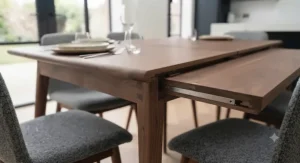
The Julian Bowen Kensington solves a problem the previous five tables can’t: what happens when you regularly need to seat more people than your everyday table allows. Closed, it measures 90cm deep by 150cm wide; extended, it stretches to 195cm wide while gaining just 3cm in height variance — a detail worth noting if your dining chairs are already a tight fit under the closed table. It’s built from walnut wood with the sleek, contemporary lines Julian Bowen markets as part of its wider Kensington range.
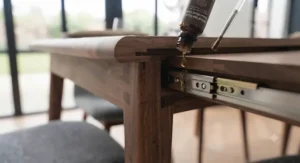
Here’s what the spec sheet won’t spell out clearly: an extending mechanism is, mechanically, the single most failure-prone part of any dining table, because it introduces moving metal runners into what’s otherwise a static structure. On paper this means the Kensington needs slightly more careful handling during extension — don’t force it, and keep the runners free of dust — but in exchange you get genuine flexibility that fixed-size tables at this price simply can’t offer. Reviewers consistently flag the extension mechanism as smooth when properly maintained, and the closed-to-open transformation as genuinely useful for households that host occasionally rather than constantly. What most buyers overlook is planning storage for the extension leaf itself when it’s not in use — it typically stores within the table body, but check this specifically before buying if space is tight.
Pros:
- ✅ Extends from 150cm to 195cm to seat up to six
- ✅ Contemporary walnut-finish design suits modern dining rooms
- ✅ Extension leaf typically stores within the table itself
Cons:
- ❌ Extension mechanisms are a common long-term wear point
- ❌ Walnut-finish veneer rather than solid hardwood construction
At around £250-£350, the Julian Bowen Kensington is the pragmatic choice for anyone who needs a table that can genuinely flex between weeknight dinners and Sunday gatherings.
7. Habitat Loxley Corner Dining Set — genuinely solid walnut corner dining set
And here’s the one genuinely solid walnut product on this list — worth the wait. The Habitat Loxley Corner Dining Set pairs a solid walnut table with two upholstered benches designed to slot into a corner, a configuration built specifically for households trying to squeeze proper dining space out of an awkward kitchen corner or open-plan layout. Unlike every other table above, the manufacturer’s own specification confirms solid wood construction throughout the table and its legs, not a veneer or lacquer treatment over a cheaper core.
Based on the spec comparison with the six walnut-finish tables earlier in this list, the practical difference solid timber makes is longevity under wear: solid walnut can be lightly sanded and re-oiled or re-waxed to remove years of scratches and watermarks, something no veneered or lacquered surface can do without exposing the substrate beneath. That’s the entire case for spending more on genuine hardwood — you’re not paying for a nicer-looking table today, you’re paying for a table that can be refreshed rather than replaced in a decade. The corner-bench configuration is a genuine practical trade-off, too: it maximises seating in a defined footprint but locks you into that specific room layout more than a freestanding table and chairs would. Reviewers on the retailer’s site note the fabric bench seating as comfortable for extended sitting and praise the visible natural grain across the tabletop, while flagging — sensibly — that the set isn’t machine-washable and needs the same fabric care as any upholstered furniture.
Pros:
- ✅ Genuinely solid walnut wood, not veneer or effect finish
- ✅ Can be sanded and refinished rather than replaced over time
- ✅ Corner design maximises seating in compact dining areas
Cons:
- ❌ Fixed corner configuration limits room layout flexibility
- ❌ Higher upfront cost than every veneered alternative on this list
At around £600-£750, the Habitat Loxley Corner Dining Set is the table on this list actually worth calling an investment piece — everything else here is a good-value stand-in until you’re ready for it.
Caring for Your New Walnut Dining Table: A Practical Setup & Maintenance Guide
Getting a walnut-finish or solid walnut table home is only step one — how you treat it in the first month genuinely determines how it looks in year five. Start by letting a solid timber table like the Habitat Loxley Corner Dining Set acclimatise to your home’s humidity for 24 to 48 hours before heavy use if it’s arrived flat-packed or freshly delivered; sudden temperature or humidity swings are what cause solid wood tops to develop hairline cracks, not everyday use. For veneered and lacquered tables such as the Julian Bowen Berkeley or Julian Bowen Kensington, this step matters less, but checking every fixing bolt is properly tightened within the first week does — flat-pack joints settle slightly under initial use and a five-minute check prevents years of wobble.
Weekly maintenance is genuinely simple across the board: a soft, slightly damp cloth followed by immediate drying removes most everyday marks without stripping any finish, lacquered or solid. Trivets and coasters aren’t optional extras for any table on this list — heat damage is the single most common complaint across lacquered, veneered, and even solid oiled surfaces, and it’s entirely avoidable. For solid walnut specifically, a light application of furniture wax or specialist walnut oil every six to twelve months keeps the timber’s natural oils topped up, preventing the dull, thirsty look untreated solid wood develops over time. A common first-30-days mistake worth flagging: using generic all-purpose cleaning sprays, many of which contain ammonia or silicone that dulls lacquer finishes and strips protective wax from solid timber alike — stick to products specifically labelled for wood furniture.
Which Walnut Dining Table Suits Your Household? Three Real-Life Scenarios
If you’re a young professional in a one-bedroom flat who eats most meals solo or with one other person, the Julian Bowen Farringdon‘s compact circular footprint and sub-£250 price point make far more sense than anything larger — you’re paying for space efficiency, not seating capacity you’ll never use. Someone in this position, on a tight budget, with limited storage for extra chairs, gets the best value-per-square-foot from this pick specifically.
A family of four to six who host semi-regularly — birthdays, occasional Sunday lunches, the odd Christmas overflow — is the exact household the Julian Bowen Kensington was designed for. Between its 150cm everyday footprint and 195cm extended capacity, it flexes with actual usage patterns rather than forcing a choice between “always cramped” or “always oversized,” which matters enormously for families whose dining needs genuinely change week to week.
And for a household actively furnishing a forever-home dining space, with the budget to treat furniture as a long-term asset rather than a five-year placeholder, the Habitat Loxley Corner Dining Set is the rational choice despite its higher upfront cost. Someone in this position — say, a couple in their thirties or forties finally out of the starter-flat cycle — benefits most from solid timber’s refinishability, because they’re the buyer actually likely to still own this table in fifteen years.
Your Buyer’s Decision Framework: Choosing Fast Without Regret
If budget is your primary constraint and you need a table within the next fortnight, choose one of the sub-£250 lacquered or veneered options — the Julian Bowen Cayman, Vida Designs Walnut Dining Table, or VASAGLE Dining Table — because at this price bracket, genuine solid walnut simply isn’t realistically available, and pretending otherwise just delays your purchase.
If longevity and refinishability matter more to you than upfront cost, choose the Habitat Loxley Corner Dining Set, because it’s the only product here where “walnut” means the timber itself rather than a surface treatment.
If your household size fluctuates — guests some weekends, just the two of you most others — choose the Julian Bowen Kensington, because an extending mechanism solves a problem that a fixed-size table, however nice, simply can’t.
If floor space is your binding constraint rather than budget or flexibility, choose the Julian Bowen Farringdon, because its circular 120cm footprint is the most space-efficient shape-to-seating ratio on this list.
How to Choose a Solid Walnut Dining Table
Choosing well comes down to working through a handful of decisions in the right order, rather than falling for the first attractive listing photo. Here’s the sequence that actually matters:
- Decide solid timber versus veneer/finish honestly, based on budget — if your realistic budget sits under roughly £400-500, plan for a walnut-finish table and choose the best-built one, rather than chasing “solid walnut” claims that often turn out to be marketing language for a walnut-coloured lacquer.
- Measure your room, including chair clearance — a common and costly mistake is measuring only the table footprint and forgetting the 60-70cm of pulled-out chair space needed on every side.
- Match seating capacity to actual usage, not aspirational usage — buying a six-seater “just in case” when you’re regularly a household of two wastes both money and floor space that a well-chosen extending table would solve more elegantly.
- Check the base/leg construction, not just the tabletop — X-frame metal legs, four-leg wooden frames, and pedestal bases all behave differently under lateral pressure from kids, pets, or enthusiastic dinner conversation.
- Read the finish maintenance requirements before buying, not after — gloss lacquer, matte lacquer, veneer, and oiled solid wood all demand genuinely different care routines, and mismatching your lifestyle to the wrong finish is a common source of buyer’s remorse.
- Consider extension mechanisms only if you’ll genuinely use them — an extending table costs more and introduces a moving part; it’s worth it for fluctuating households and a poor trade for households whose seating needs never change.
- Factor in delivery lead time for genuinely solid pieces — solid walnut furniture, particularly made-to-order ranges, can carry considerably longer delivery windows than flat-pack veneered alternatives, so don’t leave this purchase to the last minute before an event.
A frequent, avoidable mistake worth calling out on its own: buyers regularly assume “walnut” in a product title guarantees hardwood, then feel misled on delivery when the listing’s own small print says otherwise — always scroll to the material specification, not just the product name, before adding to basket.
Solid Walnut vs Walnut Veneer: What “Premium Hardwood Finish” Really Means
This is the section that probably should have come first, because it underpins every buying decision above it. “Solid walnut” means the visible timber — top, legs, and frame — is genuine walnut wood throughout, cut and jointed like any traditional hardwood furniture. A “premium hardwood finish,” by contrast, usually describes a thin layer of real walnut veneer (a few millimetres of genuine timber) bonded to a core of cheaper wood or engineered board — or, at the more budget end, simply a walnut-toned lacquer or laminate over an entirely different material, as with several tables on this list. Both can look genuinely excellent. Only one can be sanded back and refinished when it eventually shows its age.
| Comparison | Solid Walnut | Walnut Veneer | Walnut-Effect Lacquer/Laminate |
|---|---|---|---|
| Repairable/refinishable | Yes, multiple times | Once, if at all | No |
| Typical UK price band | £500+ | £250-£500 | Under £300 |
| Heat/moisture sensitivity | Moderate, improves with care | Higher | Highest |
| Longevity with care | Decades | 10-15 years | 5-10 years |
| Weight | Heaviest | Moderate | Lightest |
The value calculation here isn’t as simple as “solid always wins” — a well-built lacquered table like the Julian Bowen Berkeley, properly cared for and replaced once every decade, can work out cheaper over thirty years than one expensive solid piece bought too early and damaged through inexperienced care. But for buyers planning to stay put long-term, the refinishing capability of genuine solid walnut, such as the Habitat Loxley Corner Dining Set, changes the total cost of ownership calculation meaningfully in its favour. It’s genuinely worth reading up on sustainable sourcing too, since certified, responsibly harvested walnut carries its own value proposition beyond the wood itself — Which? has compared UK furniture retailers on their use of certified timber, which is a useful reference point before committing to any wood furniture purchase.
What to Expect: Real-World Performance of a Walnut Dining Table Set
Specs on a listing page rarely translate directly into lived experience, so here’s the practical version. A walnut dining table set advertised as seating six will genuinely seat six adults comfortably only if it’s at least 150-160cm long with standard dining chairs; anything shorter technically fits six but elbows will collide throughout the meal. Extending tables like the Julian Bowen Kensington feel noticeably different in daily use compared with their spec sheet suggests — most owners report using the extended configuration far less often than expected, meaning the everyday closed footprint matters more to daily satisfaction than the maximum capacity does.
Finish durability in real households diverges sharply from showroom conditions. Lacquered surfaces such as the Julian Bowen Cayman and Julian Bowen Berkeley hold up well against light everyday wear but show heat rings within weeks if trivets aren’t used consistently — this isn’t a manufacturing flaw, it’s simply how lacquer behaves under thermal stress. Solid walnut, as on the Habitat Loxley Corner Dining Set, actually performs somewhat better against isolated heat exposure because the timber itself tolerates brief warmth better than a surface coating does, though prolonged direct heat will still mark it. Metal-legged tables like the Vida Designs Walnut Dining Table perform noticeably better against wobble over time than four independent wooden legs, an underappreciated real-world advantage that rarely appears in marketing copy but shows up clearly in long-term owner feedback.
Long-Term Cost & Maintenance of Solid Walnut Furniture
Total cost of ownership rarely gets discussed honestly in furniture marketing, so let’s do the maths properly. A £200 walnut-effect table replaced once every seven years across a 21-year period costs roughly £600 in table purchases alone, before factoring in the environmental cost of manufacturing and disposing of three separate products. A £650 solid walnut table, refinished once at around the ten-year mark for a typical cost of £150-£250 through a professional furniture restorer, delivers a comparable or longer usable lifespan for a broadly similar total spend — but with one physical object rather than three, and considerably less landfill impact along the way.
Retailers that can demonstrate proper chain-of-custody sourcing are also the ones best placed to comply with tightening rules — Forest Stewardship Council UK explains how the UK Timber Regulation applies to businesses selling wood products, which is worth a skim if traceable sourcing matters to you as a buyer. Maintenance costs scale with finish type rather than price point. Lacquered and veneered tables need essentially nothing beyond regular cleaning and coaster discipline, making their maintenance cost close to zero across their shorter lifespan. Solid walnut needs occasional oiling or waxing — inexpensive in isolation, at roughly £10-£20 per application every six to twelve months, but a genuine ongoing commitment rather than a one-off purchase decision. For UK buyers specifically, it’s also worth understanding how timber sourcing regulation affects the furniture market more broadly; the UK government has set out its approach to strengthening deforestation regulations covering timber and wood products sold in Great Britain, which is gradually pushing more retailers toward verified, traceable sourcing — a trend that should, over time, make genuinely sustainable solid hardwood furniture easier to identify with confidence.
Dark Wood Furniture: Styling a Mid-Century Modern Dining Room with Walnut
Walnut sits at the centre of two overlapping style conversations in UK interiors right now: the broader return of dark wood furniture after roughly a decade of Scandi-pale dominance, and the persistent, seemingly evergreen popularity of mid-century modern dining aesthetics. Walnut happens to be the connective tissue between both trends, which is no accident — it was the defining timber of genuine 1950s-60s mid-century design, and its rich, warm-brown tone is exactly what’s driving the current dark wood furniture revival in dining and living spaces alike.
For a properly mid-century modern dining look, tapered, angled legs matter more than most buyers realise — tables like the Julian Bowen Farringdon, with its splayed leg design, read authentically period in a way that straight, boxy legs simply don’t, regardless of the tabletop finish. Pair any walnut-toned table with brass or warm-gold hardware and lighting rather than cool chrome, since mixing warm timber tones with cool metals is a common styling mismatch that undercuts an otherwise well-chosen table. For a broader dark wood furniture scheme rather than a strictly mid-century one, walnut dining tables like the Julian Bowen Berkeley or Julian Bowen Kensington pair naturally with matching sideboards and dark-framed artwork, creating tonal continuity through a room rather than treating the dining table as an isolated statement piece. The one genuine styling risk with dark wood furniture in general is a room without enough natural light — walnut’s depth of colour can read as heavy or cave-like in a poorly lit dining space, so balance it with pale walls, generous mirrors, or layered lighting rather than deep-coloured walls to match.
Features That Actually Matter (And Those That Don’t)
Genuinely worth prioritising: base stability (test by gently rocking a floor model or checking reviews for wobble complaints), finish durability matched honestly to your household’s habits, and — if extension is on your wishlist at all — a mechanism that’s been reviewed specifically for smoothness rather than just capacity. Genuinely worth ignoring, or at least deprioritising: exact grain-pattern promises in listing photos, since natural wood grain varies piece to piece and the table you receive will never perfectly match a hero image; and elaborate leg carving or ornamentation on budget tables, which tends to be the first detail to look cheap under close inspection regardless of overall build quality.
A specific piece of marketing language worth treating with healthy scepticism: “solid wood construction” claims that, on close reading of the small print, turn out to mean solid engineered wood or solid rubberwood rather than solid walnut specifically — technically accurate, meaningfully misleading. The spec sheet won’t flag this distinction for you; you have to go looking for it in the materials section, not the headline description.
Frequently Asked Questions
❓ What is the difference between solid walnut and walnut veneer?
❓ How much does a solid walnut dining table cost in the UK?
❓ Is walnut a good wood for a dining table?
❓ How do I care for a walnut dining table?
❓ Can I get a solid walnut dining table with a matching set of chairs?
Conclusion
The honest truth about shopping for a solid walnut dining table in the UK right now is that most of what you’ll find advertised under that phrase isn’t actually solid walnut at all — and that’s fine, provided you know it going in and price accordingly. Of the seven tables covered here, six are well-built, honestly marketed walnut-finish pieces that suit budgets from under £200 up through the mid-£300s, each with a genuinely useful niche: the Julian Bowen Farringdon for compact spaces, the Julian Bowen Cayman and Vida Designs Walnut Dining Table for tight first-home budgets, the VASAGLE Dining Table for heat-tolerant farmhouse styling, the Julian Bowen Berkeley for rectangular presence, and the Julian Bowen Kensington for flexible extending seating.
The seventh, the Habitat Loxley Corner Dining Set, is the one genuine solid walnut investment on this list — and for a household planning to stay in one place for the long haul, its refinishable timber makes a real case for the higher upfront spend. Whichever direction your budget and household actually push you, the buying framework above should get you to the right table faster than scrolling listing photos ever will. Check today’s prices on your shortlisted options before they change, and measure your room twice before anything gets delivered once.
✨ Don’t Miss These Exclusive Deals!
🔍 Take your dining room upgrade to the next level with the picks above. Click through on any table that caught your eye to check current pricing and availability — and bring some genuine walnut warmth to family dinners for years to come!
Recommended for You
- Solid Oak Dining Table: 7 Best UK Picks for 2026 (Reviewed)
- Dining Table for 10 People: 7 Best Picks for 2026 (UK Guide)
- Large Dining Table for 8: 7 Honest Picks & Mistakes to Avoid (2026)
Disclaimer: This article contains affiliate links. As an Amazon Associate, I earn from qualifying purchases. If you purchase products through these links, we may earn a small commission at no additional cost to you.
✨ Found this helpful? Share it with your friends! 💬🤗
