
In This Article
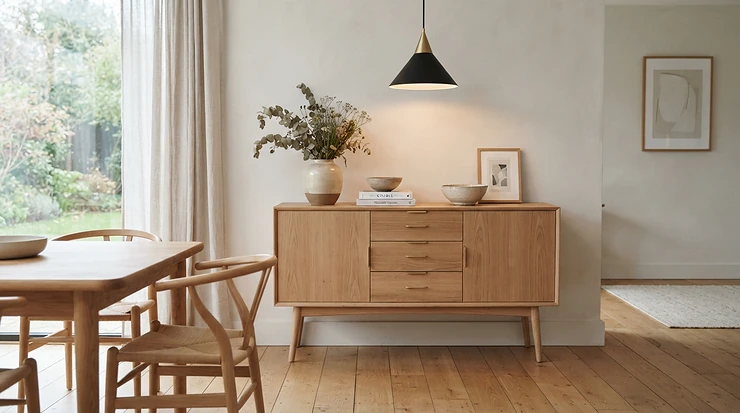
Every British dining room has the same quiet argument going on. The table wants more space, the chairs want to pull back, and your tablecloths, candles and the “good” wine glasses want somewhere to live. A full-depth buffet settles the argument by winning, and the rest of the room loses.
Narrow sideboards for small dining rooms offer a smarter ceasefire. At roughly 30cm deep, a slim sideboard gives you a serving surface and hidden storage while leaving your walkway intact. Each of the seven models below comes with its real dimensions, what those numbers mean in practice, and who it suits.
Here is what to expect:
- A spec-by-spec analysis of seven genuine models, from budget to premium.
- Honest guidance on shallow depth, wall anchoring and open-plan layouts.
- A realistic look at what a narrow sideboard under £150 can and can’t do.
- A clear verdict on sideboard vs buffet cabinet.
One note on method. Prices are given as ranges and change often. Review comments are summarised only where I could find genuine feedback, and where I couldn’t, I say so.
What Are Narrow Sideboards for Small Dining Rooms?
Narrow sideboards for small dining rooms are low storage cabinets, typically 30-45cm deep, designed to sit against a wall without crowding the dining table or chairs. They combine closed storage for crockery and linen with a top surface for serving, display or drinks.
The word “sideboard” has an old pedigree. Wikipedia’s entry on the sideboard traces it to a piece of dining furniture used for serving and storing tableware. That job description hasn’t changed, though the footprint has.
There’s no legal definition of “narrow”, which is how a 48cm cabinet ends up listed beside a 28cm one. Retail guides generally treat anything under about 40cm as genuinely slim, and a typical standard dinner plate measures 27-30cm across. That second number matters more than any marketing label, and we’ll keep returning to it.
Quick Comparison: Seven Slim Sideboards at a Glance
| Model | Approx. size (W x D x H) | Price bracket | Best For |
|---|---|---|---|
| VASAGLE LSC089B01 | 70 x 30 x 80cm | Budget | VASAGLE LSC089B01 suits kitchen-diner alcoves |
| HOMCOM 90cm Sideboard with Drawer (837-117ND) | 90 x 30 x 72cm | Budget | HOMCOM 90cm Sideboard with Drawer suits light-duty linen and table accessories |
| HOMCOM Sliding Door Tambour Sideboard | 90 x 40 x 75cm | Budget | HOMCOM Sliding Door Tambour Sideboard suits real crockery storage |
| HOMCOM 110cm Sideboard (GCUB4601) | 110 x 29.5 x 82cm | Budget to lower-mid | HOMCOM 110cm Sideboard suits longer walls |
| Next Malvern Slim Sideboard | 54 x 30 x 90cm | Around £200 | Next Malvern Slim Sideboard suits tight alcoves |
| Dunelm Georgi Slim 2 Door Sideboard | 82 x 30 x 90cm | Around £200 | Dunelm Georgi Slim 2 Door Sideboard suits a contemporary look |
| G Plan Winchester Narrow Sideboard | See retailer listing | Roughly £700-£900 | G Plan Winchester Narrow Sideboard suits buy-it-once buyers |
Read the table as three tiers. The four budget models trade finish quality for floor space and low cost. The two mid-range models add better styling and taller storage. The G Plan Winchester Narrow Sideboard is the only one built as a long-term piece.
If your priority is plates rather than linen, jump to the HOMCOM Sliding Door Tambour Sideboard. It’s the only budget option here whose interior depth clears a dinner plate. Dimensions come from retailer listings and may vary by colour or batch.
💬 Just one click — help others make better buying decisions too!😊
Top 7 Narrow Sideboards for Small Dining Rooms: Expert Analysis
1. VASAGLE LSC089B01 — best budget pick for alcoves
The VASAGLE LSC089B01 is a compact storage cabinet with a sliding barn-style door and a steel frame. It’s one of the more popular slim units in the Amazon sideboard category.
It measures 70 x 30 x 80cm, and the listing quotes a 30kg capacity on top. A 30cm depth keeps the footprint tiny, though interior depth will be a little less once the back panel and door are accounted for. That’s fine for glasses, table linen and serving dishes, but borderline for full dinner plates.
The sliding door is the real asset. It needs no swing clearance, which makes a big difference when the cabinet sits close to a chair or doorway. On paper, it’s the best match here for a kitchen-diner alcove.
Reviewers on the listing rate it around 4.7 stars from roughly 2,000 ratings at the time of research. Common themes are sturdy build, good value and a neat fit in small spaces. One buyer warns that the middle shelf panel looks identical on both sides when it isn’t, so check the instructions before you tighten anything.
Pros:
- ✅ Sliding door needs no swing clearance
- ✅ Steel frame feels sturdier than rivals
- ✅ Very compact 30cm depth
Cons:
- ❌ Narrow width limits serving space
- ❌ Plates may not stand flat inside
Price bracket: budget, likely well under £150, though you should check the current price. Verdict: excellent value if you need small-room storage rather than a statement piece.
2. HOMCOM 90cm Sideboard with Drawer (837-117ND) — slim and legged for visual lightness
The HOMCOM 90cm Sideboard with Drawer (837-117ND) pairs two cupboards with a single drawer on solid wood legs. The raised legs let you see floor beneath it, which makes a small dining room feel less boxed in.
The listing dimensions are 90 x 30 x 72cm. Inside, the drawer measures about 22 x 23.5 x 11cm, the large cupboard about 57.6 x 26.5cm deep, and the small cupboard around 27.8cm wide. Those interiors are modest. They suit napkins, placemats, candles and cutlery rather than a full dinner service.
My read of the spec sheet is that this is a “table-accessory” sideboard. It would suit someone with a small flat who wants a tidy landing spot for dining extras, while the main crockery lives in the kitchen. I couldn’t verify a meaningful pool of UK reviews for this exact variant, so treat the dimensions as the most reliable guide. Check the UK listing, as sizes may differ slightly from the source I used.
Pros:
- ✅ Raised legs keep the room feeling open
- ✅ Drawer keeps cutlery and linen separate
- ✅ Shallow 30cm footprint suits tight walls
Cons:
- ❌ Interior depth too small for dinner plates
- ❌ Small compartments limit larger serving pieces
Price bracket: budget, with the current price worth checking. Verdict: sensible for light-duty storage, not for crockery.
3. HOMCOM Sliding Door Tambour Sideboard — most usable interior depth under £100
The HOMCOM Sliding Door Tambour Sideboard takes a mid-century approach, with slatted tambour doors on steel legs. It’s the deepest model here at 40cm, but that depth buys real capability.
The dimensions are 75 x 90 x 40cm, and each compartment is about 27.5cm high, 35cm wide and 33cm deep. That 33cm interior depth clears a typical 27-30cm dinner plate, which is rare in budget furniture. The listing also states a 30kg limit per compartment or top, a 150kg total capacity and an anti-tip design.
The sliding doors matter in a small room. They mean you never need to leave a swing arc in front of the cabinet. The 16cm leg clearance also makes vacuuming underneath easy.
Listed at Argos for under £100 at the time of research, it’s among the cheapest sideboards here that can actually hold crockery. I couldn’t verify a robust pool of reviews, so treat durability as untested. Particleboard builds like this reward careful assembly and gentle handling.
Pros:
- ✅ Interior depth clears standard dinner plates
- ✅ Sliding tambour doors save swing space
- ✅ Anti-tip design listed by the retailer
Cons:
- ❌ 40cm depth uses more floor than rivals
- ❌ Particleboard construction limits long-term durability
Price bracket: under £100 at the retailer reference. Verdict: best budget choice if plates matter more than the last 10cm of floor.
4. HOMCOM 110cm Sideboard (GCUB4601) — widest of the budget slim models
The HOMCOM 110cm Sideboard (GCUB4601) is the longest budget model here, with a large drawer, a lower cabinet and three open compartments.
It measures 110 x 29.5 x 82cm. Its cabinet shelf is about 84.5cm wide and 24.2cm deep, the drawer sections are roughly 36 x 23.5 x 11cm each, and the listing quotes a 60kg maximum total load. It also includes an anti-tip device for wall mounting, which is a genuine plus.
That 24.2cm interior depth deserves honesty. A standard dinner plate won’t sit flat inside, so this is a unit for bowls, glasses, books, baskets and decorative pieces. The open cubbies are useful for display, which is helpful if you want the sideboard to look styled rather than strictly practical.
I’d suggest it for a longer wall where width matters more than depth, such as beside a dining table in a through-lounge. I couldn’t verify enough genuine reviews to summarise, so rely on the dimensions and the listed shelf limits (5kg per shelf, 3kg per drawer), which signal a light-use design.
Pros:
- ✅ 110cm width gives generous top surface
- ✅ Anti-tip device included for wall fixing
- ✅ Mix of drawer, cabinet and open display
Cons:
- ❌ Plates won’t stand flat in cabinet
- ❌ Low per-shelf weight limits
Price bracket: budget, with the current price worth checking. Verdict: good for display-led styling, poor for crockery.
5. Next Malvern Slim Sideboard — compact, with drawer and cupboard
The Next Malvern Slim Sideboard is a cream, oak-effect piece with a pull-out drawer and a double-door shelved cupboard.
It measures 54cm wide, 30cm deep and 90cm high. That tall, narrow format is unusual and very useful. The 54cm width squeezes into alcoves that wider sideboards can’t, while the height gives you extra storage and a surface at a comfortable standing level.
On paper, this suits the smallest dining nooks, such as the gap beside a chimney breast. The tall profile does mean you’ll want to think about anchoring, since a 90cm-high, 30cm-deep unit has a higher centre of gravity than a low credenza.
I couldn’t verify a meaningful review pool for this item. Retailer details suggest an easy-build system and a paid assembly service. Check the retailer’s own warranty information before purchase. The price sits around £200, so this is above the £150 mark, but the extra height and finish justify the jump for many buyers.
Pros:
- ✅ Only 54cm wide for tight alcoves
- ✅ Drawer plus shelved cupboard in one unit
- ✅ Tall 90cm height adds storage
Cons:
- ❌ Narrow width limits serving surface
- ❌ Taller profile needs wall anchoring
Price bracket: around £200. Verdict: ideal for tight alcoves if you prioritise height over width.
6. Dunelm Georgi Slim 2 Door Sideboard — ribbed doors with a slim profile
The Dunelm Georgi Slim 2 Door Sideboard has textured ribbed door fronts, softly rounded edges and slim matte gold-effect legs.
It measures 82cm wide, 30cm deep and 90cm high, weighs about 24kg, and uses adjustable internal shelves. The shelves are the practical highlight. You can set the spacing to suit tall bottles, serving platters or stacked bowls, rather than accepting fixed compartments.
The ribbed fronts and thin legs lighten the visual weight, which helps a small dining room feel less cluttered. It’s a decorative choice, so I’d say it suits someone building a styled scheme rather than hunting for pure value.
At the time of research, the product page listed it as “coming soon”, so confirm availability before planning around it. I couldn’t verify reviews. The listing describes a flat-pack, full-assembly build in particleboard and MDF.
Pros:
- ✅ Adjustable shelves suit odd-sized items
- ✅ Ribbed fronts add visual interest
- ✅ Slim 30cm depth protects walkways
Cons:
- ❌ Availability uncertain at time of research
- ❌ Particleboard and MDF construction
Price bracket: around £200. Verdict: attractive and flexible, but check stock first.
7. G Plan Winchester Narrow Sideboard — premium, mid-century craftsmanship
The G Plan Winchester Narrow Sideboard is the aspirational option here, with a light natural oak finish, rounded corners and curved edges.
Its layout is a spacious cupboard beside three smooth-gliding drawers, an arrangement that gives you both open bulk storage and organised small-item storage. For dining, drawers are underrated, because cutlery, napkins and candles shouldn’t be buried behind cupboard doors.
I couldn’t confirm the exact dimensions from the source I used, so check the listing for width and depth before buying. The retailer describes it as hand-made, with delivery of around nine to eleven weeks. That lead time is itself information. This is furniture for people who plan ahead and expect to keep it.
From a total-cost angle, a well-made solid or veneered piece can outlast several particleboard purchases. I couldn’t verify a meaningful pool of owner reviews, so judge on brand reputation and the retailer’s guarantee.
Pros:
- ✅ Cupboard plus three drawers for varied storage
- ✅ Hand-made construction suits long-term use
- ✅ Mid-century styling ages gracefully
Cons:
- ❌ Long delivery wait of several weeks
- ❌ Price far above budget alternatives
Price bracket: roughly £700-£900, depending on retailer. Verdict: worth it only if you plan to keep it for many years.
How to Choose Narrow Sideboards for Small Dining Rooms
Choosing well comes down to six decisions, taken in this order.
- Measure your clearance first. Allow at least 90cm between the table edge and the sideboard so a seated person can push their chair back. Everything else follows from this number.
- Decide the depth. For genuinely small rooms, 30cm saves floor. If you want to store crockery, 33-38cm external depth is the safer target, because plates need around 30cm of usable interior.
- Check interior depth, not just external. A listing’s overall depth includes the door and back panel. Always look for the compartment dimensions.
- Pick the door type. Sliding or tambour doors need no swing arc. Hinged doors need clear space in front, which a tight room may not have.
- Match the storage to your items. Drawers suit cutlery and linen. Cupboards suit bowls and glasses. Open shelves suit display.
- Plan the anchoring. Tall, shallow cabinets are more tip-prone. Make sure the model supports wall fixing or ships with a kit.
If you only follow one step, make it the third. It’s the step buyers skip, and the one that most often leads to returns.
Shallow Depth Sideboard: What the Numbers Really Mean
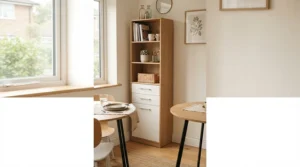
A shallow depth sideboard is any cabinet under roughly 35cm deep, and the difference between 25cm and 35cm is bigger than it looks.
Think in terms of what actually fits. A 28cm dinner plate can’t stand flat in a 24cm interior, as with the HOMCOM 110cm Sideboard (GCUB4601). A 33cm interior, like the compartments in the HOMCOM Sliding Door Tambour Sideboard, clears it with room to spare. That 9cm gap is the difference between a crockery cabinet and a display unit.
Shallow also means lighter on the floor. A 30cm piece like the Next Malvern Slim Sideboard or the Dunelm Georgi Slim 2 Door Sideboard consumes roughly half the depth of a standard 55-60cm buffet, which is the difference between a 90cm walkway and a 60cm squeeze.
The trade-off is stability. A shallow, tall cabinet has a smaller base to resist leaning, so it needs a wall fixing more urgently. Choose shallow for the walkway, and then anchor it.
Narrow Sideboard Under £150: What You Actually Get
A narrow sideboard under £150 will usually be particleboard or MDF with a laminate or melamine finish. That’s not an insult. Particleboard is simply wood chips bonded with resin, and it’s what keeps flat-pack furniture affordable.
What does that budget buy? In this guide, the VASAGLE LSC089B01, the HOMCOM 90cm Sideboard with Drawer (837-117ND), the HOMCOM Sliding Door Tambour Sideboard and the HOMCOM 110cm Sideboard (GCUB4601) all sit in budget territory. Check current prices, since they vary by retailer and season.
What it doesn’t buy is longevity. Edges chip, hinge screws loosen, and heavy loading sags shelves. The listed weight limits tell the story, such as the 5kg shelf limit on the HOMCOM 110cm Sideboard (GCUB4601).
My honest take is that under £150 is a smart choice for rented homes, first flats and rooms that will change soon. If you’re settled, saving towards the mid-range may pay off.
Sideboard vs Buffet Cabinet: Which Wins in a Small Room?
The distinction between sideboard vs buffet cabinet is blurry in shops. Traditionally, a buffet is a deeper, often taller serving piece, while a sideboard is lower and more general-purpose. In practice, the name matters less than the dimensions.
| Feature | Narrow sideboard | Traditional buffet cabinet |
|---|---|---|
| Typical depth | 30-40cm | 45-60cm |
| Floor impact | Minimal | Significant |
| Crockery capacity | Limited to light use | Generous |
| Best For | Small dining rooms, alcoves | Large dining rooms, heavy hosting |
The table shows the core trade-off. A buffet gives you room for full dinner services, tureens and serving platters. A narrow sideboard gives you back the walkway. In a small dining room, the second usually matters more.
I’d recommend a buffet only if the room genuinely has the clearance, and you host often enough to need the volume. Otherwise, pair a narrow sideboard with a tall cupboard elsewhere for bulky items.
Wall Anchoring: A Practical Guide
Wall anchoring is the unglamorous step that makes narrow sideboards for small dining rooms safe, particularly the taller models.
Before you start:
- Check whether your sideboard includes an anti-tip device. The HOMCOM 110cm Sideboard (GCUB4601) lists one, as does the HOMCOM Sliding Door Tambour Sideboard.
- Identify your wall type. Plasterboard, brick and lath-and-plaster each need different fixings.
- Use a stud finder or a cable-and-pipe detector, so you don’t drill into something you shouldn’t.
The process:
- Position the sideboard, then mark the bracket location on the wall.
- Drill a pilot hole and insert the correct wall plug for your wall type.
- Fix the bracket to the wall and the sideboard, tightening until firm.
- Pull gently on the top to confirm there’s no wobble.
Common mistakes in the first 30 days: using plasterboard plugs for a heavy load, skipping the check on rented walls (ask your landlord first), and loading heavy items on the top shelf. Keep heavier items low.
Taller, slimmer pieces like the Next Malvern Slim Sideboard and the Dunelm Georgi Slim 2 Door Sideboard benefit most, because a 90cm height on a 30cm base is a narrow stance. It takes ten minutes and could prevent an accident.
Open-Plan Dining Area: Real-World Scenarios
An open plan layout removes the walls that normally hide clutter. In an open-plan dining area, a sideboard also acts as a subtle room divider and a visual anchor, so its look matters more than usual.
Scenario 1: The kitchen-diner couple. You have a 2.5m wall between the kitchen and dining space, a modest budget and a need for everyday storage. The VASAGLE LSC089B01 suits this profile, since the sliding door avoids swing clashes with kitchen traffic.
Scenario 2: The through-lounge family. You have an L-shaped room where the dining table sits near the sofa. A longer piece like the HOMCOM 110cm Sideboard (GCUB4601) can run along the back of a seating area, doubling as a console while holding board games and table linen.
Scenario 3: The style-led renter. You rent a flat, move every few years and care about the look. The Dunelm Georgi Slim 2 Door Sideboard has the decorative detail, while keeping a light footprint. Check stock first.
In every case, match the sideboard height to the nearby furniture. A piece around 75-80cm high tends to sit comfortably beside a standard dining table, while taller models read as storage towers.
Problem-Solution Guide: Five Common Frustrations
Problem 1: “My chairs hit the sideboard.” Measure from the table edge to the wall, and keep at least 90cm. If you’re short, choose a 30cm model like the Next Malvern Slim Sideboard.
Problem 2: “My plates don’t fit.” Check interior depth. The HOMCOM Sliding Door Tambour Sideboard offers about 33cm, while the HOMCOM 90cm Sideboard with Drawer (837-117ND) doesn’t. Store plates in the kitchen if you already own a shallow unit.
Problem 3: “The sideboard wobbles.” Adjust the feet if available, tighten the fixings, and check the floor is level. Anchor to the wall if the model allows it.
Problem 4: “It looks flat and lifeless.” Layer a tray, a lamp and a plant on top, and consider a small rug beneath the nearby table. Keep styling to three objects, not ten.
Problem 5: “The surface keeps getting marked.” Use coasters, felt pads and heat-proof mats. Melamine finishes resist wiping, but hot dishes can still leave marks.
Features That Actually Matter (And Those That Don’t)
Marketing language can make every sideboard sound essential. Here’s the filter I’d apply.
Features that matter:
- Interior depth. It determines what you can store, as discussed above.
- Door mechanism. Sliding or tambour doors suit tight rooms.
- Anti-tip provision. Not optional for taller or lighter models.
- Adjustable shelves. The Dunelm Georgi Slim 2 Door Sideboard offers this, and it’s a genuine practical advantage.
- Drawers. Cutlery and napkins deserve their own space, as on the G Plan Winchester Narrow Sideboard.
Features that matter less:
- Decorative handles that can be swapped later.
- Leg colour, unless you’re matching a scheme.
- Headline “total capacity” figures, which rarely reflect per-shelf limits.
Look at per-shelf limits. A cabinet quoting 150kg total may only hold 30kg per compartment, as with the HOMCOM Sliding Door Tambour Sideboard.
Common Mistakes When Buying Narrow Sideboards for Small Dining Rooms
Most returns come from the same handful of errors.
- Buying on width alone. A 110cm sideboard can still be a poor fit if the depth blocks a chair.
- Ignoring door swing. Hinged doors need front clearance, so measure that arc.
- Skipping interior dimensions. The outside size isn’t the storage size.
- Forgetting the doorway. Measure hallways and stair turns, because a 90cm-tall flat-pack box is easy to wedge.
- Assuming all finishes behave alike. Dark or glossy surfaces show every fingerprint.
- Neglecting the wall. Skirting boards can stop furniture sitting flush, leaving a gap at the back.
- Over-loading shelves. Particleboard sags under heavy glassware over time.
The cheapest mistake to avoid is the skirting board one. Some units have a notched back, while others need a spacer to sit properly.
Long-Term Cost and Maintenance
Price isn’t the only cost. Over five to ten years, durability, repair and replacement all count.
| Tier | Example | Typical bracket | Expected lifespan feel | Best For |
|---|---|---|---|---|
| Budget | VASAGLE LSC089B01 | Under £150 | Short to medium | Rentals, first homes |
| Mid-range | Next Malvern Slim Sideboard | Around £200 | Medium | Settled small homes |
| Premium | G Plan Winchester Narrow Sideboard | Roughly £700-£900 | Long | Forever homes |
Lifespan notes are judgement-based, drawing on materials rather than tested data. The table shows the logic. If a £100 unit lasts three years, you pay roughly £33 a year, while a £700 piece lasting twenty years costs about £35 a year. The real difference is quality of experience and the hassle of replacing.
Maintenance basics: dust weekly, wipe spills straight away, avoid damp walls, tighten fixings every few months, and keep loads within stated limits. Particleboard hates moisture, so keep it away from external walls with condensation problems.
Safety and Regulations Guide
In the UK, general consumer furniture must meet general product safety expectations, and responsible retailers supply safety information and fixings. Tip-over is the main hazard to think about with sideboards, particularly where young children visit.
The OECD’s furniture tip-over campaign page notes that furniture can become unstable if climbed on, and it urges people to secure furniture to a wall or other structure. It also recommends low-set furniture with stable bases.
Practical steps:
- Anchor tall or shallow units to the wall.
- Keep heavy items low and light items high.
- Avoid placing toys or tempting items on top where children might climb.
- Check the manufacturer’s instructions for safe loading limits.
If you rent, ask your landlord about wall fixings, or look for freestanding alternatives with wide bases. Where a unit has a listed anti-tip feature, such as the HOMCOM 110cm Sideboard (GCUB4601), use it.
FAQs
❓ How much space should I leave around a narrow sideboard in a dining room?
❓ Can a 30cm deep sideboard store dinner plates?
❓ Is it worth paying more than £150 for a slim sideboard?
❓ What can I style on top of a narrow sideboard in a small dining room?
❓ Where can I buy narrow sideboards for small dining rooms in the UK?
Conclusion: Make the Wall Work Harder
Narrow sideboards for small dining rooms are one of the most useful pieces of furniture you can buy, if you choose by interior depth, door type and anchoring rather than by photograph. A 30cm piece gives back your walkway, while a 33cm interior gives you real crockery storage.
Here’s the short version of my analysis:
- For the tightest budget and alcoves, the VASAGLE LSC089B01 is a sensible starting point.
- For genuine crockery storage on a budget, the HOMCOM Sliding Door Tambour Sideboard has the interior depth to do it.
- For longer walls and display, the HOMCOM 110cm Sideboard (GCUB4601) offers width and an anti-tip device.
- For tight alcoves with taller storage, the Next Malvern Slim Sideboard is hard to beat.
- For adjustable storage and a contemporary look, the Dunelm Georgi Slim 2 Door Sideboard is worth checking if stock returns.
- For a piece to keep for decades, the G Plan Winchester Narrow Sideboard is the premium route.
Whichever you choose, measure twice, anchor it to the wall, and check current prices and availability before you buy.
✨ Your Dining Room Deserves Better Storage!
🛒 Compare the options above, check current pricing, and pick the slim sideboard that fits your wall, your plates and your budget. Click through now and take the first step towards a calmer, more spacious dining space!
Recommended for You
- White Gloss Sideboard With LED Lights: 7 Stunning Picks (2026)
- Breakfast Bar Stools: 7 Best Picks For UK Kitchens (2026)
- Adjustable Height Bar Stools For Kitchen Island: 7 Best Picks (2026)
Disclaimer: This article contains affiliate links. As an Amazon Associate, I earn from qualifying purchases. If you purchase products through these links, we may earn a small commission at no additional cost to you.
✨ Found this helpful? Share it with your friends! 💬🤗
