
In This Article
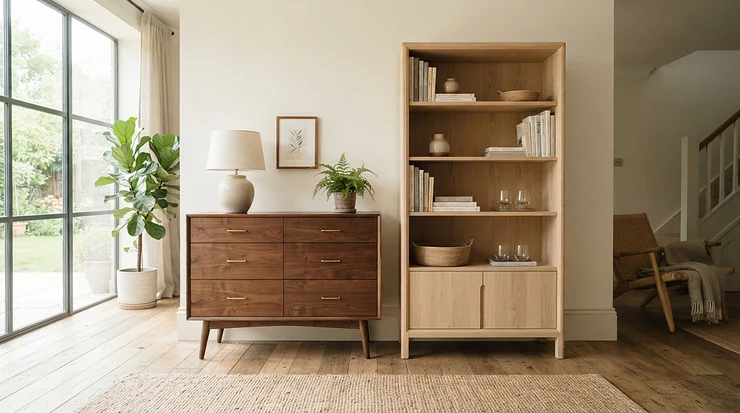
Choosing between an oak sideboard vs pine sideboard sounds like a question of taste. It isn’t. It’s a question of hardness, weight, upkeep, and how much of your budget you’re willing to sink into timber that mostly holds glasses and the odd rogue Christmas tablecloth.

Here’s the short version. Oak is the tank: dense, grainy, forgiving of knocks, and priced to match. Pine is the charming flatmate: kinder to your wallet, easy to paint, and a little more likely to wear its history on its face. Neither is wrong. Both can be superb or disappointing, depending on how the piece is built.
That build detail matters more than the species. A label saying “oak” might mean boards of solid timber. It might also mean a thin slice of real wood glued to a core such as MDF, the technique explained in this overview of wood veneer. We’ll untangle solid oak vs oak veneer properly later, because it’s where most buyers get caught out.
Over the next sections you’ll find seven real, researched options from budget to premium, with honest analysis of each. You’ll also get a practical look at what any sideboard with glass doors review UK shoppers read should really tell you. We’ll cover antique-style handles, the small detail that makes or breaks the look. And we’ll show you how to display glassware without turning your dining room into a crash site.
Prices below are ranges at the time of research, so always check current price and availability before buying.
Oak Sideboard vs Pine Sideboard: Quick Comparison
Before the individual reviews, here’s the head-to-head. Think of it as the cheat sheet you can screenshot and take shopping.
| Feature | Oak | Pine |
|---|---|---|
| Surface hardness | Harder: English oak averages around 1,120 lbf on the Janka scale | Softer: eastern white pine averages around 380 lbf |
| Look | Pronounced grain, warm honey to smoked tones | Straighter grain, visible knots, paler colour |
| Typical price (two-door piece, from this research) | Roughly £300-£650 and up | Roughly £150-£300 |
| Refinishing | Sands and re-oils well | Dents more easily, but paints beautifully |
| Best For | Busy family dining rooms and long-term buyers: Cotswold Oakham, K Interiors Embleton | Tight budgets, painters, first homes: Walplus 90 x 40 x 80 cm, IKEA HAVSTA |
The table shows a trade-off rather than a winner. Oak buys you resilience and resale-friendly looks, while pine buys you flexibility and a lower entry price. If your sideboard will be hit by school bags, vacuum cleaners and elbows, the hardness gap is the number that matters most. If you plan to repaint it in three years, pine’s softness becomes almost irrelevant.
💬 Just one click — help others make better buying decisions too!😊
Top 7 Sideboards: Expert Analysis of Oak and Pine Picks
Seven products, four oak-led and three pine-led, covering budget, mid-range and premium. Glass-fronted options appear on both sides of the divide. The comparison table comes first, then the detail.
| Product | Wood | Glass doors | Size (W x D x H) | Price range | Best For |
|---|---|---|---|---|---|
| Walplus 77 x 30 x 92 cm | Solid pine | Yes (topper unit) | 77 x 30 x 92 cm | Under £200 | Upgrading an existing base unit |
| Walplus 90 x 40 x 80 cm | Solid pine | Yes (2) | 90 x 40 x 80 cm | Low £200s | First-home display glassware |
| IKEA HAVSTA | Solid pine | Yes (cabinet and sliding) | Base 121 x 47 x 89 cm | Varies by configuration | Modular, growing collections |
| Argos Home Kent | Oak and oak veneer | No | Check listing | Around £300 | Busy households on a budget |
| Cotswold Oakham | Solid oak and veneers | No | 120 x 45 x 100 cm | £350-£400 range | Long-term dining-room storage |
| K Interiors Embleton | Solid oak and veneers | No | 110 x 45 x 90 cm | Low-to-mid £600s | Traditional, smoked-oak styling |
| Another Country Davenport | European oak (ply carcass) | Yes (fluted) | 180 x 50 x 73.5 cm | Premium | Statement glazed storage |
Read the table diagonally. Glass doors cluster in the pine tier, where manufacturers use them to make a modest piece feel like a showcase. In oak, glazing becomes a premium feature, with one notable exception we’ll get to. Also note how often “solid oak and veneers” appears: that blend is the norm, not the exception, at mid-range prices.
1. Walplus Solid Pine Sideboard (77 x 30 x 92 cm) — budget glazed topper for display glassware
This is less a sideboard than a hat for one. The listing describes a dresser top with shelves and glass doors, designed to sit on a sideboard or buffet you already own, which makes it the cheapest route to display glassware at eye level.
The specs repay a second look. At 30 cm deep it comfortably holds wine glasses, tumblers and teacups, though larger dinner plates will be a tight squeeze. The solid pine is sold untreated, so you choose the finish: leave it pale, wax it, or paint it. Stack it on a typical 80 cm base and you’re looking at roughly 1.7 metres of total height, which is why anchoring it to the wall is a must, not a nicety.
Based on the spec comparison, it suits renters who love a good paint project and anyone with a sturdy base unit already in place. I couldn’t verify a meaningful pool of customer reviews at the time of research, so there’s no sentiment to report here. Treat any claim of “five-star” reliability with suspicion.
Pros:
- ✅ Cheapest way to add glazed display storage
- ✅ Untreated solid pine, ready to paint or wax
- ✅ Wooden knobs suit a cottage or farmhouse look
Cons:
- ❌ Needs a separate base unit to be useful
- ❌ Top-heavy once stacked, so wall fixing is essential
Price: under £200 at the time of research (roughly £150-£170). It’s strong value if you already own the base, and poor value if you’d have to buy one.
2. Walplus Solid Pine Sideboard (90 x 40 x 80 cm) — two glass doors and drawers in a compact footprint
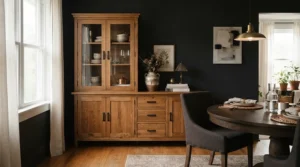
Here’s the one that most closely answers the brief: a floor-standing pine unit with two glass doors, two drawers and two shelves, finished in a grey and honey-brown scheme.
That two-tone finish is a smart trick. The grey body reads contemporary, while the honey tone keeps the pine looking like timber instead of paint. At 40 cm deep it takes standard dinner plates, and the 80 cm height puts the top at a sensible level for lamps and framed photographs. The cup handles lean gently towards antique-style handles, though they’re more rustic than genuinely period.
The listing states the unit must be fixed to the wall using the supplied attachment device, and assembly is required. Judging by the specification, it’s a first-home or small-dining-room piece rather than a forever sideboard. As with the topper above, I couldn’t verify enough genuine customer reviews to summarise sentiment honestly.
Pros:
- ✅ Glass doors, drawers and shelves in one unit
- ✅ Solid pine construction at a modest price
- ✅ Grey and honey finish feels current
Cons:
- ❌ Only 90 cm wide, limiting larger dinner sets
- ❌ Self-assembly and mandatory wall anchoring
Price: low £200s at the time of research. It’s good value for a solid-pine, glass-fronted piece, provided you don’t expect heirloom resilience.
3. IKEA HAVSTA — stackable sideboard and glass cabinet system
HAVSTA isn’t one product but a family, and that’s its real strength. You can buy the sideboard base on its own or add a glass-door cabinet on top, building the piece you need.
The base unit measures 121 x 47 x 89 cm, with two drawers, an adjustable shelf and sliding doors that take up no room when opened. That last detail is gold in narrow dining rooms where swinging doors would hit a chair. The glass-door cabinet (121 x 35 x 123 cm) uses tempered-glass shelves with wooden edges, rated for up to 32 kg per shelf, which comfortably covers a serious glassware collection. The whole range is solid pine with stain and clear lacquer.
Customer reviews on the HAVSTA listings I could access are mixed but broadly positive. Buyers praise the roomy storage and adjustable glass shelves. Complaints centre on quality-control niggles, chips sustained during assembly, and fingerprints trapped on the glass. One practical tip from reviewers: clean the glass before installing it, and wear gloves. Two people are needed to assemble it.
Pros:
- ✅ Modular: start small, add the glass cabinet later
- ✅ Sliding doors save space in tight rooms
- ✅ Sturdy tempered-glass shelves, 32 kg rated
Cons:
- ❌ Two-person assembly with fiddly glass handling
- ❌ Some reviewers report finish and quality-control issues
Price: varies by configuration, so check current price. Value is strongest when you buy in stages.
4. Argos Home Kent — chunky, rounded-edge oak value pick
The Kent is a two-door, two-drawer sideboard described as made from oak and oak veneer, with a chunky profile and rounded edges. It’s the entry ticket to the oak side of this debate.
Those rounded edges aren’t just decorative. Softer corners shrug off the small impacts that chip sharper profiles, which suits busy households. The metal cup handles lend a classic feel, and the surface shows off natural grain and knots. It also comes in a grey-and-oak variant if you want to hedge your bets.
What the listing doesn’t tell you is the split between solid and veneered components, so use the veneer guidance later in this article and ask the retailer. The Kent carries a 4.75 out of 5 rating, but from only four reviews at the time of research. That’s encouraging yet statistically thin, so it shouldn’t carry much weight. For a first real oak-look sideboard, it’s a sensible start.
Pros:
- ✅ Oak and oak veneer at an accessible price
- ✅ Rounded edges handle everyday knocks
- ✅ Metal cup handles with classic charm
Cons:
- ❌ No glass doors
- ❌ Solid-versus-veneer split isn’t spelled out
Price: around £300 at the time of research. Good value if you want oak character without the oak premium.
5. Cotswold Oakham — dovetailed solid oak for everyday dining rooms
The Oakham two-door sideboard measures 120 x 45 x 100 cm and weighs 54 kg. That weight is a quiet quality signal: you can’t fake heft with chipboard.
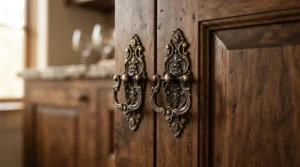
It’s built from solid oak with strengthening veneers, uses dovetail joinery in the drawers, and finishes with a hardwearing lacquer. The chunky top handles the lamp, fruit bowl and school-photo clutter of daily life. Brushed steel handles suit modern interiors, but the fixing holes make a swap to antique-style handles straightforward. The unit arrives fully assembled, which removes the biggest source of flat-pack frustration.
On sentiment, one customer reviewer described it as well made and solid in their dining room. Separately, the retailer holds a 4.5-star Trustpilot rating from around 24,000 reviews, though that’s a company-wide score, not a verdict on this product. What stands out analytically is the construction method: using veneers where they add stability, instead of hiding them, is the honest approach discussed later.
Pros:
- ✅ Solid oak with dovetail drawer joinery
- ✅ Arrives fully assembled
- ✅ Heavy, stable and easy to re-handle
Cons:
- ❌ No glass doors
- ❌ Brushed steel handles feel modern, not traditional
Price: £350-£400 range at the time of research. It’s the best all-rounder value in this lineup.
6. K Interiors Embleton — smoked oak with traditional proportions
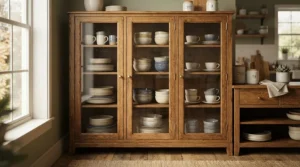
The Embleton is for people who want their oak sideboard to look like it has a story. Its smoked-oak finish deepens the grain into something close to a whisky barrel.
Built from thick solid oak with oak veneers, it measures 110 x 45 x 90 cm and arrives fully assembled. The smoked finish does a useful practical job: darker oak hides fingerprints, water rings and minor scuffs better than a pale lacquer does. It’s marked wipe-clean only, so skip abrasive polishes. Delivery is via a partner, UK mainland only, with no weekend slots, so plan your day accordingly.
Based on the spec comparison, this is the piece for traditional or period homes, especially if you plan to fit antique-style handles to push the look further. Frankly, a smoked oak top is also the most forgiving surface in this roundup for hosting. I couldn’t verify a robust review pool for this model, so I won’t pretend otherwise.
Pros:
- ✅ Thick solid oak with a rich smoked finish
- ✅ Dark tone masks everyday marks
- ✅ Delivered fully assembled
Cons:
- ❌ No glass doors
- ❌ Partner delivery, mainland only, no weekends
Price: low-to-mid £600s at the time of research. Fair value for solid oak with this finish, though it’s a tier above the Cotswold Oakham.
7. Another Country Davenport — fluted-glass oak for a statement room
Now for the showpiece. The Davenport is a three-door sideboard 180 cm wide, 50 cm deep and 73.5 cm tall, in European oak with an oil-and-wax finish that keeps the timber looking natural.
The fluted (reeded) toughened glass is the clever part. It gives “just enough of a glimpse” of the interior, as the maker puts it, which means your display glassware gets a soft, diffused backdrop without every mismatched mug being on show. Brass detailing and a sunken top add the designer touches. It shares design language with the Davenport Bureau, a 2022 Design Guild Mark winner.
Note the construction details: solid oak and raw oil, plus beech ply and oak laminate. Even at this tier, the carcass uses engineered materials, proof that “premium” doesn’t mean “solid throughout”. It’s made to order, so allow lead time. I found no verifiable customer review pool, so judge it on specification and maker reputation.
Pros:
- ✅ Fluted toughened glass hides clutter elegantly
- ✅ European oak with brass detailing
- ✅ Generous 180 cm width and interior shelving
Cons:
- ❌ Made to order, so delivery isn’t instant
- ❌ Premium price puts it out of reach for many
Price: premium, comfortably into four figures at the time of research, so check current price. Excellent for a room where the sideboard is the star, and overkill for a utilitarian hallway.
Reading across all seven, a pattern emerges. The cheapest options offer glass and flexibility, the middle tier offers real oak and construction honesty, and the top tier pays for design and glazing finesse. Your best choice depends on which of those three you value most.
How to Set Up and Care for Your Sideboard (Your First 30 Days)
A sideboard is rarely ruined by one dramatic event. It’s usually death by small neglect, so here’s a first-month plan that costs nothing.
Day 1: place it properly. Position the piece away from radiators and direct sun, both of which can fade finishes and stress timber. Fit the anti-tip kit before loading anything. Retailer instructions are unanimous that unanchored furniture can tip and cause serious injury, and several of the pieces above explicitly require wall fixing.
Week 1: level it and lift it. Use the adjustable feet or shims to stop rocking, because a wobble puts constant strain on joints and glass. Manufacturer guidance also warns against dragging furniture: always lift it into place and mop floors without splashing the base.
Weeks 2-4: establish a routine. Dust with a dry or barely damp cloth. Avoid abrasive or silicone-based polishes, which can dull finishes over time, and follow the maker’s care label, since the K Interiors Embleton, for example, is wipe-clean only. Oiled oak, such as the Another Country Davenport, benefits from an occasional maintenance coat, while lacquered pieces mostly need protecting from heat and water.
Common first-month mistakes: loading heavy items on the top shelf first, ignoring the load ratings (the IKEA HAVSTA glass shelves are rated to 32 kg), and leaving hot dishes directly on lacquered tops. Coasters and trivets are the cheapest insurance you’ll ever buy.
Real-World Scenarios: Three Households, Three Sideboards
Specs only mean something in context. Here are three typical buyers and the logic behind matching each to a piece.
Scenario 1: the renter with a small dining nook. Budget under £250, a rented flat, and a landlord who frowns on drilling. The temptation is a cheap veneer unit, but a solid-pine piece like the Walplus 90 x 40 x 80 cm offers more repaint flexibility if the style ever changes. The caveat is the wall-fixing requirement, so ask your landlord about a discreet bracket.
Scenario 2: the family of five. Budget £350-£650, daily use, small children, frequent hosting. Hardness matters most here, so oak wins. The Cotswold Oakham gives you a chunky, dovetailed body at a sensible price, while the K Interiors Embleton adds a darker finish that camouflages inevitable marks. Rounded or chunky edges help, and the Argos Home Kent is worth a look if the budget is tighter.
Scenario 3: the collector. Budget flexible, a cabinet of inherited crystal, and a room where the sideboard is on show. The Another Country Davenport makes the strongest case, with fluted glass that flatters rather than exposes. On a smaller budget, the IKEA HAVSTA pairing delivers the same “glass above, storage below” idea at far lower cost.
Display Glassware Without the Heartbreak: Problems and Solutions
Glass doors look wonderful until real life arrives. These are the most common display glassware headaches, and the fixes.
Problem 1: fingerprints and dust. Glass shows everything. Clean it before installation, as reviewers of glass-cabinet products advise, and wear cotton gloves when fitting shelves.
Problem 2: overloaded shelves. Check the stated load rating, then distribute weight evenly. The IKEA HAVSTA cabinet’s glass shelves are rated to 32 kg each, which is generous, but a full set of heavy crystal decanters can approach that surprisingly fast.
Problem 3: edge damage. IKEA specifically warns that a damaged edge or scratched surface can cause tempered glass to crack suddenly, and that side impacts are the most dangerous. Keep chair backs and vacuum heads away, and never ignore a chip on a glass edge.
Problem 4: top-heavy stacks. Glazed hutches and tall cabinets raise the centre of gravity. The Walplus 77 x 30 x 92 cm topper is the clearest example: it’s only safe when fixed to the wall.
✨ Don’t Miss These Carefully Selected Picks!
🔍 Take your display glassware to the next level with the sideboards above. Click on any highlighted product name to check current pricing and availability. A well-chosen piece will help you create a dining room that feels considered, not cluttered!
What Is an Oak Sideboard vs Pine Sideboard?
An oak sideboard is a low storage cabinet made from dense, close-grained hardwood, valued for durability and a pronounced grain. A pine sideboard uses a lighter, softer timber with straighter grain and visible knots. Oak costs more and resists dents better, while pine is cheaper and easier to paint. Both can be solid or veneered.
Beyond that definition, three practical differences matter in daily use. First, weight: dense oak is heavier, which makes it more stable but harder to move. Second, ageing: oak mellows slowly, while pine warms and shows marks sooner, a trait some buyers love and others loathe. Third, finish behaviour: pine accepts paint evenly, whereas oak’s open grain can show through opaque colours unless filled first.
Meanwhile, “solid” and “veneer” describe construction, not species, so each wood can appear in either form. That’s why the next section matters.
Solid Oak vs Oak Veneer: What You’re Really Paying For
Solid oak vs oak veneer is the most misunderstood debate in furniture shopping, so let’s defuse it. Solid oak is timber through and through. Veneer is a thin sheet of real oak bonded to a core such as plywood, MDF or particleboard.
Neither is inherently better, and a retailer’s own guidance makes the point well: quality depends on who made the piece. A carefully made veneered sideboard can outperform a cheaply made solid one. The real enemy is corner-cutting: thin veneer on weak particleboard, plastic edging and exposed raw board.
| Factor | Solid oak | Oak veneer |
|---|---|---|
| Stability | Can move with humidity changes | Often more dimensionally stable |
| Weight | Heavier | Usually lighter |
| Repair and refinishing | Sands back repeatedly | Limited by veneer thickness |
| Cost | Higher | Lower |
| Best For | Long-term buyers: Cotswold Oakham | Large panels and budgets: Argos Home Kent |
The table shows why mixed construction is so common: the Cotswold Oakham and the K Interiors Embleton both use solid oak with veneers, putting each material where it performs best. Large flat panels are the classic spot for veneer, because they resist warping. Frames, tops and drawer fronts are where solid timber shows its worth. Your checklist: ask for the veneer thickness, check edges for exposed board, and favour retailers who describe construction plainly.
How to Choose an Oak Sideboard vs Pine Sideboard
Follow these six steps and you’ll avoid most regrets.
- Measure first. Allow for door and drawer swing, skirting boards and wall sockets. Depth matters as much as width, and 40-47 cm is typical for the pieces here.
- Set your realistic budget. Pine pieces in this roundup sit around £150-£300, while oak starts near £300 and climbs quickly. Decide before you browse.
- Match wood to workload. Heavy daily use points to oak, while occasional or decorative use makes pine perfectly sensible.
- Interrogate the construction. Ask whether the piece is solid timber, veneer over ply, or veneer over particleboard, and where each is used.
- Decide on glass. Glazed doors suit display glassware and collectables but demand more cleaning and care. Solid doors hide clutter.
- Plan the finish and hardware. Pine invites paint, oak rewards oil or lacquer, and swapping handles is a cheap personality upgrade.
Oak Sideboard vs Pine Sideboard: Durability, Looks and Feel in Real Life
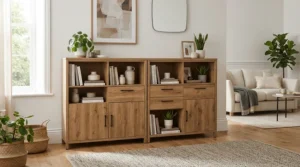
On paper, the durability gap is clear. The Janka hardness test, which measures resistance to denting, lists English oak at around 1,120 lbf and white oak at about 1,360 lbf. Softer pines sit far lower: eastern white pine is around 380 lbf and radiata pine around 710 lbf.
What does that mean in practice? A dropped keyring that leaves a faint dimple on pine may leave oak untouched. Over years, pine tends to collect small marks that some owners embrace as patina and others find irritating. Oak’s greater density also holds screws and hinges well, which matters for the heavy glass doors on a sideboard with glass doors.
Looks diverge too. Oak shows a bolder, more figured grain, while pine’s straighter lines and knots read as relaxed and rustic. Pine’s knots also give you a design decision: paint to calm them down, or keep them for character.
Pine isn’t a lesser choice, though. A well-built solid pine piece like the IKEA HAVSTA can last for years in a gentle household, and repainting is easier than refinishing oak. The honest verdict: oak for resilience, pine for flexibility and value.
Sideboard With Glass Doors Review UK: What to Expect
Search for any sideboard with glass doors review UK shoppers publish and you’ll find enthusiasm outweighing evidence. Here’s what can genuinely be said, and what can’t.
What the sentiment suggests. Reviewers of glazed IKEA pieces praise roomy storage and adjustable glass shelves, while the critical comments focus on assembly chips, quality control and smudged glass. Buyers of glass-door display units from the retailer behind the Cotswold Oakham have reported good delivery experiences.
What can’t be verified. For several pieces here, including both Walplus units and the K Interiors Embleton, I found too few genuine reviews to summarise honestly. That’s a limitation, not a verdict.
A warning about availability. The Cotswold Company’s Appleby glazed oak sideboards, both two-door and three-door, were marked discontinued at the time of research. That’s a reminder that glazed oak at mid-range prices is a shifting market, so confirm stock before you fall in love.
Design choices to weigh. Clear glass maximises display but exposes clutter. Fluted glass, as on the Another Country Davenport, forgives untidiness. Sliding doors suit tight spaces, while hinged doors give fuller access. And whatever you choose, tempered or toughened glass is the sensible standard.
Antique-Style Handles: Small Details, Big Character
Handles are the jewellery of a sideboard. A change of hardware can shift a piece from showroom-modern to country-house in an afternoon, which is why antique-style handles deserve their own conversation.
What’s on offer here. The Argos Home Kent has metal cup handles, the Walplus 90 x 40 x 80 cm uses cup handles, the Cotswold Oakham has brushed steel, and the Another Country Davenport features rich brass detailing. Each choice signals a different era.
How to swap them safely. Measure the centre-to-centre distance between existing screw holes, then buy handles that match, or you’ll be filling and redrilling. Check the screw length against your door or drawer thickness. A too-long screw can poke through the front, and a short one will loosen.
Finish matters. Unlacquered brass develops a natural patina, which suits a lived-in look. Lacquered brass stays bright. Blackened iron pairs beautifully with smoked oak like the K Interiors Embleton, and ceramic knobs lend a farmhouse touch to painted pine.
The honest take: handles are the cheapest, lowest-risk upgrade on any sideboard, and antique-style handles can make a budget pine unit look far more expensive than it is.
Long-Term Cost and Maintenance
Sticker price tells only part of the story. Cost per year of use tells the rest, as long as you’re honest about lifespan.
| Tier | Example | Price range | Value verdict | Best For |
|---|---|---|---|---|
| Budget pine | Walplus 90 x 40 x 80 cm | Low £200s | Great value for light use | First homes |
| Mid oak | Cotswold Oakham | £350-£400 | Best all-round value | Families |
| Premium oak | K Interiors Embleton | Low-to-mid £600s | Fair for finish and build | Traditional rooms |
Here’s an illustration, not a guarantee. A pine piece around £225 lasting eight years costs roughly £28 a year. An oak piece around £375 lasting 15 years comes to about £25 a year. The cheaper piece isn’t automatically the better deal.
Maintenance costs are low across the board. Oiled oak may need an occasional refresh, lacquered pieces mostly need protection from heat and water, and painted pine may need a touch-up coat after a few years. The sneaky cost is damage: a chipped glass shelf or a cracked door panel can cost more to fix than a basic duster ever will. Treat the glazed pieces with respect and they’ll repay you.
Safety and Regulations: What UK Buyers Should Know
Sideboards seem harmless, but tall, loaded or glazed furniture carries genuine risks.
Tip-over. Retailer assembly guides are blunt: unanchored products can tip and cause serious or fatal crushing injuries, so fit the supplied anti-tip kit. The Walplus 90 x 40 x 80 cm listing explicitly states the product must be used with its wall attachment device. Wall fixings often aren’t supplied, because different walls need different plugs, so check yours or consult a tradesperson.
Glass. Choose tempered or toughened glass, avoid side impacts, and replace any chipped panel promptly. IKEA’s HAVSTA guidance highlights exactly this vulnerability.
Regulations. UK law places safety duties on sellers, and government guidance on furniture and furnishings fire safety regulations explains the updated rules that came into force in October 2025. Those regulations chiefly concern upholstered furniture and related products, so a timber sideboard isn’t their main focus. General product-safety requirements still apply, so buy from reputable sellers, keep your paperwork, and report any faults.
FAQ
❓ Is a pine sideboard really cheaper than an oak sideboard?
❓ Can I paint or stain a pine sideboard?
❓ Where should I put a sideboard with glass doors?
❓ Do oak sideboards arrive fully assembled?
❓ Can I fit antique-style handles to my sideboard?
Conclusion
So, which wins the oak sideboard vs pine sideboard contest? It depends on how you live. If your sideboard will face daily knocks and you want a piece to keep for years, oak is the safer investment, with the Cotswold Oakham the best value and the K Interiors Embleton the better choice for a darker, more traditional room. If you’re furnishing on a budget, love painting projects, or simply want display glassware behind glass without overspending, solid pine like the Walplus 90 x 40 x 80 cm or the modular IKEA HAVSTA makes excellent sense.
Remember the three big lessons. Construction beats species, so interrogate the solid oak vs oak veneer split. Glass demands care, so read every sideboard with glass doors review UK buyers post, then temper it with caution where evidence is thin. And hardware is cheap personality: a set of antique-style handles can transform almost any unit.
Whatever you choose, anchor it to the wall, respect the load ratings, and enjoy it.
✨ Ready to choose your sideboard?
🔍 Click any highlighted product name above to check current pricing and availability, then pick the piece that fits your room, your budget and your glassware. Your dining room will thank you! 🪑
Recommended for You
- Narrow Sideboards For Small Dining Rooms: 7 Smart Picks (2026)
- White Gloss Sideboard With LED Lights: 7 Stunning Picks (2026)
- Breakfast Bar Stools: 7 Best Picks For UK Kitchens (2026)
Disclaimer: This article contains affiliate links. As an Amazon Associate, I earn from qualifying purchases. If you purchase products through these links, we may earn a small commission at no additional cost to you.
✨ Found this helpful? Share it with your friends! 💬🤗
