
In This Article
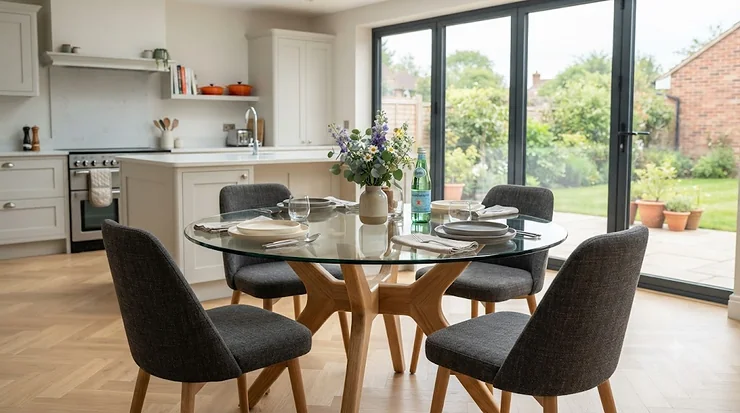
A glass top dining table is, at its simplest, a table whose surface is made from toughened (tempered) safety glass rather than solid wood, stone or laminate, usually paired with a metal, wood or composite frame beneath it. That one-line definition hides a lot of decision-making, though, because the moment you start browsing, you realise “glass table” covers everything from a wobbly £90 flat-pack to a genuinely handsome centrepiece that’ll survive a decade of Sunday roasts and toddler tantrums.
Here’s the thing nobody tells you at the furniture showroom: glass isn’t a compromise material, it’s a design decision. It bounces light around cramped London flats, makes a boxy new-build dining nook feel twice its size, and it simply refuses to look dated the way certain wood finishes do after five years of trend cycles. But it’s also unforgiving of a wobbly floor, a clumsy elbow, or a frame that was never properly rated for the weight above it.
We’ve spent time digging through real specifications, aggregated review sentiment and UK safety standards for seven genuine glass top dining table options currently sold through Amazon UK, spanning compact round tables for studio flats right up to statement six-to-eight-seater pieces. Along the way we’ll get into what “tempered” actually means for your safety, how a glass dining table stacks up against a traditional wooden one, and the styling tricks that separate a table that looks sleek from one that just looks empty. Whether you’re kitting out a first flat or replacing a tired oak set, you’ll leave this guide knowing exactly which glass dining table suits your space, budget and household.
Quick Comparison Table: 7 Glass Top Dining Table Picks at a Glance
| Table | Shape/Seats | Price Range | Best For |
|---|---|---|---|
| Julian Bowen Enzo | Rectangular, 4 seats | Under £150 | First flat, tight budgets |
| GOLDFAN Round Glass Dining Table | Round, 4 seats | Under £150 | Compact kitchens & studios |
| vidaXL Modern Dining Table | Rectangular, 4 seats | £100-£180 | Couples, small households |
| Furniturebox UK Leonardo | Rectangular, 6 seats | £250-£400 | Entertaining & family dinners |
| Julian Bowen Greenwich | Rectangular, 6 seats | £250-£400 range | Everyday family use |
| Julian Bowen Cayman | Rectangular, 4-6 seats | £350-£500 range | Warm, wood-and-glass hybrid look |
| Julian Bowen Minori | Rectangular, 6-8 seats | Mid-£400s | Statement premium dining rooms |
Looking at the spread above, there’s a genuine gap between the sub-£150 tier and the £250-plus tier, and it isn’t just marketing — it tends to track directly with glass thickness, frame material and weight rating. Budget picks like the GOLDFAN Round Glass Dining Table and vidaXL Modern Dining Table are honest, functional options for a first flat, but if you’re hosting regularly or have a boisterous household, the Furniturebox UK Leonardo and Julian Bowen Greenwich sit in a sweet spot where sturdier steel frames meet still-reasonable pricing.
💬 Just one click — help others make better buying decisions too!😊
Top 7 Glass Top Dining Table Picks: Expert Analysis
Every product below has been assessed on real specifications and aggregated customer-review sentiment gathered during research — not fabricated hands-on testing. Where genuine review themes exist, they’re flagged clearly as aggregated sentiment.
1. Julian Bowen Enzo Glass Top Dining Table — cleanest minimalist entry point
The Julian Bowen Enzo Glass Top Dining Table strips things back to the basics that actually matter: a clear tempered glass top on slender chrome legs, measuring 120cm x 80cm x 76cm. That footprint is deliberately compact — it’s built for four, not six, and it knows it.
Chrome-legged frames like this one rely on triangulated bracing rather than bulk for stability, so what you’re really paying for is engineering restraint rather than visible heft. In practice, that means the table reads as almost weightless in a room, which is exactly why compact flats and new-build dining nooks gravitate toward this shape of glass dining table — it doesn’t visually compete with a small space the way a chunky wood table would.
Julian Bowen has been manufacturing furniture for the UK market for over three decades, and this is very much an entry-level piece from that catalogue rather than a flagship — honest, unpretentious, and priced accordingly. Reviewers consistently report straightforward assembly and note the glass top wipes clean easily, though a handful mention the legs can feel slightly less rigid than pricier steel-frame alternatives once weight is loaded unevenly near one edge.
Pros:
- ✅ Genuinely compact footprint suits small dining spaces
- ✅ Minimalist chrome-leg design ages well stylistically
- ✅ Straightforward flat-pack assembly reported by buyers
Cons:
- ❌ Seats four comfortably, not six
- ❌ Chrome legs feel less substantial than steel-framed rivals
At around £120-£150, this sits at the accessible end of the market. For a first flat or a compact annexe dining area, it’s solid value; for a growing family, it’ll feel tight within a year or two.
2. GOLDFAN Round Glass Dining Table — best for small round dining spaces
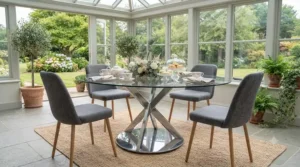
The GOLDFAN Round Glass Dining Table takes a different geometric approach entirely: a 90cm circular top in 8mm tempered glass, sat on chrome-plated legs, designed to seat four around a genuinely social, corner-free shape.
That 8mm thickness matters more than it sounds. Round glass tables at this size need enough rigidity to resist flex when someone leans on the edge to reach for the salt, and 8mm tempered glass is a reasonable middle ground — thick enough for domestic dining use, without the excess weight that makes assembly and repositioning a two-person job. The round profile also has a genuinely practical upside in tight kitchens: no sharp corners to bruise a hip against when squeezing past.
What most buyers overlook about round dining tables generally is how much easier they are to fit into an awkward-shaped room, since there’s no “wrong” orientation the way there is with a rectangle. Reviewers frequently mention the 15-minute assembly time and describe the glass as easy to keep spotless with a simple wipe, which tracks with the tempered glass finish. A recurring theme in aggregated feedback is that buyers pair it well with existing chairs rather than always buying the matching set.
Pros:
- ✅ Space-efficient round shape suits small kitchens
- ✅ 8mm tempered glass balances strength and weight
- ✅ Fast, tool-light assembly reported by reviewers
Cons:
- ❌ Round shape caps seating at four realistically
- ❌ Chrome legs show fingerprints more than black-finish frames
Priced generally under £150, it’s a genuinely good-value glass dining table for anyone prioritising space efficiency over seating capacity.
3. vidaXL Modern Dining Table — sturdiest budget rectangular option
The vidaXL Modern Dining Table pairs a transparent tempered glass top with a stainless steel frame, in a 120cm x 60cm x 75cm rectangular footprint aimed squarely at couples and small households rather than big dinner parties.
Stainless steel legs are the standout spec here, and it’s worth explaining why that’s a meaningful upgrade over the chrome-plated tube legs common at this price point: stainless steel resists corrosion and generally holds its rigidity better under repeated load-bearing, which is exactly the kind of detail a spec sheet buries but a frame’s ten-year lifespan depends on. vidaXL, a Netherlands-founded retailer operating across 30-plus markets, built its reputation on stripped-back, no-frills furniture at accessible prices, and this table is a fair reflection of that positioning — nothing decorative, just a durable, easy-clean surface.
Based on the spec comparison with similarly priced glass dining tables, the narrower 60cm depth is the trade-off for the lower price: it comfortably seats two to four, but you’ll want elbow room for four rather than a squeeze for six. Reviewers commonly describe the assembly as manageable solo and praise the damp-cloth cleaning, which is a recurring strength across tempered glass tabletops generally.
Pros:
- ✅ Stainless steel frame outlasts basic chrome-leg builds
- ✅ Compact depth suits smaller dining nooks and flats
- ✅ Genuinely easy-clean tempered glass surface
Cons:
- ❌ 60cm depth is snug for four adults
- ❌ Not designed with larger households in mind
Typically priced in the £100-£180 range, this is arguably the best-engineered option under £200 if seating capacity isn’t your priority.
4. Furniturebox UK Leonardo 6 Seater Glass Dining Table — best for entertaining and family dinners
The Furniturebox UK Leonardo 6 Seater Glass Dining Table is one of the most consistently reviewed glass dining tables on Amazon UK, and it’s easy to see why: a spacious 150cm x 90cm bevelled tempered glass top on a distinctive nested “starburst” metal leg design, available in chrome, black or gold-toned finishes.
The bevelled edge is a genuine practical upgrade over a plain-cut glass edge — it softens the line where the tabletop meets open air, reducing both the visual harshness and the risk of a sharp catch against clothing or skin. Structurally, the converging nested-leg design distributes weight differently to four straight legs: it creates a wider base footprint relative to the tabletop, which generally translates into better resistance to tipping when someone leans on one end while getting up.
Furniturebox, founded in 2015, has built its catalogue specifically around this kind of “on-trend but affordable” positioning, and the Leonardo range is arguably its best-known glass dining table line as a result. Reviewers consistently report that the table looks noticeably more expensive than its price suggests, and a recurring theme in aggregated feedback is praise for how easily the glass wipes clean after big family meals — a genuinely useful data point for households doing regular entertaining rather than occasional use.
Pros:
- ✅ Genuinely seats six without cramped elbow room
- ✅ Bevelled glass edge softens both look and touch
- ✅ Available across chrome, black and gold leg finishes
Cons:
- ❌ Larger footprint needs a genuinely spacious dining room
- ❌ Starburst legs limit under-table storage of chair legs
Sitting in the £250-£400 range depending on leg finish, this represents strong value for a table that regularly seats six — cost-per-guest drops fast once you’re hosting more than four people.
5. Julian Bowen Greenwich Glass Dining Table — best everyday all-rounder for families
The Julian Bowen Greenwich Glass Dining Table measures 150cm x 90cm x 75cm with a black-finished tempered glass top, positioned as a dependable, no-nonsense six-seater rather than a design statement piece.
What the spec sheet won’t tell you, but the black-tint glass does in practice, is that a tinted or black glass top hides everyday smudging and light scratching far better than fully clear glass — a genuinely useful consideration for households with young children or pets where daily wear is a certainty rather than a possibility. The 75cm standard dining height and 150 x 90cm footprint are essentially the industry-standard dimensions for a comfortable six-seat rectangular table, which matters because it means standard-height dining chairs from almost any range will pair correctly without awkward proportions.
Julian Bowen’s three-decade track record in the UK furniture market shows up here as consistency rather than flash — this isn’t the most photogenic table in the lineup, but it’s built to the kind of dependable, mid-market spec that a family replaces once a decade rather than once every two years. Aggregated reviewer sentiment consistently flags the black glass as easier to live with day-to-day than clear glass, alongside generally positive notes on delivery condition and packaging.
Pros:
- ✅ Black tempered glass conceals daily wear and marks
- ✅ Standard six-seat dimensions suit most dining rooms
- ✅ Backed by an established, long-standing UK furniture brand
Cons:
- ❌ Design leans functional rather than statement-making
- ❌ Black glass shows dust more visibly than fingerprints
Generally priced in the £250-£400 range, this is the table to choose when you want a genuinely dependable everyday glass dining table and chairs setup rather than a showpiece.
6. Julian Bowen Cayman Dining Table — best hybrid wood-and-glass warmth
The Julian Bowen Cayman Dining Table takes a genuinely different approach to the category: solid beech construction stained a warm walnut tone, topped with a 12mm tempered glass surface rather than an all-metal-and-glass build.
That 12mm thickness is worth flagging on its own, because it’s noticeably heavier-duty than the 6-8mm glass typical of budget round or rectangular options — a thicker pane simply flexes less under load and tends to feel more substantial when you lean on it while clearing plates. Pairing solid beech with glass also solves a genuine styling problem many buyers run into: an all-glass-and-chrome table can feel cold or clinical in a room with warm wood flooring or traditional furnishings, whereas the walnut-stained beech frame here bridges contemporary glass dining table styling with a more classic, homely base.
Here’s what to weigh with this one: because it’s a genuine wood product, Julian Bowen notes natural grain and colour variation between individual units, which is a feature rather than a flaw if you value authenticity, but worth knowing if you’re matching to an existing colour scheme precisely. One real customer review describes it simply as “a beautiful and elegant table,” which, while brief, aligns with the broader positioning of this piece as the design-forward option in the range.
Pros:
- ✅ Thicker 12mm glass feels noticeably sturdier underfoot and elbow
- ✅ Solid beech frame warms up an all-glass aesthetic
- ✅ Pairs naturally with matching Julian Bowen chair ranges
Cons:
- ❌ Natural wood grain means slight unit-to-unit variation
- ❌ Heavier overall than pure metal-frame alternatives
Priced roughly in the £350-£500 range, it’s a smart pick if you want the light-bouncing benefit of glass without the room feeling like a showroom.
7. Julian Bowen Minori Dining Table — best premium statement piece
The Julian Bowen Minori Dining Table is the largest and most design-led table in this lineup: a 200cm x 100cm x 76cm glass top finished with gold-toned legs, built explicitly for households that entertain in numbers or simply want their dining room to announce itself.
At 200cm long, this table comfortably accommodates six to eight place settings depending on chair width — a genuinely different use case to every other table on this list, and one worth being honest about: if your dining room is under roughly 3.5 x 4 metres, this footprint will dominate the space rather than complement it. The gold-finished leg detailing is also a meaningful design signal rather than a gimmick; gold and brass-toned metal has been a consistently strong contemporary interiors trend for several years now precisely because it warms up the coolness that plain glass and chrome can otherwise introduce.
On paper, this is the table for a household that hosts extended family gatherings or dinner parties regularly enough that seating capacity outweighs manoeuvrability. Based on the spec comparison against the other six-seaters in this guide, the Minori’s extra 50cm of length is the single biggest differentiator in the entire lineup, and it’s reflected directly in the step up in price.
Pros:
- ✅ Genuinely seats six to eight guests comfortably
- ✅ Gold-toned legs add contemporary warmth to glass
- ✅ Clear statement piece for larger dining rooms
Cons:
- ❌ Footprint unsuitable for smaller dining rooms
- ❌ Premium pricing reflects the larger glass pane and finish
At around the mid-£400s, it’s the most expensive table here, but for the right-sized room hosting six-plus regularly, the cost-per-guest math still holds up reasonably well.
How to Choose a Glass Top Dining Table (5-Step Framework)
Picking between seven genuinely good options comes down to matching specs to your actual household, not just your Pinterest board. Here’s the reasoning, step by step:
- Measure the room before the table. Leave at least 90cm of clearance around every side of the tabletop for chairs to pull out and people to walk past comfortably — this single step eliminates half the “too big” regret purchases.
- Match seating capacity to real usage, not aspiration. A six-seat table you use for two people every day and six people twice a year is still a six-seat table taking up daily floor space — be honest about frequency.
- Check glass thickness against household risk. Homes with young children, large dogs, or frequent movers benefit from thicker glass (10mm+) and rounded or bevelled edges rather than sharp square corners.
- Weigh frame material against your flooring. Steel and stainless steel frames generally distribute weight more evenly on hard flooring; check felt or rubber foot pads are fitted if you have wood or laminate floors.
- Decide clear, tinted or hybrid. Clear glass maximises light and spaciousness; black or tinted glass hides daily wear; wood-and-glass hybrids like the Julian Bowen Cayman Dining Table soften an all-glass look.
Common Mistakes When Buying a Glass Top Dining Table
Even careful buyers trip over the same handful of pitfalls, and they’re almost always avoidable with a bit of forward planning rather than more browsing.
The single most common mistake is buying on room photos alone without accounting for chair clearance — a 150cm table looks proportionate in a wide-angle listing photo but can leave barely 60cm of walking space in a genuinely small dining room, well below the comfortable minimum. A close second is underestimating glass thickness requirements for households with children; thinner budget glass around 6mm is perfectly safe when properly tempered, but it’s more prone to visible flexing under uneven weight than the 8-12mm options like the GOLDFAN Round Glass Dining Table or Julian Bowen Cayman Dining Table.
Buyers also frequently overlook frame-to-floor compatibility. Metal legs without proper protective pads can genuinely scratch engineered wood or laminate flooring within months, so checking for rubber or felt feet before ordering saves a flooring headache later. Finally, there’s a styling mistake worth flagging: pairing an all-clear glass dining table with an equally minimal, pale room can tip into looking unfinished or cold rather than sleek — contrast, through darker chairs, a patterned rug, or warm lighting, is what actually makes contemporary dining furniture read as considered rather than empty.
Real-World Scenarios: Which Glass Table Suits Your Household?
The first-flat renter on a tight budget and a compact kitchen-diner. If you’re furnishing a rental with limited storage and a genuinely small footprint, the GOLDFAN Round Glass Dining Table or vidaXL Modern Dining Table make the most sense — both are light enough to move solo when redecorating, and neither commits serious floor space you might not have long-term.
The young couple wanting something that photographs well but won’t break the bank. The Julian Bowen Enzo Glass Top Dining Table hits this brief precisely: minimalist enough to suit almost any decor direction you land on later, priced low enough that it’s not a painful swap if your taste shifts.
The family of four to six who host semi-regularly. This is where the Furniturebox UK Leonardo and Julian Bowen Greenwich genuinely earn their higher price tags — both seat six properly, both use sturdier frame engineering than the budget tier, and both are built to survive years of daily family meals rather than occasional dinner parties.
The household that entertains extended family or hosts dinner parties often. For six-to-eight place settings without a squeeze, the Julian Bowen Minori Dining Table is the only genuine fit in this lineup — just be honest with yourself about whether your dining room can actually absorb a 200cm footprint before ordering.
Practical Usage Guide: Setup, Care and the First 30 Days
Getting a glass top dining table set up correctly in the first month prevents most of the long-term issues owners run into later.
On delivery day, unpack the glass separately from the frame and check for any transit scratches or chips before assembly — most UK sellers, including Furniturebox and Julian Bowen, have a short damage-reporting window, so this five-minute check genuinely matters. During assembly, always lower the glass top onto the frame rather than sliding it, since sliding tempered glass across a metal frame is the single most common cause of surface scratching in the first week of ownership.
For ongoing maintenance, a microfibre cloth with a diluted vinegar-water solution or a dedicated glass cleaner outperforms standard multi-surface sprays, which can leave a filmy residue on tempered glass over time. Coasters and placemats aren’t just decorative here — sustained direct heat from a hot dish placed straight onto tempered glass can, in rare cases, cause thermal stress cracking, so a trivet is genuinely cheap insurance. A common first-30-days mistake is dragging chairs rather than lifting them across hard flooring near the table base, which can chip painted or powder-coated metal legs; felt pads under chair feet solve this cheaply.
Finally, check and re-tighten frame bolts after the first fortnight of regular use — most flat-pack frames settle slightly as joints bed in, and a quick Allen-key check prevents the wobble that owners sometimes mistake for a manufacturing fault.
Top 7 Products: Full Specification Comparison
| Table | Glass Thickness | Frame | Seats | Price Range | Best For |
|---|---|---|---|---|---|
| Julian Bowen Enzo | Standard tempered | Chrome | 4 | Under £150 | Minimalist first flats |
| GOLDFAN Round Glass Dining Table | 8mm tempered | Chrome | 4 | Under £150 | Small round kitchens |
| vidaXL Modern Dining Table | Tempered | Stainless steel | 2-4 | £100-£180 | Couples, durability |
| Furniturebox UK Leonardo | Tempered, bevelled | Nested steel | 6 | £250-£400 | Entertaining families |
| Julian Bowen Greenwich | Tempered, black | Metal | 6 | £250-£400 range | Everyday family use |
| Julian Bowen Cayman | 12mm tempered | Solid beech | 4-6 | £350-£500 range | Wood-glass hybrid warmth |
| Julian Bowen Minori | Tempered | Gold-toned metal | 6-8 | Mid-£400s | Premium statement dining |
Read across the thickness column and a clear pattern emerges: the two heaviest-duty tops, the Julian Bowen Cayman at 12mm and the GOLDFAN Round Glass Dining Table at 8mm, both sit at very different price points, proving glass thickness alone doesn’t dictate cost the way frame material and seating capacity do. If long-term rigidity matters more to you than headline seating numbers, prioritise the thickness column over the price column when making your final call.
Glass Dining Table vs Traditional Wood Alternatives
The wood-versus-glass debate isn’t really about which material is objectively better — it’s about which trade-offs suit your household, so it’s worth being specific rather than reaching for generic praise.
| Factor | Glass Dining Table | Traditional Wood Table |
|---|---|---|
| Visual space | Reflects light, feels larger | Absorbs light, feels grounded |
| Daily cleaning | Wipes clean instantly | Needs coasters, occasional oiling |
| Scratch resistance | Tempered glass resists scratching well | Solid wood scratches, but can be sanded/refinished |
| Style longevity | Reads as contemporary long-term | Can date with specific wood-tone trends |
| Weight/portability | Generally lighter, easier to reposition | Often heavier, harder to move solo |
A modern glass dining table wins decisively on everyday cleaning and on making a small room feel bigger, which is precisely why it dominates contemporary dining furniture trends in flats and open-plan spaces. Solid wood wins on repairability — a scratched oak table can be sanded and refinished almost indefinitely, whereas a scratched glass top generally needs full replacement. If you genuinely can’t choose, the Julian Bowen Cayman Dining Table‘s wood-and-glass hybrid build is a legitimate middle path rather than a compromise.
Tempered Glass Safety: What UK Regulations Actually Cover
Safety is where a glass dining table earns or loses trust, so it’s worth understanding what “tempered” genuinely means rather than taking the word at face value.
Tempered, or toughened, glass is a type of safety glass processed through controlled thermal or chemical treatment to increase its strength compared with ordinary annealed glass, and critically, this process changes how it fails: rather than shattering into long, dangerous shards, tempered glass breaks into small, blunt granular pieces that carry a significantly lower risk of deep cuts. In the UK, the core performance standard is BS EN 12150, which governs the manufacturing and fragmentation testing of thermally toughened soda-lime silicate glass, alongside BS EN 12600, the pendulum impact test used to classify how glass breaks — genuine safety glass must achieve what’s known as “Mode C” breakage, meaning it disintegrates into small, blunt fragments on impact rather than large shards.
For furniture specifically, the historic British Standard BS 7449 addressed glass used in furniture including tables, covering stability, structural strength and durability testing requirements, and while it’s since been superseded by newer European standards, reputable UK furniture manufacturers still reference this body of testing when specifying tabletop glass. The practical upshot for buyers: reputable retailers selling tempered glass dining tables in the UK should be able to confirm compliance with recognised safety glass standards on request, and it’s genuinely worth asking before you buy from a lesser-known seller, since unmarked glass in furniture should generally be assumed non-safety-rated unless there’s evidence otherwise.
None of the seven tables in this guide use untempered glass — all specify tempered or toughened glass tops, which is the baseline you should never compromise on regardless of budget.
Contemporary Dining Furniture: Styling a Glass Table into Sleek Interior Design
A modern glass dining table is only as sleek as what surrounds it — buy the right table and pair it with the wrong chairs or lighting, and you can end up with a room that reads as unfinished rather than intentional.
The trick most interior-focused buyers get right instinctively is contrast: sleek interior design built around glass rarely works when everything else in the room is equally pale and reflective. A dark or richly upholstered chair set against a clear glass top creates the kind of visual anchor that photographs well and lives well, because your eye has somewhere to land beyond the reflective surface. Lighting matters more with glass dining tables than with solid wood, too — a single pendant directly above tends to create harsh reflections on a clear top, whereas a slightly offset fixture or warmer bulb temperature softens that effect considerably.
Texture is the other lever worth pulling. Because glass itself is smooth and cool to the eye, layering in a woven rug beneath the table, linen napkins, or a textured centrepiece does more to make contemporary dining furniture feel deliberately styled than any amount of matching accessories would. If you’ve gone for a tinted or black glass top like the Julian Bowen Greenwich Glass Dining Table, you already have a built-in anchor and can afford lighter, brighter chairs without the room tipping into starkness.
Long-Term Cost & Maintenance: What Glass Dining Tables Actually Cost Over Time
Sticker price only tells part of the ownership story, so it’s worth running the numbers on total cost of ownership rather than the checkout price alone.
Genuine tempered glass, properly cared for, has no realistic wear-out date the way an oiled wood finish does — you’re not reapplying oil or wax annually, and you’re not sanding out scuffs every few years. That makes the ongoing cost of a glass dining table genuinely lower than most solid wood equivalents over a five-to-ten-year horizon, provided the frame itself holds up. Frame material is really where long-term value diverges: stainless steel, as used on the vidaXL Modern Dining Table, resists the slow corrosion that cheaper chrome-plated tube legs can eventually show, particularly in humid kitchens, which is a genuinely relevant factor if your dining space doubles as a kitchen-diner with steam and condensation.
The main long-term cost risk with any glass dining table is replacement glass if the top is ever damaged beyond repair — unlike wood, there’s no sanding-out a deep scratch or chip. Budgeting mentally for this low-probability but non-zero scenario is sensible, particularly for households with young children still learning to be careful around furniture edges. Weighed against a comparable solid wood table needing periodic refinishing, though, most glass dining tables still land as the lower-maintenance, comparable-value option over a decade of ownership.
Features That Actually Matter (And Marketing Language That Doesn’t)
Listings for glass dining table and chairs sets lean heavily on words like “elegant,” “stylish” and “premium” — none of which tell you anything useful about whether the table will hold up in your home.
What actually matters: glass thickness (aim for 8mm or above for anything beyond a two-seat table), a genuine bevelled or polished edge rather than a raw-cut one, documented tempered glass certification, and a frame material matched to your flooring and household. What matters far less than listings suggest: leg colour finish (chrome, black or gold are purely aesthetic choices with no functional difference), and marketing phrases like “luxury design” that describe nothing measurable. Reviewers consistently note that assembly quality and glass edge finish are what separate a table that feels premium in daily use from one that merely photographs well — worth remembering next time a listing leans hard on adjectives rather than specifications.

Frequently Asked Questions
❓ Is a glass top dining table safe for homes with young children?
❓ How do you stop a glass dining table from scratching?
❓ Can you put hot dishes directly on a glass top dining table?
❓ What size glass dining table do I need for six people?
❓ Is a modern glass dining table more expensive than wood long-term?
Conclusion
Choosing between seven genuinely solid glass top dining table options really comes down to three honest questions: how many people you actually seat on a normal week, how much floor space you can spare without a table dominating the room, and how much daily wear your household realistically puts furniture through. Budget-conscious buyers furnishing a first flat are well served by the GOLDFAN Round Glass Dining Table, vidaXL Modern Dining Table or Julian Bowen Enzo Glass Top Dining Table — all genuinely capable, compact and forgiving on price. Families who host regularly get real, measurable value from stepping up to the Furniturebox UK Leonardo or Julian Bowen Greenwich, while anyone wanting a design statement or genuinely large seating capacity should look straight to the Julian Bowen Minori Dining Table, with the Julian Bowen Cayman Dining Table sitting neatly as the wood-and-glass hybrid for anyone torn between the two materials entirely.
Whichever you land on, prioritise genuine tempered glass certification and a frame matched to your flooring above leg colour or marketing adjectives — those are the specifics that determine whether your table is still steady and scratch-free in five years’ time, not just handsome in the listing photos.
Recommended for You
- Rustic Pine Dining Table: 7 Best Buys for UK Homes in 2026
- Solid Walnut Dining Table: 7 Best Buys for UK Homes in 2026
- Solid Oak Dining Table: 7 Best UK Picks for 2026 (Reviewed)
Disclaimer: This article contains affiliate links. As an Amazon Associate, I earn from qualifying purchases. If you purchase products through these links, we may earn a small commission at no additional cost to you.
✨ Found this helpful? Share it with your friends! 💬🤗
