
In This Article
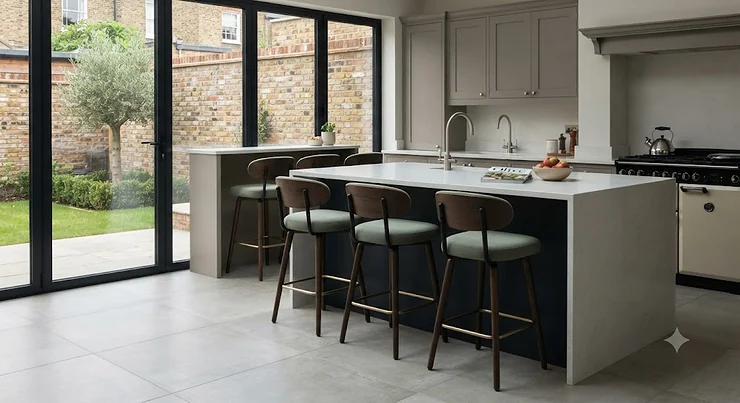
Stand a stool against the wrong worktop and you’ll know within about four seconds — knees jammed under the overhang, elbows somewhere near your ears, or feet dangling like you’re perched on a playground swing. The debate around counter height stools vs bar height stools isn’t really about style at all. It’s about geometry, and geometry doesn’t negotiate. Get the numbers wrong and even the most beautiful stool in your Pinterest board becomes the one nobody wants to sit on.
Here’s the short version: counter height stools sit around 61–66cm at the seat and pair with a standard 90cm British worktop, while bar height stools run 74–80cm and belong under a raised breakfast bar closer to 105–115cm. Everything else — the leg clearance, the footrest position, the swivel mechanism — is detail dressed up as decision-making.
This guide walks through seven real, currently available stools spanning budget to premium, backless to armrested, fixed to fully adjustable. Along the way, we’ll cover how UK kitchen worktop height standards actually work, how to measure your own setup properly, and where people most often get the sums wrong. Expect specific numbers, not vague vibes.
What Are Counter Height and Bar Height Stools?
Counter height stools measure roughly 61–66cm from floor to seat top, built for standard kitchen worktops and islands finished around 90cm high. Bar height stools measure roughly 74–80cm, designed for raised breakfast bars or dedicated home bar counters typically standing 105–115cm tall. The gap between the two exists because most kitchen counters and most bar counters are, quite literally, different pieces of furniture with different jobs.
That 900mm figure isn’t marketing fluff — the standard height of a kitchen worktop in the UK is 900mm, a measurement worktop specialists recommend as the optimum height for working without straining back or arm muscles. Bar counters, by contrast, are built taller specifically so the surface sits at a relaxed elbow height for someone standing on the other side of it, which is why matching your stool category to your counter category matters more than matching your stool colour to your cabinets.
Quick Comparison: Counter Height vs Bar Height at a Glance
| Feature | Counter Height Stools | Bar Height Stools |
|---|---|---|
| Typical seat height | 61–66cm | 74–80cm |
| Matches worktop/counter height | ~90cm (standard kitchen worktop) | ~105–115cm (raised breakfast bar) |
| Recommended clearance (seat to underside) | 25–30cm | 25–30cm |
| Best for | Kitchen islands, family dining, everyday use | Home bars, raised breakfast bars, entertaining |
| Getting on/off | Easier, closer to standard chair height | Requires a slightly bigger step up, footrest matters more |
The clearance figure is the one column worth memorising: whichever height category you’re shopping, the 25–30cm gap between seat and countertop underside is what actually determines comfort, not the seat height number on its own. A counter height stool under a low table becomes cramped just as easily as a bar stool under a low bar becomes claustrophobic — the relationship between the two numbers is what counts, and it’s exactly why the “Top 7” table further down lists compatible surface heights alongside each stool.
💬 Just one click — help others make better buying decisions too!😊
Top 7 Counter & Bar Height Stools: Expert Analysis
1. VASAGLE Echo Bar Stools — full bar height with built-in footrest
Straight out of the box, the standout here is the 76.2cm seat height, which lands this squarely in bar-height territory rather than counter-height compromise. Built with a steel frame, plywood seat base and faux leather upholstery, the Echo carries a 120kg load rating per stool and a 360-degree swivel base with adjustable levelling feet — genuinely useful on the slightly uneven floors so common in older British kitchens. What most buyers overlook about bar-height stools like this is that the footrest position matters as much as the seat: the Echo’s ring sits at a height matched to the seat, so your knees aren’t left hanging in mid-air the way they can be on cheaper bar stools built for a single generic height.
This is the stool for a genuine raised breakfast bar or a dedicated home bar counter around 105–115cm — not a standard 90cm island, where it would leave you towering over your plate. Reviewers shopping in the VASAGLE range consistently flag the swivel action and footrest placement as the details that separate a “fine” bar stool from a genuinely comfortable one, though as with most flat-pack furniture, assembly quality depends on getting the bolts snug rather than just started.
Pros:
- ✅ True bar height suits raised breakfast bars properly
- ✅ 360° swivel with adjustable feet for uneven floors
- ✅ 120kg load rating with sturdy steel-and-plywood build
Cons:
- ❌ Too tall for a standard 90cm kitchen worktop
- ❌ Fixed height means no flexibility if you move house
At around £90-£120 for the pair at the time of research, this sits mid-market — a reasonable trade for a stool that’s purpose-built for bar height rather than a compromise piece trying to do both jobs.
2. VASAGLE Margarita Bar Stools — best budget counter-height pick
The 65cm seat height is the headline feature, sitting the VASAGLE Margarita squarely in standard counter-height range for a typical 90cm UK worktop. Constructed from chipboard and iron in an industrial finish, it’s a simpler build than the Echo — no swivel, no footrest ring, just a stable four-legged frame rated to 120kg. On paper this means fewer moving parts to wear out, which is exactly the appeal for anyone who wants seating that just works without fuss.
Based on the spec comparison with pricier alternatives on this list, the trade-off is comfort rather than durability: there’s no padded seat and no swivel, so it suits quick breakfasts and casual perching better than long dinner-party evenings. What the spec sheet won’t tell you, but the design implies, is that the backless, armless profile makes this an easy stool to tuck fully under an overhang, which matters in narrower galley kitchens where every centimetre of floor space counts.
Pros:
- ✅ Correct counter height for standard 90cm worktops
- ✅ Simple, sturdy build with minimal moving parts
- ✅ Genuinely budget-friendly for a set of two
Cons:
- ❌ No padding or swivel for extended sitting
- ❌ Fixed height offers zero flexibility
Priced around £30-£40 at the time of research, this is the pick for anyone furnishing on a tight budget who has already confirmed their worktop sits at the standard height.
3. HOMCOM Adjustable Armrest Bar Stools — best for mixed-height households
The headline number on the HOMCOM Adjustable Armrest Bar Stools is the 59–84cm gas-lift range, which covers both counter height and bar height from a single stool — genuinely useful if your home has both a standard island and a raised bar, or if you simply haven’t settled on final counter heights yet. Built with a PU leather seat, sponge padding, steel frame and a wide 41cm base rated to 120kg, it also carries BS5852 flammability certification, the UK standard covering ignition resistance in upholstered furniture.
Here’s what to weigh with any gas-lift stool: the mechanism adds flexibility but also a small amount of give under weight shifts, which some buyers notice more than others. The padded armrests are the genuine differentiator here — most stools in this height range skip arms entirely to save cost, but they make a real difference for anyone lingering over coffee rather than eating and moving on. This is a strong option for households with kids growing into adult-height seating, or for anyone renting and unsure what worktop height their next kitchen will have.
Pros:
- ✅ 59-84cm range covers counter and bar height
- ✅ BS5852-certified flammability safety
- ✅ Padded armrests rare at this price point
Cons:
- ❌ Gas-lift mechanism costs more than fixed stools
- ❌ Slightly less stable than fixed-leg alternatives at full height
At roughly £65-£85 for the set at the time of research, the versatility more than justifies the premium over a fixed stool if your height needs aren’t locked in yet.
4. Yaheetech Adjustable Swivel Bar Stool — best mechanism for long sitting sessions
The Yaheetech Adjustable Swivel Bar Stool covers a 63–84.5cm seat height range through a gas-lift system independently tested by SGS against the BIFMA X5.1 standard — a commercial furniture durability benchmark that goes further than most flat-pack stools bother with. Reviewers consistently note the half-round footrest and 3-inch foam cushion as standout comfort features for anyone who sits at a counter for extended periods, whether that’s working from a kitchen island or hosting long conversations at a home bar.
What most buyers overlook about this stool is the base size: at 41cm diameter with an anti-slip rubber ring, it’s built wider than many competitors, which translates directly into better stability at the taller end of its height range — exactly where cheaper gas-lift stools tend to wobble. The biscuit-tufted PU leather finish gives it a slightly more polished look than the utilitarian HOMCOM option above, at a broadly comparable price point.
Pros:
- ✅ BIFMA-tested gas-lift mechanism for durability
- ✅ Wide 41cm base improves stability at full height
- ✅ Thick foam cushion suits long sitting sessions
Cons:
- ❌ Adjustable mechanism needs occasional maintenance
- ❌ Higher weight than fixed-leg equivalents at 7.6kg per stool
Priced around £70-£95 for a pair at the time of research, this earns its place for anyone prioritising sitting comfort over minimalist styling.
5. VASAGLE Echo Backless Stools — best space-saving counter option
The distinguishing feature of the VASAGLE Echo Backless Stools is the 63cm counter-height seat paired with footrests set at two different heights per pair — a small but genuinely thoughtful detail for households where different family members use the same stools. Built from plywood and steel with a waterproof PU leather cover and a 120kg load rating, the backless profile means these tuck completely under a worktop overhang when not in use, which matters more than it sounds in kitchens where the island doubles as a walkway.
Based on the spec comparison with the padded, backed Margarita above, the trade-off is support: no backrest means no lumbar assistance for long sitting, so this suits quick meals and casual seating rather than evening-long dinners. The scratch-resistant steel legs are a small but real upgrade for households with pets or younger children prone to kicking chair legs, and the waterproof cover makes cleanup after spills genuinely easy rather than a wipe-and-hope situation.
Pros:
- ✅ Correct counter height with dual footrest levels
- ✅ Fully tucks under overhangs when not in use
- ✅ Waterproof cover and scratch-resistant legs
Cons:
- ❌ No backrest for extended sitting
- ❌ Fixed height with no adjustment option
At around £45-£65 for the pair at the time of research, this sits comfortably between the Margarita’s bare-bones pricing and the padded options further up this list.
6. HOMCOM Diamond-Stitch Fabric Bar Stools — best fabric option for families
The HOMCOM Diamond-Stitch Fabric Bar Stools cover a 60–81.5cm adjustable range in a polyester fabric finish with decorative diamond stitching, a genuine departure from the PU leather that dominates the rest of this list. The moulded seat is filled with high-density sponge over a steel frame and wide circular base, rated to 120kg, with a built-in footrest and 93–114.5cm overall height range that flexes to match most standard worktops and several raised bar heights.
Here’s what the spec sheet doesn’t say outright: fabric upholstery feels noticeably warmer against skin than PU leather in colder months, which matters more than manufacturers tend to mention, but it also means spills need quicker attention since fabric doesn’t wipe clean the way faux leather does. For families with young children prone to sticky fingers, this is worth weighing seriously against the otherwise similar Yaheetech option above — the tactile comfort gain comes with a maintenance trade-off.
Pros:
- ✅ Fabric finish feels warmer than PU leather options
- ✅ Wide 60-81.5cm range suits multiple counter heights
- ✅ Diamond stitching adds a distinct design detail
Cons:
- ❌ Fabric requires more careful spill maintenance
- ❌ Less water-resistant than faux leather alternatives
At roughly £70-£90 for the set at the time of research, this is a solid pick specifically for households prioritising tactile comfort over easy-clean practicality.
7. Julian Bowen Alassio Bar Stool — best solid wood, premium pick
The Julian Bowen Alassio Bar Stool is crafted from solid rubberwood with a spindle-back design and integrated footrest, standing 112cm overall with a 61.5cm seat height — technically at the upper end of counter height, making it a natural fit for slightly taller islands or standard worktops with thicker stone surfaces. Unlike every other stool on this list, it’s sold as a single chair rather than a pair, and the solid wood construction shows in the individual weight of 11kg, roughly the heft of two of the lighter metal-framed alternatives combined.
Honest analytical take: solid wood construction typically ages better than steel-and-foam builds, resisting the wobble that develops in cheaper frames after a few years of daily use, though the trade-off is a firmer seat with no upholstered cushioning. The 100kg max user weight per chair is notably lower than the 120–136kg ratings elsewhere on this list, worth checking against your household’s needs before committing. For a kitchen leaning traditional or Scandinavian rather than industrial-metal, this is the stool that looks intentional rather than assembled.
Pros:
- ✅ Solid rubberwood construction ages well long-term
- ✅ Spindle back adds genuine design character
- ✅ Integrated footrest strengthens the frame itself
Cons:
- ❌ Lower 100kg weight limit than metal alternatives
- ❌ Sold individually, so pricing multiplies per seat
At around £110-£130 each at the time of research, this is a per-chair investment rather than a set purchase — factor that into your total budget before falling for the finish.
Kitchen Worktop Height Standards Explained
Before choosing a stool height, it’s worth actually confirming your worktop height rather than assuming. The British Standard surface height for a worktop is 900mm, sitting on kitchen units with an inset sink or cooking hob, with a typical depth around 600mm — though this isn’t a legally mandated figure, just the industry convention most manufacturers build to. In practice, older kitchens and bespoke installations can vary by several centimetres either side, which is exactly why measuring your own setup beats trusting the “standard” label on a product listing.
For anyone renovating or planning a new island rather than just buying stools, it’s worth reading a fuller explainer on what height a kitchen worktop should be, which breaks down how user height should influence the final figure rather than defaulting blindly to 900mm. The practical takeaway for stool shopping: measure your actual worktop before ordering, don’t assume it matches the standard, and remember that worktop thickness itself — anything from a slim laminate to a thick stone slab — shifts the final height by several centimetres.
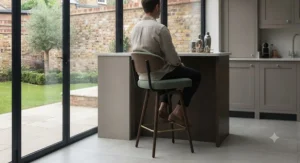
How to Measure Bar Stool Height (Properly)
Getting this right takes four measurements, not one guess.
- Measure your counter or bar height from floor to surface top. Use a proper tape measure, not an estimate — a few centimetres out changes everything downstream.
- Subtract 25–30cm for clearance. This gap between seat and counter underside is what determines whether knees fit comfortably.
- Check the resulting number against seat height, not overall stool height. Product listings often lead with overall height including the backrest, which isn’t the figure that matters for fit.
- Account for cushion compression. A padded seat compresses 1–2cm under weight, so a stool listed at exactly your target number will actually sit marginally lower once someone’s seated.
- Confirm footrest position separately. A correctly-heighted seat with a badly-placed footrest still leaves legs dangling uncomfortably.
- Measure existing floor unevenness if relevant. Older UK kitchens especially can have floors that dip several millimetres across a run, which matters more with four-legged fixed stools than swivel bases with levelling feet.
- Round down rather than up when between sizes. A stool slightly too low is easier to live with than one that leaves feet dangling.
Following these seven steps consistently prevents the single most common stool-buying mistake: ordering based on the counter type name (“counter height” or “bar height”) rather than the actual measured gap in your specific kitchen.
Kitchen Island Stool Height Guide: Matching Stools to Real Spaces
Three household scenarios illustrate how this plays out in practice.
The young family with a standard 90cm island needs counter-height stools without armrests, since arms tend to catch on little ones climbing up and down independently. The VASAGLE Echo Backless Stools or VASAGLE Margarita both fit this brief well — low cost, easy wipe-down, no obstacles for small hands and feet.
The couple entertaining regularly around a raised 110cm home bar wants genuine bar-height stools with a footrest ring that matches the taller seat position, plus enough polish to hold up visually against a feature bar. The VASAGLE Echo Bar Stools deliver exactly this brief, with the swivel action adding practical value for a space where people turn to chat rather than sit facing one direction.
The renter or frequent mover furnishing a kitchen of unknown future height benefits most from adjustable stools that hedge against uncertainty. The HOMCOM Adjustable Armrest Bar Stools or Yaheetech Adjustable Swivel Bar Stool both cover the 59–85cm range that catches nearly every UK counter and bar configuration, protecting the purchase against a house move that changes the numbers entirely.
Stool Leg Clearance: Why It’s the Number That Matters Most
Seat height gets all the attention, but leg clearance — the vertical gap between the top of the seat and the underside of the worktop overhang — is the figure that actually determines whether sitting down feels natural or cramped. The widely used benchmark sits at 25–30cm, and it holds true whether you’re working with counter height or bar height seating, because it’s measuring the relationship between two surfaces rather than either one in isolation.
Too little clearance and knees hit the underside of the worktop before the stool is even pulled in properly; too much and the counter feels distant, forcing an awkward lean forward to reach food or a drink. This is precisely why the adjustable stools on this list — the HOMCOM Adjustable Armrest Bar Stools, Yaheetech Adjustable Swivel Bar Stool, and HOMCOM Diamond-Stitch Fabric Bar Stools — carry genuine practical value beyond just flexibility for style: they let you dial in that 25–30cm gap precisely, rather than hoping a fixed-height stool happens to land correctly against your specific worktop and overhang combination.
Breakfast Bar Dimensions: Overhang, Spacing and Legroom
Beyond height, two more numbers shape whether breakfast bar seating actually works day to day: overhang depth and per-person width. A worktop overhang of around 25–30cm gives legs enough room to tuck under comfortably without the counter edge digging into thighs, while allowing roughly 60–70cm of width per stool prevents the elbow-bumping that turns a shared breakfast into a logistics exercise.
Spacing matters just as much with backless stools like the VASAGLE Echo Backless Stools as it does with armrested options — arguably more, since without arms as a visual boundary, people tend to sit closer together than the space comfortably allows. When planning a breakfast bar from scratch, working backward from stool width and clearance needs, rather than forward from however many stools fit visually, tends to produce a layout people actually want to sit at.
How to Choose Between Counter Height and Bar Height Stools
- Measure your actual counter or bar surface first. Don’t rely on the product category name; measure the real height in centimetres before shopping.
- Calculate your target seat height using the 25–30cm clearance rule. Subtract this from your measured surface height to land on the correct seat range.
- Decide whether fixed or adjustable suits your situation. Fixed stools cost less and feel sturdier; adjustable stools hedge against uncertainty or dual-height needs.
- Weigh backrest against space. Backless stools like the VASAGLE Echo Backless Stools save floor space and tuck away cleanly; backed options suit longer sitting sessions.
- Check weight ratings against your household. Most sit between 100–136kg per stool — a meaningful difference worth confirming rather than assuming.
- Consider material for maintenance reality, not just looks. PU leather wipes clean in seconds; fabric like the HOMCOM Diamond-Stitch Fabric Bar Stools needs more careful spill management.
- Factor in floor type. Swivel bases with adjustable feet cope better with slightly uneven older floors than fixed four-leg frames.
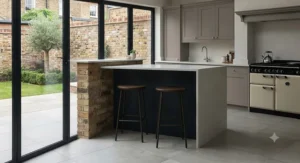
Common Mistakes When Buying Bar or Counter Stools
The single most frequent error is buying based on the listing’s height category label rather than a measured comparison against the actual counter. “Counter height” and “bar height” are useful shorthand, but they span a real range — 61–66cm and 74–80cm respectively — and a stool at the low end of bar height can sit awkwardly under a counter built at the high end of counter height, despite both technically being correctly labelled.
A second common mistake is ignoring footrest position entirely, treating it as decorative rather than functional. A stool with the correct seat height but a footrest set too low leaves legs unsupported and gradually uncomfortable over a meal, which is exactly the detail products like the VASAGLE Echo Bar Stools and VASAGLE Echo Backless Stools address by matching footrest height to seat height rather than using a generic placement. Third, buyers frequently overlook weight capacity, particularly with solid wood options like the Julian Bowen Alassio Bar Stool, where the 100kg limit sits meaningfully below the 120kg-plus ratings common on metal-framed alternatives.
Counter Height vs Bar Height: What to Expect in Real-World Use
Specs on a page translate into daily experience in ways that are easy to underestimate. Counter height stools, sitting closer to standard dining chair height, feel more natural to get on and off repeatedly — genuinely relevant for anyone using an island for quick meals throughout the day rather than settling in for one long sitting. The lower centre of gravity also means less visible wobble on uneven floors, since the leverage on the legs is reduced compared with a taller bar stool.
Bar height stools, by contrast, create a more social, “leaning in” posture that suits conversation and entertaining, which is precisely why home bars and raised breakfast bars default to this height rather than standard counter height. The trade-off shows up in accessibility: getting on and off a bar-height stool takes a slightly bigger step, which matters more for households with young children, older relatives, or anyone with mobility considerations — a factor worth weighing honestly rather than purely on style preference.
Features That Actually Matter (And Those That Don’t)
Genuinely important: correct seat height for your measured counter, adequate weight rating for your household, and footrest position matched to seat height. These three determine whether a stool gets used daily or ends up abandoned in a corner. Non-domestic furniture intended for repeated, heavy use is typically held to strength and durability requirements under standards such as BS EN 16139, and while most domestic stools aren’t tested to this exact commercial benchmark, options like the Yaheetech Adjustable Swivel Bar Stool that reference independent BIFMA testing are signalling a similar level of rigour worth valuing over marketing copy alone.
Less important, despite how much shelf space it takes in marketing: exact colour matching to cabinetry, and premium branding on otherwise identical steel-and-foam construction. A VASAGLE Margarita and a considerably pricier competitor built from near-identical chipboard and iron will perform almost the same in daily use — the price gap often reflects design flourish rather than functional difference. Swivel action is a genuine nice-to-have for bar-height stools used for socialising, but adds little value on backless counter stools used mainly for quick meals.
Long-Term Cost & Maintenance
Thinking beyond the initial price range reveals where value actually sits. Fixed-height stools like the VASAGLE Margarita and Julian Bowen Alassio Bar Stool have fewer moving parts to fail over time — no gas-lift mechanism to eventually wear, no swivel bearing to loosen — which typically means a longer maintenance-free lifespan, even if the upfront cost occasionally runs comparable to adjustable alternatives. Adjustable stools trade some of that mechanical simplicity for flexibility, a reasonable exchange if your circumstances genuinely call for it, but worth paying for deliberately rather than by default.
| Consideration | Fixed Height (e.g. VASAGLE Margarita, Julian Bowen Alassio) | Adjustable (e.g. HOMCOM Adjustable Armrest, Yaheetech) |
|---|---|---|
| Upfront cost | Generally lower | Generally £15-£30 higher per stool |
| Mechanical failure risk | Minimal | Gas-lift wear over years of use |
| Flexibility if moving house | None | High |
| Typical lifespan feel | Stable, less wobble over time | Solid but dependent on mechanism quality |
The analysis here is straightforward: if your worktop height is fixed and known, paying extra for adjustability delivers little genuine long-term value. If you’re renting, planning a kitchen renovation, or simply unsure, the adjustable premium is money well spent against the alternative of rebuying stools entirely down the line.
Safety, Regulations & Compliance Guide
UK upholstered furniture, including stool seat padding, falls under long-standing consumer protection rules. Upholstered furniture is subject to strict safety standards covering flammability, and both new and used furniture has to comply, with manufacturers required to meet ignition resistance requirements for fillings and covers. This framework has recently been under government review, and anyone wanting the current detail can read the official policy update on domestic upholstered furniture fire safety directly from government sources.
For shoppers, the practical takeaway is simple: look for a permanent label referencing compliance, as the HOMCOM Adjustable Armrest Bar Stools do with their explicit BS5852 certification mentioned in the product specification. It’s a small detail buried in a spec list, but it’s one of the few objective, verifiable safety markers available when comparing otherwise similar-looking upholstered stools.
Frequently Asked Questions
❓ What is the difference between counter height and bar height stools?
❓ How do I know what height stool I need?
❓ Can counter height stools work at a bar height counter?
❓ Is 900mm the standard kitchen worktop height in the UK?
❓ Do adjustable bar stools wear out faster than fixed ones?
Conclusion
The counter height stools vs bar height stools decision really does come down to a tape measure rather than taste. Measure your worktop, subtract that 25–30cm clearance figure, and the correct category becomes obvious rather than debatable. From there, it’s a question of budget, backrest preference, and whether your circumstances favour the mechanical simplicity of a fixed stool like the VASAGLE Margarita or Julian Bowen Alassio Bar Stool, or the hedge-your-bets flexibility of adjustable options like the HOMCOM Adjustable Armrest Bar Stools and Yaheetech Adjustable Swivel Bar Stool.
None of the seven stools covered here is universally “best” — the VASAGLE Echo Bar Stools are wasted under a standard worktop just as surely as the VASAGLE Echo Backless Stools would look stranded under a raised home bar. Match the stool to the surface, check the weight rating against your household, and the rest genuinely is down to which finish you’d rather look at every morning.
Recommended for You
- Backless Bar Stools: 7 Best Picks For UK Kitchens (2026)
- Adjustable Bar Stools vs Fixed Height Bar Stools: 7 Proven Picks 2026
- Leather Bar Stools: 7 Best Durable Picks for UK Kitchens (2026)
Disclaimer: This article contains affiliate links. As an Amazon Associate, I earn from qualifying purchases. If you purchase products through these links, we may earn a small commission at no additional cost to you.
✨ Found this helpful? Share it with your friends! 💬🤗
