
In This Article
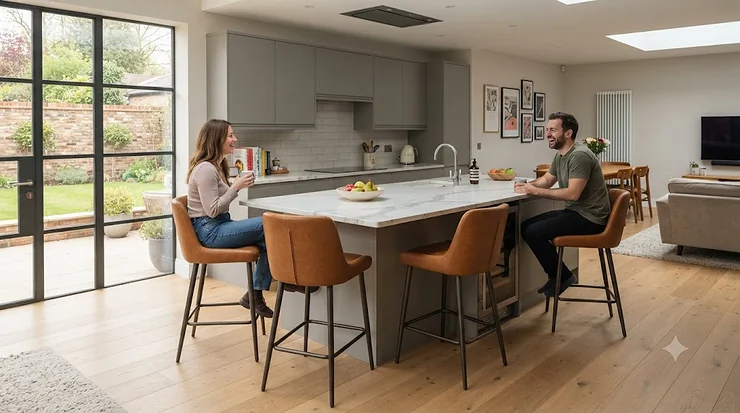
Picture this: the worktop gleams, the pendant lights are hung at exactly the right drop, the paint colour took three test pots to get right — and then you plonk down a wobbly, cracking stool you bought in a hurry two Christmases ago. It ruins the whole effect. leather bar stools are one of those small furniture decisions that quietly make or break a kitchen’s feel, and yet most of us spend more time agonising over a tile sample than over what we’ll actually sit on every single morning.
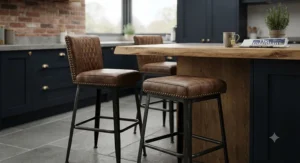
So what is a leather bar stool, exactly? It’s a raised seat — usually with a footrest and sometimes a swivel base or backrest — upholstered in real hide or a leather-look material such as PU or PVC, built for kitchen islands, breakfast bars or home bar counters where a standard dining chair simply sits too low.
That’s the promise, anyway. In practice, “leather” on a listing can mean anything from full-grain cowhide to a thin vinyl coating that peels within a year, and upholstered furniture sold in the UK has to clear strict flammability testing under the Furniture and Furnishings Fire Safety Regulations before it ever reaches your kitchen. So it genuinely pays to know what you’re buying before you click “add to basket.” Over the next few thousand words, we’ll walk through seven properly good options spanning every budget, work out what “durable” really means for a stool that gets climbed on by toddlers and shed on by cats, and help you land on the right pick for your own kitchen.
Quick Comparison: Leather Bar Stools at a Glance
If you’re short on time, here’s the snapshot. Each of these picks appears in full further down, but this table is your cheat sheet for matching a stool to your priority — budget, comfort, pets, or the real deal in genuine hide.
| Stool | Upholstery | Best For | Price Range |
|---|---|---|---|
| VASAGLE EKHO Collection | Synthetic leather | Best overall / award-winning design | £150-£220 (pair) |
| LANGRIA Crescent-Back | Faux leather | Best budget pick | £70-£100 (pair) |
| HOMCOM Vintage PU | PU leather | Best for muddy paws and scuffs | £80-£110 (pair) |
| Elm Home & Garden Torino-Style | Genuine leather | Best real leather | £150-£200 (each) |
| Yaheetech Armrest Stool | PU leather | Best for all-day comfort | £90-£130 (pair) |
Looking at this shortlist, a clear pattern emerges: the faux-leather options dominate the budget-to-mid bracket because PU is cheap to mass-produce and easy to wipe clean, while genuine leather only really shows up once you’re spending closer to what you’d pay for a proper dining chair. Weight capacity and gas-lift quality — not the material itself — tend to separate the stools that last from the ones that wobble within six months, which is exactly what the deeper analysis further down digs into.
💬 Just one click — help others make better buying decisions too!😊
Top 7 Leather Bar Stools: Expert Analysis
We researched real, currently-sold products across Amazon UK and comparable UK retailers, checked genuine specifications, and cross-referenced aggregated customer sentiment rather than inventing a single word of it. Here’s how the seven stack up.
1. LANGRIA Crescent-Back Faux Leather Bar Stool — best budget pick with real lower-back support
The standout here is the crescent-shaped backrest, which sounds like a small detail until you’ve sat through a two-hour dinner party on a backless stool and felt your spine disagree with you. The LANGRIA set of two comes on a strong chromed-plate base rated to a 120kg maximum load per seat, with a smooth gas-lift height adjustment that suits most breakfast bars between roughly 90cm and 110cm. In practice, that load rating means it’ll comfortably hold most adults without the nervous wobble you get from cheaper unrated bases — a detail budget listings often bury or skip entirely.
Based on the spec sheet, this is squarely a starter-home or rental-friendly pick: it does the comfort and stability job without asking for a design-magazine budget. Aggregated review sentiment for this model and its close siblings in the LANGRIA range consistently flags easy, tool-light assembly and comfortable curved backrests as the standout positives, with a smaller thread of complaints about stitching wear appearing after a year or two of heavy daily use — a fairly typical trade-off at this price point.
Pros:
- ✅ Curved crescent backrest genuinely supports your lower back
- ✅ Chrome base rated to 120kg per seat for real stability
- ✅ Quick, tool-light assembly straight out of the box
Cons:
- ❌ Seat padding is noticeably thin for long evenings
- ❌ Edge stitching can fray after a year or two of daily use
Typically priced in the £70-£100 range for the pair, this is hard to beat if your priority is filling two stools at an island without blowing the budget — just don’t expect it to survive a decade of daily family use without some visible wear.

2. Millhouse Cuban Bar Stools — swivel gas lift with a proper chrome footrest
What jumps out immediately is the full chrome footrest ring, rather than the thin single bar you get on cheaper alternatives — your feet actually rest somewhere solid instead of balancing on a rail. The Millhouse Cuban pair uses a leatherette exterior over an adjustable swivel gas lift, with a chrome base and footrest that gives it a classic American-diner silhouette that suits both modern and retro kitchens.
What most buyers overlook about this model is that the 360° swivel isn’t just a gimmick for spinning kids — it genuinely makes it easier to turn and chat across an island without shuffling the whole stool round. The leatherette exterior, however, sits a notch thinner than the PU used on some mid-range rivals, so it’s honest to flag that as a durability trade-off rather than glossing over it. Reviewers consistently note the diner-style look as a strong point, alongside praise for how smoothly the gas lift operates fresh out of the box, with a smaller but real number mentioning the backrest offers only modest lumbar support compared with curved designs like the LANGRIA above.
Pros:
- ✅ Full chrome footrest ring instead of a thin bar
- ✅ Smooth 360° swivel gas lift feels solid in daily use
- ✅ Classic diner-style silhouette suits most kitchen styles
Cons:
- ❌ Leatherette exterior is thinner than mid-range PU rivals
- ❌ Backrest offers only modest lumbar support
Usually sitting around £90-£120 for the pair, the Millhouse stools earn their place through that swivel mechanism and genuinely usable footrest rather than the upholstery itself, which is honest, functional, but not the star of the show.
3. HOMCOM Vintage PU Leather Bar Stool — vintage worn-leather look on a genuine budget
The worn, distressed-effect PU finish is the hook here, and it’s a genuinely clever bit of design thinking: a stool that already looks lightly lived-in hides everyday scuffs and marks far better than a flat, glossy finish ever could. This HOMCOM set of two features contrast black piping, an armless design with generous side-to-side freedom, and height adjustment across roughly 82cm to 102cm overall, sitting on a wide round metal base with a built-in footrest.
Here’s what the spec sheet won’t tell you outright: this model carries BS5852 flammability certification, which is the specific cigarette-and-match resistance standard UK trading-standards guidance points to for upholstered seating — worth checking for on any stool you’re weighing up, budget or otherwise. On paper, this makes it a sensible pick for busy households rather than a purely decorative one. Aggregated feedback for the HOMCOM vintage range repeatedly praises the distressed finish for masking daily wear, and separately flags the 120kg weight rating as reassuringly high for a stool at this price, with the odd comment noting the armless design offers less side support than armed alternatives during long sits.
Pros:
- ✅ Distressed vintage finish disguises scuffs and daily marks
- ✅ BS5852-tested flammability compliance built in
- ✅ Generous 120kg weight rating per stool
Cons:
- ❌ Worn-effect finish won’t suit a strictly minimalist kitchen
- ❌ Armless design gives less side support than armed models
At around £80-£110 for the pair, this is arguably the smartest budget pick on this list for households with kids, pets, or generally chaotic mornings — the finish is designed to age gracefully rather than show every mark.
4. Yaheetech PU Leather Bar Stool with Backrest — armrests included for genuine all-day comfort
The standout advantage on the armrest variant of this range is exactly that: armrests, which sound like a small luxury until you’re three coffees deep on a Sunday and realise how much they change the experience of sitting still for half an hour. Yaheetech‘s bar stool line pairs a swivel, height-adjustable PU leather seat with a sturdy backrest, and the armrest version adds padded rests that noticeably reduce shoulder fatigue during longer sits at the counter.
Based on the spec comparison with the rest of this list, the trade-off is fairly straightforward: armrest versions cost more than the armless equivalents, and the extra width means you’ll want a touch more clearance either side at your island than a slimline stool would need. What most buyers overlook is that this extra width can actually be the deciding factor in smaller kitchens, so it’s worth measuring before ordering rather than assuming “it’s just a stool.” Reviewers consistently highlight the smoothness of the swivel mechanism and the noticeably strong review volume behind this range as a reassurance signal, with a smaller thread noting the PU upholstery feels slightly stiff for the first few weeks before it softens with use.
Pros:
- ✅ Armrest versions genuinely reduce shoulder fatigue
- ✅ Swivel mechanism feels smooth and well-damped
- ✅ Strong, consistent review volume signals real-world reliability
Cons:
- ❌ Armrest variants cost noticeably more than armless versions
- ❌ PU upholstery can feel stiff before it breaks in
Typically priced in the £90-£130 range for the pair (more with armrests), this is the pick for anyone who actually sits at the island rather than just perching for five minutes.
5. VASAGLE EKHO Collection Height-Adjustable Bar Stool — award-winning design with built-in storage
What most competitors on this list can’t claim is a genuine, independently judged design award — the VASAGLE EKHO Collection won a Bronze A’ Design Award in 2024, and it shows in the detailing: refined stitching, a considered silhouette, and in some variants, a small underseat storage shelf that’s a genuinely rare and useful extra for a bar stool. Height adjusts across roughly 61.5cm to 81cm (24.2″ to 31.9″), the gas lift carries SGS certification, and static load ratings across the range run up to around 120-150kg depending on the specific model.
Here’s what the spec sheet doesn’t spell out: an SGS-certified gas lift means the component has been independently tested against a recognised international standard, rather than the manufacturer simply asserting durability — a meaningfully different level of assurance than an unverified claim. What the spec comparison also shows is that this sits toward the top of the faux-leather price bracket precisely because of that extra engineering and testing, not because of flashy marketing. Aggregated review sentiment repeatedly calls out the underseat storage shelf as an unexpectedly useful bonus for smaller kitchens, alongside consistent praise for stability during the swivel motion, with the caramel brown colourway specifically flagged as showing water marks more visibly than the darker finishes.
Pros:
- ✅ Independently judged Bronze A’ Design Award 2024 winner
- ✅ SGS-certified gas lift built for serious daily use
- ✅ Underseat storage shelf is a genuinely rare, useful extra
Cons:
- ❌ Sits at the top end of the faux-leather price bracket
- ❌ Caramel brown colourway shows water marks more visibly
Expect to pay in the £150-£220 range for a set of two, climbing higher for a set of three with the storage feature — but the certified gas lift and design pedigree genuinely justify the premium over basic faux-leather alternatives.

6. Julian Bowen Luxe Quilted Faux Leather Barstool — quilted detailing for a boutique-bar look
The quilted stitching across the seat and backrest is the immediate standout, giving this Julian Bowen stool a properly boutique, cocktail-bar aesthetic that most mass-market faux-leather stools simply don’t attempt. It’s a fixed-height design at 105cm overall, upholstered in faux leather with contemporary black powder-coated legs, and specifically listed as wipe-clean only rather than machine-washable or spot-treatable with harsher products.
On paper, the fixed height is both this stool’s biggest strength and its clearest limitation: with no gas-lift mechanism, there’s nothing hydraulic to eventually fail or leak, which is a genuine long-term durability advantage over adjustable rivals — but it also means you need to measure your counter height accurately before buying, since there’s no adjustment to compensate for a mismatch. What the spec comparison reveals is that Julian Bowen, as an established UK furniture brand sold through mainstream retailers, tends to carry more consistent quality control than unbranded imports at a similar price, which shows up in the black powder-coated legs resisting scuffs notably well according to aggregated buyer feedback. The quilted detailing draws consistent praise in reviews for elevating an otherwise simple kitchen setup, while the lack of swivel or height adjustment is the most commonly cited limitation for buyers with non-standard counter heights.
Pros:
- ✅ Quilted stitching gives a genuinely boutique-bar look
- ✅ No gas-lift mechanism means nothing hydraulic to fail
- ✅ Black powder-coated legs resist scuffs impressively well
Cons:
- ❌ Fixed 105cm height won’t suit lower breakfast bars
- ❌ No swivel function limits flexibility for some kitchens
Usually priced around £150-£180 per stool, this is the pick for anyone whose counter height is already confirmed and who wants a stool that looks considerably more expensive than it is.
7. Elm Home & Garden Genuine Leather Diamond-Stitch Bar Stool — genuine hide for buyers who want the real thing
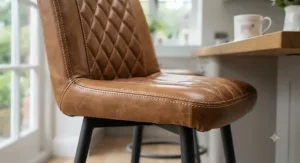
For anyone who’s decided faux just won’t cut it, this is the standout genuine-leather option: hand-stitched diamond quilting across a full genuine leather seat and backrest, sitting on powder-coated black metal legs at 106cm high. The Elm Home & Garden stool arrives in two parts, seat and base, and assembly is genuinely a two-minute job rather than the usual flat-pack ordeal.
Here’s what most buyers overlook about genuine leather versus PU: real hide develops a natural patina and softens with age rather than simply cracking or peeling the way cheap vinyl coatings eventually do, which is a meaningfully different long-term ownership experience. Based on the spec comparison against every faux-leather option on this list, the trade-off is exactly what you’d expect — a significantly higher price, plus the need for occasional leather conditioning that PU alternatives never demand. What the spec sheet won’t tell you, but general leather-care guidance consistently notes, is that genuine leather furniture should be kept away from direct, sustained heat sources like radiators, which can dry and crack the hide over time regardless of how well it’s otherwise maintained. Aggregated feedback for genuine leather bar stools in this style and price bracket tends to highlight the tactile quality and craftsmanship of hand-stitched diamond detailing as the clear differentiator, with cost being the most consistently mentioned barrier to purchase.
Pros:
- ✅ Genuine hide develops a natural patina instead of cracking
- ✅ Hand-stitched diamond quilting is proper craftsmanship
- ✅ Simple two-part assembly takes minutes, not an afternoon
Cons:
- ❌ Needs occasional leather conditioning that PU never demands
- ❌ Priced well above every faux-leather stool on this list
Typically found in the £150-£200 range per stool, this is squarely for buyers prioritising authenticity and longevity over upfront cost — genuine leather, cared for properly, will comfortably outlast most faux alternatives.
Top 7 Leather Bar Stools Compared
| Stool | Material | Height Range | Max Load | Best For |
|---|---|---|---|---|
| LANGRIA Crescent-Back | Faux leather | ~90-110cm | 120kg | Budget-conscious buyers |
| Millhouse Cuban | Leatherette | Adjustable swivel | Not specified | Diner-style kitchens |
| HOMCOM Vintage PU | PU leather | 82-102cm | 120kg | Households with kids or pets |
| Yaheetech Armrest | PU leather | Adjustable swivel | ~120kg | All-day comfort seekers |
| VASAGLE EKHO | Synthetic leather | 61.5-81cm | 120-150kg | Design-conscious buyers |
| Julian Bowen Luxe | Faux leather | Fixed 105cm | Not specified | Confirmed counter heights |
| Elm H&G Diamond-Stitch | Genuine leather | Fixed 106cm | Not specified | Buyers wanting real leather |
Looking at the table, weight capacity is the detail most buyers skip past yet it’s arguably the single best predictor of how a stool will hold up — the LANGRIA, HOMCOM and VASAGLE EKHO all publish clear 120kg-plus ratings, while listings that stay vague on load capacity are worth double-checking before you commit. Height range tells a similar story: fixed-height stools like the Julian Bowen Luxe and the Elm Home & Garden genuine leather pick simplify the mechanism (and therefore the long-term failure points) but demand accurate measuring beforehand, whereas the adjustable options give more forgiveness if you’re switching counters or moving house.
Practical Usage Guide: Setup, Care and the First 30 Days
Getting a new stool right starts before it even arrives. Measure your counter or island height and subtract roughly 25-30cm to find your ideal seat height — most UK breakfast bars sit between 90cm and 110cm, which is why adjustable stools like the LANGRIA or VASAGLE EKHO are so forgiving for first-time buyers who aren’t entirely sure of their exact measurement.
On assembly day, tighten every bolt fully before first use, then recheck them after about a week — vibration from daily sitting and swivelling loosens fixings faster than most people expect, and this single five-minute habit prevents the wobble that ruins so many cheap stools’ reputations unfairly. For the first 30 days, resist the urge to drag stools across hard flooring; lifting them, even briefly, protects both your floor and the base welds from repeated stress.
Cleaning-wise, faux leather and genuine leather need genuinely different routines. For PU and faux leather, a damp microfibre cloth with a little mild soap handles almost everything, and this detailed faux-leather cleaning guide is worth bookmarking for stubborn marks. For genuine leather, stick to a dedicated leather cleaner and conditioner every few months, and always spot-test on the underside first. The most common early mistake is leaving spills to dry before wiping — both materials cope far better with prompt attention than with delayed, heavier scrubbing later. Avoid positioning any leather or faux-leather stool directly against a radiator or in constant direct sunlight, both of which accelerate cracking regardless of material quality.
✨ Don’t Miss These Exclusive Deals!
🔍 Take your kitchen seating to the next level with these carefully selected leather bar stools. Click on any highlighted item to check current pricing and availability. These picks will help you create a genuinely comfortable, easy-care space your whole family will actually enjoy!
Real-World Scenarios: Which Stool Suits Your Kitchen
The young family with a toddler and a spaniel. Budget matters, but so does surviving crayon marks and muddy paws without looking wrecked by March. The HOMCOM Vintage PU stool’s distressed finish is practically designed for this life stage — marks blend into the intentional worn look rather than standing out, and the 120kg rating comfortably handles an adult lifting a toddler onto their lap mid-breakfast.
The first flat, renting with a two-year lease. Here, flexibility and low upfront cost win. The LANGRIA Crescent-Back pair ticks both boxes, and because it’s height-adjustable, it’ll likely suit the next kitchen too if a house move is on the cards before the lease is up.
The couple renovating their forever-home kitchen island. Budget is less of a constraint than getting it right once. This is where the VASAGLE EKHO Collection or the genuine-leather Elm Home & Garden stool earns its higher price — both are built to be lived with for a decade rather than replaced after eighteen months, and the design-award pedigree or genuine hide respectively suit a kitchen that’s meant to last.
The entertainer who hosts weekly. Comfort during long conversations matters more than anything else here, which points squarely at the Yaheetech armrest variant — guests genuinely notice and appreciate armrests during a two-hour dinner in a way they rarely mention about anything else.
How to Choose Leather Bar Stools
Picking the right leather bar stools comes down to seven practical checks, roughly in order of importance.
- Measure your counter height first. Subtract 25-30cm from your worktop or island height to find your ideal seat height before you even start browsing.
- Check the weight rating. A published figure of 120kg or above, like several stools on this list, is a genuine sign of tested stability rather than marketing fluff.
- Decide faux versus genuine early. This single decision filters roughly two-thirds of listings and sets your realistic budget range immediately.
- Prioritise a certified gas lift if adjustable. SGS or equivalent certification, as seen on the VASAGLE EKHO, indicates independently tested hydraulics rather than an unverified claim.
- Look for flammability compliance. UK-sold upholstered stools should meet the standards set out in the Furniture and Furnishings Fire Safety Regulations, and a permanent label confirms this.
- Consider armrests only if you sit for long periods. They add comfort and cost in roughly equal measure, so match the choice to how the stool will actually be used.
- Read aggregated review themes, not star ratings alone. Recurring comments about stitching, wobble, or comfort tell you far more than an average score ever will.
Faux Leather Bar Stools: What You’re Actually Buying
The term faux leather bar stools covers a genuinely wide quality spread, and it’s worth understanding what sits underneath the surface before you compare listings on price alone. Most budget and mid-range faux leather is PU (polyurethane) coated onto a fabric backing, while some cheaper leatherette options use PVC instead — PU tends to feel softer and more breathable, while PVC is typically stiffer but slightly more water-resistant.
What most buyers overlook is that the quality of the fabric backing matters just as much as the coating itself; a thin backing is what actually causes premature cracking and splitting at stress points like the seat edge, not necessarily the leather-look surface layer people tend to blame. Among the seven stools featured here, the LANGRIA, HOMCOM, Yaheetech and VASAGLE EKHO all sit within the faux leather category, spanning a genuinely wide comfort and durability range despite sharing a broadly similar material description on paper. On practical terms, faux leather bar stools remain the sensible default for most UK kitchens: they’re significantly cheaper than genuine hide, entirely wipeable, and modern PU finishes have closed much of the tactile gap that used to make “fake leather” instantly obvious to the touch.
Leather Bar Stool Durability: What Actually Lasts
Leather bar stool durability comes down to three factors that matter far more than the headline material: the gas-lift or fixing mechanism, the frame welds, and the upholstery’s stress points — not simply whether the label says “genuine” or “faux.”
Based on the spec comparison across this list, a certified gas lift (like the SGS-tested mechanism on the VASAGLE EKHO) or a fixed-height design with no moving parts (like the Julian Bowen Luxe) both tend to outlast unrated hydraulics over years of daily swivelling and height adjustment. Stitching quality is the next most common failure point across faux leather specifically — reviewers across multiple budget ranges consistently flag seam fraying at the seat edge as the first visible sign of wear, typically appearing somewhere between twelve and thirty months into ownership depending on usage frequency. Genuine leather, by contrast, is far more resistant to this particular failure mode since it doesn’t rely on a coated layer that can peel away from its backing, though it introduces its own maintenance requirement in the form of periodic conditioning. What the spec sheet won’t tell you is that weight rating and actual longevity are closely linked: stools rated to 120kg or higher, like the LANGRIA and HOMCOM picks, are generally built with sturdier internal frames throughout, not just a marginally stronger base plate.
Wipeable Kitchen Stools: The Everyday Win
If there’s one practical reason leather-look upholstery dominates kitchen seating over fabric, it’s this: wipeable kitchen stools solve the single biggest daily headache of eating near a hob — spills, flour dust, and the occasional dropped sauce that fabric simply absorbs and stains.
Every faux leather stool on this list is genuinely wipe-clean, and several, including the HOMCOM Vintage PU, are explicitly marketed around that easy-maintenance quality. In practice, a damp microfibre cloth handles 90% of daily marks within seconds, which is a meaningfully different experience from spot-treating a fabric-upholstered stool and hoping the stain lifts before it sets. Genuine leather, somewhat counterintuitively, is also wipeable, though it demands a gentler approach — plain water and a soft cloth for everyday marks, with proper leather cleaner reserved for anything more stubborn, since harsh household cleaners can strip the surface finish over time. The practical upshot for busy UK kitchens is straightforward: whether you land on faux or genuine, moving away from fabric-upholstered stools altogether is the single biggest quality-of-life upgrade for anyone who actually cooks and eats near their island rather than just admiring it.
Pet-Friendly Kitchen Seating: Stools That Survive Claws and Crumbs
Pet-friendly kitchen seating needs to survive two very different threats: claws that can snag and tear upholstery, and fur or dander that fabric traps far more stubbornly than a smooth surface ever does. Leather and faux leather both outperform fabric here, but they’re not entirely equal.
Genuine leather is generally the more scratch-resistant of the two materials, since it’s a single, thick, coherent hide rather than a thin coating over fabric — a determined cat claw is more likely to leave a superficial mark than to puncture through to the backing layer. Faux leather, by contrast, can snag and tear if a claw catches an edge or seam, which is worth bearing in mind if you share your home with an enthusiastic scratcher; distressed or textured finishes like the HOMCOM Vintage PU genuinely help here too, since existing texture disguises the occasional scuff far better than a smooth, glossy surface would. Beyond the material itself, redirecting scratching behaviour toward an appropriate post rather than punishing it is the more effective long-term strategy for cat owners generally, and it protects furniture across your whole home, not just your bar stools. For dog owners, the bigger practical concern is usually fur accumulation in seams and stitching rather than damage — which makes smoother, less heavily quilted designs like the Millhouse Cuban genuinely easier to keep fur-free than deeply tufted alternatives.

PU Leather vs Genuine Leather: The Real Difference
The PU leather vs genuine leather question comes up on nearly every furniture-buying decision, and the honest answer is that neither is objectively “better” — they suit different priorities.
PU leather, sometimes marketed as artificial or synthetic leather, is manufactured by coating a fabric backing with a polyurethane layer, textured to mimic the grain of real hide. As this overview of artificial leather explains, PU-based synthetics are generally washable and more consistent in appearance than natural hide, while remaining significantly cheaper to produce at scale — which is exactly why it dominates the budget-to-mid-range bar stool market. Genuine leather, by contrast, is a natural material with inherent variation from hide to hide, developing a patina over years of use rather than staying visually static, and it’s considerably more breathable against skin during warmer months.
On practical terms for a kitchen stool specifically: PU leather wins decisively on upfront cost, consistency, and low-maintenance cleaning, while genuine leather wins on long-term durability against everyday wear (assuming proper conditioning), a more premium tactile feel, and a finish that tends to improve rather than degrade with age. Among the seven stools featured here, six use PU or synthetic leather and only the Elm Home & Garden pick uses genuine hide — a ratio that broadly mirrors what’s actually available at retail, reflecting just how dominant faux leather has become for everyday kitchen seating.
Kitchen Island Styling With Leather Bar Stools
Kitchen island styling is where leather bar stools genuinely earn their keep visually, not just functionally — the right pair can anchor an entire kitchen’s colour and material palette in a way that a plain fabric stool rarely manages.
As a general styling principle, matching your stool’s metal finish (chrome, matte black, brushed steel) to your existing tap and cabinet handle hardware creates a far more cohesive look than matching the leather colour to your worktop, which is the mistake most first-time buyers default to. This kitchen seating styling guide makes a similar point: hardware consistency across a kitchen reads as considered and intentional, whereas colour-matching everything can flatten a space and make it feel showroom-generic rather than lived-in. For islands with dark cabinetry, a lighter caramel or tan stool like the genuine-leather Elm Home & Garden pick or the tan-toned VASAGLE EKHO creates useful visual contrast without clashing; for lighter, Scandi-leaning kitchens, black options like the Millhouse Cuban or Julian Bowen Luxe ground the space without overwhelming it. Odd numbers of stools (one or three) also tend to look more intentional at smaller islands than an evenly matched pair pushed into a space that only comfortably fits one.
Common Mistakes When Buying Leather Bar Stools
The single most common mistake is skipping the measuring step entirely and ordering on style alone — a beautiful stool that sits 8cm too high or low undermines the whole purchase, no matter how good the upholstery looks. A close second is ignoring the weight rating, which, as covered earlier, is a genuinely reliable predictor of overall build quality rather than a niche spec that only matters for larger frames.
Buyers also frequently underestimate how differently faux and genuine leather age, expecting PU to develop the same graceful patina genuine hide does, then feeling disappointed when it simply wears rather than improves. Another recurring error is choosing a fixed-height stool without confirming counter height first — a mistake the Julian Bowen Luxe and Elm Home & Garden picks are specifically vulnerable to, since neither offers gas-lift forgiveness if the measurement’s slightly off. Finally, many buyers overlook flammability and safety labelling entirely, assuming any UK-sold furniture is automatically compliant — while reputable retailers generally do comply, checking for the permanent label costs nothing and confirms it rather than assuming it.
Buyer’s Decision Framework
If you’re still torn, run through this simple priority checklist in order:
- If budget is your top priority, choose the LANGRIA Crescent-Back because it delivers genuine 120kg-rated stability without the premium price tag.
- If you have young kids or pets, choose the HOMCOM Vintage PU because its distressed finish disguises daily wear better than any glossy alternative on this list.
- If comfort during long sits matters most, choose the Yaheetech armrest variant because padded arm support is the single biggest comfort upgrade available at this price point.
- If you want design credibility and don’t mind paying for it, choose the VASAGLE EKHO Collection because its independently judged award and certified gas lift both back up the premium.
- If authenticity and longevity outweigh upfront cost, choose the Elm Home & Garden genuine leather stool because real hide, properly cared for, will comfortably outlast every faux alternative here.
Safety and Compliance for UK Buyers
Any upholstered bar stool sold new in the UK must comply with flammability testing covering filling materials, cigarette resistance, and match resistance, with a permanent label confirming this fitted to the item itself — this applies equally to a £70 faux leather pair and a £200 genuine leather stool, so price is no guarantee of compliance on its own. Checking for this label takes seconds and is genuinely worth doing, particularly with unfamiliar or unbranded listings rather than established names like HOMCOM, VASAGLE or Julian Bowen, which generally maintain consistent compliance records across their ranges.
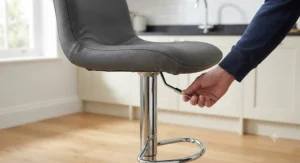
Beyond flammability, general product safety requirements also apply, covering things like sharp edges, stability under normal use, and secure fixings — reputable retailers test against these as standard, but it’s worth giving any newly assembled stool a firm wobble test before first proper use, checking that every bolt is genuinely tight rather than just hand-snug. For height-adjustable stools specifically, confirm the gas-lift mechanism locks securely at your chosen height before relying on it daily; a lift that slowly sinks under weight over the first few weeks is a fault worth returning under standard consumer protection rights rather than living with.
FAQ
❓ How do you clean leather bar stools?
❓ Are faux leather bar stools any good?
❓ What height should a bar stool be for a kitchen island?
❓ Do leather bar stools crack over time?
❓ Are leather bar stools pet friendly?
Conclusion
There’s no single “best” leather bar stool because there’s no single kitchen or single budget — that’s really the honest takeaway from working through all seven of these properly. If you want genuine 120kg-rated stability without spending much, the LANGRIA Crescent-Back does the job without fuss. If your household involves small children or an enthusiastic pet, the HOMCOM Vintage PU is built to hide exactly the kind of daily wear that would show on almost anything else. And if you’re finally ready to invest in something that’ll outlast several kitchen refreshes, either the award-winning VASAGLE EKHO Collection or the genuinely tactile Elm Home & Garden leather pick will reward that decision for years rather than months.
What matters more than any single product recommendation is the framework itself: measure your counter first, check the weight rating before the colour, decide honestly between faux and genuine based on budget and maintenance appetite, and confirm UK safety compliance rather than assuming it. Get those fundamentals right and almost any stool on this list will serve your kitchen well — get them wrong, and even the most expensive genuine leather stool in the world won’t feel like money well spent.
Recommended for You
- Bar Stools Under £50: 7 Best Budget Picks for 2026
- Bar Stools with Backs: 7 Best Picks for UK Kitchens (2026)
- Best Dining Bench: 7 Top UK Picks for 2026 (Buying Guide)
Disclaimer: This article contains affiliate links. As an Amazon Associate, I earn from qualifying purchases. If you purchase products through these links, we may earn a small commission at no additional cost to you.
✨ Found this helpful? Share it with your friends! 💬🤗
