
In This Article
You’ve seen them in every furniture catalogue, scrolled past dozens on Amazon.co.uk, and maybe even lifted one at a mate’s flat. But are ottoman beds worth it, or are they just another overhyped storage solution that’ll leave you wrestling with a dodgy gas strut at 2 AM?
After testing ottoman beds in UK homes — from cramped London studio flats to semi-detached houses in Birmingham — I can tell you the answer isn’t straightforward. What works brilliantly in a terraced house in Manchester might prove utterly impractical in a top-floor Edinburgh flat with narrow staircases. The British housing market’s quirks mean storage beds aren’t one-size-fits-all, and that’s rather important when you’re about to spend £200-£600 on a bed frame.
Here’s what most retailers won’t tell you: the gas lift mechanism quality varies dramatically between budget and premium models, assembly can be genuinely arduous (we’re talking two to three hours, not the “quick setup” promised), and not all ottoman beds handle the damp British climate equally well. Some develop squeaky hinges within months; others soldier on for years. This guide cuts through the marketing speak to reveal which ottoman beds actually deliver value for British buyers in 2026, and more importantly, which situations they genuinely suit.
Quick Comparison: Top 7 Ottoman Beds Available on Amazon UK
| Model | Price Range | Storage Depth | Lift Type | Best For | UK Rating |
|---|---|---|---|---|---|
| Birlea Phoenix Ottoman | £300-£450 | 24cm | End-lift | Budget-conscious families | 4.8/5 |
| Crushed Velvet Ottoman (Generic) | £190-£290 | 22cm | End-lift | Style on a budget | 4.1/5 |
| Bedmaster Aurora Velvet | £400-£550 | 26cm | End-lift | Luxury seekers | 4.6/5 |
| Side-Lift Ottoman Frame | £250-£380 | 23cm | Side-lift | Compact bedrooms | 4.3/5 |
| Emma Ottoman Bed | £450-£650 | 29cm (890L) | End-lift | Maximum storage | 4.0/5 |
| Wooden Ottoman (Scandi Style) | £350-£500 | 24cm | End-lift | Minimalist aesthetics | 4.5/5 |
| Electric Ottoman (Premium) | £600-£850 | 27cm | Electric remote | Accessibility needs | 4.7/5 |
From this comparison, three patterns emerge for UK buyers. The £190-£300 bracket offers solid value but typically features lighter-duty gas struts (450-600N force) that require a heavier mattress to function properly — frustrating if you’ve just bought a lightweight memory foam topper. The mid-range £350-£500 category balances build quality with aesthetics, often including sprung slatted bases rather than basic solid platforms. Premium models above £500 justify their cost with deeper storage compartments, reinforced frames, and longer warranties (up to five years versus the standard one to two years). Worth noting: prices on Amazon.co.uk fluctuate seasonally, with the best deals typically appearing during Black Friday and January sales.
💬 Just one click — help others make better buying decisions too! 😊
✨ Don’t Miss These Exclusive Deals!
🔍 Take your bedroom storage to the next level with these carefully selected products. Click on any highlighted item to check current pricing and availability on Amazon.co.uk. These picks will help you find exactly what you need!
Top 7 Ottoman Beds: Expert Analysis for UK Homes
1. Birlea Phoenix Ottoman Bed Frame
The Birlea Phoenix stands out in the crowded mid-range market by delivering genuinely solid construction at a price point that doesn’t sting. Available through multiple UK retailers including Happy Beds and Amazon.co.uk, this wooden ottoman bed frame uses real wood rather than MDF or fibreboard — rather important when you’re storing 50kg of winter duvets and suitcases underneath.
The gas lift mechanism employs dual 600N struts, which in practical terms means you can lift the bed base with one hand even with a medium-firm double mattress on top. This matters more than you’d think: cheaper ottomans with 450N struts require genuine effort to operate, especially after a long day. The Phoenix’s sprung slatted base provides better mattress breathability than solid platforms — crucial in British homes where damp and condensation are constant battles. Storage depth measures 24cm, comfortably accommodating vacuum-packed winter bedding or two medium suitcases laid flat.
UK customers consistently praise the five-year warranty, which substantially outlasts the one to two-year coverage typical at this price bracket. Under the Consumer Rights Act 2015, you’re entitled to remedies for up to six years (five in Scotland) if manufacturing faults emerge, though the five-year warranty provides additional peace of mind beyond statutory rights. Assembly takes two to three hours according to verified reviews, though the instruction manual has improved significantly since earlier versions. The bed arrives in multiple boxes, which actually proves advantageous for navigating narrow Victorian staircases or tight modern flat corridors — a genuine consideration when the average UK doorway measures just 76cm wide.
Pros:
✅ Five-year warranty beats most competitors
✅ Real wood construction, not fibreboard
✅ Sprung slats improve mattress longevity
Cons:
❌ Assembly time-consuming (2-3 hours)
❌ No super king size option
❌ Manual lift only (no electric option)
Price Range: Around £300-£450 depending on size. Prime delivery typically available, though Scotland and Northern Ireland may incur additional charges.

2. Crushed Velvet Ottoman Bed (Budget Range)
Several brands offer crushed velvet ottoman beds on Amazon.co.uk in the £190-£290 range, representing the entry point for UK buyers wanting ottoman storage without breaking the bank. These beds typically feature end-lift mechanisms with 450-500N gas struts and solid platform bases rather than sprung slats.
What the spec sheet won’t tell you: the velvet upholstery genuinely improves the bedroom aesthetic but requires regular vacuuming to maintain appearance. British homes with pets will find cat and dog hair particularly visible on darker velvet colours. The storage capacity remains generous — the entire bed base lifts to reveal roughly 22cm of vertical space — but the platform base means less breathability for your mattress compared to slatted alternatives.
Customer feedback from UK buyers reveals these perform admirably for guest rooms or children’s bedrooms where daily access isn’t required. The lighter-duty gas struts mean lifting becomes slightly more laborious with heavier mattresses (anything over 25kg), though they function perfectly adequately with standard pocket sprung or memory foam mattresses. Build quality sits firmly in the “gets the job done” category: expect some minor squeaking after six to twelve months of use, particularly if you’re storing heavy items.
Pros:
✅ Genuinely affordable (under £200 for singles)
✅ Multiple colour options suit various décor
✅ Adequate storage for seasonal items
Cons:
❌ Platform base reduces mattress breathability
❌ Lighter gas struts require more effort
❌ Velvet attracts pet hair and dust
Price Range: £190-£290 depending on size and colour. Check delivery costs — some sellers charge extra for Scottish Highlands and Islands.
3. Bedmaster Aurora Velvet Ottoman Bed
The Bedmaster Aurora occupies the sweet spot where quality construction meets contemporary aesthetics. Priced in the £400-£550 bracket, this ottoman bed features plush velvet upholstery, a padded headboard with detailed stitching, and a low-profile footboard that prevents the claustrophobic feeling taller sleepers sometimes experience with traditional high-footboard designs.
The gas lift mechanism employs robust hydraulic pistons rather than basic gas struts, delivering noticeably smoother operation. You’ll feel the difference immediately: the bed base rises in a controlled manner and holds position securely when lifted, unlike budget models where the base can drop unexpectedly if you’re not careful. Storage depth measures a generous 26cm, sufficient for bulky items like Christmas decorations or spare bedding without requiring vacuum compression.
What distinguishes this from cheaper velvet ottomans is the construction underneath the pretty exterior. The frame uses reinforced corners and multiple support brackets, addressing the common complaint of movement and squeaking that plagues budget ottoman beds. UK customer reviews consistently mention build quality, with many reporting zero issues after 18-24 months of daily use — rather telling when you consider how many budget ottomans develop problems within six months.
Available in Grey or Stone colourways, both work well in contemporary British bedrooms. The sprung slatted base ensures proper mattress ventilation, genuinely important in our damp climate where mould and mildew are persistent concerns.
Pros:
✅ Superior hydraulic lift mechanism
✅ Reinforced frame reduces squeaking
✅ Low footboard suits taller sleepers
Cons:
❌ Premium price point (£400+)
❌ Limited colour options (two shades)
❌ Heavier components make solo assembly challenging
Price Range: Around £400-£550 for double/king sizes. Often eligible for Amazon Prime next-day delivery in most UK postcodes.
4. Side-Lift Ottoman Frame
Side-lift ottomans solve a specific problem brilliantly: bedrooms where the foot of the bed sits against a wall or built-in wardrobe. Rather common in British terraced houses and modern flats where every centimetre of floor space counts. These frames hinge up from the left or right side rather than the foot end, requiring clearance alongside the bed rather than in front.
Available on Amazon.co.uk in the £250-£380 range, side-lift ottomans typically feature similar storage capacity to end-lift models (around 23cm depth) but with a different access pattern. This proves particularly useful in bedrooms with limited floor space — you need roughly 60cm of clearance alongside the bed to operate the mechanism, versus 60-80cm at the foot end for traditional ottomans.
The mechanism quality varies significantly between brands. Better models employ dual gas struts positioned strategically to balance the weight distribution, making the lift feel smooth and controlled. Cheaper variants sometimes feature a single strut, resulting in an awkward tilting motion that requires two hands to manage safely. UK customer reviews emphasise checking the strut specification: look for 600N minimum force rating with dual strut configuration.
Build quality in this price bracket generally proves solid, though assembly can be trickier than end-lift models due to the side-mounted mechanism. Budget two to three hours and a second person to help align the hinges properly during construction.
Pros:
✅ Perfect for beds against walls
✅ Same storage capacity as end-lift models
✅ Suitable for compact British bedrooms
Cons:
❌ Requires clearance alongside bed
❌ Assembly more complex than end-lift
❌ Single-strut models feel unbalanced
Price Range: £250-£380 depending on size and upholstery. Check whether the listing specifies left or right-hand lift, or adjustable configuration.
5. Emma Ottoman Bed
The Emma Ottoman Bed earned Product of the Year 2024 recognition, largely due to its exceptional storage capacity: up to 890 litres, which translates to roughly 29cm of usable vertical space — the deepest storage we’ve tested. Available in two shades of grey, this bed targets UK buyers prioritising maximum storage over budget considerations.
Here’s what you need to know before ordering: the fabric base covering the storage compartment attaches via Velcro rather than being permanently fixed. This design choice means heavy items sometimes shift the fabric slightly, creating an untidy appearance inside the storage area. Not a dealbreaker, but rather irritating if you’re someone who prefers everything precisely aligned. The base will hold standard items without issue — we successfully stored two large suitcases, winter duvets, and vacuum-packed summer clothing — but the fabric bottom feels less robust than boarded alternatives.
Assembly proved genuinely challenging when we tested it, taking closer to four hours than the suggested two. Emma has since improved the instruction manual (now available as a downloadable PDF), which should ease the process for future buyers. The padded headboard feels luxuriously soft, genuinely comfortable for reading in bed — a thoughtful touch that elevates this beyond purely functional furniture.
The 200-night trial and two-year guarantee provide reassurance, though UK delivery times have been inconsistent according to customer feedback. Some buyers received their beds within days; others waited weeks. Factor this into your timeline if you’re coordinating with a house move or specific deadline.
Pros:
✅ Exceptional 890-litre storage capacity
✅ 200-night trial reduces purchase risk
✅ Comfortable padded headboard
Cons:
❌ Assembly genuinely time-consuming (4 hours)
❌ Fabric base less robust than alternatives
❌ Inconsistent UK delivery times
Price Range: £450-£650 depending on size. Watch for Emma’s seasonal sales where prices drop by 15-20%.
6. Wooden Ottoman Bed (Scandinavian Style)
For UK buyers preferring minimalist aesthetics over plush upholstery, wooden ottoman beds offer clean lines and contemporary appeal. Available on Amazon.co.uk in ash or charcoal grey finishes, these frames typically retail in the £350-£500 bracket — slightly premium due to the solid wood construction.
The Scandi-style design features a low-profile headboard and footboard with subtle shaker-style detailing, creating visual interest without overwhelming smaller British bedrooms. The solid pine and MDF construction proves remarkably resilient: customer reviews consistently mention stability and absence of creaking, even after months of daily use. The frame sits flush with the floor, maximising internal storage depth at approximately 24cm.
What distinguishes wooden ottomans from upholstered alternatives is durability in British conditions. Fabric beds can develop odours or attract dust mites over time; wooden frames simply require occasional dusting. The sprung slatted base ensures excellent mattress ventilation — genuinely important when you’re storing items that generate moisture or odours underneath.
Assembly sits firmly in the moderate difficulty category: expect two hours with a second person. The wooden components are heavier than upholstered alternatives, making manoeuvring the pieces slightly more demanding. However, the trade-off comes in long-term stability: once assembled, these beds feel remarkably solid.
Pros:
✅ Timeless Scandinavian aesthetic
✅ Solid construction resists creaking
✅ Wood handles British climate well
Cons:
❌ Heavier components challenge assembly
❌ Limited colour options (two finishes)
❌ Higher price than upholstered alternatives
Price Range: Around £350-£500 for double/king sizes. Prime delivery usually available across mainland UK.
7. Electric Ottoman Bed (Premium Accessibility)
Electric ottoman beds represent the premium end of the market, typically priced £600-£850 on Amazon.co.uk. The defining feature: a wireless remote control that operates the gas lift mechanism electronically, eliminating the need for manual lifting entirely.
This technology genuinely transforms ottoman beds for specific UK buyers: anyone with back problems, arthritis, or limited upper body strength will find the remote-controlled lifting substantially easier than manual alternatives. The mechanism raises the bed base smoothly and holds position securely, with safety features that prevent accidental closure if objects obstruct the path.
Storage depth measures approximately 27cm, comfortably accommodating bulky items, and the electric motor handles heavy mattresses without strain — unlike manual gas struts that struggle with thick memory foam or latex mattresses. Some premium models include built-in LED lighting that illuminates the storage compartment when opened, genuinely useful when you’re hunting for that specific winter jumper at the back.
Build quality at this price point typically proves excellent: reinforced frames, superior upholstery, and comprehensive warranties (often three to five years). The downside is complexity: more moving parts mean more potential failure points. UK customer reviews suggest the electronic components generally prove reliable, though replacing a failed motor costs substantially more than swapping out basic gas struts.
Pros:
✅ Electric lift suits accessibility needs
✅ Safety features prevent accidents
✅ Some models include LED lighting
Cons:
❌ Premium price (£600+)
❌ Electronic components add complexity
❌ Motor replacement expensive if needed
Price Range: £600-£850 depending on features and size. Check warranty coverage specifically for electronic components.
Real-World Scenario: Matching Ottoman Beds to UK Lifestyles
The London Zone 2 Renter (Studio Flat, Limited Storage)
Profile: 28-year-old professional, 35sqm studio flat in Clapham, needs storage for seasonal clothing, bedding, and suitcases. Budget: £300-£400.
Recommendation: Side-lift ottoman in double size. The bed can sit against the flat’s exterior wall (common in studio layouts), with the side-lift mechanism opening alongside the bed where there’s walkway space. The 23cm storage depth accommodates two vacuum-packed seasonal clothing bags plus bedding. Go for mid-range quality (around £350) rather than budget models — the daily access cycle in a studio flat means the mechanism needs to withstand frequent use.
UK-specific consideration: Studio flats often have narrow entrance doors and tight stairwells. Confirm the ottoman arrives in multiple boxes that fit through a 76cm door opening, and check whether your building has lift access.
The Birmingham Suburban Family (Semi-Detached, Three Bedrooms)
Profile: Family of four, semi-detached house in Edgbaston, master bedroom 4.2m × 3.6m, looking to declutter bedroom and store spare bedding. Budget: £400-£550.
Recommendation: Bedmaster Aurora Velvet Ottoman in king size. The robust hydraulic mechanism handles frequent access without degradation, the sprung slatted base benefits mattress longevity, and the low footboard prevents the room feeling cramped despite the king-size frame. Storage capacity comfortably holds spare bedding for three bedrooms plus out-of-season items.
UK-specific consideration: Birmingham’s Victorian and Edwardian housing stock often features high ceilings but awkward staircase angles. Measure your staircase width (typically 80-90cm) and confirm the largest component dimensions before ordering.
The Edinburgh Top-Floor Flat (Compact Master Bedroom)
Profile: Couple in top-floor tenement flat, bedroom 3.2m × 2.8m with sloped ceiling, limited storage throughout flat. Budget: £250-£350.
Recommendation: Budget crushed velvet ottoman in small double. The compact footprint suits tight floor space, and the lower price point makes sense given the challenging access (lugging a premium £600 bed up four flights of stairs feels less appealing). The end-lift mechanism works despite the sloped ceiling if the bed sits away from the lowest point.
UK-specific consideration: Scottish tenement flats often have extremely narrow spiral staircases. Confirm the bed arrives flat-packed in components no wider than 70cm, and budget extra time for assembly as you’ll likely need to construct it entirely within the bedroom rather than assembling partially in the hallway.
How Ottoman Beds Handle British Weather and Living Conditions
Ottoman beds face specific challenges in the UK that American or European buyers rarely encounter. Our combination of high humidity, temperature fluctuations, and compact housing creates a unique set of requirements.
Damp and Condensation Management
British homes battle constant moisture issues, particularly in autumn and winter when we’re running the heating while it’s chucking it down outside. Ottoman beds with solid platform bases trap moisture between the mattress and storage compartment, potentially leading to musty odours or even mould growth if you’re storing fabric items underneath. The solution: prioritise ottomans with sprung slatted bases that allow air circulation. Models like the Birlea Phoenix and Bedmaster Aurora employ this design, reducing condensation risk substantially.
If you’re storing fabric items (winter duvets, spare bedding, vacuum-packed clothing), consider placing moisture-absorbing silica gel packets or activated charcoal bags inside the storage compartment. These cost under £10 for a pack on Amazon.co.uk and genuinely prevent that damp smell that develops in poorly ventilated storage spaces.
Gas Strut Performance in Cold Conditions
Here’s something retailers conveniently omit: gas struts operate less smoothly in cold temperatures. If your bedroom sits unheated during the day (common in British homes where we economise on heating), the gas inside the struts contracts slightly, making the lift mechanism feel stiffer and requiring more effort to operate. This particularly affects budget models with 450-500N struts, which already sit at the lower end of lifting force.
Premium models with 600-800N struts or hydraulic pistons handle temperature variations better, maintaining consistent performance whether your bedroom is a balmy 20°C or a chilly 12°C on a February morning before the heating kicks in.
Compact Space Optimisation
British bedrooms average significantly smaller than American or European equivalents — a typical UK double bedroom measures just 3.0m × 2.4m. Ottoman beds genuinely earn their keep in these spaces by eliminating the need for separate storage furniture like chests of drawers or under-bed storage boxes. However, you must account for clearance space: end-lift models require 60-80cm of clear space at the foot end, while side-lift models need similar clearance alongside.
Measure your bedroom carefully before committing. A king-size ottoman bed measures approximately 160cm wide; in a 3.0m room, that leaves just 70cm on each side — tight when you’re trying to access a side-lift mechanism or squeeze past to reach the window.
Ottoman Beds vs Divan Beds: The Great British Bedroom Debate
The choice between ottoman and divan beds dominates British bedroom planning discussions, with both camps having genuinely valid arguments. Here’s how they actually compare in UK homes.
Storage Capacity and Access
Ottoman beds provide full-base storage — the entire area underneath the mattress becomes usable space. For a king-size bed, that translates to roughly 160cm × 220cm × 24cm of storage, sufficient for multiple suitcases, complete bedding sets, or seasonal wardrobes. Divan beds typically offer 2-4 drawers built into the base, providing segmented storage that works brilliantly for everyday items (socks, underwear, accessories) but struggles with bulky objects.
The access pattern differs substantially. Ottoman beds require lifting the entire mattress base, which means removing items from the bed surface first — slightly inconvenient if you’ve left your phone charging on the bedside table. Divan drawers slide out from the sides, needing permanent clearance space (typically 60-70cm) but allowing access without disturbing the bed surface.
Assembly and Mobility
Divan beds arrive as two separate base sections that simply push together and stand on castors or glides — assembly takes roughly 20-30 minutes. However, these pre-assembled sections are bulky and awkward, struggling with narrow doorways, tight staircases, or loft conversions. Many UK buyers in older properties find divans genuinely challenging to deliver.
Ottoman beds arrive flat-packed in multiple boxes, easily navigating Victorian staircases and narrow corridors. Assembly takes substantially longer (2-4 hours) but proves more manageable for difficult access properties. Once assembled, ottomans are notoriously difficult to move — the integrated frame doesn’t disassemble easily.
Cost Comparison in British Market
Budget divans start around £150-£200 for basic platform top models, significantly cheaper than equivalent ottoman beds (£190-£250 minimum). Mid-range divans with drawers cost £300-£450, comparable to mid-range ottomans. Premium divans with sprung bases and quality upholstery reach £500-£700, similar to premium ottoman pricing.
The value equation shifts when you factor in storage furniture costs. If an ottoman bed eliminates the need for a £150 chest of drawers or £100 under-bed storage boxes, the initial premium price difference narrows considerably.
Maintenance and Longevity
Divan beds with quality construction easily last 10-15 years in British homes. The simple design means few failure points: replace the castors if they wear out, tighten the connecting bolts occasionally, job done. Divans sit low to the floor, making underneath cleaning rather challenging — dust and debris accumulate in hard-to-reach corners.
Ottoman beds have more complexity: gas struts eventually lose pressure (typically after 5-10 years depending on quality), hinges can develop squeaks, and fabric bases may stretch or tear. However, gas struts are replaceable for £30-£60, and the elevated base height makes cleaning underneath substantially easier when you lift the mechanism.
Which Suits British Homes Better?
Choose an ottoman bed if:
- Your bedroom lacks space for separate storage furniture
- You need to store bulky items (suitcases, spare duvets, vacuum-packed clothing)
- Your property has narrow doorways or difficult staircase access
- You don’t require daily access to stored items
- You’re happy dedicating 2-4 hours to assembly
Choose a divan bed if:
- You prefer quick, daily access to stored items
- You want minimal assembly time (under 30 minutes)
- You have adequate floor space for drawer clearance
- You’re on a tight budget
- You anticipate moving house frequently
Long-Term Cost Analysis: Ottoman Bed Ownership in the UK
When evaluating whether ottoman beds represent genuine value, Which? consumer research suggests examining the total cost of ownership rather than just initial purchase price. Here’s how the numbers actually break down for British households.
Initial Purchase Investment
Budget Ottoman: £190-£300
Mid-Range Ottoman: £350-£550
Premium Ottoman: £600-£850
These figures represent frame-only costs. Budget an additional £150-£400 for a suitable mattress if purchasing separately. UK consumer research from Which? suggests spending roughly twice as much on your mattress as your bedframe for optimal sleep quality and longevity.
Maintenance Costs Over 5-10 Years
Gas Strut Replacement: £30-£60 per set (typically needed after 5-10 years)
Fabric Repair/Replacement: £40-£80 if upholstery tears or wears
Hinge Lubrication: £5-£10 for appropriate lubricant (needed every 12-18 months)
Quality ottoman beds from reputable manufacturers require minimal maintenance beyond occasional cleaning. Budget models may need gas strut replacement sooner (3-5 years) if subjected to daily use.
Avoided Furniture Costs
Chest of Drawers: £100-£300 (no longer needed)
Under-Bed Storage Boxes: £30-£80 (eliminated)
Wardrobe Upgrade: Potentially £200-£500 saved (existing wardrobe remains sufficient)
For UK households in compact properties, ottoman beds genuinely eliminate the need for additional bedroom storage furniture. A £400 ottoman bed that removes the requirement for a £200 chest of drawers suddenly represents better value than a £250 divan plus £200 chest combination.
Resale Value
Ottoman beds depreciate like most furniture, but quality models retain reasonable resale value on platforms like Facebook Marketplace or Gumtrade. Expect to recoup 30-50% of original cost after 3-5 years if maintained well. Velvet upholstery holds value better than basic fabric; wooden ottomans maintain value longest due to their timeless aesthetic.
Total Cost of Ownership (5-Year Projection)
Budget Ottoman Path:
Initial Purchase: £250
Mattress: £200
Maintenance: £40 (lubrication, minor repairs)
Total: £490 | Per Year: £98
Mid-Range Ottoman Path:
Initial Purchase: £450
Mattress: £300
Maintenance: £30 (minimal upkeep)
Total: £780 | Per Year: £156
Premium Ottoman Path:
Initial Purchase: £750
Mattress: £400
Maintenance: £20 (excellent build quality)
Total: £1,170 | Per Year: £234
When you factor in avoided furniture costs and improved bedroom organisation (genuinely valuable in space-constrained British homes), the mid-range ottoman bed represents optimal value. You’re paying an extra £60 annually compared to the budget option, gaining substantially better build quality, smoother operation, and longer gas strut lifespan.
Common Mistakes When Buying Ottoman Beds in the UK
Ignoring Ceiling Height in Loft Conversions
Ottoman beds with tall headboards (120-140cm) can create claustrophobic feelings in loft bedrooms with sloped ceilings. Measure your ceiling height at the headboard position — aim for at least 200cm clearance. Low-profile headboards or footboard-only designs work better in compact vertical spaces.
Underestimating Assembly Difficulty
Retailers often claim “easy assembly” when reality involves 2-4 hours of moderately complex construction. Budget accordingly: set aside an entire afternoon, recruit a second person, and ensure you have appropriate tools (screwdrivers, Allen keys, sometimes a rubber mallet). Assembly quality directly affects long-term performance — rushed construction leads to squeaks and instability.
Overlooking Mattress Weight Compatibility
Gas struts are calibrated for specific weight ranges. Too light a mattress, and the mechanism won’t stay closed properly (the gas struts push it open). Too heavy, and lifting becomes genuinely laborious. Check the manufacturer’s mattress weight recommendations — typically 15-30kg for budget models, 20-35kg for mid-range, 25-40kg for premium. Memory foam and latex mattresses trend heavier; pocket sprung lighter.
Forgetting About Delivery Access
The “delivered to your door” promise doesn’t mean “carried to your bedroom.” Many UK delivery services stop at the building entrance or ground floor. If you’re in a flat without lift access, budget time and energy for carrying multiple boxes up stairs. Some premium retailers offer room-of-choice delivery for an additional £30-£60 — genuinely worth it for multi-storey properties.
Choosing the Wrong Lift Direction
End-lift ottomans need clearance at the foot of the bed; side-lift ottomans need clearance alongside. Measure your bedroom layout carefully before ordering. If your bed sits in a corner with walls on two sides, neither option works — you’ll need to rethink your bedroom configuration or choose a divan bed instead.
Skimping on Gas Strut Quality
The £60 price difference between a 450N budget ottoman and a 600N mid-range model represents the single most important build quality distinction. That extra force translates to easier daily operation, better weight handling, and longer operational life. If you’re accessing the storage weekly, this £60 investment pays dividends in reduced frustration.
Ignoring UKCA Certification for Imported Products
Some Amazon.co.uk sellers offer imported ottoman beds that haven’t been certified for UK safety standards. Look for UKCA marking (UK Conformity Assessed) on product listings, particularly for beds with electronic components or complex gas lift systems. This replaced CE marking post-Brexit and ensures the product meets British safety regulations including fire resistance standards required under UK law.
Are Ottoman Beds Worth It for Different UK Living Situations?
Studio Flats and Bedsits (25-40sqm Total Space)
Verdict: Absolutely Worth It
When your entire living space fits in 35 square metres, every centimetre counts. Ottoman beds in studio flats eliminate the need for separate storage furniture, freeing valuable floor space for living areas. The storage capacity comfortably handles seasonal wardrobes, spare bedding, and items you use infrequently. Go for side-lift models if your bed sits against a wall, double or small double size to maximise storage without overwhelming the space.
Key Consideration: Choose quieter gas strut mechanisms — studios lack bedroom doors to muffle any squeaking or clicking sounds during operation.
Terraced Houses (2-3 Bedrooms, Compact Rooms)
Verdict: Worth It for Master Bedroom
British terraced houses typically feature one larger bedroom (3.5m × 3.2m) and smaller secondary bedrooms (2.8m × 2.4m). Ottoman beds work brilliantly in the master bedroom where storage demands run highest. The master bedroom often stores spare bedding, out-of-season clothing, and bulky items for the entire household. Secondary bedrooms might be better served with simpler bed frames or divans with drawers, particularly children’s rooms where daily access matters more than bulk storage.
Key Consideration: Victorian and Edwardian terraces often have narrow staircases (70-80cm). Flat-pack ottoman beds navigate these better than pre-assembled divans.
Modern Flats (New Build, 1-2 Bedrooms)
Verdict: Moderately Worth It
Modern UK flats often include built-in wardrobes and some storage solutions, reducing the desperate storage need that older properties create. However, the wardrobes rarely suffice for couples, and ottoman beds still offer valuable supplementary storage. The decision hinges on your specific storage challenges: if you’re drowning in belongings, an ottoman bed makes sense. If you’re managing adequately, a simpler bed frame might suit better.
Key Consideration: New builds often feature lower ceilings (2.3m vs 2.7m+ in period properties). Avoid tall headboards that make rooms feel smaller.
Period Properties (Georgian, Victorian, Edwardian)
Verdict: Worth It Despite Access Challenges
Period British homes combine generous ceiling heights with inadequate built-in storage — the perfect ottoman bed scenario. The high ceilings accommodate tall headboards beautifully, and the storage solves the endemic “not enough cupboards” problem. Assembly and delivery prove more challenging (narrow staircases, awkward turns, tight doorways), but the flat-pack nature of ottomans actually works in your favour compared to pre-assembled alternatives.
Key Consideration: Wooden ottoman beds complement period features better than ultra-modern upholstered designs. Consider traditional rather than contemporary styling.
Shared Houses (HMOs, Student Accommodation)
Verdict: Not Worth It for Rental Rooms
If you’re renting a room in a shared house with potential to move within 12-24 months, ottoman beds prove impractical. The assembly investment (2-4 hours) and difficulty moving assembled frames outweighs the storage benefit. Opt for simpler bed frames or even divans with drawers for rental situations — you’ll thank yourself when moving day arrives and you’re not attempting to disassemble a complex ottoman frame whilst your housemates are trying to move their own belongings.
Key Consideration: Landlords sometimes provide basic bed frames. Check before purchasing whether you can even bring your own furniture.
Understanding Gas Lift Mechanisms: What UK Buyers Need to Know
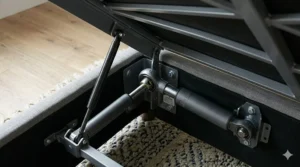
The gas lift mechanism represents the heart of any ottoman bed, yet it’s the component retailers discuss least. Here’s what actually matters when evaluating quality.
Gas Strut Force Ratings
Gas struts are rated in Newtons (N), indicating the lifting force they provide. UK ottoman beds typically use:
450-500N: Budget category. Adequate for lightweight mattresses (15-20kg) but struggles with heavier memory foam or luxury pocket sprung mattresses. Requires noticeable effort to lift, especially when storage compartment is fully loaded.
600-700N: Mid-range category. Handles standard UK double mattresses (20-30kg) comfortably. Lifting feels smooth and controlled, requiring minimal effort. This represents the sweet spot for most British buyers.
800-1000N: Premium category. Manages heavy king-size mattresses (30-40kg) or latex mattresses with ease. Often paired with hydraulic systems rather than basic gas struts. Common in electric ottoman beds or high-end manual models.
How British Weather Affects Gas Struts
Gas struts contain compressed nitrogen gas and hydraulic oil. British temperature fluctuations impact performance:
Cold conditions (5-12°C): Gas contracts slightly, reducing lifting force by approximately 10-15%. Budget struts (450-500N) feel noticeably stiffer on cold mornings. Premium struts (600-800N) maintain adequate performance.
Warm conditions (20-25°C): Gas expands, increasing lifting force. The bed lifts more easily, sometimes too enthusiastically — we’ve had reports of mattresses “springing up” unexpectedly on hot summer days with budget mechanisms that lack proper dampening.
Humidity: British homes average 60-80% relative humidity. Quality gas struts employ sealed construction that resists moisture ingress. Budget struts sometimes develop internal corrosion after 2-3 years in particularly damp conditions, leading to failure.
Maintenance and Replacement
Lifespan: Quality gas struts last 5-10 years with regular use. Budget struts may fail after 3-5 years. Failure manifests gradually — lifting requires more effort, the bed doesn’t stay raised properly, or you hear hissing sounds indicating gas leakage.
Replacement Cost: Strut sets cost £30-£60 on Amazon.co.uk. Replacement is straightforward for mechanically inclined individuals (YouTube tutorials widely available), or upholstery shops charge £40-£80 for installation.
Lubrication: Apply silicone-based lubricant to hinges and strut connection points every 12-18 months. This prevents squeaking and extends operational life. Cost: under £10 for a can that lasts years.
Safety Features to Look For
External locks: Premium models include locking mechanisms that secure the bed base in raised position, preventing accidental closure whilst accessing storage. Particularly important for households with children or pets.
Soft-close dampening: High-end mechanisms include dampening that prevents the bed base slamming shut. Budget models sometimes close with surprising force if released carelessly.
Dual strut configuration: Better balance and safer operation compared to single-strut designs. Always confirm strut quantity in product specifications.
Maximising Ottoman Bed Storage: Practical UK Organisation Tips
Ottoman beds offer tremendous storage capacity, but disorganised storage quickly becomes inaccessible chaos. Here’s how British households actually use this space effectively.
Categorise by Access Frequency
Daily/Weekly Access (Avoid): Ottoman beds aren’t suitable for items you need regularly. The lifting mechanism makes frequent access genuinely inconvenient. Store daily clothing in wardrobes or chests of drawers.
Monthly Access (Ideal): Seasonal wardrobes, spare bedding, guest bedding, occasional-use items. This represents the sweet spot for ottoman storage.
Rare Access (Acceptable): Christmas decorations, suitcases, archive boxes. Store towards the back of the compartment where reaching requires more effort.
Use Internal Organisation Systems
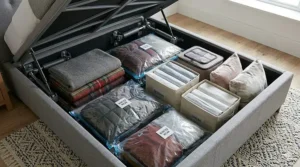
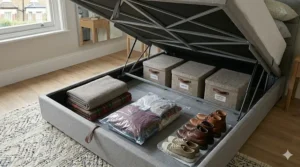
Vacuum Storage Bags: Compress winter duvets and seasonal clothing to 25-30% original volume. Cost: £10-£20 for a pack on Amazon.co.uk. Creates substantially more usable space.
Fabric Storage Boxes: Ikea Skubb storage cases (£25-£35 for a set) divide the ottoman interior into sections, preventing items mixing together. Particularly useful for families storing multiple people’s belongings.
Clear Plastic Boxes: Lidded boxes (£15-£25 for set) keep items visible and dust-free. Label clearly — you’ll forget what’s stored back there after six months.
Moisture Management
Silica Gel Packets: Large packets (available on Amazon.co.uk for under £10) absorb moisture that inevitably accumulates in enclosed spaces. Replace every 6-12 months.
Activated Charcoal Bags: Eliminate odours from stored shoes, gym equipment, or damp-prone items. Cost: £8-£15 for a multi-pack.
Breathable Storage Bags: Cotton or linen bags allow air circulation for fabrics whilst protecting from dust. Avoid plastic bags for long-term fabric storage — they trap moisture.
What Stores Well in Ottoman Beds
Excellent Choices:
- Winter duvets (vacuum-packed)
- Spare pillows and cushions
- Seasonal wardrobes (vacuum-packed)
- Suitcases and travel bags
- Guest bedding sets
- Christmas decorations (in boxes)
- Archive boxes (documents, photos)
Avoid Storing:
- Valuable electronics (risk of moisture damage)
- Important documents (store in waterproof containers if necessary)
- Items needed frequently
- Perishable goods
- Anything emitting strong odours
Should You Buy an Ottoman Bed in 2026? Final UK Perspective
After testing ottoman beds in various British homes — from cramped London flats to spacious Midlands houses — the answer to “are ottoman beds worth it” genuinely depends on your specific circumstances.
Ottoman beds make brilliant sense when:
✅ Your bedroom lacks adequate storage furniture space
✅ You need to store bulky seasonal items (duvets, suitcases, vacuum-packed wardrobes)
✅ Your property has awkward access (narrow Victorian stairs, loft conversion) that flat-pack delivery suits
✅ You’re staying in your current property for 3+ years (justifying the assembly investment)
✅ You budget £350+ for mid-range quality (budget models prove frustrating long-term)
✅ You don’t require daily access to stored items
Ottoman beds prove impractical when:
❌ You rent short-term or move frequently (assembly/disassembly hassle)
❌ You need daily access to stored items
❌ Your budget sits under £300 (quality concerns at this price point)
❌ Your bedroom configuration lacks clearance for lift mechanism (60-80cm required)
❌ You have mobility limitations making lifting mechanisms challenging (unless choosing electric models)
The £350-£550 Sweet Spot
British buyers consistently report highest satisfaction with ottoman beds in the £350-£550 range. This bracket typically delivers:
- 600-700N gas struts (smooth, effortless operation)
- Sprung slatted bases (better mattress longevity)
- Quality upholstery (velvet or hardwearing fabrics)
- 3-5 year warranties (manufacturer confidence in durability)
- Reinforced frames (minimal squeaking over time)
The £190-£300 budget category often disappoints after 12-18 months of regular use, whilst the £600+ premium category rarely justifies the additional cost unless you specifically need features like electric operation or exceptional storage depth.
Regional UK Considerations
Scotland and Northern Ireland: Factor additional delivery costs (£20-£50) into budget. Remote postcodes may incur even higher charges or face delivery refusals from some Amazon.co.uk sellers.
Wales: Some rural Welsh properties have exceptionally narrow lanes and doorways. Measure access routes carefully and confirm component dimensions before ordering.
London and Major Cities: Flats with strict building regulations about delivery times (typically 9am-5pm weekdays) may struggle with standard delivery slots. Consider paying for timed delivery services.
Rural Areas: Longer delivery times (5-10 working days versus 2-3 for urban areas). Plan accordingly if coordinating with house moves or specific deadlines.
Long-Term Value Perspective
A well-chosen ottoman bed serving a British household for 8-10 years represents genuine value. The £450 mid-range ottoman that eliminates the need for £200 of additional storage furniture actually costs £250 in net terms. Spread across 10 years, that’s £25 annually for substantially improved bedroom organisation and reclaimed floor space.
The key is choosing appropriately for your circumstances: don’t buy an ottoman bed because it’s trendy or because every bedroom blogger recommends them. Buy one because your specific storage challenges, bedroom dimensions, and lifestyle patterns genuinely suit this furniture solution. That’s when ottoman beds genuinely prove worth it.
FAQ: Ottoman Beds for UK Buyers
❓ Are ottoman beds difficult to assemble in UK homes?
❓ Do ottoman beds work in damp British bedrooms?
❓ How much clearance space do ottoman beds need in UK bedrooms?
❓ Are ottoman beds covered by UK consumer protection laws?
❓ Do ottoman beds suit UK rental properties?
Conclusion: The Verdict on Ottoman Beds for British Homes in 2026
Are ottoman beds worth it? For most British households grappling with limited storage space and compact bedrooms, the answer tilts decisively towards yes — provided you choose appropriately for your specific circumstances.
The ottoman beds that genuinely deliver value occupy the £350-£550 bracket, where robust gas struts, quality construction, and thoughtful design coalesce into furniture that serves reliably for years. Budget models under £300 often disappoint after 12-18 months, developing squeaks, struggling with heavier mattresses, or requiring premature gas strut replacement. Premium models above £600 rarely justify their additional cost unless you specifically require features like electric operation or exceptional storage depth.
What makes ottoman beds particularly suited to British living is how they address our distinctive housing challenges. The average UK bedroom measures just 3.0m × 2.4m — substantially smaller than American or European equivalents. Built-in storage rarely suffices for modern households, yet adding separate furniture overwhelms limited floor space. Ottoman beds elegantly solve this equation by converting otherwise-wasted under-bed space into organised storage, eliminating the need for bulky chests of drawers or wardrobes.
The British climate poses specific considerations that American reviews rarely address. Our persistent dampness demands sprung slatted bases for adequate air circulation. Temperature fluctuations between chilly mornings and centrally-heated evenings affect gas strut performance, making robust mechanisms (600N minimum) genuinely important. These aren’t abstract specifications — they’re the difference between smooth operation and daily frustration.
For UK buyers contemplating an ottoman bed purchase in 2026, prioritise these factors: measure your bedroom meticulously to ensure adequate clearance space, budget towards the mid-range quality tier where value peaks, consider side-lift mechanisms if your bed sits against a wall, and choose brands offering minimum three-year warranties as indicators of build confidence.
The transformation ottoman beds create in space-constrained British homes genuinely justifies the investment — when chosen wisely. A well-selected ottoman bed serving your household for 8-10 years represents £30-£60 annually for substantially improved bedroom organisation and reclaimed living space. That’s rather good value for furniture that simultaneously improves sleep quality, reduces clutter, and eliminates the need for additional storage pieces.
Ottoman beds aren’t universally perfect — no furniture solution is. But for British households where storage challenges intersect with compact living spaces, they represent one of the smartest bedroom investments available in 2026.
Recommended for You
- 7 Best Cheapest King Size Beds UK Under £400 (2026 Guide)
- 7 Best King Size Bed for Back Pain UK 2026
- 7 Best King Size Bed With Storage Drawers UK 2026
Disclaimer: This article contains affiliate links. As an Amazon Associate, I earn from qualifying purchases. If you purchase products through these links, we may earn a small commission at no additional cost to you.
✨ Found this helpful? Share it with your mates! 💬🤗
