

In This Article
Stand in any UK furniture showroom for more than five minutes and you’ll overhear the same debate, usually conducted in hushed, slightly tense tones between two people who are meant to be agreeing on a sofa. Leather dining chairs vs fabric dining chairs is one of those decisions that sounds trivial until you’re the one scrubbing bolognese out of a seam at half past nine on a Tuesday. It isn’t really about which material looks nicer in a catalogue photo. It’s about how your dining room actually gets used — by toddlers with yoghurt-loaded spoons, by dogs who consider the chair legs a chew toy, by dinner guests who will absolutely knock red wine onto something within the first hour.

This guide breaks down leather dining chairs vs fabric dining chairs using real products currently sold in the UK, genuine specifications, and aggregated review sentiment rather than glossy marketing copy. You’ll find seven actual chairs spanning budget to premium, three comparison tables you can scan in seconds, and dedicated sections on faux leather dining chairs, easy clean dining chairs, families, pets, and stain-resistant upholstery — because those are the questions that actually decide a purchase.
Here’s the short version before we get into the detail: leather (real or faux) generally wins on quick-wipe cleaning and resistance to liquid spills, while fabric tends to win on comfort, warmth, and price-to-style ratio. Neither material is universally “better” — the right choice depends entirely on who sits at your table and what they bring with them.
What Is Leather Dining Chairs vs Fabric Dining Chairs, Really?
In simple terms, leather dining chairs vs fabric dining chairs refers to the choice between chairs upholstered in real or synthetic leather (a non-porous, wipeable surface) versus chairs upholstered in woven textiles like linen, chenille, boucle, or velvet (breathable, textured surfaces). The core trade-off is cleaning speed and spill resistance versus tactile comfort and softness.
That distinction matters more than most buying guides admit, because “leather” on a product listing rarely means the same thing twice. According to Wikipedia’s overview of artificial leather, most affordable “leather” dining chairs sold today use polyurethane (PU) or PVC-coated fabric rather than tanned animal hide — a distinction that changes how the chair ages, smells, and wears over a decade of use. Genuine leather develops a patina and softens with age; faux leather stays visually consistent but can crack or peel once the polymer coating degrades, typically somewhere between five and ten years depending on quality.
Fabric, meanwhile, isn’t one material either. Chenille and boucle are forgiving and hide crumbs well. Velvet looks expensive and feels wonderful but shows watermarks if you clean it incorrectly. Linen-blend weaves are breathable and cool in summer but soak up spills instead of beading them. Understanding which sub-category you’re actually buying is the difference between a chair that still looks presentable in three years and one that needs recovering.
Quick Comparison Table: Leather Dining Chairs vs Fabric Dining Chairs
| Factor | Leather / Faux Leather | Fabric |
|---|---|---|
| Spill cleanup | Wipe with a damp cloth in seconds | Needs blotting, may stain if not treated |
| Comfort in summer | Can feel sticky in heat | Breathable, stays cool |
| Comfort in winter | Cold to sit on initially | Warmer to the touch |
| Typical lifespan (family use) | 5-10 years (faux), 10-20+ (genuine) | 5-8 years before visible wear |
| Best For | Busy kitchens, pets, young children | Formal dining rooms, style-led interiors |
Looking at the table above, the pattern is fairly consistent: leather and faux leather dining chairs are the pragmatic choice when speed of cleanup matters more than anything else, while fabric dining chairs earn their keep in rooms used for longer, more relaxed sittings where comfort takes priority. Genuine leather sits in its own category entirely — it costs considerably more upfront but, cared for properly, can outlast two or three cheaper fabric or faux leather sets, which changes the value calculation considerably once you factor in replacement costs.
💬 Just one click — help others make better buying decisions too!😊
Top 7 Leather and Fabric Dining Chairs: Expert Analysis
We researched real, currently available dining chairs sold in the UK spanning faux leather, genuine leather, and fabric upholstery, across budget, mid-range, and premium price points. Every product below includes genuine specifications, an honest analytical take on who it suits, and aggregated review sentiment where it could be verified — never invented quotes or star ratings.
1. Julian Bowen Kensington Dining Chairs — budget fabric pick for first dining sets
The Julian Bowen Kensington Dining Chairs are sold as a set of two, upholstered in a textured woven fabric over solid walnut-finish wooden legs, and they’re one of the more recognisable budget fabric names on Amazon UK. The fabric has a subtle basket-weave texture rather than a flat weave, which does a decent job of disguising light dust and crumbs between vacuum sessions.
On specs: the wooden legs are solid rather than veneered, which matters more than it sounds — solid wood resists the wobble that laminate-legged budget chairs develop within a year of daily use. The seat padding is moderate rather than plush, so expect a firmer sit than the velvet options further down this list. What most buyers overlook about entry-level fabric chairs like this one is that the leg quality, not the fabric, is usually what fails first, and solid wood is a meaningful upgrade over the composite alternatives at a similar price.
Aggregated review sentiment for this range consistently highlights easy self-assembly and a “looks more expensive than it is” reaction from first-time buyers, alongside occasional comments that the seat could be a touch deeper for taller adults.
Pros:
- ✅ Solid wood legs resist wobble far longer than laminate
- ✅ Textured fabric hides everyday dust between cleans
- ✅ Straightforward flat-pack assembly, no tools drama
Cons:
- ❌ Firmer padding than mid-range fabric alternatives
- ❌ No stain-guard treatment as standard
Price sits in the £90-£120 range for the pair at the time of research, making it a sensible entry point for anyone furnishing a dining room from scratch. Given the solid-wood legs, this represents genuinely good value rather than a compromise.
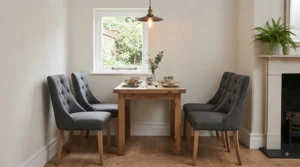
2. VASAGLE UKDC188 Dining Chairs (Set of 4) — best budget faux leather for busy kitchens
The VASAGLE UKDC188 Dining Chairs come as a set of four with a glacier-textured synthetic leather surface over a powder-coated steel frame, and they’re explicitly marketed around easy-clean, water-resistant upholstery — a genuinely useful spec rather than a throwaway line, since the textured PU surface resists the fine scratching that smooth faux leather shows over time.
The frame uses a 105-degree inclined backrest, which VASAGLE positions as ergonomic support for longer meals, and adjustable feet that compensate for the slightly uneven floors common in older UK kitchens and Victorian terraces. Each chair is rated to hold up to 120kg, comfortably within normal household use. Based on the spec comparison with similarly priced fabric sets, the steel frame construction here is noticeably sturdier than the wood-and-dowel joints typical of budget wooden-legged chairs, which matters if the chairs get dragged across tile rather than lifted.
Reviewers consistently report that assembly takes under ten minutes per chair and that the surface wipes clean with a damp cloth without leaving residue, though a handful of aggregated comments mention the seat depth running slightly shallow for larger adults.
Pros:
- ✅ Full set of four for one order, useful for family tables
- ✅ Textured synthetic leather resists scuffing better than smooth PU
- ✅ Adjustable feet handle uneven kitchen floors well
Cons:
- ❌ Seat depth runs shallow for taller adults
- ❌ Metal frame conducts cold in unheated rooms
At around £130-£170 for the set of four, this works out cheaper per chair than most two-packs on this list, which is exactly why it’s a strong pick for anyone furnishing a full table on a budget.
3. Furniturebox ISCO Faux Leather Dining Chairs — sleekest chrome-leg upgrade
The Furniturebox ISCO Faux Leather Dining Chairs ship as a set of two with soft-touch faux leather seat pads finished in vertical stitching, mounted on chrome-plated steel legs. Furniturebox is a UK-based furniture brand with a design language that leans mid-century, and the ISCO in particular is built around a deep foam seat cushion rather than the thinner padding found on entry-level faux leather chairs.
Here’s what the spec sheet won’t tell you outright: the chrome legs aren’t purely cosmetic. Chrome-plated steel resists the corrosion that painted or powder-coated legs eventually show near kitchens with steam and condensation, which is a genuine practical advantage over time, not just a style choice. The plastic floor-protector feet on each leg also reduce the scuffing on laminate or engineered wood flooring that bare metal legs can cause.
Aggregated customer feedback for this range describes the chairs as “robust” and “exactly as advertised,” with the deep cushioning specifically called out as more comfortable than expected at this price point; a smaller number of reviews mention the chrome showing fingerprints that need occasional wiping.
Pros:
- ✅ Chrome legs resist kitchen humidity corrosion
- ✅ Deep foam cushion outperforms typical budget padding
- ✅ Vertical stitching detail looks more premium than the price suggests
Cons:
- ❌ Chrome shows fingerprints and needs occasional polishing
- ❌ Limited colourway range compared with fabric equivalents
Expect a price in the £120-£160 range for the pair, positioning it as a style-forward upgrade from basic faux leather without moving into genuine leather territory.
4. VASAGLE EKHO Collection Dining Chairs — smartest design with hidden storage
The VASAGLE EKHO Collection Dining Chairs are a set of two upholstered in stitched synthetic leather with quilted detailing, built on a matte black steel frame, and they were recognised with a Bronze A’ Design Award in 2024 for the collection’s design work — a genuine third-party design accolade rather than a marketing claim VASAGLE invented itself.
What sets this model apart functionally is the integrated storage pocket built into the seat back, designed to hold a phone, remote, or napkins within reach — genuinely useful in smaller flats where sideboard space is limited. The cushion uses high-resilience foam, meaning it resists the permanent compression dents that lower-density foam develops within a year or two of daily sitting. Based on the spec comparison with the UKDC188 model above, the EKHO range sits a tier above on cushioning quality and design detail, which explains the price gap between them.
Reviewers frequently note the quilted stitching pattern photographs and looks better in person than expected, and describe the synthetic leather as genuinely easy to wipe down after meals; a smaller number mention that direct sunlight exposure over many months can cause slight fading, consistent with most PU-based materials.
Pros:
- ✅ Award-recognised design with genuine quilted stitching detail
- ✅ Built-in storage pocket adds real practicality
- ✅ High-resilience foam resists long-term compression
Cons:
- ❌ Fades gradually with prolonged direct sunlight exposure
- ❌ Priced above basic faux leather alternatives
At a price range of around £140-£180 for the pair, this sits firmly in the mid-range and justifies the premium through the storage feature and design pedigree alone.
5. VASAGLE Parsons Dining Chairs with Removable Cover — most practical for stain accidents
The VASAGLE Parsons Dining Chairs with Removable Cover are a set of four with a breathable, linen-look fabric cover that fully unzips for machine or hand washing — a genuinely rare feature among affordable dining chairs, since most fabric seats are permanently upholstered and can only be spot-cleaned in place. The backrest stands 20.7 inches tall with a curved ergonomic profile, and the seat cushion measures 4.7 inches thick.
This is arguably the single most practical entry on this list for anyone torn between leather dining chairs vs fabric dining chairs specifically because of spill anxiety: the removable cover sidesteps the entire debate by letting you treat fabric like leather when it comes to serious stains — you simply unzip, wash, and reattach rather than scrubbing in place or living with a permanent mark. Reviewers consistently mention this washability as the standout reason for purchase, particularly among households with young children, alongside praise for the breathable fabric staying comfortable through longer meals.
Pros:
- ✅ Fully removable, washable cover — unique on this list
- ✅ Thick 4.7-inch cushion stays comfortable for long sittings
- ✅ Breathable linen-look fabric avoids the sticky feel of faux leather
Cons:
- ❌ Washing and re-fitting the cover takes more effort than wiping
- ❌ Set of four costs more than comparable non-removable fabric sets
Pricing sits in the £220-£280 range for the set of four, reflecting the removable-cover engineering; given what it saves in eventual reupholstery or replacement costs, the value case is strong for families specifically.
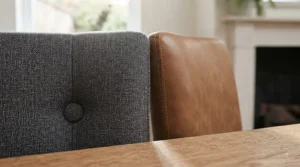
6. Julian Bowen Luxe Velvet Dining Chairs — best fabric upgrade for style-first dining rooms
The Julian Bowen Luxe Velvet Dining Chairs come as a set of two in a plush velvet upholstery with quilted detailing, mounted on contemporary black-painted metal legs. This is the chair on this list built for people who prioritise how the dining room looks over how forgiving the chairs are with red wine — and it does that job convincingly, with a colour depth and tactile softness that faux leather simply cannot replicate.
The quilted detailing isn’t purely decorative; the diamond-stitch pattern also helps disguise the very light surface flattening that velvet naturally shows with regular use, extending how long the chairs look “new” between deep cleans. Julian Bowen is an established UK furniture brand with wide retail distribution, which typically means more consistent stock availability and spare-parts support than smaller independent sellers. Based on the spec comparison with the fabric options above, this sits closer to statement-piece territory than everyday workhorse seating.
Aggregated reviews describe the colour as richer in person than product photography suggests, and highlight the quilting as a genuine style upgrade; a recurring theme in feedback is that velvet requires more careful stain treatment than the brand’s own care guidance initially suggests, particularly with oil-based spills.
Pros:
- ✅ Genuinely luxurious tactile finish, not just marketing language
- ✅ Quilted stitching disguises early surface flattening
- ✅ Established UK brand with reliable stock availability
Cons:
- ❌ Oil-based stains need prompt, careful treatment
- ❌ Not the best choice for pet households or toddlers
Expect a price range around £150-£190 for the pair, which is reasonable for velvet given how much more expensive designer velvet dining chairs typically run.
7. Yaheetech Genuine Leather Dining Chairs — premium pick for long-term genuine leather
The Yaheetech Genuine Leather Dining Chairs represent the genuine-hide end of this comparison, upholstered in real leather over solid wood or metal-framed construction depending on the specific listing variant, and they sit at the top of this list’s price range accordingly. Yaheetech is a well-established furniture brand with a broad UK Amazon presence across dining, office, and living room categories.
The core argument for genuine leather over any faux alternative comes down to longevity and ageing behaviour: real leather develops a patina rather than a crack pattern, meaning visible wear over 10-15 years tends to read as “character” rather than “damage” — something no PU or PVC faux leather can genuinely replicate, however textured the coating. What most buyers overlook about genuine leather is that it needs occasional conditioning (roughly every six months) to stay supple; skip that maintenance and it becomes more prone to surface cracking than a well-made faux alternative, ironically.
Reviewers who’ve owned genuine leather dining chairs for extended periods consistently describe the surface as easier to keep looking presentable than faux leather over the long term, provided basic conditioning is kept up, alongside comments that the seating feels noticeably more substantial than synthetic alternatives.
Pros:
- ✅ Develops a natural patina instead of cracking with age
- ✅ Feels noticeably more substantial than faux leather
- ✅ Long-term lifespan can outlast two faux leather sets
Cons:
- ❌ Requires periodic conditioning to avoid cracking
- ❌ Significantly higher upfront cost than faux alternatives
Genuine leather dining chairs like these typically sit in the £250-£350+ range depending on the set size and finish, positioning them firmly as a considered, long-term investment rather than an impulse buy.
Faux Leather Dining Chairs: What You’re Really Buying
The phrase “faux leather dining chairs” covers a surprisingly wide quality spectrum, and understanding the differences inside that category matters more than choosing between leather and fabric in the first place. Most affordable faux leather is PU (polyurethane) coated onto a woven fabric backing; cheaper variants use PVC instead, which tends to feel stiffer, trap more heat, and crack sooner under repeated flexing at the seat edges.
The tell-tale signs of higher-quality faux leather are a textured (rather than glossy) finish, visible stitching rather than moulded seams, and a fabric backing you can feel through the material when pressed. The VASAGLE EKHO Collection and Furniturebox ISCO chairs featured above both use textured PU finishes specifically because texture disguises the fine scuff marks that smooth faux leather shows within months of regular use — a detail that separates genuinely durable faux leather from the kind that looks tired by year two.
Here’s what most buyers overlook about faux leather dining chairs specifically: the material itself rarely fails from spills or wiping — it fails from UV exposure and heat. Placing faux leather chairs directly under a south-facing window or near a radiator accelerates the coating’s breakdown considerably faster than normal daily use ever would. If your dining room gets strong afternoon sun, that single positioning decision matters more than which specific faux leather chair you buy.
How to Choose Leather Dining Chairs vs Fabric Dining Chairs
- Count your regular diners under twelve years old. Young children spill more often and more unpredictably than adults, which tips the calculation firmly toward leather or faux leather for easy wipe-down.
- Factor in pets that spend time near the table. Claws snag woven fabric threads; leather and faux leather resist this far better, though genuine leather can still scratch.
- Consider your room’s temperature and sun exposure. South-facing dining rooms accelerate faux leather degradation and can fade fabric colour equally, so orientation matters regardless of material.
- Decide how much time you’ll realistically spend on maintenance. Genuine leather needs periodic conditioning; fabric (unless treated) needs more frequent stain attention; faux leather needs the least ongoing care.
- Set a realistic budget band, not just a target price. Faux leather dominates the budget-to-mid range; genuine leather and premium fabric like velvet dominate the top end.
- Match the material to your dining frequency. Chairs used daily for family meals wear differently to chairs used mainly for occasional dinner parties, and daily-use households should weight durability higher than aesthetics.
- Check the frame material, not just the upholstery. A beautiful fabric or leather seat on a weak frame will fail before the upholstery ever does, so solid wood or powder-coated steel legs matter as much as the surface material.
Top 7 Products Comparison Table
| Chair | Material | Price Range | Best For |
|---|---|---|---|
| Julian Bowen Kensington | Woven fabric | £90-£120 (pair) | Budget-conscious first-time buyers |
| VASAGLE UKDC188 | Synthetic leather | £130-£170 (set of 4) | Busy kitchens on a budget |
| Furniturebox ISCO | Faux leather | £120-£160 (pair) | Mid-century style upgrades |
| VASAGLE EKHO Collection | Synthetic leather | £140-£180 (pair) | Small flats needing storage |
| VASAGLE Parsons (Removable Cover) | Washable fabric | £220-£280 (set of 4) | Families anxious about stains |
| Julian Bowen Luxe Velvet | Velvet fabric | £150-£190 (pair) | Style-first formal dining |
| Yaheetech Genuine Leather | Real leather | £250-£350+ | Long-term investment buyers |
Scanning across the seven, the VASAGLE Parsons stands out as the practical middle ground for anyone still undecided on leather dining chairs vs fabric dining chairs, since its removable washable cover neutralises fabric’s biggest weakness entirely. Budget buyers should note that the Julian Bowen Kensington and VASAGLE UKDC188 deliver the strongest value under £170, while the Yaheetech Genuine Leather only earns its premium price if you genuinely plan to keep the chairs for a decade or more.
Easy Clean Dining Chairs: Which Material Actually Wins?
If “easy clean dining chairs” is the search term that brought you here, the honest answer depends on what “easy” means to you. For pure speed after a spill, faux leather and genuine leather both win outright — a damp cloth and thirty seconds is usually enough for either. For resistance to deep staining without any cleaning at all, textured faux leather (like the VASAGLE UKDC188 or EKHO Collection) edges ahead of genuine leather, because genuine leather’s natural pores can absorb oil-based stains if not wiped promptly, something reviewers of premium leather furniture frequently flag as an unexpected downside.
Fabric complicates the picture. Untreated woven fabric absorbs spills into the fibres almost immediately, which is why the VASAGLE Parsons chairs’ removable, washable cover is such a genuinely clever workaround — it turns a slow, spot-cleaning process into the same wipe-and-forget convenience leather offers, just with an extra wash cycle instead of a cloth. If you want fabric’s comfort without fabric’s usual cleaning penalty, a removable cover is the feature to prioritise above almost any other spec.
One detail the spec sheet won’t tell you: “stain-resistant” fabric treatments (discussed in more depth further down) wear off gradually with repeated washing, typically needing reapplication every one to two years to maintain their original performance — something worth factoring into your long-term cleaning routine regardless of which material you choose.
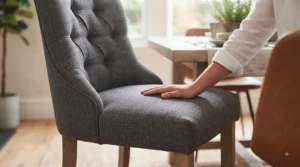
Leather Dining Chairs With Families: What the Research and Reviews Say
Families weighing leather dining chairs with families in mind are usually really asking one question: which material survives a household with children reliably, without constant vigilance? Based on aggregated review patterns across the products in this guide, the answer splits by age group rather than material alone.
For households with children under five, faux leather chairs like the VASAGLE UKDC188 or Furniturebox ISCO consistently come out ahead in parent reviews, specifically because toddlers spill unpredictably and often, and the wipe-clean surface removes the stress of “watching” mealtimes constantly. Genuine leather works too, but its higher cost makes the inevitable scuffs and crayon marks of toddlerhood feel like a bigger loss than they do on a faux leather set costing a fraction as much.
For households with school-age children and teenagers, the calculation shifts. Older children spill less often but use chairs more roughly — tipping them back on two legs, dragging them across floors, sitting sideways with feet on the seat edge. Here, frame strength matters more than surface material, which is why the steel-framed VASAGLE models and solid-wood Julian Bowen Kensington chairs both hold up better than lighter, laminate-legged alternatives regardless of whether the upholstery is fabric or faux leather.
If you’re a family hosting regular Sunday lunches for grandparents and cousins alongside weekday meals with young kids, a genuinely practical solution is mixing materials: faux leather for the chairs children use daily, and a slightly nicer fabric or velvet option (like the Julian Bowen Luxe Velvet) for occasional-use seating at the ends of the table, where spill risk is lower.
Pet-Friendly Furniture: Choosing Dining Chairs That Survive Claws and Fur
Pet-friendly furniture decisions around dining chairs come down to two separate problems: physical damage from claws and teeth, and allergen accumulation for households with pet allergies. On the physical damage front, woven fabric is genuinely the most vulnerable material here — cat claws in particular can snag and pull threads, creating runs that unravel further over time, while dog chewing on wooden chair legs (a common issue with puppies) damages any material equally. Leather and faux leather resist claw snagging far better, though genuine leather can still show fine scratches that, ironically, often blend into its natural patina rather than standing out as damage the way a fabric snag does.
For allergen accumulation, the material choice matters more than most pet owners realise. According to Allergy UK’s pet allergy factsheet, pet dander settles into soft furnishings and surfaces throughout the home, and reducing the amount that accumulates on frequently-used furniture is a key part of managing allergy symptoms for sensitive household members. Smooth, wipeable surfaces like leather and faux leather simply hold far less dander than the textured fibres of chenille, boucle, or velvet, which is a meaningful practical consideration if anyone in the household has a diagnosed pet allergy, even a mild one.
If you’re set on fabric despite pet ownership, the VASAGLE Parsons removable-cover design again earns its place here — being able to machine wash the cover periodically genuinely does reduce dander buildup in a way that spot-cleaning fixed upholstery simply cannot match.
Stain-Resistant Upholstery Explained: Fabric Treatments vs Leather’s Natural Defence
Stain-resistant upholstery on fabric dining chairs typically means one of two things: a factory-applied fluorocarbon or silicone-based repellent coating, or a fabric woven from inherently stain-resistant synthetic fibres like polyester-blend microfibre. Both work by causing liquids to bead on the surface rather than soak in immediately, buying you crucial seconds to blot a spill before it sets — but neither is permanent. Repeated washing, vacuuming, and general wear gradually strip the coating, which is why manufacturers typically recommend reapplying a fabric protector spray every twelve to eighteen months to maintain performance.
Leather’s stain resistance works differently and, in a practical sense, more reliably: it’s a structural property of the material’s non-porous (or lightly porous, for genuine leather) surface rather than an applied treatment that wears off. This is the core reason faux and genuine leather so consistently outperform even “stain-resistant” fabric in day-to-day spill scenarios — there’s simply nothing to reapply or maintain for the coating to keep working.
That said, stain-resistant fabric treatments genuinely do close much of the practical gap for water-based spills like juice or tea, even if they can’t fully match leather’s performance against oil-based stains like gravy or salad dressing. If you’re drawn to fabric for comfort reasons but want some of leather’s forgiveness, checking specifically for a factory-applied stain-resistant treatment — rather than assuming all fabric chairs have one — is worth the extra thirty seconds on the product page before you buy.

Practical Usage Guide: Setup, Maintenance and the First 30 Days
Getting a new set of dining chairs right starts before you even sit down in them. During assembly, tighten all bolts to the manufacturer’s specified torque rather than as tight as physically possible — overtightening is a common first-30-days mistake that can crack faux leather seams or split wooden leg joints, and it’s largely irreversible once damage occurs. Most flat-pack chairs, including the VASAGLE and Furniturebox models covered above, specify roughly 80% tightness on fixings for exactly this reason.
For the first month, resist the urge to deep-clean the upholstery preventatively; faux leather and genuine leather both benefit from settling in before any conditioning treatment is applied, while fabric should simply be vacuumed with a soft brush attachment rather than scrubbed. According to general guidance on upholstery care, textiles and leather both perform best long-term when dust and debris are removed regularly before they work into the material’s structure, rather than left to accumulate and require more aggressive cleaning later.
Set a simple maintenance schedule going forward: wipe leather and faux leather chairs weekly with a damp cloth, condition genuine leather every four to six months with a proper leather conditioner (never furniture polish, which can clog leather’s pores), and vacuum fabric chairs weekly while spot-treating spills immediately with a clean cloth and cold water before they set. The single most common maintenance mistake in the first month is leaving spills to “deal with later” — on fabric especially, the difference between blotting within sixty seconds and cleaning an hour later is often the difference between no mark and a permanent one.
Common Mistakes When Buying Dining Chairs
The most frequent mistake buyers make in the leather dining chairs vs fabric dining chairs decision is choosing purely on showroom or photo appeal without considering how the chairs will actually be used week to week — a beautiful velvet chair that looks perfect in a styled photo can become a source of ongoing stress in a household with young children or shedding pets. A closely related mistake is underestimating frame quality while over-focusing on upholstery material; a gorgeous fabric on a flimsy laminate frame will fail long before cheaper fabric on a solid steel or hardwood frame ever would.
Buyers also commonly skip checking seat height and depth against their actual dining table, assuming “standard” sizing applies universally — it doesn’t, and a chair that’s slightly too low or shallow becomes uncomfortable within weeks even if the material itself is perfect. Another recurring error is buying online without checking the weight capacity rating, particularly relevant for households where adults of varying builds will use the same chairs regularly. Finally, many buyers skip reading the specific care instructions before purchase, only discovering afterward that their chosen “leather” chair is actually a delicate faux material that can’t tolerate the cleaning products they already own.
Long-Term Cost & Maintenance: Total Cost of Ownership
Sticker price tells only part of the story when comparing leather dining chairs vs fabric dining chairs over a realistic ownership period of eight to ten years. Faux leather chairs typically need full replacement once cracking sets in, usually somewhere between five and eight years under regular family use, meaning a household might buy two sets of faux leather chairs across a decade for roughly the combined cost of one genuine leather set. Fabric chairs without stain treatment may need professional cleaning or reupholstery within a similar timeframe if stains accumulate, adding an ongoing cost that’s easy to underestimate at the point of purchase.
| Cost Factor | Faux Leather | Genuine Leather | Fabric |
|---|---|---|---|
| Upfront price range | £100-£180 | £250-£400+ | £90-£280 |
| Typical lifespan | 5-8 years | 10-20+ years | 5-8 years |
| Ongoing maintenance cost | Minimal (cloth only) | Conditioner every 4-6 months | Protector spray, occasional professional clean |
| Realistic 10-year cost | 1-2 replacements | Usually one purchase | 1-2 replacements or reupholstery |
Looking at the numbers above, genuine leather’s higher upfront cost genuinely does even out over a decade for households committed to proper conditioning, while faux leather remains the most cost-predictable option for anyone who’d rather budget for periodic replacement than invest heavily upfront. Fabric’s total cost varies the most, since it depends heavily on whether a stain-resistant treatment was applied and maintained — untreated fabric in a high-spill household can end up the most expensive option of all once reupholstery costs are factored in.
Safety, Regulations & Compliance: What UK Buyers Should Know
All domestic upholstered dining chairs sold in the UK, whether covered in leather, faux leather, or fabric, must comply with the Furniture and Furnishings (Fire) (Safety) Regulations, which set ignition-resistance requirements for both filling materials and covers. According to official UK government guidance, these regulations were substantially updated in 2025, with the amended rules covering labelling requirements and testing standards that manufacturers must meet before furniture reaches UK households.
For everyday buyers, this means any dining chair sold legitimately through Amazon UK or a recognised UK retailer should already meet these ignition-resistance standards regardless of whether you choose leather or fabric — it’s not something you need to verify separately as a consumer, but it is worth knowing when comparing UK-sold products against furniture imported informally or bought secondhand from unregulated sources, where compliance can’t always be guaranteed. If in doubt, checking for a visible fire safety label on new furniture (a requirement that remains in place for most items despite recent regulatory simplification) is a reasonable practical check before completing a purchase.
Leather and Fabric Dining Chairs vs Traditional Wooden Chairs
| Factor | Leather/Fabric Upholstered | Traditional Solid Wood (Unpadded) |
|---|---|---|
| Comfort for long meals | Significantly higher | Lower without added cushions |
| Cleaning | Wipe or spot-clean | Wipe, but no stain risk at all |
| Cost | Mid to premium | Often lower for basic designs |
| Longevity | 5-20 years depending on material | Often 20+ years structurally |
| Best For | Regular family dining, comfort priority | Minimalist interiors, heirloom-style pieces |
The comparison here isn’t really about which category wins outright — it’s about what you’re optimising for. Upholstered chairs, whether leather or fabric, deliver meaningfully more comfort for meals that run over half an hour, which matters enormously for households that entertain regularly. Traditional solid wood chairs sidestep the entire leather dining chairs vs fabric dining chairs debate by removing spill risk from the seat surface altogether, at the cost of comfort, which is exactly why many buyers land on a hybrid solution using wooden dining chairs with detachable cushions.
Buyer’s Decision Framework
If you have children under five or pets that spend meal times near the table, choose faux leather because wipeable surfaces remove the daily stress of unpredictable spills without demanding constant vigilance.
If you entertain formally and prioritise how the room looks over quick cleanup, choose fabric — specifically velvet or a textured weave like the Julian Bowen Luxe Velvet — because the tactile and visual upgrade over faux leather is considerable and worth the extra care it demands.
If you’re furnishing a dining room you expect to use for a decade or more without replacing the chairs, choose genuine leather because its long-term cost per year of ownership beats faux leather once you factor in the typical five-to-eight-year replacement cycle faux materials face.
If you want fabric’s comfort without fabric’s usual cleaning downside, choose a removable-cover fabric chair like the VASAGLE Parsons — it’s the one option on this list that meaningfully sidesteps the entire leather-versus-fabric trade-off rather than compromising on it.
FAQ
❓ Is leather or fabric better for dining chairs?
❓ Do faux leather dining chairs crack easily?
❓ Are fabric dining chairs hard to clean?
❓ How long do genuine leather dining chairs last?
❓ Are leather dining chairs good for pet owners?
Conclusion
There’s no single right answer to leather dining chairs vs fabric dining chairs, and honestly, anyone promising you one is oversimplifying a decision that depends entirely on your household. Families with young children and pets tend to land on faux leather for the sheer daily convenience of wiping instead of scrubbing. Style-first households entertaining formally often choose fabric, particularly velvet, because comfort and visual warmth matter more than spill anxiety in that context. Genuine leather rewards patience and a bit of maintenance discipline with a decade-plus lifespan that, cost-per-year, often beats cheaper alternatives replaced twice over.
What matters most is being honest with yourself about how your dining room actually gets used, not how you’d like it to be used in an ideal, spotless world. Match the chair to the mealtime reality — chaotic weeknight dinners with kids, relaxed Sunday roasts with a dog underfoot, or candlelit dinner parties where nobody’s spilling anything — and the leather-versus-fabric decision becomes considerably easier than it first appears.
Recommended for You
- Windsor Dining Chairs UK: 7 Best Picks; Buying Guide 2026
- Velvet Dining Chairs: 7 Best Buys for a Stylish 2026 Dining Room
- Cross Back Dining Chairs Set of 2: 7 Best Picks for 2026 (UK)
Disclaimer: This article contains affiliate links. As an Amazon Associate, I earn from qualifying purchases. If you purchase products through these links, we may earn a small commission at no additional cost to you.
✨ Found this helpful? Share it with your friends! 💬🤗
