
In This Article
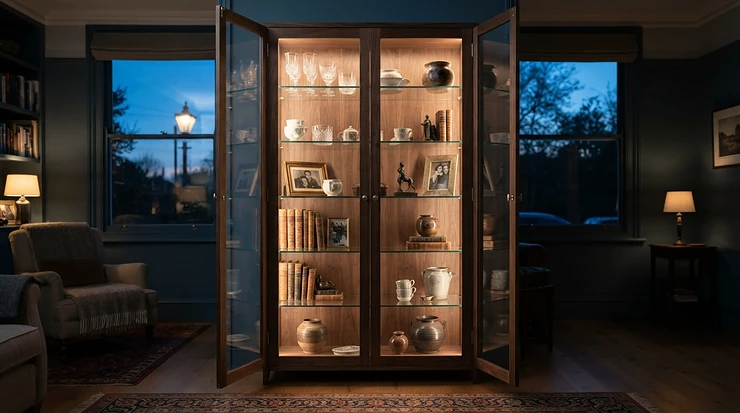
Picture your wine collection right now. Three bottles on top of the fridge, a couple behind the bread bin, one rolling gently about in the cupboard beside the oven. Dramatic? Slightly. Familiar? Probably. A wine cabinet with glass doors is the grown-up fix: a proper home for your bottles that also looks rather good in the corner of a living room.
Here’s where it gets confusing. Ask five British shoppers what a wine cabinet with glass doors is and you’ll get two answers. Some mean furniture: a sideboard with a bottle rack and a glass front. Others mean a cooled appliance, basically a wine fridge in a glass-fronted case that holds a steady temperature. Prices run from under £100 to four figures, and the two types do very different jobs.
This guide sorts them out. I’ve compared seven real models sold through amazon.co.uk, using published specifications, retailer listings and established storage guidance. To be upfront, I haven’t tested any of them myself. You’ll get analysis and reasoning, not invented anecdotes.
Along the way we’ll cover humidity and temperature, realistic bottle capacity, whether you need a glass holder rack, what a small wine cabinet under £150 can actually deliver, and the wine fridge vs wine cabinet question that trips up so many buyers.
Quick Comparison: Seven Wine Cabinet with Glass Doors Options at a Glance
| Product | Type | Bottle Capacity | Best For |
|---|---|---|---|
| HOMCOM Modern Sideboard | Furniture, no cooling | 12 | Tight budgets and display |
| HOMCOM 20-Bottle Wine Cabinet | Furniture, no cooling | 20 | Bottles plus stemware |
| Baridi 12 Bottle Wine Fridge | Thermoelectric cooler | 12 | Quiet flats |
| Subcold Barcool VINO12 | Thermoelectric tabletop | 12 | Worktop display |
| Baridi 18 Bottle Dual Zone | Compressor, dual zone | 18 | Reds and whites together |
| Baridi 27 Bottle Dual Zone | Compressor, dual zone | 27 | Growing collections |
| Caple WC1792 | Full-height compressor | Up to 89 (as quoted) | Serious collectors |
The table splits cleanly into two camps. The two HOMCOM pieces are furniture that stores bottles. The other five are appliances that look after them. If you plan to keep wine for years, that gap matters far more than the colour of the finish. If you just want tidy storage for this month’s bottles, the HOMCOM Modern Sideboard costs a fraction of the rest.
💬 Just one click — help others make better buying decisions too!😊
What Is a Wine Cabinet with Glass Doors?
A wine cabinet with glass doors is a storage unit, either furniture or a temperature-controlled appliance, that holds wine bottles behind transparent doors. The glass lets you see and show off your collection. The cabinet protects bottles from dust and handling and, in better models, from UV light and temperature swings.
Three things matter most to wine in storage: light, humidity and temperature, as Wikipedia’s overview of wine storage explains. A furniture-style cabinet manages only the first, and only partly. A cooled one can manage all three. The rest of this guide helps you decide how much of that protection you need.
Top 7 Wine Cabinet with Glass Doors Options: Expert Analysis
1. HOMCOM Modern Sideboard — cheapest route to glass-fronted storage
This sideboard is a wine cabinet with glass doors in the broadest sense, and it costs roughly what a decent dinner for two does. Retailer listings describe a white unit with two glass-fronted side cupboards, a drawer, an open shelf and a 12-bottle rack, all on five wooden legs.
In practice, that bottle capacity is modest, but the rest of the unit swallows glasses, corkscrews and table linen. It’s a sideboard that happens to hold wine, not a wine store. It has no cooling and no humidity control, so position matters: a cool room, away from radiators and windows.
Based on the spec comparison, this suits casual drinkers who buy for the week rather than the decade. I couldn’t confirm any UV filtering in the glass, so keep it out of direct sun.
On customer sentiment, I couldn’t verify enough current reviews of this exact model to summarise honestly. Check the latest reviews for feedback on assembly and finish, which is where flat-pack furniture usually shows its flaws.
Pros:
- ✅ Glass doors, drawer and rack in one piece
- ✅ Hides everyday clutter while showing off bottles
- ✅ Budget-friendly entry into glass-fronted storage
Cons:
- ❌ No temperature or humidity control whatsoever
- ❌ Only 12 bottles fit in the rack
Expect a price in the £80-£95 range at retailers (check current price). It’s strong value as furniture, but not as wine storage.
2. HOMCOM 20-Bottle Wine Cabinet — bottles and stemware in one unit
The standout here is the combination: a 20-bottle rack plus a dedicated glass holder rack behind a glass door. For anyone who hosts, that means bottles and glasses live in the same spot.
The listing positions it for living rooms, home bars and dining rooms. A full 750ml wine bottle weighs well over a kilo, so 20 of them put real load on particleboard. Another HOMCOM wine cabinet listing quotes roughly 10kg per shelf, so check this model’s weight ratings and use the anti-tip fixings. Don’t assume the rack will take a full load without reading them.
My analysis: this is the better pick for entertainers who rotate stock quickly. Like the cheaper sideboard, it offers no climate control, so it suits bottles you’ll drink within weeks or months.
I couldn’t verify a meaningful pool of reviews for this exact listing. The honest advice is to read recent buyer feedback on stability and glass-door alignment before ordering.
Pros:
- ✅ Twenty-bottle rack beats most budget rivals
- ✅ Built-in glass holder rack for stemware
- ✅ Glass door keeps dust off bottles
Cons:
- ❌ No cooling, so unsuitable for long-term ageing
- ❌ Full load strains particleboard weight limits
This sits in the budget bracket (check current price). The same maker’s glass-door pieces tend to land in the £75-£95 range elsewhere, so confirm it falls under £150 before buying. Verdict: good value if you treat it as furniture.
3. Baridi 12 Bottle Wine Fridge — whisper-quiet thermoelectric cooling in a slim body
This is the first model where the wine gets active temperature control. Retailer listings for the DH73 (black) and DH74 (stainless steel) describe a slim unit about 27cm wide with a mirrored tempered-glass door, touchscreen controls and an internal LED.
The temperature range of 12-18°C is the key spec. It lets you hold reds and long-stored bottles at sensible levels, but it won’t chill whites to fridge temperatures. Thermoelectric cooling has no compressor, so it’s quiet and vibration-light. Listed noise varies between 25dB and 35dB by variant and retailer. The trade-off is that thermoelectric units generally struggle in hot rooms, so skip the sunny conservatory.
Annual energy use is listed at about 92kWh, and the maximum bottle height is 33cm. That suits standard Bordeaux shapes but not tall sparkling bottles.
On reviews, I couldn’t verify a robust sample for this exact model. The retailer pages echo the manufacturer’s claims about quiet running, and that isn’t the same as independent buyer sentiment.
Pros:
- ✅ Quiet, low-vibration thermoelectric cooling
- ✅ Slim footprint suits flats and worktops
- ✅ Low listed annual energy use
Cons:
- ❌ Can’t reach white-wine serving temperatures
- ❌ Struggles in very warm rooms
Expect roughly £180-£215 (check current price). That’s above the £150 line, but it’s the cheapest route to genuine temperature control here.
4. Subcold Barcool VINO12 — UKCA-certified tabletop display
What stands out is its certification. The retailer listing cites CE, ERP and UKCA marking, which is reassuring for a mains appliance sold in Britain.
It’s a 32-litre tabletop unit measuring roughly 34.5 x 50.5 x 46.5cm, with a frameless tempered-glass door, removable chrome wire shelves and white LED lighting. Chrome wire shelving suits standard bottles but leaves less flexibility for oddly shaped ones. At 46.5cm tall, it’s designed for a worktop, not the floor.
Listings disagree on the temperature range, quoting 5-18°C in some places and 4-15°C in others. Confirm the figure with the seller, because it decides whether you can hold whites near serving temperature.
Based on the spec comparison, it suits people who want the cooled glass-door look at counter height. The thermoelectric approach should keep noise low, but, as with any thermoelectric model, heat in the room limits performance.
I couldn’t verify a solid pool of reviews, so I’m not summarising sentiment here.
Pros:
- ✅ UKCA, CE and ERP certification listed
- ✅ Compact tabletop footprint with LED display lighting
- ✅ Frameless glass door looks sleek
Cons:
- ❌ Listings disagree on temperature range
- ❌ Thermoelectric cooling limits hot-room performance
It’s likely in the same bracket as the 12-bottle Baridi 12 Bottle Wine Fridge, roughly £150-£250 depending on retailer (check current price). Verdict: decent value if the temperature range suits you.
5. Baridi 18 Bottle Dual Zone — red and white at different temperatures
Dual zones are the standout. The upper and lower compartments each run between 5°C and 18°C, so reds can sit at cellar temperature while whites wait near serving temperature.
Listings describe beech wooden shelves, a compressor, automatic defrost and a mirrored tempered-glass door, with space for 6 bottles above and 12 below. It measures roughly 34.5 x 48 x 83cm, and the maximum bottle height is 32cm.
Ventilation is the detail most buyers overlook. The listing asks for around 5cm clear at the rear and 3cm at the top and sides. Cram it into a tight alcove and it will run harder and age faster.
My take: this suits people who actually drink both colours and want one appliance to cover storage and serving. Wooden shelves also look more like furniture than wire racks do.
I couldn’t verify an adequate sample of reviews, so I won’t characterise buyer sentiment here. Check recent feedback on noise and door-seal quality.
Pros:
- ✅ Dual zones with 5-18°C range each
- ✅ Beech shelves look good behind glass
- ✅ Compressor with automatic defrost
Cons:
- ❌ Needs ventilation clearance on all sides
- ❌ Only 18 bottles at a noticeably higher price
Expect the low £400s (check current price). Verdict: good value for mixed drinkers, but poor value if you only drink red.
6. Baridi 27 Bottle Dual Zone — more bottles without a bigger footprint class
This one is the same idea scaled up: 12 bottles in the upper zone and 15 in the lower, with both zones running 5-18°C.
Listings describe beech shelves, a compressor and automatic defrost, with a maximum bottle height of 32cm. It asks for the same ventilation gaps as its smaller sibling, 5cm at the back and 3cm at the top and sides.
That 27-bottle bottle capacity is the sweet spot for a household that buys cases. Buy a case of twelve, and you still have room for the bottles you’re keeping. Dividing the price range by capacity, it works out cheaper per bottle slot than the Baridi 18 Bottle Dual Zone. That’s simple arithmetic on the price ranges, not a measured claim.
Who’s it for? Growing collections, or anyone who has outgrown a 12-bottle unit and wants a few special bottles resting at stable conditions. Because it’s a mirrored-glass door, it still reads as a display piece.
On reviews, I couldn’t verify enough current feedback for this exact model, so check recent reviews on noise and temperature stability.
Pros:
- ✅ Twenty-seven bottles across two zones
- ✅ Lower cost per bottle slot than the 18-bottle
- ✅ Wooden shelves and mirrored glass door
Cons:
- ❌ Needs ventilation clearance on all sides
- ❌ Noticeably bulkier than the slim models
It’s in the high £400s range (check current price). Verdict: the best value of the cooled models for a serious home collection.
7. Caple WC1792 — full-height cabinet for serious collections
The headline is scale. Retailer listings quote a 246-litre, 1788mm-tall unit with 8 shelves and a stated bottle capacity of up to 89.
The cooling spec is more sophisticated than the Baridi range. Listings describe fan-circulated cold air, a no-frost compressor and three humidity control tanks, which tackles humidity and temperature together. The temperature range is 5-18°C with touch controls, an acoustic alarm and a reversible UV-protected glass door. Quoted noise is 45dB, and annual consumption is 162kWh.
Retailer pages disagree on the energy rating. One text says B, but the spec table says G. Check the label on the actual product.
As a full-height wine cabinet with glass doors, it suits collectors who want cellar-like behaviour in a kitchen or dining room. The 89-bottle figure is a best case, so treat realistic bottle capacity as lower with wide bottles.
I couldn’t verify a reliable pool of reviews for this exact model. The listing quotes a two-year warranty, which is a reassuring sign for a large appliance.
Pros:
- ✅ Humidity control tanks plus fan-circulated air
- ✅ UV-protected, reversible glass door
- ✅ Huge capacity and two-year warranty
Cons:
- ❌ Needs a large, ventilated space
- ❌ Conflicting energy-rating information on retailer pages
It’s a considerably bigger outlay than the Baridi range (check current price). Verdict: right for collectors, overkill for casual drinkers.
How the Seven Compare on Paper
| Product | Cooling | Temperature Range | Bottle Capacity | Price Range | Best For |
|---|---|---|---|---|---|
| HOMCOM Modern Sideboard | None | Room temperature | 12 | £80-£95 range | Budget display |
| HOMCOM 20-Bottle Wine Cabinet | None | Room temperature | 20 | Budget bracket, check price | Entertainers |
| Baridi 12 Bottle Wine Fridge | Thermoelectric | 12-18°C | 12 | Around £180-£215 | Quiet flats |
| Subcold Barcool VINO12 | Thermoelectric | 5-18°C quoted (some listings 4-15°C) | 12 | Check current price | Worktops |
| Baridi 18 Bottle Dual Zone | Compressor | 5-18°C per zone | 18 | Low £400s | Mixed reds and whites |
| Baridi 27 Bottle Dual Zone | Compressor | 5-18°C per zone | 27 | High £400s | Growing collections |
| Caple WC1792 | Compressor, fan-circulated | 5-18°C | 89 quoted | Premium, check price | Collectors |
Two numbers stand out. The cheapest unit costs roughly a fifth of the dual-zone models, but it offers no temperature control at all. The jump from thermoelectric to compressor is where you start paying for dual zones and larger bottle capacity. I’ve left star ratings out because they shift daily, so check the live listing.
✨ Don’t Miss These Exclusive Deals!
🔍 Take your wine storage to the next level with these carefully selected cabinets. Click on any highlighted product name to check current pricing and availability. They’ll help you create a display your guests will admire!
How to Choose a Wine Cabinet with Glass Doors
- Decide between furniture and a cooled unit. If you’ll drink the bottles within a few months, furniture is fine. If you plan to keep wine for years, you need active cooling.
- Measure the space, including ventilation. The Baridi 18 Bottle Dual Zone and Baridi 27 Bottle Dual Zone listings ask for gaps at the rear, top and sides. Allow for them, or the unit won’t run well.
- Be realistic about bottle capacity. Headline numbers assume standard bottle shapes. The Baridi 12 Bottle Wine Fridge lists a 33cm maximum bottle height.
- Check the glass. Tinted or UV-filtering glass, like that on the Caple WC1792, protects bottles better than clear glass.
- Pick the cooling type. Thermoelectric is quiet but heat-sensitive. Compressors handle warmer rooms and dual zones.
- Compare noise and energy. Listed figures run from 92kWh (Baridi 12 Bottle Wine Fridge) to 162kWh (Caple WC1792) a year, so scale to your usage.
- Check the warranty. One retailer lists six months on a HOMCOM wine cabinet, a year on the Baridi range and two years on the Caple WC1792.
Wine Fridge vs Wine Cabinet: What’s the Real Difference?
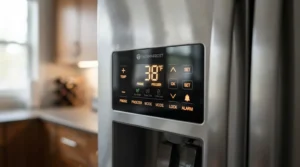
The wine fridge vs wine cabinet question is mostly about how the words are used. Some UK retailers use “wine cabinet” for cooled appliances like the Caple WC1792. Others use it for furniture like the HOMCOM Modern Sideboard. Always read the specification, not the product name.
| Factor | Furniture Wine Cabinet | Wine Fridge or Cooled Cabinet |
|---|---|---|
| Temperature control | None | Set between roughly 5-18°C |
| Humidity | Whatever your room has | Sometimes managed, as in the Caple WC1792 |
| Cost | Under £150 is realistic | From roughly £180 upwards |
| Best For | Short-term storage and display | Long-term storage and serving |
Looking at the comparison, the furniture route wins on price and versatility, while the cooled route wins on protection. Which? notes that the wine coolers it tested cost from about £170 upwards, which matches the gap in the table. If your bottles never see a second Christmas, furniture is a perfectly sensible choice.
Humidity and Temperature: What Your Bottles Actually Need
Humidity and temperature are the two things a furniture cabinet can’t control. Experts disagree on the ideal figures, which is useful to know before you spend money.
On temperature, Decanter’s Steven Spurrier suggests a classic cellar sits around 12°C and that 8-15°C is fine. His main warning is about swings, so avoid the kitchen. On humidity, Decanter’s Q&A with a wine storage specialist argues that 65-70% is best for fine wine, because low humidity will damage it over time. Other sources give a broader 50-70% range, and Wikipedia notes that experts debate how much humidity matters at all.
Here’s the practical reading. Stable conditions matter more than perfect numbers. A furniture cabinet in a steady, cool room beats a cooled unit in a boiling kitchen. For anything you plan to keep, an actively cooled glass-door unit gives you far more control. Compressor units tend to dry the air, so a cheap hygrometer helps you check. The Caple WC1792 addresses humidity directly with its tanks. The thermoelectric Baridi 12 Bottle Wine Fridge and Subcold Barcool VINO12 give you temperature control but no stated humidity management.
Bottle Capacity: How Many Bottles Do You Really Need?
Quoted bottle capacity is a best case, not a promise. Listings assume standard Bordeaux shapes. Wider Burgundy bottles, champagne and magnums take more room, and bottle height limits apply. The Baridi 18 Bottle Dual Zone and Baridi 27 Bottle Dual Zone list a 320mm maximum, while the Baridi 12 Bottle Wine Fridge lists 330mm.
My rule of thumb is to buy for the collection you’ll have in 18 months, not today. Collections grow faster than people expect, and an overfull cooler loses temperature stability. A 12-bottle unit suits a couple who drink a bottle or two a week. Twenty to thirty bottles suits a household that buys by the case. Anything bigger, like the Caple WC1792, is for collectors.
Glass Holder Rack: Does a Cabinet Need One?
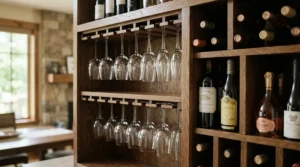
A glass holder rack is a small rail inside the cabinet that hangs stemware upside down. It’s a clever way to keep glasses and bottles in the same place.
The HOMCOM 20-Bottle Wine Cabinet includes one. Cooled units generally don’t, since their racks are built for bottles. HOMCOM’s own spec sheets for related cabinets quote around 12 glasses on one model.
If your chosen unit lacks one, a standalone hanging rack is cheap. Some listings, such as one at The Range, claim a capacity of up to a dozen stems. One practical tip is to air out new flat-pack furniture and rinse glasses before first use, since new boards can carry a faint smell.
Small Wine Cabinet Under £150: What You Can (and Can’t) Expect
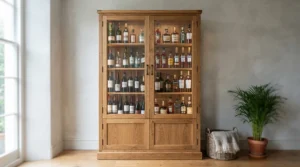
A small wine cabinet under £150 means furniture, not a cooled appliance. Given that Which? places tested wine coolers at about £170 and up, cooled glass-door units under £150 are rare.
| Budget Tier | Products | Type | Best For |
|---|---|---|---|
| Under £150 | HOMCOM Modern Sideboard, HOMCOM 20-Bottle Wine Cabinet | Furniture | Short-term storage |
| £150-£250 | Baridi 12 Bottle Wine Fridge, Subcold Barcool VINO12 | Thermoelectric | Quiet temperature control |
| Low to high £400s | Baridi 18 Bottle Dual Zone, Baridi 27 Bottle Dual Zone | Compressor | Mixed collections |
| Premium | Caple WC1792 | Full-height cooled | Collectors |
Divide the price by bottle slots and a pattern appears. The HOMCOM Modern Sideboard works out at roughly £7-£8 per slot, the Baridi 12 Bottle Wine Fridge in the mid-to-high teens, and the Baridi 27 Bottle Dual Zone in the high teens. Those figures come from the price ranges, not exact prices. A small wine cabinet under £150 is the cheapest per bottle but gives the least protection, so it’s good value only if the wine won’t age there.
Common Mistakes When Buying a Wine Cabinet with Glass Doors
Buying on looks alone. A beautiful furniture piece won’t protect a bottle you plan to keep for years.
Ignoring ventilation. Tight alcoves choke compressor units, as the listings for the Baridi 18 Bottle Dual Zone and Baridi 27 Bottle Dual Zone make clear.
Trusting headline capacity. Check bottle height and width, particularly for sparkling and Burgundy shapes.
Putting it in the wrong room. Spurrier warns against kitchens because of temperature swings. A sunny spot is just as bad.
Overlooking weight. Full racks are heavy, so read shelf ratings on the HOMCOM 20-Bottle Wine Cabinet before filling it.
Setup and Maintenance Guide: Your First 30 Days
Day one: position it. Place your wine cabinet with glass doors away from windows, radiators and ovens. Leave the clearances listed for compressor models, and follow the manual on settling time after transport.
Set the temperature. For long-term storage, aim near 12-13°C. Listed ranges for the Baridi 12 Bottle Wine Fridge start at 12°C, so it’s best used for storage rather than chilling.
Load sensibly. Lay bottles on their sides so corks stay moist, and put heavy bottles low. Don’t overfill, because airflow matters.
Measure humidity. A basic hygrometer tells you whether a dry compressor unit needs a small water tray, an approach common to wine cabinet guidance.
Leave bottles alone. Spurrier’s storage advice is to move bottles as little as possible once they’re laid down.
Common first-month mistakes: switching on too soon after delivery, blocking vents with boxes and forgetting to wipe condensation from the glass. Each takes seconds to avoid.
Real-World Scenarios: Which Cabinet Fits Which Home?
The first-flat host. You’ve got about £100, ten bottles of everyday wine and a living room that stays cool. The HOMCOM Modern Sideboard fits. You drink within weeks, so cooling isn’t essential.
The monthly entertainer. You have a dining room, twenty bottles on rotation and a shelf of wine glasses. The HOMCOM 20-Bottle Wine Cabinet puts bottles and stemware in one place, provided you respect the weight ratings.
The patient collector. You buy reds to keep, whites to drink soon, and a few special bottles you plan to age. The Baridi 27 Bottle Dual Zone covers both temperatures, and the Caple WC1792 suits a bigger, longer-term collection with its humidity tanks and UV-protected door.
FAQ
❓ Does glass make a wine cabinet with glass doors bad for wine?
❓ What can you actually buy in a small wine cabinet under £150?
❓ Do glass-door wine fridges cost a lot to run?
❓ Can I put a wine cabinet with glass doors in the kitchen?
❓ How many bottles will a 12-bottle cabinet really hold?
Conclusion
The best wine cabinet with glass doors depends on how long your bottles will stay in it. For drinking within weeks, furniture like the HOMCOM Modern Sideboard or the HOMCOM 20-Bottle Wine Cabinet does the job at a friendly price, as long as you keep it in a cool, steady room. For anything you plan to keep, active control is worth paying for.
Among the cooled options, the Baridi 12 Bottle Wine Fridge and Subcold Barcool VINO12 offer quiet, compact temperature control. The Baridi 18 Bottle Dual Zone and Baridi 27 Bottle Dual Zone add dual zones and more bottle capacity, and the Caple WC1792 gives collectors something closer to a cellar in a cabinet.
Remember the basics: stable humidity and temperature beat perfect numbers, ventilation matters, and quoted capacity is a best case. Check current price and recent reviews on each listing before you buy, since I couldn’t verify review data for these models.
✨ Ready to Give Your Bottles a Proper Home?
🍷 Click any highlighted product name above to check current pricing and availability. Your wine, and your living room, will thank you!
Recommended for You
- Display Dressers For Crockery: 7 Stunning Picks For UK Homes (2026)
- Small Kitchen Dresser Units: 7 Best Buys For UK Homes (2026)
- Best Welsh Dressers UK: 7 Proven Picks (Painted, Pine) 2026
Disclaimer: This article contains affiliate links. As an Amazon Associate, I earn from qualifying purchases. If you purchase products through these links, we may earn a small commission at no additional cost to you.
✨ Found this helpful? Share it with your friends! 💬🤗
