
In This Article
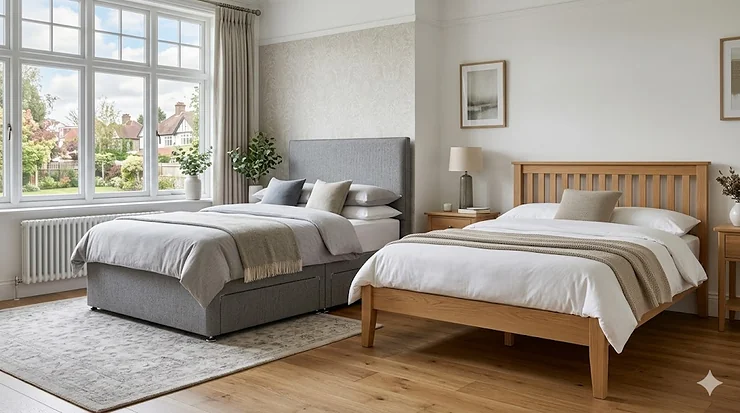
Choosing between a divan bed vs bed frame might sound straightforward until you’re standing in the middle of a furniture shop, slightly overwhelmed by the options and wondering whether your upstairs bedroom will actually accommodate the delivery. It’s one of those decisions that seems simple on the surface but quickly becomes rather more involved once you start factoring in British realities: cramped Victorian staircases, damp climates that necessitate proper airflow, and the eternal question of where exactly you’re meant to store all those extra duvets.
Here’s what most UK buyers don’t realise until they’ve made the purchase: the distinction between divan or bed frame better isn’t just about aesthetics. It’s about how your mattress performs over time in Britain’s notoriously damp weather, whether you can actually manoeuvre the thing up a narrow staircase in a terraced house, and—most importantly—how much precious storage space you’re gaining or losing in the process. A divan base offers built-in drawers that could mean the difference between a tidy bedroom and perpetual clutter, whilst a traditional bed frame provides better airflow beneath your mattress, which matters more than you’d think during those soggy British autumns when everything feels slightly damp.
In this comprehensive guide, we’ll dissect the pros cons divan beds and bed frames with the kind of detail that actually helps you make an informed decision. We’ve researched real products available on Amazon.co.uk, examined customer feedback from actual UK buyers, and considered the specific challenges of British homes—from compact flats in London to Victorian semis in Birmingham. By the end, you’ll know exactly which bed type suits your space, budget, and lifestyle.
Quick Comparison: Divan Bed vs Bed Frame at a Glance
| Feature | Divan Bed | Bed Frame |
|---|---|---|
| Base Type | Solid or sprung platform | Slatted or solid base |
| Storage | Built-in drawers/ottoman | Limited (underbed space only) |
| Assembly | Simple (2 halves clip together) | More complex (multiple parts) |
| Footprint | Same size as mattress | Extends beyond mattress |
| Price Range (UK) | £200-£800 | £60-£600 |
| Airflow | Limited (solid base) | Excellent (slatted design) |
| Best For | Small UK homes, storage needs | Aesthetic focus, traditional style |
| Manoeuvring | Easier (splits in two) | More difficult (one large piece) |
From the comparison above, divans clearly win on practicality for typical UK living situations—those terraced houses with narrow hallways and limited bedroom storage. The built-in drawer options mean you’re essentially getting a wardrobe’s worth of storage without sacrificing floor space. However, bed frames offer superior mattress ventilation, which genuinely matters in Britain’s damp climate. If you’ve ever lived in an older property without central heating in every room, you’ll know that condensation beneath a mattress is a real concern. Slatted bed frames allow air to circulate freely, helping prevent that musty smell and extending your mattress’s lifespan. The choice ultimately hinges on whether you prioritise storage (divan) or breathability (bed frame).
💬 Just one click — help others make better buying decisions too!😊
✨ Don’t Miss These Exclusive Deals!
🔍 Take your bedroom setup to the next level with these carefully selected products. Click on any highlighted item to check current pricing and availability on Amazon.co.uk. These picks will help you find exactly what you need!
Top 7 Beds: Expert Analysis for UK Buyers
1. Sleep Factory Grey Pearl Memory Foam Divan Set
The Sleep Factory Grey Pearl represents exceptional value in the mid-range divan market, and it’s genuinely hard to fault at its price point. This UK-manufactured set includes a memory foam sprung mattress (13.5 gauge open coil springs with memory foam layer), an upholstered divan base in grey pearl fabric, and a matching padded headboard. The mattress measures 25cm deep with a medium tension that suits most sleepers, whilst the solid timber frame construction provides that reassuringly sturdy feel you want from a bed that’s going to last.
What most buyers overlook about this model is the adjustable headboard height—rather useful if you’re working with sloped ceilings in a loft conversion or simply want the headboard to align properly with your bedside tables. The divan base splits into two halves (standard for all divans), making it considerably easier to navigate those awkward British staircases. You can opt for drawer storage on either side, and the 13.5g spring unit provides adequate support for most body types, though taller or heavier individuals might prefer a higher spring count for additional longevity.
UK customers consistently praise the comfort level and build quality, noting it feels more expensive than its price suggests. Several reviewers mention sleeping better from the first night, which speaks to the memory foam layer’s pressure-relieving properties. The grey pearl fabric is practical for British homes—neutral enough to match most décor schemes and less likely to show marks than lighter colours.
Pros:
✅ UK-made with solid timber frame construction
✅ Medium-firm mattress suits most sleepers
✅ Adjustable headboard height for versatility
Cons:
❌ Memory foam layer relatively thin compared to premium models
❌ Drawer capacity limited to standard UK divan size (53cm deep)
Price: Around £200-£350 depending on size (excellent value for money)
2. Happy Beds Contour Divan Set with Spring Memory Foam
Happy Beds Contour offers one of the most comprehensive storage solutions in the UK divan market, with options for up to four drawers positioned strategically around the base. This set includes a pocket sprung mattress with memory foam top layer, making it notably more sophisticated than basic open coil alternatives. The pocket springs work independently—each sewn into individual fabric pockets—which means better motion isolation if you’re sharing the bed with a restless partner or a wriggly child who insists on climbing in at 6am.
The clever bit here is the drawer configuration flexibility. You can specify drawers on one side (useful if your bed sits against a wall), two drawers on the same side, or drawers on both sides depending on your room layout. Each standard drawer holds up to 15kg, whilst the mini drawers manage 7kg—perfectly adequate for spare bedding, seasonal clothes, or that collection of books you insist you’ll read someday. The 5-year manufacturer’s guarantee is reassuring, particularly given that Happy Beds scores 4.6/5 on Trustpilot from thousands of UK customer reviews.
What genuinely impresses about this model is the mattress depth at 25cm—properly substantial without being so thick that fitted sheets become a wrestling match. British buyers appreciate that it’s sold as a complete set (base, mattress, headboard), eliminating the faff of trying to match components from different manufacturers. The drawers glide smoothly even on carpet, which sounds trivial until you’ve wrestled with sticky runners at 7am whilst trying to find clean socks.
Pros:
✅ Pocket springs provide superior motion isolation
✅ Flexible drawer configurations suit any room layout
✅ 5-year guarantee and strong UK customer satisfaction scores
Cons:
❌ Higher price point than basic open coil models
❌ Heavier than platform divans (drawers add weight)
Price: In the £300-£500 range for double size
3. Zinus Justin Metal Bed Frame Double
The Zinus Justin represents the budget end of the bed frame market, but don’t let the price fool you—this is a properly solid piece of kit that’s become Amazon UK’s bestseller for good reason. It’s a straightforward metal platform frame with steel slat support, measuring 14.2 inches (36cm) in height, which provides generous underbed storage space for those plastic storage boxes from Ikea that everyone in Britain seems to own. The simple black powder-coated finish is mercifully unfussy and works with practically any bedroom aesthetic.
Assembly takes about 20-30 minutes with the included tools, and what strikes you immediately is how quiet it is once properly tightened—no squeaking when you shift position at night, which is often the Achilles’ heel of budget metal frames. The steel slats are spaced appropriately (under 6.5cm apart as recommended by UK mattress manufacturers) to support your mattress without voiding warranties. Zinus includes noise-reducing foam padding between the slats and frame, which is a thoughtful detail at this price point.
For British buyers in rented accommodation or anyone who moves frequently, this frame is genuinely brilliant—it disassembles completely and fits into a reasonably compact box for transport. The 14-inch height means you’re not banging your shins when you stumble to the bathroom at 3am, and there’s enough clearance underneath for vacuum attachments to reach. UK customers note it holds up well even with heavier individuals (tested to 250kg capacity), though the lack of a headboard might bother some traditionalists.
Pros:
✅ Exceptional value—often under £70 for double size
✅ Quick assembly with proper noise-reduction features
✅ Ample underbed clearance for storage boxes
Cons:
❌ No headboard (must purchase separately)
❌ Basic aesthetic won’t suit period properties
Price: Around £60-£80 (remarkable value)
4. VASAGLE King Bed Frame Ottoman with Lift-Up Storage
The VASAGLE Ottoman takes a different approach to the traditional vs modern beds debate by combining a bed frame’s aesthetic appeal with a divan’s storage practicality. This is an upholstered bed frame with a hydraulic lift mechanism that raises the entire mattress to reveal a cavernous storage space beneath—roughly equivalent to a large wardrobe’s capacity. It’s particularly clever for British homes where bedroom furniture must multi-task, and the slate grey fabric finish looks considerably more expensive than the price suggests.
What sets this apart from budget ottomans is the hydraulic mechanism itself—gas struts provide smooth, controlled lifting even when the mattress is in place, which isn’t always the case with cheaper alternatives that require muscle and a prayer. The storage area beneath is around 30cm deep, easily accommodating suitcases, seasonal bedding, or that collection of childhood memorabilia your mother insists you must keep. The upholstered design includes a proper headboard, making it a complete sleep solution rather than just a storage vessel.
UK buyers consistently mention how straightforward the assembly is—most report completing it solo in under an hour, which is unusual for ottoman beds that typically require two people and some creative swearing. The minimalist design suits modern British homes beautifully, though it might look slightly stark in a cottage or period property. Worth noting: the hydraulic mechanism does add some weight, so manoeuvring it into position is a two-person job even though assembly can be solo.
Pros:
✅ Massive storage capacity (whole mattress lifts up)
✅ Quality hydraulic mechanism operates smoothly
✅ Upholstered finish looks premium
Cons:
❌ Heavier than standard bed frames
❌ Hydraulics may require eventual replacement (though rare)
Price: In the £180-£280 range for king size
5. Vida Designs Veronica Ottoman Bed Dark Grey
Vida Designs Veronica brings a touch of elegance to the ottoman category with its dark grey linen upholstery and UKFR certification, which confirms it meets stringent UK fire resistance standards. This matters more than many buyers realise—furniture regulations in Britain are among the strictest globally, and proper certification means the upholstery materials have passed ignition tests. The lift-up storage mechanism reveals approximately 350 litres of space (double size), which translates to roughly 6-7 medium storage boxes’ worth.
The headboard on this model deserves specific mention—it’s generously padded and tall enough (around 110cm) to actually function as a comfortable backrest when you’re reading or watching telly in bed. Many cheaper ottomans skimp on headboard padding, leaving you with a surface that’s uncomfortable within minutes. The dark grey linen is practical for British homes; it’s textured enough to hide minor marks yet neutral enough to work with various colour schemes.
What British customers appreciate most is the robust construction—the frame is proper solid timber (not particle board), and the gas struts are German-made, which genuinely shows in the smooth operation. The lift mechanism requires minimal effort even when the mattress is in place, and the safety stay prevents the base from slamming shut if you let go accidentally. Several UK reviewers note it’s survived house moves without issues, which speaks to build quality that extends beyond initial impressions.
Pros:
✅ UKFR certified for British safety standards
✅ Generously padded, comfortable headboard
✅ German-made gas struts for reliable operation
Cons:
❌ Higher price than basic ottomans
❌ Linen fabric requires more careful cleaning than synthetic alternatives
Price: Around £200-£350 for double size
6. Silentnight Luxury Divan Set with Miracoil Springs
The Silentnight Luxury Divan represents Britain’s most trusted mattress brand’s take on the complete sleep system. Silentnight’s Miracoil spring system is their proprietary continuous coil design, which provides zoned support across the mattress—firmer where you need it (under hips and shoulders) and slightly softer elsewhere. This matters particularly for side sleepers or anyone with lower back issues, as the zoning helps maintain proper spinal alignment throughout the night.
The divan base on this set uses a platform top (solid surface) rather than a sprung edge, making it the firmer option if you prefer that solid, stable feel rather than additional bounce. British customers often choose platform tops specifically because they extend mattress life—the solid surface prevents sagging that can occur with inadequate support. The upholstery comes in several fabric options including plush velvet and suede-effect materials, though the crushable velvet variants show wear more readily than the linen alternatives.
What sets Silentnight apart is the nationwide recognition and 5-year guarantee backed by a company that’s been manufacturing in the UK since 1946. If something goes wrong, you’re dealing with a British customer service team rather than chasing an overseas supplier. The Miracoil springs are edge-to-edge, maximising the usable sleeping surface—important in British homes where bedrooms are often compact and every centimetre counts.
Pros:
✅ Miracoil zoned support for proper spinal alignment
✅ Trusted UK brand with comprehensive 5-year guarantee
✅ Platform top extends mattress lifespan
Cons:
❌ Higher price reflects brand premium
❌ Heavier than budget alternatives (quality construction trade-off)
Price: Around £400-£700 depending on size and fabric choice
7. Zinus Maya Upholstered Bed Frame with Headboard
The Zinus Maya offers an affordable entry into upholstered bed frames, combining the aesthetic appeal of fabric covering with the practical slat support system. The dark grey upholstery is a safe choice for British homes—neutral, practical, and forgiving of the inevitable marks from daily life. At 11.8 inches (30cm) height, it sits lower than many metal frames, creating that modern low-profile look whilst still providing reasonable underbed storage access.
The headboard is properly substantial (not just a token board), upholstered to match the frame and tall enough to lean against comfortably. Assembly is refreshingly straightforward—the frame sections bolt together with included Allen keys, and the wooden slats simply drop into place. British buyers note it takes about 45 minutes solo or 25 minutes with two people, which is considerably faster than many competitors. The slats are proper solid wood (not engineered wood), spaced appropriately to support mattresses without voiding manufacturer warranties.
What genuinely impresses at this price point is the noise-free performance once assembled. Many upholstered frames at the budget end squeak within weeks, but the Maya includes foam padding between contact points that effectively eliminates noise. UK customers in flats particularly appreciate this—no disturbing neighbours below when you’re shifting position at night. The dark grey fabric is tough enough to withstand normal wear, though it will show pet hair if you allow animals on the bed.
Pros:
✅ Upholstered aesthetic at budget frame prices
✅ Solid wood slats with proper spacing
✅ Noise-free construction with anti-squeak padding
Cons:
❌ Lower height means less underbed storage
❌ Fabric quality adequate but not premium
Price: Around £120-£180 for king size (outstanding value)
How to Actually Use Your New Bed: UK-Specific Setup Guide
Initial Assembly and Room Positioning
Divan beds arrive in two halves, which sounds simple until you’re actually trying to connect them on your own. Here’s what the instruction manual won’t tell you: lay both halves on their sides against a wall, black fabric base facing you, before attempting to connect the plastic clips. This gives you proper leverage and prevents the frustrating situation where one half slides away as you’re clipping the other. Most manufacturers provide U-shaped plastic connectors—slide one end beneath the stapled fabric of one base, then hook the other end onto the second base. If your clips feel flimsy, a quick trip to any hardware shop for proper bed bolts (around £5) provides more secure joining.
For bed frames in British homes, consider the damp factor before positioning. Placing your bed directly against an exterior wall might seem like efficient space use, but those walls get cold in winter, creating condensation that transfers to your mattress. Leave at least 10cm gap between the headboard and external walls, which allows air circulation and prevents that musty smell that develops in poorly ventilated bedrooms. If your room’s small and the gap feels wasteful, consider a thin shelf unit behind the headboard—functional and it maintains crucial airflow.
Drawer divans require specific positioning. If your drawers are on one side, that side needs at least 60cm clearance to fully extend (standard drawers are 53cm deep plus operating room). British bedrooms rarely accommodate drawers on both sides unless you’re working with a king or super king size in a properly spacious room. Ottoman beds need even more consideration—you’ll need approximately 180cm ceiling clearance when the base is lifted, which rules out loft conversions with sloped ceilings unless you’re positioning the lift mechanism away from the slope.
Maintaining Your Bed in British Conditions
Britain’s damp climate demands specific bed maintenance that overseas manufacturers don’t always mention. If you’ve chosen a divan with solid platform top, rotate your mattress quarterly (head to foot) and flip if it’s double-sided—this prevents moisture accumulation in one area. Open your bedroom window for 15-20 minutes daily even in winter; the air exchange reduces humidity that would otherwise condense between mattress and base. In particularly damp properties (Victorian terraces, ground floor flats, anywhere without central heating), consider a dehumidifier in the bedroom or moisture-absorbing products tucked discreetly near the bed.
Bed frames with slatted bases require occasional tightening—those bolts work loose over time, especially if you’re shifting the bed for cleaning. Check them every six months; loose slats create uneven mattress support and can void your mattress warranty. Wooden slats should be cleaned annually with a barely damp cloth (not wet—you don’t want moisture seeping into the wood). Metal frames benefit from a quick wipe-down with a dry microfibre cloth to prevent dust buildup that can work into joints and cause eventual squeaking.
Ottoman and drawer mechanisms need annual maintenance that takes about five minutes but extends their life considerably. Vacuum inside drawers and ottoman storage every few months—dust accumulates remarkably quickly in enclosed spaces, and in British homes it often carries moisture that can lead to musty smells. The hydraulic gas struts on ottoman beds can be wiped with a dry cloth occasionally to remove dust; avoid lubricants unless the manufacturer specifically recommends them, as some can degrade the seals.
Real-World Scenarios: Which Bed Suits Your UK Living Situation?
Scenario 1: London Studio Flat (Young Professional)
You’re in a 30 square metre studio in Zone 2, paying rent that makes you wince monthly, and your bedroom is effectively a corner of the main room separated by a decorative screen. Floor space is precious, storage is non-existent, and you’ve got friends visiting occasionally who’ll need somewhere to sleep. The VASAGLE Ottoman or a divan with four drawers becomes transformative here—that storage capacity means the difference between a tidy space and perpetual clutter. Store your winter clothes, spare bedding, and gym equipment inside the bed rather than paying £100 monthly for external storage. Budget: £250-£350 total.
Scenario 2: Victorian Semi in Birmingham (Family of Four)
The master bedroom’s generous but the children’s rooms are compact, and you’re working with that frustrating Victorian layout where doorways are in awkward positions. For the main bedroom, a traditional bed frame (like the Zinus Maya) provides the aesthetic weight that suits the period property whilst slatted base ensures proper mattress ventilation in an older building prone to damp. For the children’s rooms, divans with drawer storage maximise limited space—the Sleep Factory Grey Pearl offers affordable quality and the storage keeps toys and clothes contained. Budget: £400-£600 for the family.
Scenario 3: Retirement Flat in Coastal Town (Active Retiree)
You’ve downsized to a modern two-bedroom flat in Brighton or Bournemouth. The bedrooms are decent-sized but you want ease of use—no wrestling with heavy mechanisms or complicated assembly when you occasionally fancy rearranging furniture. A mid-range divan like the Happy Beds Contour with two drawers provides adequate storage without excessive weight, whilst the pocket springs offer the support ageing joints appreciate. The complete set means no matching headaches, and the 5-year guarantee provides peace of mind. Budget: £350-£500.

Common Mistakes When Buying Beds in the UK
Mistake 1: Ignoring Staircase Dimensions
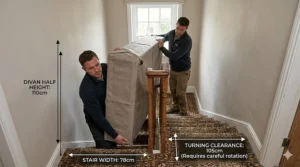
Perhaps the most expensive mistake UK buyers make is ordering a bed without measuring their staircase first. A king size divan splits into two pieces measuring roughly 75cm × 200cm each—manageable for most British staircases. However, bed frames are one piece, and a king size frame won’t navigate a standard staircase with a turning. Measure your staircase width at its narrowest point, measure any turns, and check ceiling height on the landing. If in doubt, divans are almost always the safer choice for awkward access.
Mistake 2: Underestimating British Damp
Choosing a divan with platform top (solid base) in an older property without central heating is asking for mattress problems. That solid surface prevents air circulation, moisture accumulates between mattress and base, and within months you’ve got that characteristic musty smell. If you’re in a period property, pre-1970s building, ground floor flat, or anywhere prone to condensation, either choose a sprung divan base or opt for a slatted bed frame instead. The airflow genuinely matters in British conditions.
Mistake 3: Prioritising Aesthetics Over Practicality
Instagram-worthy bed frames look stunning, but in a British bedroom measuring 3 metres × 3.5 metres, that elaborate Victorian-style brass bedstead with ornate posts reduces your functional floor space significantly. The frame extends beyond the mattress on all sides, the high footboard limits how you can position furniture, and you’ve gained nothing in storage capacity. Unless you’re genuinely working with a large room (and by British standards, that’s 4 metres × 5 metres minimum), prioritise practical beds with storage over aesthetic statements.
Mistake 4: Buying Drawer Divans Without Considering Drawer Position
You’ve ordered a four-drawer divan without checking which side the drawers are on, and it arrives with two drawers left, two drawers right—except your bedroom layout means the bed must sit against the left wall, rendering the left-side drawers completely inaccessible. Most manufacturers let you specify drawer configuration at checkout; some even offer “continental” drawers at the foot of the bed if side access is limited. Check your room layout before ordering, and if unsure, contact the seller to confirm configuration options.
Divan Bed vs Bed Frame: Detailed Feature Analysis
Support Structure and Mattress Longevity
The bed frame vs divan base debate fundamentally comes down to support methodology. Divan bases use either platform tops (solid, firm surface) or sprung edges (springs within the base providing additional bounce). Platform tops extend mattress life by preventing sagging—your mattress sits on an unyielding surface rather than flexing slats. This particularly benefits memory foam and hybrid mattresses that require stable foundations. Sprung divans add an extra layer of cushioning, creating a softer overall feel, though they can potentially reduce mattress firmness over time.
Bed frames with slatted bases allow superior airflow but require properly spaced slats—UK mattress manufacturers generally recommend gaps no wider than 6.5cm between slats. Wider gaps cause mattresses to sag between slats, creating uncomfortable ridges and potentially voiding warranties. Quality bed frames (the VASAGLE and Zinus Maya included in our reviews) space slats correctly, but budget frames sometimes sacrifice proper spacing to reduce costs. Check specifications before purchasing, and if slat spacing isn’t mentioned, that’s often a red flag.
The British climate factor: slatted bases genuinely perform better in damp conditions because air circulates freely beneath the mattress. In poorly insulated British homes, this air movement prevents moisture accumulation that leads to mould growth and that distinctive musty smell. Divan platform tops can trap moisture, particularly problematic in ground-floor flats, period properties without damp-proof courses, and anywhere the heating’s temperamental. If your home runs damp, slats trump solid bases regardless of other considerations.
Storage Solutions and Space Efficiency
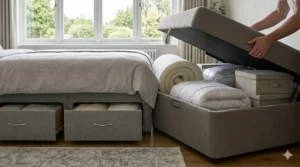
Divan base benefits become undeniable when examining storage capacity. A standard double divan with four drawers provides roughly 200 litres of storage—equivalent to a small wardrobe. Ottoman divans offer even more, with some king size models providing 400+ litres beneath the mattress. For typical British homes where storage is perpetually inadequate, this represents genuine value beyond the bed’s primary sleeping function.
Traditional bed frames offer minimal built-in storage—just the open space beneath. This works well enough if you’re the sort who uses that space efficiently with vacuum storage bags and labelled boxes, but most people end up with an unsightly collection of randomly shoved items gathering dust. Some modern bed frames now include drawer units built into the base (essentially copying the divan approach), though these tend to be more expensive than comparable divans.
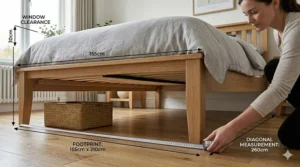
The space efficiency consideration extends beyond storage. Divans match the mattress footprint exactly—a double mattress on a double divan occupies precisely 135cm × 190cm of floor space. Bed frames extend beyond the mattress on all sides; that same double mattress on a frame might occupy 145cm × 200cm including the headboard and side rails. In compact British bedrooms, those extra centimetres genuinely matter—they’re the difference between fitting a small chair in the corner or not having space to open the wardrobe door fully.
Aesthetic Considerations for British Homes
Traditional bed frames win decisively on aesthetic versatility. You can find frames in solid oak, painted wood, wrought iron, upholstered fabric, and combinations thereof—styles ranging from minimalist Scandi to ornate Victorian. This variety means you can match the bed precisely to your bedroom’s character, particularly important in period properties where a fabric-covered divan might look jarring against original cornicing and picture rails.
Modern divans have evolved beyond the beige upholstered boxes of previous decades. Current options include crushed velvet, linen-effect fabrics, and even buttoned headboards that wouldn’t look out of place in a boutique hotel. However, the basic form remains inherently contemporary—a fabric-covered rectangle works beautifully in modern flats and new-build homes but can struggle aesthetically in older properties. If your bedroom features exposed beams, original floorboards, or period details, a wooden or metal bed frame often harmonises better with the architecture.
Cost Analysis and Long-Term Value in the UK Market
Initial purchase costs favour bed frames at the budget end—basic metal frames start around £60 for a double, whilst the cheapest complete divan sets begin around £200. However, this comparison becomes misleading when you factor in the complete system. A £60 bed frame requires a separate mattress (£150 minimum for decent quality) and potentially a headboard (£50-£100), totalling £260-£310. A £250 divan set includes base, mattress, and headboard—often representing better overall value.
At the premium end (£500+), bed frames and divans reach price parity when comparing like-for-like quality. A solid oak bed frame costs roughly the same as a high-specification divan with pocket springs and ottoman storage. The choice here becomes purely about priorities: aesthetics and ventilation (frame) versus storage and practicality (divan).
Long-term value considerations in British homes favour divans slightly. The reduced component count (fewer joints and fixings) means less that can work loose or break over time. Bed frames require periodic bolt-tightening, slat replacement, and frame adjustments. Divans are essentially solid boxes; barring catastrophic damage, they function identically in year ten as year one. This reduced maintenance requirement suits British buyers who value reliability and low-fuss ownership.
Which Bed Type Suits Small UK Homes?
The divan or bed frame better question for compact British properties has a clear answer: divans dominate through sheer practicality. Consider the typical London one-bedroom flat with its 2.8m × 3.2m bedroom. A double divan with four drawers provides sleeping space plus approximately 200 litres of storage in a 135cm × 190cm footprint. An equivalent bed frame occupies more floor space, offers no integrated storage, and forces you to use that awkward underbed area where items get shoved and forgotten.
The manoeuvrability factor becomes critical in terraced houses and flats with narrow staircases. Divans split into two manageable pieces, each roughly half the width of a complete bed frame. British staircases often turn sharply, have low ceiling clearances, and feature awkward angles that make furniture delivery a challenge. Bed frames, particularly king and super king sizes, simply won’t navigate many Victorian and Edwardian staircases regardless of how many burly delivery people you employ.
Storage optimisation in small spaces extends beyond the drawers themselves. Four-drawer divans let you eliminate a separate chest of drawers, freeing 60cm × 45cm of floor space—significant in a compact bedroom. Ottoman divans can replace wardrobes for seasonal clothes and spare bedding, potentially liberating enough space to fit a small desk or reading chair. This multi-functionality transforms how small British bedrooms function, making them feel less cramped and more organised.
However, small rooms prone to damp (common in older flats and basements) might paradoxically benefit from slatted bed frames despite the storage sacrifice. The air circulation beneath prevents moisture problems that plague solid divan bases in poorly ventilated spaces. If your small British bedroom runs damp, prioritise ventilation over storage—a dehumidifier plus a slatted frame costs less than replacing a mould-damaged mattress after a particularly wet winter.
UK Regulations and Safety Standards for Beds
British furniture safety regulations rank among the strictest globally, particularly regarding flammability. The Furniture and Furnishings (Fire) (Safety) Regulations 1988 require that all upholstered furniture (including beds, divans, and headboards) meet specific ignition resistance standards. When purchasing beds on Amazon.co.uk, look for products displaying compliance with these regulations—reputable manufacturers include permanent labels indicating conformity.
Mattresses and divan bases should comply with BS 7177, the British Standard for resistance to ignition of mattresses, mattress pads, divans, and bed bases. This isn’t compulsory labelling, but quality manufacturers include it to demonstrate compliance. Products without this certification aren’t necessarily unsafe, but the label provides reassurance that materials have been properly tested. Given how much time you spend in close proximity to your bed, fire safety genuinely matters beyond mere regulatory box-ticking.
Post-Brexit, UKCA marking has become relevant for certain bed components, particularly metal frames and any electrical elements (adjustable beds with motors, for instance). The UK government currently accepts both UKCA and CE marking indefinitely, providing businesses flexibility. For British buyers, this means you’ll see either marking on compliant products; both indicate the manufacturer has assessed the product against UK safety requirements.
The General Product Safety Regulations 2005 establish that all consumer products must be safe for use. This seems obvious, but it means manufacturers bear legal responsibility for bed safety beyond just fire regulations. Sharp edges, structural stability, and material safety all fall under these regulations. When buying from established brands on Amazon.co.uk (Sleep Factory, Happy Beds, Silentnight, Zinus), you’re purchasing from suppliers who understand and comply with UK safety standards. Lesser-known importers sometimes cut corners, so stick with recognised names unless you’re confident verifying compliance yourself.
FAQ: Your Divan Bed vs Bed Frame Questions Answered
❓ Can I use any mattress with a divan base?
❓ Do bed frames make more noise than divans?
❓ Which lasts longer: divan or bed frame in UK conditions?
❓ Are ottoman beds worth the extra cost for UK homes?
❓ Can bed frames damage wooden floors in British homes?
Conclusion: Making Your Decision
The divan bed vs bed frame choice ultimately hinges on your specific British living situation. If you’re in a compact London flat where every centimetre counts, a divan with drawer or ottoman storage transforms bedroom functionality whilst the split-base design ensures you can actually get it upstairs. The integrated storage eliminates furniture, creating breathing room in cramped quarters, and the solid support extends your mattress’s lifespan in ways that justify the investment.
Conversely, if you’re in a period property with generous room sizes and adequate storage elsewhere, a quality bed frame provides superior aesthetics and mattress ventilation. The slatted base becomes genuinely important in older British homes prone to damp, preventing the moisture accumulation that plagues solid divan bases. The wider variety of frame styles also means you can match your bedroom’s architectural character rather than settling for a contemporary fabric-covered box that clashes with original features.
For most British buyers, divans represent better practical value. The storage capacity, easier manoeuvrability through awkward staircases, simpler assembly, and complete set (base, mattress, headboard) at competitive prices make them the sensible choice. However, “sensible” isn’t always “best”—if proper mattress ventilation matters in your damp ground-floor flat, or if you’re furnishing a beautiful period bedroom where aesthetics genuinely matter, the traditional bed frame remains entirely valid.
Whichever direction you lean, prioritise quality construction, verify UK safety compliance, and choose based on your actual living conditions rather than idealised Pinterest boards. Your bed occupies roughly one-third of your life; getting this decision right affects your sleep quality, bedroom functionality, and daily comfort more than almost any other furniture purchase.
Recommended for You
- Best Ottoman Storage Bed Under £500 UK 2026 | Top 7 Picks
- 7 Hydraulic Ottoman Bed Problems UK Buyers Face 2026
- Are Ottoman Beds Worth It? 7 UK Models Tested (2026)
Disclaimer: This article contains affiliate links. As an Amazon Associate, I earn from qualifying purchases. If you purchase products through these links, we may earn a small commission at no additional cost to you.
✨ Found this helpful? Share it with your mates! 💬🤗
