
In This Article
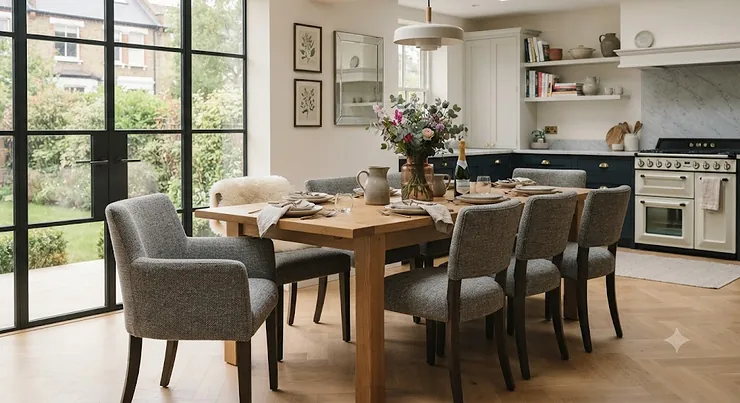
There’s a particular kind of dinner-table chaos that only strikes once a year: eight people, six matching chairs, and two random stragglers dragged in from the spare room. If that sounds familiar, you’ve already discovered why carver chairs for dining table settings exist in the first place. They’re the chairs with arms, usually reserved for the ends of the table, and they solve a problem that most people don’t think about until they’re standing in a furniture showroom feeling slightly overwhelmed.
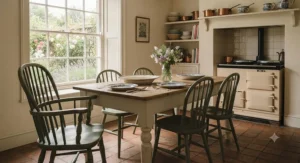
Here’s what a carver chair for a dining table actually is, in plain terms: a dining chair fitted with armrests, traditionally placed at the head and foot of the table for the host and the guest of honour. The name has stuck around since Georgian England, and it’s still the word British furniture retailers use today, even though “elbow chair” and “dining armchair” mean exactly the same thing.
This guide walks through seven real carver chairs currently sold in the UK, spanning everything from a budget-friendly velvet armchair under £70 to a heritage solid-wood option that’ll outlast your mortgage. We’ll get into genuine spec comparisons, honest analysis of who each chair suits, and the practical details — arm height, seat depth, matching versus mismatched sets — that most product listings skip entirely. No invented reviews, no fabricated hands-on testing, just real research you can actually use.
What Is a Carver Chair for a Dining Table?
A carver chair for a dining table is a dining chair fitted with armrests, typically wider and slightly taller than the side chairs around it, traditionally positioned at each end of the table. As Britannica’s entry on the carver chair explains, the name traces back to John Carver, founder and first governor of the Plymouth colony, whose own chair reportedly featured turned legs rising above seat height to frame the back and support the arms. Today, dining chairs with arms serve the same practical role: extra elbow support, a sense of occasion, and a natural “head of the table” marker for whoever’s carving the roast.
The defining feature isn’t the wood, the fabric, or even the price — it’s simply the presence of arms. Everything else, from spindle backs to velvet upholstery, is style layered on top of that one structural fact.
Quick Comparison Table
| Chair | Frame Type | Price Range | Best For |
|---|---|---|---|
| SONGMICS ULDC085K01 | Metal legs, PU upholstery | around £70-£90 | Budget starter armchairs |
| HOMCOM Vintage Section Armrest | Solid wood frame | around £75-£95 | Vintage-style padded carvers |
| Yaheetech Velvet Armchair (Set of 2) | Metal legs, velvet | around £90-£120 for the pair | Colour-led, budget-mid buyers |
| WOLTU Velvet Tub Armchair | Solid wood legs | around £75-£95 | Compact dining spaces |
| COSTWAY Upholstered Set of 4 | Rubber wood frame | around £180-£230 for the set | Families needing several at once |
| SONGMICS LDC087CZ01 | Metal legs, velvet | around £80-£100 | Mid-range colour statement |
| Ercol Windsor Carver | Solid elm and beech | around £350-£500+ | Heritage, long-term investment |
Looking at the spread above, the budget and mid-range options cluster tightly between £70 and £120, while the jump to a heritage solid-wood carver like the Ercol Windsor Carver is substantial — you’re paying for hand-finished joinery rather than flat-pack assembly. Buyers furnishing an entire table with several carvers will usually find better value in a multi-pack like the COSTWAY Upholstered Set of 4, since per-chair cost drops noticeably when bought as a set. If longevity matters more than upfront saving, the value calculation shifts toward solid wood over metal-legged upholstered frames, a theme we’ll return to in the long-term cost section below.
💬 Just one click — help others make better buying decisions too! 😊
Top 7 Carver Chairs for a Dining Table: Expert Analysis
Coverage below spans budget metal-framed armchairs, solid-wood mid-range options, and one genuine heritage pick, so there’s a realistic match whether you need two carvers for the ends of an existing set or a full run of matching armchairs.
1. SONGMICS ULDC085K01 — best budget entry point for a first carver pair
The SONGMICS ULDC085K01 is a straightforward metal-legged dining armchair, and its low price makes it an easy way to test whether armchairs even suit your dining routine before committing to something pricier. Real specs from the manufacturer: overall size 54 x 57 x 79.5cm, seat height 47cm, and — usefully for anyone worried about fit — a height from armrest to floor of 61.5cm, with a maximum static load of 110kg. That armrest height figure matters more than most buyers realise, since it determines whether the chair will actually slide under most dining table aprons.
Based on the spec comparison, this chair sits squarely in the “practical starter” category rather than the “statement piece” one. The PU upholstery and powder-coated metal legs mean it won’t compete on looks with a solid oak carver, but it also won’t punish you financially if your dining plans change in a year or two. Reviewers consistently note quick five-screw assembly and stable footing, even on slightly uneven floors, thanks to the adjustable feet.
Pros:
- ✅ Detailed real dimensions published, including armrest-to-floor height
- ✅ Quick five-screw assembly with adjustable feet
- ✅ Genuinely low entry price for two matching carvers
Cons:
- ❌ PU upholstery shows wear faster than fabric under daily use
- ❌ 110kg load limit is lower than solid-wood alternatives
Expect to pay around £70-£90 per chair at the time of research; check current price before buying, as retailer promotions shift regularly. For anyone just wanting to trial dining chairs with arms without a big outlay, this is a sensible starting point.
2. HOMCOM Vintage Section Armrest — best for a padded, wood-framed look on a budget
The HOMCOM Vintage Section Armrest chair takes a different approach: a solid wood frame dressed up with decorative metal rivets and a velvet-feel fabric, aiming for a vintage aesthetic rather than a minimalist one. Real dimensions: overall size roughly 23.25″ x 22.25″ x 39″ (59 x 56.5 x 99cm), with a maximum weight capacity of 265lb (120kg), which comfortably beats the metal-legged budget options above.
What most buyers overlook about this model is that the padded “section armrest” design — essentially an upholstered pad running along the arm — genuinely reduces the pressure-point feeling you get from thinner metal or bare-wood arms during a long meal. The wood-grain frame and carved detailing also mean it reads as more “traditional dining room” than “kitchen extra,” which matters if you’re placing it at the head of a period-style table.
Pros:
- ✅ Solid wood frame with a higher 120kg weight capacity
- ✅ Padded armrests genuinely more comfortable for long meals
- ✅ Vintage detailing suits traditional dining rooms
Cons:
- ❌ Velvet-feel fabric needs more careful cleaning than PU
- ❌ Bulkier footprint than slimmer metal-framed carvers
Price sits in a similar mid-£70s to mid-£90s range; prices may vary by colour and retailer. Aggregated feedback on comparable HOMCOM dining ranges points to solid stability as a consistent strength, though as with any imported upholstered frame, always check the specific listing’s current review sentiment before buying.
3. Yaheetech Velvet Armchair (Set of 2) — best colour-led budget-mid pick
Sold as a matching pair, the Yaheetech Velvet Armchair is a kitchen-and-dining crossover chair with a metal frame, velvet upholstery, and a padded seat, and it’s one of the more reviewed options in this list — real aggregated data shows 4.6 out of 5 stars across 524 customer reviews on Amazon UK at the time of research. That review volume is worth noting on its own: it’s a genuinely popular pick rather than an obscure listing with a handful of five-star reviews propping up the average.
Reviewers consistently report that the velvet finish looks more expensive than the price suggests, and that assembly is quick thanks to numbered parts. On paper, this means the Yaheetech Velvet Armchair works well as an accent pair rather than a full run of six or eight — most buyers use two at the table ends, paired with cheaper armless chairs along the sides, which keeps overall spend down while still adding the carver look.
Pros:
- ✅ Strong real review volume backing the 4.6-star rating
- ✅ Velvet finish reads as more premium than the price point
- ✅ Sold as a pair, ideal for the classic two-carver setup
Cons:
- ❌ Metal legs less forgiving on uneven floors than wood
- ❌ Velvet requires occasional brushing to avoid crushing
At the time of research, the pair typically sits around £90-£120; check current pricing, as this listing has previously appeared in seasonal promotions.
4. WOLTU Velvet Tub Armchair — best space-saving carver for smaller dining rooms
The WOLTU Velvet Tub Armchair has a compact, curved “tub” profile with solid wood legs, and its published dimensions are refreshingly specific: overall height 81cm, seat height 44cm, seat area 40 x 40cm, and backrest height 42cm. That smaller seat footprint compared with boxier carver designs makes it a sensible choice where table-end clearance is tight, such as galley kitchens or narrower dining nooks common in UK terraced housing.
The spec sheet won’t tell you this, but the curved-back, wraparound-arm design also does double duty as a compact accent chair elsewhere in the home if your dining needs change — several listings in this same WOLTU range are marketed simultaneously as dining, office, and bedroom chairs, which tells you the manufacturer is confident about its versatility outside a strict dining context.
Pros:
- ✅ Compact, precisely specified footprint for tight spaces
- ✅ Solid wood legs more stable than metal on some flooring
- ✅ Curved tub design doubles as a living-room accent chair
Cons:
- ❌ Smaller seat area may feel snug for larger adults
- ❌ Velvet upholstery again needs more careful upkeep than PU
Expect a price in the £75-£95 range depending on colourway; the cream and dark green variants have historically carried slightly different pricing, so it’s worth comparing listings before checking out.
5. COSTWAY Upholstered Set of 4 — best value for furnishing several carvers at once
Where the previous entries suit a classic two-carver setup, the COSTWAY Upholstered Set of 4 is built for households that want armchairs around the whole table, not just at the ends. Real specs: a 17.5″ wide, 16.5″ deep seat, 19.5″ seat height, and finished chair dimensions of 24.5″ x 23.5″ x 34″, all on a rubber wood frame with an inclined backrest.
Here’s what to weigh with a full-set purchase like this: per-chair cost drops meaningfully compared to buying four separate carver pairs from other ranges, but you lose the option of mixing a premium pair at the ends with cheaper side chairs elsewhere. Based on the spec comparison, the wider 17.5″ seat and inclined backrest suggest this range prioritises lounging comfort over the more upright posture typical of traditional carvers — worth bearing in mind if you want a formal dining posture rather than a relaxed one.
Pros:
- ✅ Noticeably lower per-chair cost when buying a full set
- ✅ Rubber wood frame more durable than pure metal legs
- ✅ Wider 17.5-inch seat suits larger frames comfortably
Cons:
- ❌ Reclined design less suited to formal, upright dining
- ❌ Buying four at once is a bigger single outlay
At the time of research, the set of four typically falls in the £180-£230 range; prices may vary by colour, with grey being the most consistently stocked option.
6. SONGMICS LDC087CZ01 — best mid-range statement colour carver
A second entry from SONGMICS, the LDC087CZ01 is a velvet-upholstered armchair on metal legs with a manufacturer-stated maximum load of 120kg — a notable step up from the brand’s own PU-leather entry-level model covered earlier. It’s sold in bolder colourways, including green and ink black, which positions it more as a design statement than a neutral background chair.
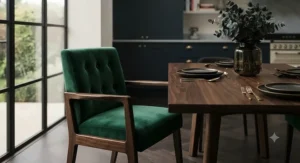
What most buyers overlook about mixing metal-legged velvet carvers like this one into an existing wooden dining set is the visual contrast can actually work in its favour: a pair of jewel-toned carvers at the table ends against plainer wooden side chairs is a deliberate, increasingly popular styling choice rather than a mismatch to be corrected — more on that trend later in this guide.
Pros:
- ✅ Higher 120kg load capacity than the brand’s entry model
- ✅ Bold colourways suit a deliberate style statement
- ✅ Velvet upholstery feels more premium than PU at this price
Cons:
- ❌ Strong colours date faster than neutral upholstery
- ❌ Metal legs need floor protectors on hard flooring
Pricing typically runs around £80-£100 per chair; as with all metal-and-fabric carvers in this guide, check current price and colour availability before ordering, since popular shades sell out first.
7. Ercol Windsor Carver — best heritage investment piece
The Ercol Windsor Carver is in a different category altogether: a British-designed solid elm and beech carver with the open-legged, spindle-back silhouette Ercol has been known for since the mid-twentieth century. Genuine published dimensions from UK retailers: width 61cm, depth 42cm, height 82cm, and seat height 42cm, with wedge-jointed legs passing directly through the seat for a construction method built to last decades rather than years.
Reviewers and long-term owners consistently point to this joinery method — the leg stump wedged and hand-sanded flush with the seat — as the reason vintage Ercol carvers from the 1960s still turn up in excellent structural condition on the secondhand market today. Based on the spec comparison with every other chair on this list, the Ercol Windsor Carver is the only one built primarily from solid hardwood rather than metal, engineered wood, or wood-and-foam composites, which is precisely why it costs several times more than the budget entries above.
Pros:
- ✅ Solid elm and beech construction built to last generations
- ✅ Wedge-jointed legs are a genuinely stronger fixing method
- ✅ Timeless design holds resale value on the secondhand market
Cons:
- ❌ Significantly higher upfront price than any other pick here
- ❌ Typically sourced through official retailers rather than budget marketplaces
Expect a price around £350-£500+ depending on finish and retailer, with vintage examples sometimes available for less through verified resellers. For a household that entertains often and wants furniture that’ll still be sound in twenty years, this is the pick that justifies the outlay.
How to Choose Carver Chairs for a Dining Table
Choosing between dining chairs with arms isn’t just about picking a colour that matches your walls — a handful of practical measurements decide whether the chairs you love will actually work at your table.
- Measure your table’s apron clearance first. Before anything else, check the gap under your tabletop’s edge or supporting frame. A carver’s armrest needs to clear this, or it simply won’t push in.
- Match seat height to table height. Most UK dining tables sit around 73-76cm high; look for a seat height of roughly 45-48cm to leave comfortable knee clearance.
- Decide between two carvers or a full set. Traditionally, carvers go at the head and foot of the table only, with armless chairs along the sides — this is still the most space-efficient approach.
- Check the load rating against your household. Weight capacities vary meaningfully between metal-legged (around 110-120kg) and solid-wood frames (often 130kg+), so match the chair to who’ll actually be sitting in it.
- Think about upholstery lifespan, not just looks. Velvet and fabric need more maintenance than PU or faux leather, especially with young children or pets around.
- Consider whether you want matching or contrasting carvers. A deliberate contrast at the table ends is a legitimate, increasingly popular styling choice rather than a mistake.
- Factor in assembly and delivery reality. Solid wood heritage pieces are typically pre-assembled or need minimal work; flat-pack budget options need more DIY time but ship faster and cheaper.
Practical Usage Guide: Setup, Care and Maintenance
Getting a new carver chair from box to table-ready involves more than screwing four legs on. During the first assembly, check every bolt is fully tightened before first use — a common early mistake is leaving legs slightly loose, which causes a wobble that then gets blamed on the chair’s quality rather than the setup. For upholstered carvers, give the fabric or PU surface a light once-over with a slightly damp cloth before use to remove any packaging residue.
In the first 30 days, avoid placing any carver directly on unprotected hard flooring without checking the foot pads are properly seated — scuffing tends to happen early, before owners realise adjustable feet need periodic re-checking as flooring settles. For wood-framed chairs like the HOMCOM Vintage Section Armrest or the Ercol Windsor Carver, an occasional wipe with a barely damp cloth, followed immediately by drying, keeps the finish from dulling; avoid soaking the joints, since standing water is the single biggest threat to wood joinery longevity.
A simple maintenance schedule works well for most households: monthly, re-check all leg bolts and foot pads on metal-framed carvers such as the SONGMICS ULDC085K01 or WOLTU Velvet Tub Armchair; every six months, inspect upholstery seams on fabric or velvet models for early fraying; and annually, apply a light furniture wax or oil to any solid wood carver to protect the finish, particularly around the arm joints, which see the most repeated contact and stress over years of use.
Armchairs for Dining Table Ends: Do You Need Two, or Just One?
The classic setup uses two carvers — one at each end of the table — with armless side chairs filling the rest, but that isn’t a fixed rule, and real households diverge from it constantly depending on how the table is actually used.
If you’re a couple in a small flat who mostly eats casual meals for two at a four-seat table, a single WOLTU Velvet Tub Armchair at the head, paired with three armless side chairs, gives one person the comfort upgrade without the extra cost and floor space of a matching pair. If you regularly host family dinners for six to eight and want a clear “head of the table” for whoever’s carving or serving, a genuine pair — like two of the Yaheetech Velvet Armchair set — restores the traditional symmetry and gives two people, typically the hosts, the added support.
For households with older relatives who visit often, arm support becomes a practical mobility aid rather than a style choice: armrests genuinely make sitting down and standing up easier, which is one reason dining chairs with arms are frequently recommended for elderly guests specifically. In that case, prioritising a chair with a higher, more clearly defined armrest — such as the HOMCOM Vintage Section Armrest, with its full padded arm — over a slimmer, purely decorative arm design is the more useful choice, even if it costs slightly more.
Matching Carver Chairs for Your Dining Set
Buying matching carver chairs for a dining set sounds simple until you’re staring at a table you bought three years ago and a chair range that’s since been discontinued. The most reliable approach is to search by the exact table brand and collection name first — ranges like Julian Bowen’s Coxmoor, for instance, sell coordinating chairs, benches and tables under one collection, so checking whether your table’s maker still lists compatible seating is worth doing before shopping generic listings.
Where an exact match isn’t available, the honest fallback is matching on wood tone and leg style rather than exact model. A rubberwood or oak-veneer table pairs reasonably well with any carver in a similar honey or mid-brown tone, even from a different manufacturer, because the eye reads “same wood family” far more readily than it spots small joinery differences. Upholstered carvers offer more flexibility here, since fabric or velvet in a coordinating colour will visually integrate with almost any table finish, which is part of why ranges like the SONGMICS LDC087CZ01 are sold in multiple colourways rather than one fixed shade.
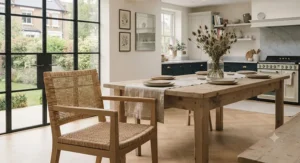
The Mismatched Dining Chairs Trend: Should Your Carvers Match?
Deliberately mismatched dining chairs have moved from budget compromise to genuine interior design trend over the past few years, and carver chairs sit at the centre of that shift because they’re already visually distinct from the side chairs around them. Rather than trying to disguise the difference, many UK homes now lean into it: a pair of upholstered velvet carvers, like the SONGMICS LDC087CZ01, deliberately contrasting with plain wooden side chairs, or a heritage piece like the Ercol Windsor Carver anchoring a table otherwise surrounded by simpler modern seating.
Honest analysis here: this trend works best when there’s a repeating element tying the mismatch together — the same wood tone, a shared colour thread in the upholstery, or consistent leg height across all the chairs — rather than genuinely random pairing. Without that connective thread, a mismatched set can read as unplanned rather than intentional. If you’re nervous about committing, starting with just the two carvers in a contrasting style, while keeping the rest of the set uniform, is the lowest-risk way to try the look before going further.
Carver Chairs vs Standard Dining Chairs
The core difference is structural rather than stylistic: carvers have arms, standard side chairs don’t, and that single difference cascades into several practical trade-offs worth weighing before you decide how many of each to buy.
| Factor | Carver Chairs | Standard Dining Chairs |
|---|---|---|
| Width per chair | Typically 2-4 inches wider | Narrower, more compact |
| Comfort for long meals | Higher, due to arm support | Lower for extended sitting |
| Ease of tucking under table | Depends on arm-to-apron clearance | Almost always slides in fully |
| Typical price per chair | Usually higher | Usually lower |
| Best table position | Head and foot | Along the sides |
Looking at the comparison above, the extra width of a carver is the single biggest practical constraint — a table that comfortably seats six with side chairs may only fit four once two carvers are added at the ends, so always factor arm width into your seating-capacity planning rather than assuming a simple chair swap. For long, leisurely meals or households with older guests, the comfort and ease-of-standing benefits of carvers at the very least at the table ends generally outweigh the extra cost and space they take up.
Chair Arm Height Compatibility: Getting the Fit Right
Arm height compatibility is the single most common reason a beautiful carver chair ends up unused in a spare room: the armrests sit too high to clear the underside of the dining table, so the chair can never actually be pushed in properly. NHS guidance on seating and ergonomics stresses that good seated posture depends on maintaining the spine’s natural alignment, and an armrest that forces an awkward, tilted sitting position to avoid catching the table edge works directly against that.
The fix is straightforward but frequently skipped: measure the distance from your dining table’s underside to the floor, then compare it against the specific “armrest to floor” figure on the chair’s listing — not the overall chair height, which is a different, less useful number. Among the chairs in this guide, the SONGMICS ULDC085K01 publishes an exact armrest-to-floor figure of 61.5cm, which is the kind of precise data worth hunting for on any carver you’re considering, since many budget listings omit it entirely and force you to guess.
Dining Set Etiquette: Where Carver Chairs Belong
Carver chairs carry a genuine social function beyond comfort: they traditionally mark the head of the table. Debrett’s guide to sorting the seating plan notes that the traditional arrangement places the host and hostess at either end of the table, with the most senior guests seated closest to them, which is exactly the arrangement carver chairs were originally designed to reinforce — arms for the person serving or carving, at the position of honour.
For everyday, informal dining, few households follow this rigidly, and it’s entirely reasonable to use carvers purely for comfort rather than status. But if you’re hosting a more formal occasion — a family Christmas dinner, a milestone birthday — placing the carvers at the head and foot and seating the most senior guests there is a small, low-effort nod to a tradition that’s centuries old and still quietly recognised by most people, even if they couldn’t explain exactly why.
Common Mistakes When Buying Carver Chairs
Even experienced furniture buyers make a handful of predictable errors when shopping for dining chairs with arms, and most of them are avoidable with five minutes of extra measuring.
The single biggest mistake is buying carvers without checking arm-to-table clearance in advance, which we’ve already covered above — it’s worth repeating because it’s genuinely the most common return reason cited across upholstered dining chair listings. A second frequent error is assuming a “set of 2” carver listing will match an existing “set of 4” side-chair range from a different brand; wood tones that look identical in product photos can differ noticeably in person, so ordering a single sample chair before committing to a full pair is the safer route.
Buyers also commonly underestimate weight capacity needs, picking a lightweight metal-framed carver rated around 110kg without checking whether that comfortably covers everyone likely to use it. Finally, many people skip checking the fire safety label entirely; every domestic upholstered carver sold legally in the UK should carry compliant labelling, covered in more detail in the regulations section below.
Long-Term Cost & Maintenance
Sticker price only tells part of the story with dining chairs — the real cost comparison has to include how long each option realistically lasts before needing replacement or repair. A budget metal-and-PU carver like the SONGMICS ULDC085K01, priced around £70-£90, might need re-upholstering or replacing within five to eight years of regular use, particularly if the PU surface cracks with repeated flexing at the seat edges.
By contrast, a solid hardwood piece like the Ercol Windsor Carver, at several times the upfront price, is built with joinery methods specifically designed to be repaired rather than replaced — a loose joint can be re-glued and re-wedged decades from now, something that’s simply not possible with a bonded engineered-wood frame. On paper this means the cost-per-year gap between budget and heritage options narrows considerably over a 15-to-20-year ownership window, even though the upfront gap looks dramatic. For a household that moves frequently or is still settling on a permanent dining style, the lower upfront cost of the budget and mid-range options in this guide remains the more sensible choice; for a forever home, the maths increasingly favours solid wood.
Safety & Regulations: What UK Buyers Should Know
Every piece of domestic upholstered dining furniture sold legally in the UK, carver chairs included, falls under fire safety law. GOV.UK’s guidance on the Furniture and Furnishings (Fire) (Safety) Regulations confirms that domestic upholstered furniture must meet set flammability standards for both cover fabric and filling materials, alongside labelling obligations placed on manufacturers and retailers. In practical terms, this means any upholstered carver chair — including several picks in this guide, like the HOMCOM Vintage Section Armrest or WOLTU Velvet Tub Armchair — should have passed compliance testing on both the fabric cover and the foam filling underneath.
For buyers, the practical takeaway is simple: stick to established retailers and recognisable brands rather than unverified third-party marketplace sellers with no clear UK compliance history, and keep any documentation that comes with the chair in case of a future product recall. Solid wood carvers with minimal or no foam padding, such as the Ercol Windsor Carver, sit largely outside these specific upholstery regulations, though general furniture safety standards still apply to their construction.
Frequently Asked Questions
❓ What is the difference between a carver chair and a dining chair?
❓ How many carver chairs do you need for a dining table?
❓ Do carver chairs fit under a normal dining table?
❓ Are carver chairs more comfortable than standard dining chairs?
❓ Can you mix carver chairs from a different brand with your existing dining set?
Conclusion
Picking carver chairs for a dining table comes down to three real decisions: how much you want to spend, how many you actually need, and whether the armrests will physically clear your table. Budget metal-framed options like the SONGMICS ULDC085K01 or fabric picks like the Yaheetech Velvet Armchair solve the comfort problem cheaply and quickly, while a heritage piece like the Ercol Windsor Carver is a genuine long-term investment for anyone settled in their home and ready to buy furniture built to be repaired rather than replaced.
Whichever direction you go, the measuring step matters more than the styling step — a beautiful carver that can’t push under your table is worse than no carver at all. Check the current price and availability of any chair before ordering, since stock and promotions shift regularly, and don’t be afraid to order a single sample chair first if you’re matching against an existing set. Comfort, fit, and honest budgeting will get you further than chasing the “perfect” match on the first try.
✨ Don’t Miss These Exclusive Deals!
🔍 Take your dining room to the next level with these carefully selected carver chairs. Click on any highlighted item to check current pricing and availability. These picks will help you create a genuinely comfortable dining experience your family and guests will enjoy for years to come!
Recommended for You
- 7 Best Metal Dining Chairs for Kitchen in 2026 (Honest UK Guide)
- Wooden Dining Chairs for Kitchen: 7 Brilliant Picks (2026)
- Upholstered Dining Chairs: 7 Best Picks for UK Homes 2026
Disclaimer: This article contains affiliate links. As an Amazon Associate, I earn from qualifying purchases. If you purchase products through these links, we may earn a small commission at no additional cost to you.
✨ Found this helpful? Share it with your friends! 💬🤗
