
In This Article
There’s a particular kind of heartbreak that comes with a wobbly kitchen chair. You know the one — it creaks when Auntie Pat leans back mid-anecdote, and every single time, your stomach drops half an inch. Wooden dining chairs for kitchen spaces are supposed to be the reliable ones, the furniture equivalent of a good pair of boots: sturdy, handsome, unbothered by whatever life (or a toddler with a yoghurt pouch) throws at them. And yet the market is stuffed with chairs that look the part in a product photo and fall apart the moment real family life gets involved.
This guide exists because kitchens are brutal environments for furniture. Steam, spilled squash, dragged-out chairs, the odd dropped fork — it all adds up. What is wooden dining chairs for kitchen use, really, if not a test of honest materials over marketing gloss? Solid timber, whether oak, beech or a well-finished hardwood blend, tends to shrug off the chaos that upholstery and veneer struggle with, which is exactly why we’ve gone hunting for real, currently available models rather than generic stock photography.
We’ve dug into actual specifications, genuine review patterns, and the practical business of sourcing responsibly grown timber — you can read more about the standards that govern that on the Forest Stewardship Council’s UK site, which is worth a glance if sustainability matters to your household. Across the seven chairs below, you’ll find budget rubberwood pieces that punch above their price, proper solid oak that’ll outlast the kitchen it sits in, and a couple of Scandi-leaning beech designs for anyone chasing that pared-back, hygge-adjacent look. Let’s get into it.
Quick Comparison Table
| Chair | Wood Type | Finish | Price Range | Best For |
|---|---|---|---|---|
| Hallowood Furniture Aston | Rubberwood | Lacquered, wipe-clean | Under £150 (set of 2) | Easy-clean family kitchens |
| Julian Bowen Ibsen | Rubberwood | Light oak lacquer | £150-£200 range | Budget shaker style |
| Julian Bowen Coxmoor | Solid oak | Oiled | £200-£300 range | Mid-range solid oak |
| Oak Furniture King Harvard | Solid oak | Matte lacquer | £300-£450 range | Premium everyday oak |
| Oak Furniture King Princeton | Solid oak | Matte lacquer | £300-£450 range | High-back formal dining |
| Nicholas Winter Scandi | Beech | Natural steam-bent | Under £150 (pair) | Scandi wooden dining chairs look |
| Yaheetech Beech-Leg | Beech legs, upholstered seat | Natural beech | Under £150 (set of 2) | Budget scandi/beech blend |
Looking at the spread here, the split roughly follows what you’d expect: rubberwood chairs undercut solid oak by a wide margin but trade away some longevity, while the two Oak Furniture King entries sit at the premium end precisely because they’re cut from genuine solid oak rather than a veneer or composite. If your kitchen sees three meals a day, seven days a week, the mid-to-premium oak options are worth the stretch — but for a first flat or a rarely-used breakfast nook, the lighter rubberwood and beech picks do a perfectly respectable job for considerably less outlay.
💬 Just one click — help others make better buying decisions too!😊
Top 7 Wooden Dining Chairs for Kitchen: Expert Analysis
1. Hallowood Furniture Aston — best wipe-clean lacquer finish on a budget
The Hallowood Furniture Aston opens our list because it solves the single biggest headache in kitchen seating: mess. Sold in pairs, it comes with a light oak or white lacquered rubberwood frame and a fabric-topped seat pad, though the frame itself is the real story here.
The rubberwood construction is finished with a lacquer coat that Hallowood explicitly markets on spill and scratch resistance, and the frame measures a compact 41cm wide by 89cm high — sized for smaller kitchen diners rather than sprawling dining rooms. Rubberwood is a plantation timber, which is part of why this chair undercuts solid oak so significantly on price while still offering genuine wood construction rather than particleboard dressed up with a wood-effect wrap.
Based on the spec comparison with pricier oak alternatives, this is the chair for anyone whose kitchen doubles as a homework station, a toddler feeding zone, or general household chaos hub — the lacquer buys you forgiveness that an oiled oak finish simply doesn’t offer. Reviewers consistently note straightforward flat-pack assembly and describe the cream fabric seat pad as comfortable for extended sitting, though a handful mention the seat pad itself (rather than the wooden frame) is the part that shows wear first over several years of daily use.
Pros:
- ✅ Lacquered finish wipes clean in seconds
- ✅ Genuine solid rubberwood frame, not veneer
- ✅ Compact size suits smaller kitchen diners
Cons:
- ❌ Fabric seat pad wears faster than the frame
- ❌ Less premium feel than solid oak alternatives
At around £120-£150 for a pair at the time of research, the Hallowood Furniture Aston represents strong value for anyone prioritising practicality over heirloom-quality timber — check current price before ordering, as furniture pricing shifts seasonally.
2. Julian Bowen Ibsen — best budget shaker-style light oak
Julian Bowen has been a fixture of the UK’s mid-market furniture scene for years, and the Julian Bowen Ibsen dining chair shows why. It’s a contemporary take on the classic shaker silhouette, built from rubberwood with a light oak lacquered finish, and specifically designed to pair with Julian Bowen’s matching Ibsen dining table.
What most buyers overlook about this model is that the shaker-inspired vertical slats aren’t purely decorative — they lighten the visual weight of the chair considerably compared with a solid-panel backrest, which matters if your kitchen diner is on the smaller side and you don’t want six chairs making the room feel cramped. The seat sits at a fairly standard height, and the frame itself is rated for everyday domestic use rather than heavy commercial rotation.
Here’s what to weigh: rubberwood is a genuinely hardwearing timber for indoor furniture, but it isn’t oak, and the lacquer finish — while durable — will show its age faster under a decade of daily kitchen abuse than a thicker oak equivalent would. Aggregated customer sentiment on this range points to easy self-assembly and a finish that photographs well against both light and dark kitchen cabinetry, which explains its popularity as a starter dining chair.
Pros:
- ✅ Contemporary shaker styling suits most kitchens
- ✅ Light oak lacquer resists everyday knocks
- ✅ Matches Julian Bowen’s wider Ibsen furniture range
Cons:
- ❌ Rubberwood, not solid oak, despite the finish
- ❌ Assembly required straight out of the box
Expect prices in the £150-£200 range for a set, positioning the Julian Bowen Ibsen as a sensible middle step between rock-bottom budget chairs and genuine solid oak.
3. Julian Bowen Coxmoor — best mid-range solid oak with an oiled finish
Step up from rubberwood and you land at the Julian Bowen Coxmoor, which is constructed from solid oak rather than a lacquered composite — a meaningful jump for anyone who has specifically searched for solid oak dining chairs rather than an oak-effect alternative. The chair pairs a padded faux leather seat with an oiled solid oak frame, measuring roughly 45cm deep, 50cm wide and 90cm tall.
The oiled finish, rather than a lacquer, is the detail worth dwelling on. Oil soaks into the timber grain rather than sitting on top of it as a plastic-like shell, which means the wood breathes and ages with a warmer patina over time — but it also means it needs the occasional re-oiling to stay protected, unlike the wipe-and-forget lacquered chairs further up this list. What the spec sheet won’t tell you, but reviewers note, is that the faux leather seat pad is genuinely practical for family kitchens, since it resists staining far better than a fabric equivalent while keeping the overall look warmer than an all-oak seat would.
This is a chair for buyers who want the character of real oak grain visible through an oiled finish, without committing to the premium end of the market. It suits anyone furnishing a compact kitchen diner who still wants the durability credentials that solid oak dining chairs are known for.
Pros:
- ✅ Genuine solid oak frame, not composite
- ✅ Faux leather seat resists stains well
- ✅ Oiled finish shows off natural oak grain
Cons:
- ❌ Oil finish needs occasional reapplication
- ❌ Pricier than rubberwood equivalents
At a mid-range £200-£300 for a pair, the Julian Bowen Coxmoor sits comfortably between entry-level and premium, making it one of the more balanced picks on this list.
4. Oak Furniture King Harvard — best premium everyday solid oak
If longevity is the priority, the Oak Furniture King Harvard is where this list starts getting serious. Handmade from solid oak timber with a matte lacquer finish, it features a classic high-back slat design and braced legs — a construction detail that materially improves stability under the kind of daily lean-back, scrape-back, drag-out treatment that kitchen chairs endure.
The braced-leg design distributes weight across a wider footprint than a simple four-leg chair, and the matte lacquer finish means, unlike the oiled Coxmoor above, there’s no ongoing maintenance routine beyond a wipe-down — the lacquer seals and protects the timber without needing re-oiling. Based on the spec comparison with lighter rubberwood chairs, the sheer density of solid oak used here also gives it a reassuring weight in hand, which buyers repeatedly cite as a marker of quality versus the lighter, more portable budget alternatives.
Reviewers consistently report satisfaction with the delivery experience and describe the chairs as arriving fully assembled — a genuine time-saver compared with flat-pack rivals — while aggregated feedback also highlights the padded bonded leather seat as comfortable for long dinners. Oak Furniture King backs the range with a 12-month manufacturer’s warranty, which is a meaningful confidence signal for a furniture purchase at this price point.
Pros:
- ✅ Braced solid oak legs add real stability
- ✅ Arrives fully assembled, no flat-pack faff
- ✅ 12-month manufacturer’s warranty included
Cons:
- ❌ Noticeably heavier to move around
- ❌ Premium price versus rubberwood options
Priced in the £300-£450 range depending on set size, the Oak Furniture King Harvard is a strong long-term investment for a kitchen that sees genuine daily use.
5. Oak Furniture King Princeton — best high-back solid oak for formal dining
Sitting alongside the Harvard in Oak Furniture King’s solid oak lineup, the Oak Furniture King Princeton takes a slightly more elegant approach with a taller high-back design and the same braced oak-leg construction underneath. It’s built from solid oak timber, features a premium bonded leather seat, and is finished with the same protective matte lacquer as its stablemate.
Reviewers consistently note the visual impact of the taller backrest, which reads as a touch more formal — a useful distinction if your kitchen diner also plays host to Sunday lunches and needs to look the part rather than purely function as everyday seating. On paper this means slightly more oak per chair than a low-back equivalent, which is worth factoring into your total budget across a full six or eight-seat set.
What most buyers overlook about high-back dining chairs generally is headroom: measure your kitchen’s clearance under any overhanging cabinets or pendant lighting before committing, since a taller backrest can occasionally clash with low-hanging fixtures in a compact galley kitchen. Beyond that consideration, the build quality mirrors the Harvard closely — solid oak, braced legs, full assembly on delivery, and the same 12-month warranty.
Pros:
- ✅ Elegant high-back design suits formal dining
- ✅ Solid oak construction with braced legs
- ✅ Delivered fully assembled, warranty included
Cons:
- ❌ Tall backrest may clash with low fixtures
- ❌ Among the pricier options on this list
Expect a £300-£450 range for the Oak Furniture King Princeton, broadly in line with the Harvard, so the choice between the two really comes down to backrest height and personal taste.
6. Nicholas Winter Beech Wooden Scandi Danish Style — best scandi wooden dining chairs pick
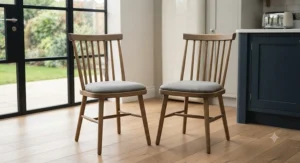
For anyone specifically chasing scandi wooden dining chairs, the Nicholas Winter Beech Wooden Scandi Danish Style dining chair is the most on-the-nose option here. It’s built from natural steam-bent beech wood in the distinctive Y-chair silhouette popularised by mid-century Danish design, complete with a woven rope seat rather than upholstery.
The steam-bending process is worth understanding, because it’s the reason this chair looks the way it does. Beech responds unusually well to steam treatment — better than oak, in fact — which is precisely why Scandinavian furniture makers have favoured it for curved backrests and Y-shaped supports since the mid-twentieth century. Based on the spec comparison with the oak chairs above, beech’s slightly higher Janka hardness rating means this frame is genuinely tough despite its slender, minimalist profile — it just wears that toughness differently, favouring elegant curves over chunky bulk.
The woven rope seat is the detail that will divide opinion. It’s authentic to the Danish design tradition and breathes better than upholstery in a warm kitchen, but it isn’t the wipe-clean surface that a young family with sticky hands might want. Reviewers consistently describe it as bringing genuine character and warmth to a dining space, particularly against pale Scandi-toned kitchen cabinetry.
Pros:
- ✅ Authentic steam-bent beech Y-chair design
- ✅ Rope seat breathes well in warm kitchens
- ✅ Distinctive look versus generic wooden chairs
Cons:
- ❌ Rope seat isn’t wipe-clean like lacquered wood
- ❌ Less forgiving of very heavy daily use
At under £150 for a pair at the time of research, the Nicholas Winter Beech Wooden Scandi Danish Style chair is an accessible entry into genuine Scandinavian design language.
7. Yaheetech Beech-Leg Upholstered — best budget scandi/beech blend
Rounding out the list, the Yaheetech Beech-Leg Upholstered dining chair splits the difference between the fully upholstered comfort of a fabric seat and the natural warmth of solid beech legs. The frame combines durable PP, PVC leather or fabric upholstery and solid beech wood legs, with a load capacity Yaheetech rates at around 130kg per chair.
This is a genuinely useful hybrid for kitchens where the household is torn between “we want real wood” and “we want something soft to sit on for a two-hour Sunday roast.” The beech legs deliver the scandi-adjacent aesthetic and genuine hardwood durability underfoot, where scuffs and knocks are most likely, while the cushioned seat top adds comfort that a fully solid-wood chair can’t match without a separate cushion.
Here’s what to weigh: because the legs alone are solid beech rather than the whole frame, this chair won’t match the longevity of a fully solid oak or beech piece like several others on this list — but for the price, reviewers consistently describe it as excellent value, citing simple flat-pack assembly with illustrated instructions and praising the cross-support structure beneath the seat for stability. It’s a sensible pick for a first home, a rental, or a household stretching a furniture budget across a full dining set.
Pros:
- ✅ Genuine solid beech wood legs
- ✅ Cushioned seat adds comfort over bare wood
- ✅ Budget-friendly compared with full solid wood
Cons:
- ❌ Upholstered seat not fully wipe-clean
- ❌ Less durable overall than solid-frame chairs
Typically priced under £150 for a set, the Yaheetech Beech-Leg Upholstered chair is a smart compromise pick for value-conscious households.
How to Care For and Maintain Wooden Kitchen Chairs
Buying the right chair is only half the job — keeping it looking good for a decade is the other half, and this is where most people quietly get it wrong within the first month.
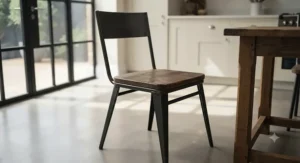
Start with the first 30 days. New wooden chairs, whether oiled or lacquered, need a settling-in period where you avoid dragging them hard across tiled or stone floors — the legs can pick up hairline scuffs before the finish has fully cured, especially on oiled oak pieces like the Julian Bowen Coxmoor. Fit felt or rubber floor protectors under each leg immediately; it’s a five-minute job that prevents years of scratched flooring and chair-leg wear in equal measure.
For lacquered chairs such as the Hallowood Furniture Aston or either Oak Furniture King model, a weekly wipe with a damp (not wet) cloth handles most kitchen grime, and a mild washing-up liquid solution lifts grease splatter without damaging the lacquer seal. Avoid abrasive scourers entirely — they’ll dull the sheen faster than any amount of normal use.
Oiled oak needs a different rhythm: reapply a food-safe furniture oil roughly every six to twelve months, more often in a kitchen that runs warm and dry, since heat draws moisture out of timber and accelerates the need for re-oiling. A quick test is running a fingertip across the surface — if it feels dry rather than slightly smooth, it’s time to oil again.
Rope-seated beech chairs, like the Nicholas Winter Scandi pick, benefit from occasional light vacuuming with a brush attachment to lift dust from the weave, and should be kept away from direct exposure to standing liquid, which the rope will absorb far more readily than a lacquered surface would.
The most common first-month mistake, across every wood type, is over-tightening bolts during assembly, which can hairline-crack timber joints that only reveal themselves as a wobble months later — hand-tighten first, then snug everything with a tool rather than forcing it.
Which Wooden Dining Chair Suits Your Household? Real-World Scenarios
Rather than treating every buyer as identical, it’s worth matching chairs to actual living situations — because the “best” chair genuinely depends on who’s sitting in it and how often.
The young family with sticky hands and a dog. If you’re feeding two under-fives three meals a day, wipe-clean surfaces beat everything else on the priority list. The Hallowood Furniture Aston‘s lacquered finish and the Yaheetech Beech-Leg chair’s practical footprint both suit this household well — the goal here is minimising cleanup time, not maximising design points.
The design-conscious couple in a new-build flat. For a household chasing a considered, Scandinavian interior design look on a modest budget, the Nicholas Winter Beech Wooden Scandi Danish Style chair does genuine heavy lifting aesthetically, especially paired with pale oak flooring and minimal clutter. It won’t survive toddler warfare, but that’s not the brief here.
The household that hosts often and wants chairs to last a decade. If Sunday lunches for eight are a regular fixture, either Oak Furniture King model earns its higher price tag through braced-leg stability and genuine solid oak longevity — this is where hardwearing dining furniture stops being a nice-to-have and becomes the actual point of the purchase.
The renter or first-time buyer on a tight budget. The Julian Bowen Ibsen offers a genuinely presentable, contemporary chair without the commitment of solid oak pricing, making it sensible for anyone who might be moving again within a couple of years and doesn’t want to transport heavy solid-wood furniture twice.
How to Choose Wooden Dining Chairs for Kitchen Use
Choosing wooden dining chairs for kitchen spaces comes down to a handful of genuinely decisive factors, tackled roughly in order of importance:
- Wood type and construction. Confirm whether a chair is solid wood throughout or only wood-finished on select parts — the product description usually reveals this if you read past the marketing headline.
- Finish type. Lacquer suits busy kitchens that need wipe-clean practicality; oil suits households happy to maintain a warmer, more natural patina over time.
- Seat material. Upholstered and faux leather seats add comfort but reduce wipe-clean practicality versus bare wood or a treated surface.
- Weight capacity and leg bracing. Braced legs distribute stress better under regular lean-back use, which matters enormously over years of daily kitchen seating.
- Dimensions versus your table and room. Measure seat height against your table’s underside clearance, and factor in doorway and floor-space width if chairs will be pushed fully under the table between meals.
- Assembly requirements. Fully assembled chairs cost more but save real time and reduce the risk of amateur-assembly wobble compared with flat-pack alternatives.
- Warranty and after-sales support. A 12-month or longer manufacturer’s warranty, as offered on both Oak Furniture King picks, signals genuine confidence in build quality.
Solid Oak Dining Chairs vs Other Wood Types
Solid oak dining chairs occupy a specific niche in this market: genuinely premium, genuinely heavy, and genuinely built to outlast most kitchen renovations. But it’s worth being honest about where oak wins and where it doesn’t.
Oak’s dense grain structure gives it excellent resistance to dents and scuffs — the kind of everyday knocks a kitchen chair takes from being pulled in and out constantly. Rubberwood, used in budget picks like the Julian Bowen Ibsen and Hallowood Furniture Aston, is a genuinely useful plantation timber that’s more affordable partly because it grows faster and is more widely farmed, but it’s softer underfoot and shows dents slightly more readily over a decade of hard use. Beech, meanwhile, actually rates marginally harder than oak on the Janka hardness scale in some comparisons, though oak tends to edge ahead on long-term moisture resistance, which matters more in a kitchen that runs humid from regular cooking and washing-up steam.
The honest verdict: if your kitchen chairs will be in constant daily use for a decade or more, solid oak dining chairs like the Oak Furniture King Harvard or Julian Bowen Coxmoor are worth the premium. If you’re furnishing a spare room, a rental, or simply don’t need furniture built for the very long haul, rubberwood and beech alternatives deliver excellent value without meaningfully compromising day-to-day comfort.
Beech vs Oak Furniture: Which Wood Wins for Everyday Dining?
The beech vs oak furniture question comes up constantly in dining chair searches, and the honest answer is: it depends on what you’re optimising for, not which wood is objectively “better.”
On raw hardness, European beech and oak are genuinely close — close enough that the difference rarely matters in daily kitchen use, whichever specific comparison table you check. Where they diverge meaningfully is workability and appearance. Beech takes to steam-bending far more gracefully than oak, which is exactly why Scandinavian and Danish-style chairs — including our Nicholas Winter pick — are so often built from beech rather than oak; you simply can’t achieve those elegant curved backrests as reliably with oak’s more brittle grain. You can read more about European beech’s natural range and properties on Wikipedia if you’re curious about the species itself.
Oak, on the other hand, tends to win on long-term moisture resistance and visible grain character — that warm, prominent figuring people associate with “proper” solid wood furniture. It’s also generally considered the more premium material in the UK furniture market, which is reflected in the pricing gap between our oak and beech picks above.
For a kitchen specifically: if you want curved, minimalist Scandi styling, beech is the practical choice. If you want maximum durability and don’t mind a more traditional look, oak edges ahead. Neither is a wrong answer — they’re simply built for slightly different design briefs.
Scandi Wooden Dining Chairs and Scandinavian Interior Design
Scandi wooden dining chairs have become one of the most searched dining furniture styles in the UK over the past several years, and it’s not hard to see why — the aesthetic pairs effortlessly with the pale, light-maximising kitchens that dominate current new-build and renovation trends.
Scandinavian interior design, as a broader movement, prizes function over ornamentation, natural materials over synthetic ones, and light-toned palettes that make the most of limited daylight hours — a genuinely practical response to the long, dark winters of the Nordic countries where the style originated. You can read a fuller overview of the movement’s history and principles on Wikipedia, which traces its roots back through mid-century Danish and Swedish design houses.
In dining chair terms, this translates into a few consistent hallmarks: pale beech or ash timber, minimal ornamentation, curved or steam-bent backrests, and natural seat materials like woven rope, cane or simple linen rather than heavy upholstery. Our Nicholas Winter Beech Wooden Scandi Danish Style pick ticks every one of these boxes convincingly. For a household chasing this look on a tighter budget, pairing lighter oak chairs — like the Julian Bowen Ibsen — with pale linen cushions can approximate the aesthetic without committing to full rope-seat authenticity.
Kitchen Chairs That Wipe Clean: Common Mistakes When Buying
Searching for kitchen chairs that wipe clean sounds simple, but buyers make a handful of recurring mistakes worth flagging honestly.
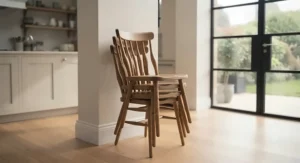
The first mistake is assuming “wood finish” automatically means wipe-clean. Oiled oak, despite being genuinely solid timber, is considerably less forgiving of spills than a lacquered equivalent — oil is porous by design, and red wine or turmeric-heavy sauces can stain it if not wiped promptly. If wipe-clean practicality is your top priority, prioritise lacquered finishes like the Hallowood Furniture Aston over oiled alternatives like the Julian Bowen Coxmoor.
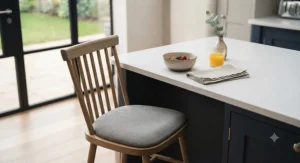
The second mistake is overlooking the seat material entirely while fixating on the frame. A gorgeous lacquered wooden frame paired with a porous fabric seat pad still leaves you with a genuinely stainable surface — faux leather or bonded leather seats, as found on both Oak Furniture King models, wipe clean far more reliably than woven fabric.
The third mistake is ignoring fire safety labelling on upholstered elements. Any dining chair sold in the UK with upholstered seating, including padded seat pads, falls under the Furniture and Furnishings (Fire) (Safety) Regulations, which set flammability standards for the fillings and covers used — worth checking a listing genuinely complies before buying from an unfamiliar seller.
The fourth mistake is buying based on a single glossy photo rather than checking real material descriptions — “wood-effect” and “solid wood” are meaningfully different claims, and only one of them delivers genuine long-term wipe-clean durability.
Hardwearing Dining Furniture for Family Kitchens
Hardwearing dining furniture isn’t really about a single spec — it’s a combination of construction, finish and realistic expectations matched to how your household actually behaves at mealtimes.
For families specifically, the braced-leg construction found on both Oak Furniture King models genuinely earns its keep: children leaning back, chairs being dragged rather than lifted, and the general wear of multiple daily uses all put stress on the joints between legs and seat frame first. A braced design distributes that stress rather than concentrating it at a handful of weak points, which is precisely why premium chairs favour it.
Beyond bracing, weight capacity matters more than most buyers initially consider — not just for larger adults, but for the reality of children standing on chairs, leaning chairs back onto two legs, or piling onto a single seat together. The Yaheetech Beech-Leg chair’s stated 130kg rating, for instance, is a useful benchmark to compare against when shopping other budget options, since not every listing states this clearly.
Finally, hardwearing dining furniture should be judged over a five-to-ten-year horizon, not a first impression. A chair that looks stunning on delivery day but develops a wobble within eighteen months has ultimately cost more per year of use than a plainer chair that’s still solid a decade later — which is the core argument for solid oak or solid beech constructions over composite or veneer alternatives whenever the household budget allows it.
Long-Term Cost & Maintenance
| Consideration | Budget Rubberwood/Beech | Mid-Range Oak | Premium Solid Oak |
|---|---|---|---|
| Typical price range | Under £150-£200 | £200-£300 | £300-£450+ |
| Expected lifespan | 5-8 years daily use | 8-12 years | 12-20+ years |
| Maintenance | Wipe clean, minimal | Occasional oiling | Wipe or occasional oil |
| Cost per year (rough) | £20-£30 | £20-£25 | £15-£25 |
Interpreting the table above, the cost-per-year gap narrows dramatically once you account for realistic lifespan — a £120 rubberwood pair replaced every seven years actually costs a broadly similar annual sum to a £400 solid oak set that lasts fifteen. The premium oak options, like the Oak Furniture King Harvard, therefore aren’t really “more expensive” in total cost of ownership terms; they simply require a larger upfront outlay in exchange for fewer replacement cycles down the line. Households on tighter month-to-month budgets, however, may still reasonably prefer spreading cost across more frequent, smaller purchases like the Hallowood Furniture Aston.
Safety, Regulations and Compliance: What UK Buyers Should Know
UK dining chair buyers benefit from a genuinely robust regulatory framework, even if it’s rarely front of mind while browsing product photos. Upholstered elements — seat pads, cushioned seats, and any fabric or faux leather coverings — fall under the Furniture and Furnishings (Fire) (Safety) Regulations 1988 and its subsequent amendments, which set specific flammability requirements for filling materials and fabric covers used in domestic furniture, including dining chairs sold as part of a set.
For solid timber elements without upholstery, the regulations are less directly relevant, but sourcing standards still matter. Look for suppliers who reference FSC certification or equivalent responsible-forestry credentials on solid wood ranges — it’s a genuine indicator that the timber, whether oak, beech or rubberwood, was harvested through managed, sustainable practices rather than contributing to deforestation. Several of the ranges featured above, including entries from Hallowood and Julian Bowen, reference FSC-sourced materials on at least some models within their wider collections, though it’s always worth double-checking the specific listing you’re buying rather than assuming brand-wide compliance.
Weight capacity ratings, while not strictly a legal requirement for domestic dining chairs, are a sensible practical safety check — particularly in households with growing children who will inevitably test furniture limits in ways manufacturers can’t fully predict.
Frequently Asked Questions
❓ Are wooden dining chairs better than upholstered ones for a kitchen?
❓ How do I stop wooden kitchen chairs scratching my floor?
❓ Is oak or beech better for dining chairs?
❓ How often should I oil solid oak dining chairs?
❓ What weight can wooden dining chairs hold?
Conclusion
Choosing wooden dining chairs for kitchen use ultimately comes down to matching real household habits to real material properties, rather than chasing the prettiest listing photo. If wipe-clean practicality tops your list, the lacquered Hallowood Furniture Aston or the faux-leather-seated Oak Furniture King pair make the most sense. If you’re chasing genuine Scandinavian interior design credentials, the steam-bent beech of the Nicholas Winter chair delivers real authenticity rather than a diluted approximation.
For households prioritising sheer longevity, solid oak dining chairs with braced legs — both Oak Furniture King picks fit this brief precisely — earn their higher price tag through a genuinely lower cost per year of ownership once you account for realistic lifespan. And for anyone furnishing on a tighter budget without wanting to compromise on genuine timber construction, the Julian Bowen Ibsen and Yaheetech Beech-Leg options both deliver honest value.
Whichever direction you go, the underlying principle holds across every price point on this list: genuine solid or well-finished timber, sized correctly for your table and room, will always outlast and out-perform a chair chosen purely on first impressions. Measure twice, check the wood type described in the listing rather than just the finish colour, and your kitchen chairs should be earning their keep for a very long time to come.
Recommended for You
- Upholstered Dining Chairs: 7 Best Picks for UK Homes 2026
- Leather Dining Chairs vs Fabric Dining Chairs: 7 Picks for 2026
- Windsor Dining Chairs UK: 7 Best Picks; Buying Guide 2026
Disclaimer: This article contains affiliate links. As an Amazon Associate, I earn from qualifying purchases. If you purchase products through these links, we may earn a small commission at no additional cost to you.
✨ Found this helpful? Share it with your friends! 💬🤗
