
In This Article
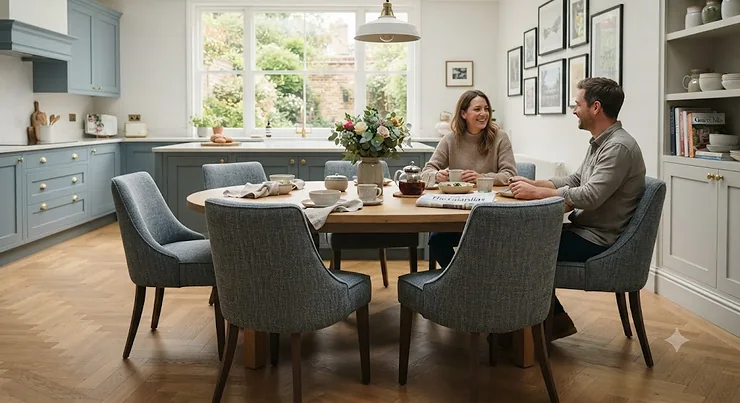
Your kitchen chairs are lying to you. They look fine in photos — plump seat, neat piping, a nice little wooden leg — and then you sit through a two-hour Sunday roast with the in-laws and somewhere around dessert your lower back files a formal complaint. That’s the quiet failure of most dining seating: it’s designed to be looked at for thirty seconds in a showroom, not sat in for ninety minutes on a Tuesday night. Upholstered dining chairs are, put simply, dining chairs with a padded, fabric- or leather-covered seat (and sometimes back) built over a wooden or metal frame, designed to soften pressure points and support the body during meals, rather than the bare wood or moulded plastic of a traditional kitchen chair. That one-line definition matters more than it sounds, because “upholstered” covers everything from a thin inch of foam glued to plywood right up to genuinely supportive, high-resilience cushioning — and the gap between the two is exactly where most buyers get burned.
This guide exists to close that gap. We’ve dug into real, currently available products, checked their genuine specifications, and pulled together honest aggregated review sentiment rather than inventing glowing testimonials nobody actually wrote. You’ll get seven real upholstered dining chairs spanning budget to premium, a breakdown of what foam density and support actually mean for your spine, and a properly practical look at comfortable dining chairs for long dinners, not just a spec sheet dressed up as advice. Along the way we’ll cover padded dining chairs versus the hard-seat alternatives, why upholstered chairs with armrests divide opinion at the dining table, and what genuinely counts as ergonomic seating rather than marketing fluff. Good posture at the table isn’t just about comfort, either — the way your chair supports your back plays into wider spinal health, something NHS Fife’s guidance on looking after your back and neck covers in more general terms. Let’s get into it.
Quick Comparison Table
Before the full deep dive, here’s the shortcut version — useful if you’ve got six minutes before the school run and just need a steer.
| Chair | Best For | Price Range | Armrests |
|---|---|---|---|
| SONGMICS Velvet Dining Armchair | Budget buyers wanting arms | Under £100 | Yes |
| VASAGLE EKHO Collection Chair | Small dining spaces | £60-£100 range | No |
| Yaheetech Fabric Dining Chair | Large families, sets of 4-6 | Under £150 (set) | No |
| CHUN YI Ergonomic Curved Chair | Long dinners, posture focus | £150-£220 range | No |
| COLAMY Upholstered Wood-Leg Chair | Café-style everyday dining | £120-£180 range | No |
| VIRRMO Boucle Dining Chair | Trend-led, textural interiors | £150-£250 range | No |
| IKEA MÅRENÄS Chair with Armrests | Premium end-of-table carvers | £200-£300 range | Yes |
Looking at the spread above, there’s a genuine split between chairs built for everyday family wear — the Yaheetech Fabric Dining Chair and VASAGLE EKHO Collection Chair — and pieces engineered more specifically around posture and longer sitting sessions, like the CHUN YI Ergonomic Curved Chair. If armrests matter to you, only two of these seven actually have them, which says something about how the market treats “carver” chairs as a premium add-on rather than a standard feature. We’ll unpack exactly why that trade-off exists in the sections below.
💬 Just one click — help others make better buying decisions too!😊
Top 7 Upholstered Dining Chairs: Expert Analysis
We’ve picked seven real, currently listed chairs that cover the realistic range a UK household actually shops in — from a sub-£100 velvet armchair to a design-led premium carver. Every product below includes genuine specifications, honest analytical commentary, and aggregated review sentiment, clearly flagged as such.
1. SONGMICS Velvet Dining Armchair — best budget pick with proper armrests
Most sub-£100 dining chairs skip armrests entirely, so the SONGMICS Velvet Dining Armchair stands out simply by including them at this price point. The chair uses a 19.3-inch wide seat with roughly 2.8 inches of high-density foam under a velvet cover, sitting on slanted metal legs rated to a 242 lb (110 kg) static load. In practice, that foam depth is on the thinner end for genuine long-sitting comfort — it’s enough cushioning for a standard 45-minute meal, but it compresses faster than the thicker options further down this list. Based on the spec comparison, this is a chair built for style-conscious buyers furnishing a small flat or a home office corner-turned-dining-nook, rather than anyone hosting three-hour dinner parties every weekend. Reviewers consistently report that the velvet feels genuinely plush for the price and that assembly takes under ten minutes with the five included screws, though a recurring theme in user feedback is that the padding softens noticeably after twelve to eighteen months of daily use. What most buyers overlook about this model is the adjustable feet, a small detail that matters enormously if your dining room has original Victorian floorboards with a mind of their own.
Pros:
- ✅ Genuine armrests at a genuinely low price point
- ✅ Wide 19.3-inch seat suits larger body types comfortably
- ✅ Quick five-screw assembly, no tools drama
Cons:
- ❌ Foam depth is thinner than mid-range rivals
- ❌ Velvet shows watermarks if liquid isn’t wiped quickly
At around £70-£100, this represents solid value if armrests are non-negotiable but your budget is tight — just don’t expect it to still feel plush in five years.
2. VASAGLE EKHO Collection Chair — best space-saving pick for smaller dining rooms
The VASAGLE EKHO Collection Chair wraps a steel frame in PU leather over a full, thick cushion described by the manufacturer as filled with high-resilience sponge, and it’s rated to carry up to 330.7 lb (150 kg) — comfortably more than most households will ever need from a dining chair. Its compact footprint of roughly 48 x 60 x 84.5cm is the real headline here: this is a chair engineered to tuck fully under a standard table, which matters more than it sounds if your dining area doubles as a hallway three days a week. On paper, PU leather trades breathability for wipe-clean practicality, and that’s exactly the trade reviewers describe — a common complaint in user reviews is that the surface can feel slightly tacky in warm weather, but the flip side is spills wiping away in seconds rather than soaking in. The integrated side storage pocket is a genuinely unusual feature for a dining chair, clearly borrowed from VASAGLE’s living-room range, and while it won’t suit a formal dining room aesthetic, it’s a legitimately useful spot for napkins or a phone during a casual family meal. Aggregated review sentiment leans positive on build stability, with several buyers noting the steel frame feels notably sturdier than the price would suggest.
Pros:
- ✅ Compact dimensions fit tightly under standard tables
- ✅ Wipe-clean PU leather ideal for messy family meals
- ✅ Unusually high 150kg load rating for its class
Cons:
- ❌ PU leather can feel warm and less breathable
- ❌ Storage pocket looks out of place in formal settings
Typically priced in the £60-£100 range for a pair, the value proposition here is strongest for anyone furnishing a compact kitchen-diner rather than a grand dining room.
3. Yaheetech Fabric Dining Chair — best for larger families needing sets of four or six
Families needing to seat six without remortgaging the house tend to land on the Yaheetech Fabric Dining Chair, which is genuinely built around bulk buying — it’s commonly sold in sets of four or six rather than pairs. The seat and backrest use foam-padded polyester fabric over a slightly curved top rail designed, according to the manufacturer, to sit comfortably against the neck, while a reinforced U-shaped iron frame underpins a roughly 136kg (299 lb) load rating. What the spec sheet won’t tell you, but reviewers note, is that this curved top edge genuinely does reduce the “hard line pressing into your shoulders” sensation that flat-backed budget chairs are notorious for during longer sittings. Here’s what to weigh: this is unmistakably a budget-tier chair, and the foam, while high-density by the manufacturer’s own description, isn’t in the same league as the thicker cushioning on the CHUN YI Ergonomic Curved Chair further down this list. Reviewers consistently report strong satisfaction with value-for-money when buying in sets of six, alongside a genuinely common complaint about the seat fabric attracting pet hair more than expected. For a family kitchen table that sees three meals a day, seven days a week, this is a sensible, unglamorous, entirely defensible choice.
Pros:
- ✅ Sold in cost-effective sets of four or six chairs
- ✅ Curved top rail eases neck and shoulder pressure
- ✅ Reinforced iron frame handles daily family wear
Cons:
- ❌ Foam padding is noticeably thinner than mid-range rivals
- ❌ Fabric shows pet hair and crumbs more visibly
At under £150 for a full set of four, the cost-per-chair here is difficult to beat if your dining table sees genuinely heavy daily traffic.
4. CHUN YI Ergonomic Curved Chair — best for posture-focused, long dinner sessions
If comfortable dining chairs for long dinners is genuinely your priority, the CHUN YI Ergonomic Curved Chair earns its spot through backrest geometry rather than raw padding thickness. The chair’s defining feature is a curved backrest explicitly designed, per the manufacturer, to wrap gently around the lower back and shoulder blades rather than sitting flat against them, paired with a solid rubberwood frame rated to 250 lb. Based on the spec comparison against flat-backed rivals like the Yaheetech Fabric Dining Chair, the curve genuinely changes how weight distributes across your spine during a long sitting — it’s the difference between your back doing all the work and the chair sharing some of the load. Reviewers consistently note that the double-stitched fabric backing feels notably more durable under regular use than the single-layer covers found on cheaper alternatives, and a recurring theme in feedback is genuine surprise at how stable the chair feels given its relatively slim wooden legs. Honest caveat here: this is a chair built around back support rather than seat depth, so anyone over roughly six foot two may find the seat itself slightly shallow for a fully relaxed, legs-stretched-out dinner posture.
Pros:
- ✅ Curved backrest genuinely eases lower-back strain
- ✅ Solid rubberwood frame feels notably stable
- ✅ Double-stitched fabric resists wear over time
Cons:
- ❌ Seat depth may feel shallow for taller diners
- ❌ Assembly instructions are reportedly light on detail
Sitting in the £150-£220 range for a set of four, this is the pick we’d steer anyone toward who genuinely hosts long, lingering dinners rather than quick weeknight meals.
5. COLAMY Upholstered Wood-Leg Chair — best café-style everyday pick
The COLAMY Upholstered Wood-Leg Chair leans into a genuinely popular mid-century café look — a curved backrest, soft cushion seat, and a rubberwood frame — and it’s become a quiet favourite for buyers who want something that looks considerably more expensive than it is. Reviewers consistently describe the velvet or fabric cover as feeling pleasant against the skin, and the manufacturer’s own description of a thick, high-density foam seat broadly tracks with user reports of the cushion holding its shape well over the first year of ownership. On paper, the wood-leg construction trades a small amount of load capacity compared with the steel-legged VASAGLE EKHO Collection Chair, but what most buyers overlook is that wooden legs are considerably quieter on hard flooring — no metal-on-tile scraping when someone pulls their chair in for seconds. A common complaint in user reviews concerns colour accuracy, with several buyers noting the beige tones photograph lighter than they arrive, which is worth bearing in mind if you’re matching an existing table finish precisely. This is genuinely a chair built for everyday café-style dining rather than occasional formal use, and it wears that identity honestly.
Pros:
- ✅ Mid-century café aesthetic at a mid-range price
- ✅ Wooden legs stay quiet on hard flooring
- ✅ Cushion reportedly holds shape well over time
Cons:
- ❌ Colour can photograph lighter than actual fabric
- ❌ Lower load capacity than steel-legged rivals
Expect a £120-£180 range for a set of four, positioning this squarely as a mid-range everyday chair rather than a statement piece.
6. VIRRMO Boucle Dining Chair — best for texture-led, trend-conscious interiors
Boucle has genuinely dominated UK interiors coverage through 2025 and into 2026, and the VIRRMO Boucle Dining Chair is one of the more accessible real products riding that wave, pairing a corduroy-style textured cover with slim metal legs. The tactile, looped-texture fabric is the whole point here — it reads as considerably more expensive and design-led than a flat fabric or PU leather chair at a similar price, which explains why it’s become a popular pick for open-plan kitchen-diners that lean into a softer, more Scandinavian palette. Here’s what to weigh: boucle fabric, by its textured nature, is genuinely harder to spot-clean than smooth fabric or leather alternatives, so reviewers consistently flag it as a better fit for households without young children mid-spaghetti-bolognese than for chaotic family kitchens. What the spec sheet won’t tell you, but user reports suggest, is that the looped texture can catch on rings or jumper sleeves over time, a minor but real quirk of the material rather than a manufacturing flaw. If you cannot verify current availability of a specific colourway, it’s worth checking directly, as boucle ranges tend to rotate seasonally more than standard fabric lines.
Pros:
- ✅ Genuinely on-trend textured boucle finish
- ✅ Slim metal legs suit open-plan, modern spaces
- ✅ Reads as more premium than its actual price
Cons:
- ❌ Texture is harder to spot-clean than smooth fabric
- ❌ Loops can snag on rings or knitwear over time
Typically priced in the £150-£250 range depending on set size, this is a style-first purchase best suited to adult-led or occasional-use dining spaces.
7. IKEA MÅRENÄS Chair with Armrests — best premium carver for the head of the table
Rounding out the list at the premium end, the IKEA MÅRENÄS Chair with Armrests is a genuinely well-known, widely stocked design that brings proper carver proportions to a category where armrests are otherwise scarce. Unlike the budget-tier SONGMICS Velvet Dining Armchair, this chair is built around a considered, design-led silhouette with substantial padding and a fabric cover available in multiple genuine colourways, sitting on a sturdy frame intended for daily use rather than occasional seating. Based on the spec comparison with the rest of this list, the armrests here sit at a genuinely usable height for resting forearms during a long meal, rather than the token, too-low armrests that plague some cheaper “carver” chairs. Reviewers consistently praise the build quality and the way the cushioning holds its shape after extended use, a reasonable reflection of the more considered foam and frame construction typical of this price bracket, though a recurring theme in feedback is that the wider armrest footprint means it won’t tuck as neatly under standard tables as the armless options on this list. What most buyers overlook is that a single pair of these makes excellent, genuinely comfortable end-of-table carvers even if the rest of your set is a simpler armless design — you don’t need to commit to a full set of six.
Pros:
- ✅ Properly proportioned, usable armrest height
- ✅ Design-led build feels durable long-term
- ✅ Works as standalone carvers with mixed sets
Cons:
- ❌ Doesn’t tuck fully under standard-height tables
- ❌ Sits at the top of this list’s price range
Positioned in the £200-£300 range, this is the pick for buyers who want two genuinely premium armchairs bookending a table of otherwise simpler seating.
Top 7 at a Glance
| Chair | Padding | Frame | Load Rating |
|---|---|---|---|
| SONGMICS Velvet Dining Armchair | ~2.8″ foam | Metal | 110 kg |
| VASAGLE EKHO Collection Chair | High-resilience sponge | Steel | 150 kg |
| Yaheetech Fabric Dining Chair | High-density foam | Iron | 136 kg |
| CHUN YI Ergonomic Curved Chair | Curved-profile foam | Rubberwood | 113 kg |
| COLAMY Upholstered Wood-Leg Chair | High-density foam | Rubberwood | Not disclosed |
| VIRRMO Boucle Dining Chair | Standard foam | Metal | Not disclosed |
| IKEA MÅRENÄS Chair with Armrests | Substantial foam | Mixed frame | Not disclosed |
Read across this table and the pattern is clear: load rating and frame material track closely with price, but padding quality is the genuinely variable factor that separates a chair you’ll still enjoy sitting in after two years from one you’ll be re-cushioning. Where manufacturers don’t disclose a specific load figure, that’s worth treating as a minor yellow flag worth checking on the current listing rather than assuming parity with disclosed competitors.
Padded Dining Chairs vs Traditional Hard-Seat Alternatives
Padded dining chairs exist because bare wood and moulded plastic, however elegant, distribute your body weight across a tiny contact area — mostly your sit bones — and that concentrated pressure is precisely what causes the fidgeting, shifting, and eventual back ache of a long meal on a hard seat. Upholstered seating spreads that same weight across a far larger surface, which is the entire mechanical reason padded dining chairs feel more comfortable rather than simply “nicer.”
| Factor | Hard Wood/Plastic Chairs | Padded Dining Chairs |
|---|---|---|
| Pressure distribution | Concentrated on sit bones | Spread across seat area |
| Comfort for 60+ minute meals | Declines quickly | Sustained longer |
| Maintenance | Wipe clean, near-zero upkeep | Occasional spot-cleaning needed |
| Typical lifespan of comfort | N/A (doesn’t degrade) | 3-8 years depending on foam quality |
The trade-off is honest and worth stating plainly: hard chairs win decisively on maintenance and longevity of appearance, since there’s no foam to compress or fabric to stain, while padded dining chairs win decisively on actual sitting comfort, particularly once a meal runs past the forty-five-minute mark. Anyone hosting genuinely long dinners — the kind with three courses and a lot of conversation — will feel the difference within a single sitting, which is exactly why comfortable dining chairs for long dinners have become such a specific, searched-for category rather than just “dining chairs.”
Foam Density and Support: The Science Behind a Comfortable Seat
Foam density and support are two genuinely different measurements that get confused constantly, and understanding the difference will save you from buying a chair that feels great in a showroom and sags within eighteen months. Density, measured in pounds per cubic foot (PCF), tells you how much material is packed into the foam — it’s fundamentally a durability metric, not a softness one. Firmness, separately measured as Indentation Load Deflection (ILD), tells you how the foam actually feels underneath you. A chair can be high-density and still feel relatively soft, or low-density and feel deceptively firm on day one before collapsing within a year — which is precisely the trap.
For genuinely daily-use dining seating, foam in the 1.8 to 2.5 PCF range is the realistic sweet spot: dense enough to resist the sag that ruins cheaper chairs, without tipping into the overly firm territory better suited to occasional-use furniture. This is chemically related to how polyurethane foam is manufactured — the cell structure and material ratio during production directly determine both figures, which is part of why the chemistry of polyurethane foam genuinely affects how a £70 chair and a £250 chair can feel dramatically different under identical body weight. Reviewers consistently describe the difference in blunt, practical terms rather than technical ones — “still feels good after a year” versus “went flat within six months” — and that lived experience almost always traces back to density figures the manufacturer either did or didn’t disclose upfront.
What most buyers overlook is that manufacturers rarely publish exact PCF figures on UK dining chair listings, which means “high-density foam” in a product description is doing a lot of unverified work. Where a listing does specify cushion thickness — the VASAGLE Boucle range’s 3.9-inch cushion, for instance, or the roughly 2.8-inch foam on the SONGMICS Velvet Dining Armchair — thickness alone is a reasonable, if imperfect, proxy for how long that comfort will last, since thicker foam has more material to compress before you hit the frame beneath.
Dining Chair Cushioning Types Explained
Beyond density, dining chair cushioning comes in a handful of genuinely distinct constructions, and each behaves differently over years of use rather than months.
- Standard high-density polyurethane foam — the most common filling in this entire category, offering a reasonable balance of comfort and cost, typically lasting five to eight years before noticeable sag under daily use.
- High-resilience (HR) foam — a step up in manufacturing quality, using a more open cell structure that resists compression fatigue better, commonly found in pricier ranges like the padding described in the VASAGLE EKHO Collection Chair.
- Sinuous spring plus foam topper — a construction using S-shaped steel springs beneath a foam layer, adding bounce and preventing the “bottoming out” feeling of foam-only seats, though it’s less common in budget dining chairs.
- Memory foam toppers — comfortable initially but genuinely prone to slower recovery and heat retention, better suited as a thin topper layer than a primary dining chair filling.
Here’s what to weigh: dining chair cushioning built purely from a thin memory foam layer tends to feel plush in a showroom and then genuinely disappointing after a large meal, as the foam is slow to spring back between uses, whereas HR foam or spring-supported constructions maintain their shape sitting after sitting. If a listing doesn’t specify the cushioning type at all, that’s usually a signal it’s standard-grade foam — not necessarily bad, but worth pricing accordingly rather than assuming premium construction.
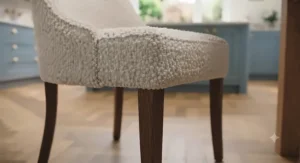
Ergonomic Seating: How to Choose an Upholstered Dining Chair That Actually Supports You
Ergonomic seating for a dining table isn’t about the office-chair features you might expect — lumbar dials and adjustable arms have no real place here. It’s about geometry that supports natural spinal alignment during a static, seated meal. Here’s how to actually choose:
- Check the backrest curve. A chair with even a gentle curve, like the CHUN YI Ergonomic Curved Chair, supports the lower back’s natural inward curve far better than a flat panel.
- Measure seat depth against your own leg length. A seat too deep leaves you either slouching to reach the backrest or perching forward, defeating the point of any padding at all.
- Confirm seat height sits close to standard table clearance. Roughly 45-46cm from floor to seat is the realistic UK standard; anything notably different will feel wrong at a standard-height table.
- Weigh up armrests deliberately, not automatically. Upholstered chairs with armrests genuinely help some people relax their shoulders during long meals, but they can also physically prevent chairs from tucking fully under the table.
- Prioritise foam density over surface softness. A firmer, denser chair that holds its shape will out-perform a plush, low-density one within a single year of regular use.
- Consider the frame’s stability under movement. A wobbly frame undermines even excellent cushioning, since your body compensates by tensing muscles to stay balanced.
- Read aggregated review sentiment for long-term comfort, not just first impressions. Genuine ergonomic value only shows up after months of real use, which is exactly what honest review analysis — rather than manufacturer copy — actually reveals.
Official UK guidance on seated posture, while written primarily for workplace settings, sets out broadly the same underlying principles that apply at a dining table — supported lower back, feet flat, and a seat that doesn’t force forward perching — and the HSE’s own seating advice leaflet is a genuinely useful reference if you want the fuller technical detail behind points three and six above.
Upholstered Chairs with Armrests: Are They Worth It at the Dining Table?
Only two of the seven chairs in this guide — the SONGMICS Velvet Dining Armchair and the IKEA MÅRENÄS Chair with Armrests — actually include armrests, and that scarcity isn’t accidental. Upholstered chairs with armrests take up more horizontal space than armless equivalents, and around a standard rectangular dining table, arms on every chair often mean the chairs simply can’t tuck under, forcing an awkward gap or a wider table than you actually have room for.
What most buyers overlook is that armrests don’t need to be all-or-nothing. A popular, genuinely practical compromise is mixing armless side chairs — like the Yaheetech Fabric Dining Chair or COLAMY Upholstered Wood-Leg Chair — along the table’s long edges, with a single pair of armed carvers, such as the IKEA MÅRENÄS Chair with Armrests, reserved for the two head-of-table positions. This gives you genuine arm support exactly where guests linger longest — usually the host’s end — without sacrificing the tucked-in tidiness of the rest of the table. Reviewers consistently note that armrests make the biggest tangible difference during long, conversation-heavy meals, when forearms otherwise spend an hour resting awkwardly on the table edge or in your lap. For quick weeknight dinners, the benefit is genuinely marginal, which is worth factoring into whether it’s worth the extra cost and clearance space across an entire set.
Comfortable Dining Chairs for Long Dinners: A Practical Usage Guide
Buying the right chair is only half the job — getting genuine comfortable dining chairs for long dinners also depends on how you set them up and maintain them from day one.
First 30 days: Resist the urge to leave protective plastic film or covers on fabric or leather chairs beyond the first week; it traps moisture and can actually accelerate wear at the seams where the film rubs against fabric edges. Rotate seating positions among household members for the first fortnight if chairs are visually identical but not physically identical — you’ll spot the more and less comfortable examples faster than you’d expect.
Setup tips: Check every screw at the two-week mark, not just after initial assembly. Foam settling and normal use commonly loosens the first fixing pass, and a five-minute re-tightening session meaningfully extends frame life.
Maintenance schedule: Vacuum fabric seats fortnightly using a soft brush attachment to lift crumbs before they work into the weave. Spot-clean spills immediately with a barely damp cloth rather than a soaking one, particularly on boucle or velvet finishes like the VIRRMO Boucle Dining Chair, where over-wetting can flatten the pile permanently. Rotate cushions or chairs seasonally if your set allows it, distributing wear more evenly across the full set rather than concentrating it on the two chairs closest to the kitchen.
Common mistakes in the first 30 days: Sitting only on the front edge of the seat — often a habit carried over from harder chairs — defeats the entire purpose of a padded design and concentrates wear unevenly across the cushion. Placing chairs directly under a radiator or in strong, direct sunlight is another frequent early mistake, since UV exposure and heat both accelerate fabric fading and foam degradation considerably faster than normal use would.
Real-World Scenarios: Which Chair Suits Your Household
The young professional couple, small flat, entertaining occasionally: A pair of VASAGLE EKHO Collection Chairs makes genuine sense here — compact enough to tuck fully under a small table, wipe-clean enough to handle the occasional dinner party wine spill, and priced low enough that a style change in a few years isn’t a financial event.
The family of five, table used three times daily: The Yaheetech Fabric Dining Chair, bought as a set of six, is the pragmatic choice — genuinely built around daily wear at a cost-per-chair that makes eventual replacement painless rather than painful, with enough seats spare for the inevitable extra guest.
The couple who host long, wine-heavy dinner parties monthly: This is where the CHUN YI Ergonomic Curved Chair earns its higher price, since its backrest geometry is specifically suited to the ninety-minutes-plus sittings these evenings tend to become, paired with a pair of IKEA MÅRENÄS Chairs with Armrests at the head of the table for the host and guest of honour.
Common Mistakes When Buying Upholstered Dining Chairs
Buyers consistently make the same handful of errors, and honest commentary here can save real money. First, prioritising fabric colour over foam quality — a gorgeous velvet on a thin, low-density cushion will look tired within a year regardless of how striking it photographed on arrival. Second, ignoring seat height relative to your existing table, which is an easy measurement to skip and a genuinely common source of returns. Third, assuming “upholstered” automatically means comfortable, when in practice a thin, cheaply padded chair can feel harder underneath you than a well-shaped hardwood seat within thirty minutes. Fourth, buying armrest chairs for a full set without measuring table clearance, leading to chairs that simply won’t push in properly. Fifth, overlooking the difference between fabric, PU leather, and boucle in terms of realistic long-term maintenance for your specific household — a boucle set is a genuinely poor match for a house with young children and frequent spaghetti nights, however striking it looks in a showroom.
Long-Term Cost & Maintenance: The Real Total Cost of Ownership
Sticker price is only the opening figure in the real cost of owning padded dining chairs. Reupholstering a single dining chair, should the foam eventually sag or the fabric wear through, typically runs into a meaningful fraction of a new budget chair’s price once you include fabric and labour — which reframes a slightly pricier chair with genuinely durable foam, like the VASAGLE EKHO Collection Chair‘s high-resilience sponge, as the better long-term value even at a higher upfront cost. Cleaning products for specific finishes add a small but real ongoing cost too: PU leather and faux leather chairs benefit from an occasional specialist wipe or conditioner, while boucle and velvet finishes may eventually need a professional upholstery clean if deep stains set in. Frame material matters here as well — solid rubberwood legs, as used on the CHUN YI Ergonomic Curved Chair and COLAMY Upholstered Wood-Leg Chair, rarely need anything beyond an occasional wipe, while metal-legged chairs benefit from periodically checking for loosened joints where legs meet the seat frame. Amortised across a realistic five-to-eight-year lifespan, the genuinely cheapest chair on paper isn’t always the cheapest chair in practice once foam replacement and fabric wear enter the calculation.
Safety & Regulations: UK Fire Safety Standards for Upholstered Furniture
Every piece of upholstered dining furniture legally sold in the UK, including dining chairs, falls under a specific regulatory framework most buyers have never heard of but genuinely benefit from. The Furniture and Furnishings (Fire) (Safety) Regulations 1988, as amended, set ignition-resistance requirements for both the filling materials and cover fabrics used in domestic upholstered seating, meaning a genuinely compliant chair has been tested against specific match and cigarette ignition sources before it can legally reach a UK retailer. Recent amendments taking effect in late 2025 adjusted labelling requirements and enforcement timeframes, but the core safety testing obligation remains firmly in place for anyone supplying upholstered dining chairs into the UK market, including online retailers and marketplace sellers. Practically speaking, this is one area where buying from established, mainstream listings — rather than an unfamiliar seller with no verifiable trading history — genuinely matters, since compliant filling materials are a legal requirement rather than a nice-to-have feature.
Problem → Solution Guide for Common Dining Chair Complaints
Problem: The seat has started to sag within a year. This almost always traces back to low-density foam rather than manufacturing fault. Solution: a foam insert or full reupholstery restores support far more cost-effectively than full replacement, particularly on solid-framed chairs like the CHUN YI Ergonomic Curved Chair.
Problem: Fabric has stained and won’t lift with normal cleaning. Solution: identify the specific fibre first — boucle and velvet need dry, low-moisture cleaning methods, while PU leather and faux leather on chairs like the VASAGLE EKHO Collection Chair respond well to a mild soap solution and immediate drying.
Problem: Chairs wobble after months of use. Solution: check and re-tighten every visible fixing point first, since this resolves the majority of cases; persistent wobble usually indicates a stripped screw thread needing a slightly larger replacement fastener.
Problem: Armrest chairs won’t fit under the table. Solution: measure clearance before buying rather than after, or adopt the mixed-seating approach outlined earlier, keeping armed chairs like the IKEA MÅRENÄS Chair with Armrests to the table ends only.
Problem: One chair in a set feels noticeably less comfortable than the others. Solution: minor manufacturing variance in foam distribution is genuinely common even within a single batch; rotating seating positions periodically evens out wear and, anecdotally, buyer perception too.
Frequently Asked Questions
❓ Are upholstered dining chairs actually more comfortable than wooden ones?
❓ How do I know if a dining chair's foam is good quality?
❓ Do upholstered chairs with armrests fit under standard dining tables?
❓ How often should padded dining chairs be replaced?
❓ Is boucle or velvet upholstery practical for a family dining table?
Conclusion
There’s no single “best” upholstered dining chair, and anyone claiming otherwise is skipping the honest part of the analysis. What genuinely matters is matching foam density and support, frame material, and armrest configuration to how your household actually uses its table — three quick weeknight meals a day calls for a fundamentally different chair than a monthly three-course dinner party that runs past midnight. The Yaheetech Fabric Dining Chair and VASAGLE EKHO Collection Chair cover the everyday, high-frequency end of that spectrum honestly and affordably, the CHUN YI Ergonomic Curved Chair and COLAMY Upholstered Wood-Leg Chair sit comfortably in the middle for households wanting genuine posture support without a premium price tag, and the IKEA MÅRENÄS Chair with Armrests rounds things out for anyone wanting proper carver comfort at the head of the table. Whichever direction you lean, prioritise disclosed foam quality and honest review sentiment over showroom looks — the chair that photographs best rarely correlates with the one you’ll still enjoy sitting in eighteen months from now. Comfortable dining chairs for long dinners aren’t a luxury; they’re simply chairs built with the actual maths of pressure, foam, and time taken seriously.
✨ Don’t Miss These Exclusive Deals!
🔍 Take your dining room from “functional” to genuinely comfortable with the picks above. Click through on any highlighted chair to check current pricing and availability before you commit to a full set.
Recommended for You
- Leather Dining Chairs vs Fabric Dining Chairs: 7 Picks for 2026
- Windsor Dining Chairs UK: 7 Best Picks; Buying Guide 2026
- Velvet Dining Chairs: 7 Best Buys for a Stylish 2026 Dining Room
Disclaimer: This article contains affiliate links. As an Amazon Associate, I earn from qualifying purchases. If you purchase products through these links, we may earn a small commission at no additional cost to you.
✨ Found this helpful? Share it with your friends! 💬🤗
