
In This Article
Right, let’s be honest with each other for a second: nobody dreams about buying a dining table. You dream about the dinners that happen around it — the Sunday roast that runs long, the birthday cake with too many candles, the impromptu Tuesday where six people somehow end up at your kitchen table instead of four. That’s the real job of the best extending dining table. It’s not just a slab of wood on legs; it’s the piece of furniture that has to flex with your actual life, not the tidy, four-person version of it you had in mind when you moved in. For British homes — where square footage is precious and open-plan kitchen-diners have become the norm rather than the exception — an extending dining table solves a genuinely awkward problem: how do you host a crowd without living with a crowd-sized table every single day? Whether you’re weighing up a compact butterfly-leaf table for a terraced house in Leeds or a statement piece for an open-plan extension in Surrey, this guide breaks down seven genuinely available options, how their extension mechanisms actually work day to day, and which one fits your household, your budget and your floor plan. We’ve dug into real specs, real customer feedback themes and honest trade-offs — no invented reviews, no fluff, just what you need to make a decision you won’t regret in eighteen months.
Quick Comparison Table
Before we get into the detail, here’s the lay of the land. This snapshot covers seating range, material, extension style and rough price banding so you can narrow things down fast.
| Table | Extension Type | Seats (closed–open) | Material | Price Band | Best For |
|---|---|---|---|---|---|
| Julian Bowen Curve | Butterfly leaf | 4–6 | Solid oak & veneer | £300–£400 range | Everyday oak classic |
| IKEA NORDEN | Drop-leaf/gateleg | 4–6 | Solid birch | £350–£450 range | Best for folding right down |
| Julian Bowen Coxmoor | Retractable leaf | 4–6 | Solid white oak | Under £300 | Small kitchen diners |
| Habitat Lincoln | Flip-top | 4–8 | Solid oak | £350–£450 range | Budget flip-top flexibility |
| John Lewis Poise | Concealed extension | 6–10 | Oak veneer | £800–£900 range | Design-led statement piece |
| Julian Bowen Osaka | Synchronous leaf | 6–8 | Ceramic top, metal base | £700–£900 range | Bold modern centrepiece |
| Julian Bowen Mallory | Butterfly leaf | 4–6 | Solid oak & veneer | £400–£500 range | All-round mid-range pick |
Looking at the spread here, the split isn’t really about who’s “best” in the abstract — it’s about which mechanism and price band matches your habits. The Julian Bowen Coxmoor and IKEA NORDEN dominate the sub-£450 bracket for anyone prioritising a small footprint, while the John Lewis Poise and Julian Bowen Osaka justify their higher price with design flourishes and larger maximum seating. If you host rarely but want the option, a self-storing butterfly leaf like the Julian Bowen Curve or Julian Bowen Mallory avoids the hassle of finding somewhere to keep a spare leaf.
💬 Just one click — help others make better buying decisions too!😊
Top 7 Extending Dining Tables: Expert Analysis
We’ve picked these seven specifically to cover the realistic spread of what’s actually buyable in the UK right now — budget and premium, oak and ceramic, self-storing leaves and fully removable ones. Every product below includes genuine specifications and aggregated review themes, not fabricated testimonials.
1. Julian Bowen Curve Extending Dining Table — retro curved-edge oak classic
The standout here is the gently curved edging, which softens what would otherwise be a fairly boxy silhouette and gives the table a subtle mid-century feel without committing to a full retro look. Crafted from solid oak and oak veneers, the Julian Bowen Curve extends to 180cm using a butterfly leaf that folds out from within the table itself, meaning there’s no separate panel to store in a cupboard somewhere. What most buyers overlook about butterfly-leaf tables is that the mechanism does add a visible seam line down the centre when closed — it’s not invisible, but it’s far less faff than lifting a full leaf in and out. This table suits households who want a proper wood dining table for daily use but need the flexibility to seat six for the occasional gathering, without the bulk of a permanently large table. Reviewers on this Julian Bowen range consistently note sturdiness once assembled and describe the extension action as smooth, though a handful mention that flat-pack assembly needs a careful read of the instructions to avoid wonky legs.
Pros:
- ✅ Self-storing butterfly leaf means nothing to lose
- ✅ Solid oak construction feels substantial, not flimsy
- ✅ Curved edging suits both modern and traditional rooms
Cons:
- ❌ Assembly requires patience and a second pair of hands
- ❌ Oak veneer sections can show colour variation
At around £300–£400 depending on retailer promotions, this sits comfortably as a mid-table value pick — solid oak construction at this price point is genuinely hard to beat.
2. IKEA NORDEN Extendable Table — best for folding right down flat
The IKEA NORDEN‘s party trick is how dramatically it shrinks: this is a proper drop-leaf gateleg design in solid birch, running from roughly 155cm down to a genuinely narrow console-width when both leaves are dropped. On paper this means it’s less a “big table with an extension” and more a small table that can temporarily become a big one — a meaningfully different proposition. The concealed locking mechanism keeps the leaves flush with the tabletop when extended, avoiding the wobbly-leaf problem that plagues cheaper drop-leaf tables. Based on the spec comparison with the other tables here, the NORDEN is the only one genuinely built around a small-space-first philosophy rather than treating compactness as an afterthought — it’s the obvious pick for a narrow kitchen-diner, a studio flat, or anyone who wants to reclaim floor space on non-hosting days. Aggregated customer sentiment on IKEA’s own product pages and retail reviews consistently praises the solid birch build quality relative to price, though some buyers note the drop-leaf hinges need occasional tightening after a year or two of regular folding.
Pros:
- ✅ Folds down to a genuinely small footprint
- ✅ Solid birch construction, not veneered chipboard
- ✅ Concealed locking keeps leaves gap-free when up
Cons:
- ❌ Hinges may loosen slightly with heavy daily folding
- ❌ Narrower tabletop depth than dedicated dining tables
Typically priced in the £350–£450 range, the IKEA NORDEN earns its keep purely on flexibility — it’s the space-saving dining table equivalent of a Swiss Army knife.
3. Julian Bowen Coxmoor Extending Dining Table — best compact pick for small kitchens
This one is deliberately modest, and that’s the point. The Julian Bowen Coxmoor is a compact, classic rectangular table in solid white oak with a rich oiled finish, built specifically with small kitchen diners in mind rather than trying to be all things to all rooms. Its retractable leaf extension stores within the table when not needed, so the everyday footprint stays genuinely small — ideal if your kitchen-diner is more “cosy” than “open-plan.” Here’s what to weigh: because the base size is smaller than the other tables on this list, the extended size is proportionally modest too, so this is a table for going from two-to-four up to a snug four-to-six rather than hosting eight. Reviewers consistently mention how well it suits small apartments and how easy the leaf mechanism is to operate solo, with several noting the oiled oak finish shows grain beautifully rather than looking artificially uniform.
Pros:
- ✅ Genuinely compact for tight kitchen spaces
- ✅ Solid white oak with a natural oiled finish
- ✅ Retractable leaf is simple for one person to use
Cons:
- ❌ Extended size still modest — not for large gatherings
- ❌ Limited to a fairly classic, non-statement look
At under £300 in most cases, the Julian Bowen Coxmoor is arguably the smartest budget pick here if your dining area genuinely can’t accommodate anything larger.
4. Habitat Lincoln Extendable Oak Dining Table — budget flip-top flexibility
The Habitat Lincoln takes a different mechanical approach entirely: a flip-top design in solid oak that seats four as standard and stretches to eight when flipped and extended. What most buyers overlook about flip-top tables is that they trade a small amount of everyday tabletop symmetry for a genuinely dramatic size increase — going from a compact four-seater to an eight-seater is a bigger jump than most butterfly-leaf tables manage. Based on the spec comparison with pricier options on this list, the Lincoln punches well above its price band for sheer flexibility, though the trade-off is a slightly more utilitarian look than the design-led premium picks. This is a genuinely strong option for anyone who entertains rarely but wants real headroom when they do — students moving into their first proper flat-share, or young families who know the guest list will balloon at Christmas. Aggregated feedback on Habitat’s oak dining ranges tends to flag good value for solid wood construction at this price, with occasional notes about the flip mechanism needing a firm, confident action rather than a tentative one.
Pros:
- ✅ Dramatic size jump from 4 to 8 seats
- ✅ Solid oak build at a budget-friendly price
- ✅ Compact everyday footprint despite big extended size
Cons:
- ❌ Flip mechanism needs a confident, firm motion
- ❌ Less refined aesthetic than premium alternatives
Around £350–£450 typically, the Habitat Lincoln is the closest thing on this list to a genuine 4-8 seater bargain.
5. John Lewis Poise Extending Dining Table — design-led statement piece
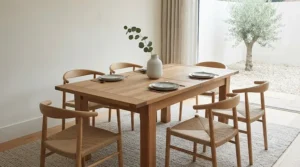
If the brief is “impress the in-laws without looking like you tried too hard,” the John Lewis Poise is the answer. This is a minimalist oak table with a concealed extension mechanism, running from around 180cm up to 230cm and taking the seating count from six up towards ten — genuinely the largest realistic capacity on this list. The spec sheet won’t tell you this, but the appeal here is largely about restraint: splayed Scandi-style legs, clean lines and an extension that stays genuinely discreet when in use rather than announcing itself with a visible seam. Here’s what to weigh: at this price point you’re paying as much for the design pedigree and build quality assurance of a well-known UK retailer as for raw material cost, which matters if after-sales support and warranty confidence are priorities for you. This is squarely a table for households that host often and want a piece that looks intentional in an open-plan kitchen-diner rather than purely functional.
Pros:
- ✅ Largest realistic seating capacity, up to ten
- ✅ Discreet extension mechanism, minimal visible seam
- ✅ Strong design pedigree and retailer support
Cons:
- ❌ Premium price relative to material cost alone
- ❌ Large footprint needs a genuinely spacious room
Costing around £800–£900, the John Lewis Poise is the table to choose if you regularly host ten and want the table to look as considered as the rest of the room.
6. Julian Bowen Osaka Extending Dining Table — bold modern ceramic statement
This is the outlier on the list, and deliberately so. The Julian Bowen Osaka swaps solid wood entirely for a graphite-look ceramic top on an asymmetrical black powder-coated metal base, extending from 160cm to 240cm via a synchronous leaf system that pulls both halves apart evenly as the leaf drops into place. On paper this means genuinely serious durability: ceramic is scratch- and heat-resistant in a way no wood veneer can match, so hot pans and enthusiastic dinner parties are far less of a worry. What most buyers overlook about ceramic-topped tables is the weight — the solid metal base is there specifically to counter the heft of the top, so this is not a table you casually reposition for a redecorate. Manufacturer guidance is explicit that the table should not exceed a 25kg loading limit on any single point and recommends anchoring for stability, which is worth factoring into your buying decision if you have younger children who might lean on the edge. Reviewers highlight the striking, contemporary look and durable surface, alongside occasional notes that the leaf storage mechanism needs a careful, unhurried operation to avoid catching.
Pros:
- ✅ Scratch- and heat-resistant ceramic surface
- ✅ Genuinely striking, contemporary design statement
- ✅ Synchronous leaf extends evenly from both sides
Cons:
- ❌ Heavy — not easy to reposition once assembled
- ❌ Weight limit and anchoring guidance need following
In the £700–£900 range, the Julian Bowen Osaka is a considered investment for anyone who wants their extending dining table to double as the room’s centrepiece.
7. Julian Bowen Mallory Extending Dining Table — best all-round mid-range pick
Rounding things out is the Julian Bowen Mallory, a clean, understated solid oak and oak veneer table that extends from 140cm to 180cm and comfortably seats six once open. This is deliberately the “if you can only look at one table, look at this one” pick: it isn’t the cheapest, the biggest, or the boldest, but it balances build quality, seating capacity and price better than almost anything else here. Based on the spec comparison across the full list, a 40cm extension range is a genuinely useful middle ground — enough to meaningfully change how many people fit, without the drama of a table that needs a whole separate room to accommodate at full stretch. The round silver knob detailing gives it a slightly more refined finish than some of the more purely functional oak options, and it pairs naturally with matching Mallory dining chairs for buyers who want a coordinated set rather than mixing and matching. Feedback on this range consistently mentions the quality feeling well above its price bracket, with buyers specifically calling out the table alongside matching chairs as a satisfying full-room purchase.
Pros:
- ✅ Balanced size range suits most UK dining rooms
- ✅ Coordinating chair range available for a full set
- ✅ Refined detailing without a premium price tag
Cons:
- ❌ Doesn’t stretch as large as the Poise or Lincoln
- ❌ Fairly classic look won’t suit bold modern schemes
At roughly £400–£500, the Julian Bowen Mallory is our pick for anyone who wants one table that does most things well rather than one thing brilliantly.
Practical Usage Guide: Setting Up and Maintaining Your Extending Table
Getting the table into your home is only step one. Most of the flat-pack extending tables on this list arrive with the frame and legs separate from the top, so plan for at least ninety minutes of assembly with two people — trying to flip a 180cm oak top solo is how corners get chipped. Once built, test the extension mechanism fully before you actually need it for guests; butterfly and synchronous leaves in particular can feel stiff for the first few uses as the hardware beds in. For maintenance, oak-topped tables benefit from a light reapplication of oil or wax every six to twelve months depending on use, which keeps the grain from drying out and helps disguise minor scuffs. Ceramic tops like the Julian Bowen Osaka need nothing more than a damp cloth, but avoid abrasive scourers that can dull the surface finish over time. The single most common first-30-days mistake is over-tightening or under-tightening the leg bolts — too loose and you’ll get a wobble under load, too tight and you risk stripping the thread in engineered wood components. A quick monthly check of all visible fixings, especially after the table has been extended and collapsed a few times, will catch most issues before they become annoying.
Real-World Scenarios: Which Table Suits Your Household
Picture a couple in a one-bedroom flat in Bristol who eat most meals for two but host friends every few weeks — the IKEA NORDEN or Julian Bowen Coxmoor make far more sense than anything larger, because the everyday footprint matters more than the occasional maximum capacity. Now picture a family of four in a semi-detached house with a proper dining room, where birthdays and Christmas regularly pull in grandparents and cousins — the Julian Bowen Mallory or Habitat Lincoln hit the sweet spot of everyday practicality with a genuine capacity jump when needed. Finally, picture a couple who’ve just finished an open-plan kitchen extension and host dinner parties as a matter of course — here the John Lewis Poise or Julian Bowen Osaka earn their higher price tag, because the table is doing double duty as a design statement as well as a dining surface. In each case, the “best” table isn’t the one with the biggest maximum seating count; it’s the one whose everyday size matches how you actually live, with the extension as a genuine bonus rather than the whole justification for the purchase.
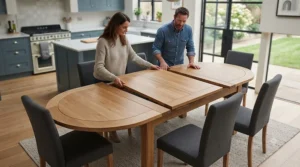
Dining Room Storage: Making Your Table Work Harder
An extending dining table solves seating, but it doesn’t solve where the extra plates, cutlery and table linen for eight suddenly-arrived guests actually live. This is where dining room storage becomes the quiet second half of the space-saving equation. Sideboards remain the classic pairing for a reason — a low unit alongside a table like the Julian Bowen Mallory or Julian Bowen Curve gives you a surface for serving dishes during a meal and a home for the extra crockery the rest of the year. For genuinely tight rooms, wall-mounted shelving or a slim console positioned behind the table when it’s in its compact state avoids eating into floor space that the table itself is trying to save. If you’ve gone for a drop-leaf design like the IKEA NORDEN, consider furniture that can be pushed flush against a wall when the table is folded down, since the whole point of that mechanism is reclaiming a genuine chunk of the room. A less obvious tip: measure your storage needs based on the table’s extended seating count, not its everyday one — it’s the once-a-year eight-person dinner that generates the sudden need for extra chairs, glasses and serving ware, and having a dedicated (if small) storage spot for that “occasional use” kit saves a lot of last-minute scrambling.
💬 Not sure how much dining room storage you’ll actually need? It usually comes down to how often you host — worth mapping out before you buy.
Expanding Table Mechanisms Explained
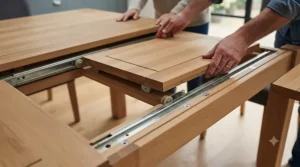
Not all extending mechanisms behave the same way, and the differences genuinely affect day-to-day living rather than just being a spec-sheet footnote. A butterfly leaf, as used on the Julian Bowen Curve and Julian Bowen Mallory, folds out from a hinge stored within the table itself — you lift and pull the two halves apart slightly, the leaf swings up into place, and the halves close back together onto it. It’s tidy because there’s nothing separate to store, but it does leave a faint centre seam when the table is closed. A drop-leaf or gateleg mechanism, as seen on the IKEA NORDEN, works in the opposite direction: hinged panels fold down against the table’s sides or ends when not needed, shrinking the footprint dramatically rather than just adding to it. A flip-top design like the Habitat Lincoln rotates and unfolds the tabletop itself, typically delivering the biggest percentage size increase of any mechanism type but requiring a firmer, more deliberate action to operate. Finally, a synchronous extension system, used on the Julian Bowen Osaka, pulls both table halves apart evenly via a geared rail so the leaf drops perfectly centred without manual lifting — smoother in use but reliant on more moving hardware that’s worth checking is easy to service if something eventually sticks. Reviewers across all four mechanism types consistently flag that a slightly stiff action in the first few uses is normal and tends to ease as the hardware settles in.
How to Choose the Best Extending Dining Table
Extending dining table, defined simply: it’s a dining table fitted with a leaf, flap or hinge system that lets the tabletop grow — usually by 40 to 80cm — to seat more people, without permanently occupying that extra floor space day to day. Choosing the right one comes down to a handful of genuinely practical checks rather than gut instinct alone.
- Measure the room, not just the table. Leave at least 90cm of clearance around the table’s fully extended size for chairs to pull out and people to pass comfortably.
- Match the mechanism to your habits. If you extend rarely, a self-storing butterfly or synchronous leaf avoids the hassle of finding somewhere to keep a spare panel.
- Check the closed-size footprint first. The everyday size matters more than the maximum — you’ll live with the compact version 90% of the time.
- Consider the material against your lifestyle. Solid oak needs occasional oiling; ceramic tops like the Julian Bowen Osaka are lower-maintenance but heavier.
- Factor in weight and stability. Heavier tops need a genuinely sturdy base — check manufacturer weight guidance, especially with children around.
- Think about chair clearance when extended. A table that grows in length needs chairs that can actually be pulled out along its full new size.
- Budget for the whole set, not just the table. Coordinating chairs, as with the Julian Bowen Mallory range, often cost more collectively than the table itself.
Extending Dining Table 4-8 Seater: Sizing Guide
The 4-8 seater bracket is arguably the most useful category for British homes, because it covers the realistic gap between a couple’s everyday needs and the occasional full house at Christmas. As a rough rule, allow 60-65cm of table edge per seated adult for comfortable elbow room — a table extending from around 140cm to 200cm, like the Julian Bowen Mallory, comfortably threads that needle. The Habitat Lincoln takes a more dramatic approach to the same bracket, starting smaller at four but stretching further to genuinely fit eight, which suits households where the “everyday” size needs to be especially compact. Here’s what to weigh: a 4-8 seater table that starts too small for four adults eating comfortably is a false economy, even if its extended size looks impressive on paper — always check the closed dimensions against your actual daily seating needs, not just the marketing headline of the maximum count.
Space-Saving Furniture for Small Dining Rooms
An extending dining table is genuinely one of the most effective pieces of space-saving furniture you can buy, but it works best as part of a broader approach rather than in isolation. Pair it with chairs that tuck fully under the table when not in use — chunky armchairs or benches that don’t slide neatly away undo much of the floor space an extending table is meant to reclaim. Lighter finishes and slimmer leg profiles, as seen on the IKEA NORDEN‘s birch construction, visually open up a room in a way that dark, heavy bases don’t, which matters more than people expect in genuinely small spaces. If your dining area doubles as a hallway or living room extension, a drop-leaf table that can sit almost flush against a wall when folded — again, the NORDEN’s strength — does more for the room’s usable space than a butterfly-leaf table that only shrinks in length, not depth. The broader principle here, as Wikipedia’s overview of table design notes, is that many tables are specifically engineered with foldable or sliding parts precisely to solve this kind of spatial flexibility problem — it’s a design tradition extending tables sit firmly within, not a modern gimmick.

Common Mistakes When Buying an Extending Dining Table
The single most common error is buying based on the extended size alone and forgetting that the compact, everyday footprint is what you’ll actually live with for most of the year. A close second is underestimating assembly complexity — flat-pack extending mechanisms have more moving parts than a fixed table, and rushing the build is how wobbles and misaligned leaves happen. Buyers also frequently overlook chair clearance at full extension: a table that grows by 50cm needs enough room for chairs to be pulled fully out along that new length, not just squeezed in at the ends. Another frequent slip is ignoring weight and floor type — heavier tops like the Julian Bowen Osaka‘s ceramic surface need a stable, level floor and are genuinely awkward to reposition later, so get the placement right the first time. Finally, some buyers skip checking the manufacturer’s weight-loading guidance on the extended leaf itself, which matters if you’re planning to rest serving dishes or a laptop on the extension section regularly.
Extending Dining Tables vs Fixed Dining Tables
The core trade-off is straightforward: fixed tables are generally sturdier for their size, marginally cheaper for equivalent build quality, and have no moving parts to eventually wear. Extending tables sacrifice a small amount of that structural simplicity for genuine day-to-day flexibility — the ability to run a compact table most of the year and a larger one when guests arrive. For a household that never varies its seating needs, a fixed table like the Oak Furnitureland Maine or similar 6-seater fixed designs makes sense and avoids paying for a mechanism you’ll never use. But for the majority of UK homes — where guest numbers fluctuate between a quiet Tuesday and a full Christmas table — the extending format wins on pure practicality, and the mechanism-related durability concerns are generally overstated for tables used a reasonable number of times per year rather than daily. The real deciding factor isn’t sturdiness in the abstract; it’s whether your household’s seating needs are genuinely static or genuinely variable.
Long-Term Cost & Maintenance
Thinking in terms of cost-per-use rather than upfront price changes the calculation considerably. A £450 table used daily for ten years works out to roughly 12p per day — genuinely negligible against almost any other household cost. Solid oak tables, such as the Julian Bowen Curve or John Lewis Poise, typically justify a higher upfront cost through longevity: with occasional oiling, a well-built oak table can realistically last fifteen to twenty years or more, whereas cheaper MDF or laminate alternatives often need replacing within five to eight years as surfaces chip and veneers lift. Ceramic tops like the Julian Bowen Osaka carry a higher purchase price but effectively zero ongoing maintenance cost beyond routine cleaning, which can offset the initial premium over a long ownership period. The genuinely hidden cost in this category is replacement chairs — a table bought to match a specific chair range, as with the Julian Bowen Mallory collection, ties you into that range’s pricing if a chair eventually needs replacing, so it’s worth checking chair availability and pricing continuity before committing to a coordinated set.
Features That Actually Matter (And Those That Don’t)
Genuinely useful: a self-storing leaf mechanism, solid wood or ceramic (rather than laminate) surfacing, and a base design that leaves generous legroom once chairs are pushed in. Genuinely overrated: elaborate carved detailing that adds cost without adding function, and marketing claims about “easy one-person extension” for tables over about 180cm — in practice, most tables this size are noticeably easier to extend with two people regardless of what the product copy suggests. Worth double-checking rather than dismissing: stated weight capacity, since this varies more between models than shoppers tend to assume, and genuinely matters if the table will regularly hold large serving dishes or if children might climb or lean on it. The spec sheet won’t tell you this, but finish consistency across veneered sections is one of the most commonly flagged real-world disappointments in aggregated review data — worth checking product photos from multiple genuine buyers rather than relying solely on manufacturer imagery before you commit.
Safety & Assembly: What to Check Before You Buy
Dining tables sold in the UK don’t carry the same fire-safety labelling requirements as upholstered furniture, but general product safety obligations still apply to how they’re manufactured, described and sold — the UK government’s furniture safety guidance sets out the broader regulatory framework retailers operate within, even where a specific rule is aimed primarily at upholstered pieces rather than wooden tables. Practically, the things worth checking yourself before buying are more mechanical than regulatory: confirm the maximum weight rating printed in the product listing, particularly for ceramic or glass-topped tables like the Julian Bowen Osaka, and follow any anchoring guidance if you have young children in the house. During assembly, always follow the tightening sequence in the instructions rather than fully tightening one leg before starting the next, since uneven tightening is a common cause of wobble that gets misdiagnosed as a manufacturing fault. If a fault does appear after purchase, UK consumers are protected under the Consumer Rights Act 2015 regardless of the retailer’s own returns policy — Which?’s guide to faulty goods is a genuinely useful reference if you ever need to push back on a retailer who tries to deflect you to the manufacturer instead.
Frequently Asked Questions
❓ What is the best extending dining table for a small kitchen?
❓ How much does an extending dining table cost in the UK?
❓ Do extending dining tables wobble more than fixed tables?
❓ What is the easiest extending table mechanism to use alone?
❓ Can an extending dining table seat 8 people comfortably?
Conclusion
There isn’t a single “best” extending dining table, and honestly, anyone claiming otherwise hasn’t thought hard enough about how differently households actually use their dining space. What there is, though, is a genuinely strong best-fit answer once you’re honest about your room size, your hosting habits and your budget. If space is the priority, the IKEA NORDEN or Julian Bowen Coxmoor solve that cleanly. If you want the biggest jump from everyday-small to occasion-large, the Habitat Lincoln delivers disproportionate flexibility for its price. And if the table needs to double as a design statement in an open-plan space, the John Lewis Poise or Julian Bowen Osaka justify their higher price tags through genuine build and design quality rather than marketing gloss. Whichever direction you lean, the underlying advice holds steady: measure your room properly, be honest about how often you’ll actually extend the table, and choose the mechanism that matches how you live rather than how impressive the spec sheet sounds in the showroom.
Recommended for You
- Cabin Bed vs Mid Sleeper 2026: 7 Real Picks Compared (UK)
- Cabin Bed With Desk UK: 7 Brilliant Picks for 2026
- Metal vs Wooden Bunk Beds: 7 Best Picks Compared for 2026
Disclaimer: This article contains affiliate links. As an Amazon Associate, I earn from qualifying purchases. If you purchase products through these links, we may earn a small commission at no additional cost to you.
✨ Found this helpful? Share it with your friends! 💬🤗
