In This Article
There’s a particular kind of Tetris that happens in every family home with a small box room: a bed here, a wardrobe there, and somehow a desk is meant to squeeze in as well, without anyone losing a knee to a drawer handle in the dark. If that sounds familiar, a cabin bed with desk is probably already on your search history, and for good reason. It solves the maths problem furniture catalogues rarely admit exists — that a 7 to 9 square metre single bedroom simply cannot fit a bed, a wardrobe, a chest of drawers and a full-size desk without something giving.
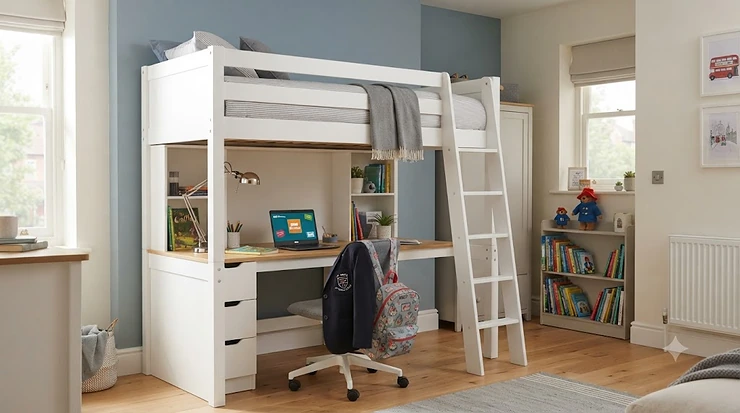
So what is a cabin bed with desk? In short, it’s a raised single bed — typically 60 to 90cm off the ground — with a desk built into or slotted beneath the frame, so a child gets a proper place to sleep and a proper place to do homework without eating up any extra floor space. Some tuck the desk on wheels so it slides fully underneath; others fix it to one side with shelving above. It’s a genuinely practical answer to a real constraint: a legally recognised single bedroom in England can be as compact as around 6.5 square metres under the government’s nationally described space standard, which leaves precious little room for separate furniture pieces.
We’ve spent time digging into the actual specs, aggregated review sentiment and safety standards behind seven genuinely available UK models, spanning solid pine budget options through to gaming-ready high sleepers for teens. Every price mentioned below is a range rather than a fixed figure, because retailer pricing shifts constantly — always check the current price before buying. What follows isn’t a rewritten product listing; it’s the analysis, comparison and practical guidance you’d want from a friend who has already read every spec sheet and review thread so you don’t have to.
Quick Comparison Table: Cabin Bed With Desk at a Glance
| Model | Bed Type | Desk Style | Price Range | Best For |
|---|---|---|---|---|
| Noa & Nani Moro Cabin Bed Midsleeper with Pullout Desk | Midsleeper | Pull-out, 3 shelves | £200–£300 | Budget-first buyers |
| Julian Bowen Kimbo Cabin Bed | Midsleeper | Freestanding, repositionable | £250–£350 | Flexible room layouts |
| Flair Charlie Mid Sleeper Staircase Storage Set with Desk | Midsleeper (staircase) | Pull-out with shelving | £400–£500 | Younger climbers |
| Julian Bowen Jupiter Midsleeper | Midsleeper | Pull-out on wheels | £350–£450 | All-round storage + study |
| Noa & Nani Una Kids Cabin Bed with Drawers & Desk | Midsleeper | Pull-out, deep surface | £450–£600 | Build quality seekers |
| Noa & Nani Thomas High Sleeper with Louis Desk | High sleeper | Fixed under-bed desk | £500–£650 | Maximising floor space |
| Noa & Nani Vortex Gaming Station High Sleeper with Desk | High sleeper | Double-tier desk | £550–£700 | Teen gamers |
Looking across the table, the split roughly tracks height and complexity: midsleepers with a simple pull-out desk sit at the affordable end, while high sleepers with taller frames, reinforced ladders and larger desks command a premium. Notice, too, that price doesn’t map cleanly onto desk size — the Julian Bowen Jupiter Midsleeper offers a genuinely wide pull-out surface for less than several beds with smaller desks, which is exactly the kind of detail a spec sheet alone won’t flag. If your priority is simply “biggest desk for the money,” it’s worth scrolling ahead to the full breakdown rather than assuming the most expensive option wins by default.
💬 Just one click — help others make better buying decisions too!😊
Top 7 Cabin Beds With a Desk: Expert Analysis
Below is our pick of seven real, currently available models that combine a genuine cabin bed desk combination — not a bed with a flimsy fold-down shelf bolted on as an afterthought. We’ve covered budget, mid-range and premium options, plus a mix of midsleepers and taller high sleepers, so there’s something here whether you’re kitting out a five-year-old’s first proper bedroom or a fourteen-year-old’s homework-and-gaming den.
1. Noa & Nani Moro Cabin Bed Midsleeper with Pullout Desk — best budget entry point
The standout here is the price-to-function ratio: a solid midsleeper frame with a genuinely usable pull-out desk for less than many standalone kids’ desks cost on their own. The frame stands at roughly 114cm high with around 74cm of clearance underneath, and the desk — known as the Kasper desk in Noa & Nani’s range — slides out on runners to about 75cm and includes three open shelves for books and stationery. That clearance height matters practically: it’s tall enough for a desk chair to tuck fully under when not in use, which a surprising number of budget midsleepers get wrong.
Based on the spec comparison with pricier rivals, what you’re sacrificing isn’t structural integrity — it’s frame material variety and colour choice, since this model comes in a single classic white pine finish. Reviewers consistently note that assembly, while a two-person job, is manageable in an afternoon, and that the desk runners glide smoothly rather than sticking after a few months of use, which is often where budget furniture starts to show its age.
Pros:
- ✅ Genuinely usable pull-out desk at a low starting price
- ✅ Solid pine frame construction, not just chipboard
- ✅ Desk shelving keeps school books tidy without extra furniture
Cons:
- ❌ Only available in one colourway
- ❌ Desk is not on wheels, so sliding it takes a bit more effort
At around £200–£300, the Noa & Nani Moro Cabin Bed Midsleeper with Pullout Desk represents strong value for families furnishing a first “big kid” bedroom without overspending on features a five- or six-year-old won’t yet need.
2. Julian Bowen Kimbo Cabin Bed — best for flexible room layouts
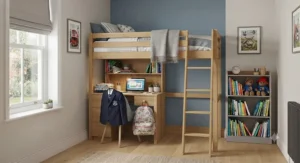
What most buyers overlook about this model is the freestanding desk, drawer chest and shelving unit — because none of it is fixed to the bed frame, you can genuinely rearrange the whole set-up as the room evolves, rather than being locked into whatever configuration the bed shipped in. The frame itself measures 115cm high by 120cm wide by 203cm deep and takes a standard UK single mattress, and it’s available in a small range of colourways rather than just white.
The three-drawer chest and shelving unit tuck neatly beneath, and because they’re not integral to the structure, parents report repositioning the desk to sit under a window for better natural light — something fixed-desk cabin beds simply don’t allow. This is the kind of practical flexibility that a features list won’t spell out but matters enormously once you’re actually living with the furniture day to day.
Pros:
- ✅ Fully freestanding desk and storage can be rearranged anytime
- ✅ Available in more than one colour option
- ✅ Standard single mattress size keeps bedding costs down
Cons:
- ❌ Freestanding pieces can shift slightly if the floor isn’t level
- ❌ No integrated safety rail on the desk edge for younger children
In the £250–£350 range, the Julian Bowen Kimbo Cabin Bed suits parents who know their child’s room layout might change in a year or two and want furniture that can adapt with it.
3. Flair Charlie Mid Sleeper Staircase Storage Set with Desk — best staircase access for younger climbers
The standout advantage is right there in the name: a staircase instead of a ladder. For a child who isn’t yet confident on rungs, wide, deep steps make a genuine difference to how safely and independently they can get in and out of bed — several steps even double as pull-out storage drawers, so the access route earns its keep rather than just taking up floor space. The set includes a pull-out desk with shelving, a three-drawer chest and additional storage compartments, all finished in an easy-clean grey or white lacquer.
Here’s what the spec sheet won’t tell you but user reports suggest: staircase midsleepers take up noticeably more floor footprint than ladder equivalents, so this is a model worth measuring carefully for before ordering rather than assuming it’ll slot into the same space as a standard cabin bed. Aggregated review sentiment points to genuine praise for the staircase’s stability underfoot, alongside occasional comments about the flat-pack instructions requiring patience during the build.
Pros:
- ✅ Wide staircase access is safer than a ladder for younger children
- ✅ Some stairs double as pull-out storage drawers
- ✅ Easy-clean lacquered finish resists everyday scuffs
Cons:
- ❌ Larger overall footprint than ladder-access midsleepers
- ❌ Flat-pack build is more involved due to the staircase structure
Priced in the £400–£500 range, the Flair Charlie Mid Sleeper Staircase Storage Set with Desk is worth the premium if safe, confident access matters more to you than shaving every last centimetre off the room plan.
4. Julian Bowen Jupiter Midsleeper — best all-rounder for storage plus study
This model earns its “best all-rounder” tag through sheer breadth of function: a chest of drawers, generous shelving and a pull-out desk on wheels, available in white, grey oak or anthracite finishes to suit almost any bedroom scheme. The desk glides out on castors rather than fixed runners, which reviewers consistently flag as smoother in daily use than static pull-out designs, and the ladder includes glow-in-the-dark strips on the treads — a small but genuinely useful safety touch for middle-of-the-night trips to the bathroom.
Based on the spec comparison, the particleboard construction supports up to roughly 95kg, comfortably covering a child through to the early teenage years, and the overall footprint (196cm long by 135cm wide by 138cm high) is compact enough for most standard UK single bedrooms without dominating the room. What buyers overlook is the desk’s dual role as extra shelving when folded away — a detail that makes the Jupiter feel less like a “bed with a desk bolted on” and more like a genuinely integrated small-room furniture system.
Pros:
- ✅ Wheeled desk glides smoothly rather than sticking on runners
- ✅ Three finish options to match different bedroom styles
- ✅ Glow-in-the-dark ladder treads add a genuine safety benefit
Cons:
- ❌ Particleboard construction, not solid wood
- ❌ Assembly instructions can be dense for first-time flat-pack builders
At around £350–£450, the Julian Bowen Jupiter Midsleeper hits a sensible middle ground between the budget picks and the solid-pine premium options further down this list.
5. Noa & Nani Una Kids Cabin Bed with Drawers & Desk — best build quality for the price
The Una earns its place through material honesty: a blend of solid pine framing and MDF panelling rather than the hollow particleboard found in cheaper alternatives, which translates into a noticeably sturdier feel underfoot and on the ladder. The bed supports up to 70kg, and the desk — deep enough for a laptop plus a stack of textbooks — pulls out fully when needed and tucks away completely when it isn’t, instantly freeing up floor space for play.
Reviewers consistently report smooth-running drawer mechanisms and praise the storage cabinet for swallowing bulkier items like board games and spare bedding that would otherwise clutter the room. On the practical side, we’d recommend leaving at least 80cm of clearance in front of the desk area so a child can sit comfortably once it’s extended — a measurement worth checking against your own room plan before ordering, since the footprint (198cm by 102.5cm) doesn’t account for that pulled-out desk space.
Pros:
- ✅ Solid pine and MDF blend feels sturdier than particleboard rivals
- ✅ Desk and drawers both operate smoothly according to reviewers
- ✅ Generous storage cabinet handles bulky items well
Cons:
- ❌ Heavier packaging makes solo assembly impractical
- ❌ Needs extra clearance in front for the desk to extend fully
In the £450–£600 range, the Noa & Nani Una Kids Cabin Bed with Drawers & Desk is the pick for parents who’ve been burned before by furniture that looks fine in photos but flexes and creaks within a year.
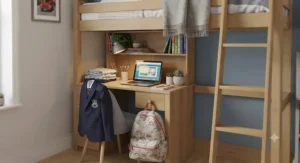
6. Noa & Nani Thomas High Sleeper with Louis Desk — best for maximising floor space
Once a child outgrows a midsleeper’s under-bed clearance, a high sleeper like the Thomas becomes the logical next step, and this is where the real floor-space transformation happens. Standing around 172cm tall with roughly 136.5cm of clearance beneath, it comfortably fits a full-size desk — the companion Louis Desk — plus room for a wardrobe or small sofa, something a midsleeper’s lower deck simply can’t accommodate.
What most buyers overlook about high sleepers generally is that the trade-off for all that extra under-bed real estate is a taller ladder climb, so it’s worth being honest about whether your child is genuinely ready for a higher sleeping platform before committing. On the plus side, the solid pine construction and robust ladder with cut-out handles give the structure a reassuringly sturdy feel, and the open-back, open-sided design avoids the slightly boxed-in look some high sleepers have.
Pros:
- ✅ Tall clearance fits a full desk plus wardrobe or seating below
- ✅ Solid pine build with a robust, easy-grip ladder
- ✅ Open design avoids a cramped, boxed-in feel underneath
Cons:
- ❌ Higher climb isn’t suitable for younger or less confident children
- ❌ Desk sold as a companion piece, adding to the total spend
Around £500–£650 depending on desk bundling, the Noa & Nani Thomas High Sleeper with Louis Desk rewards families with a genuinely small room where every centimetre of floor space has to work hard.
7. Noa & Nani Vortex Gaming Station High Sleeper with Desk — best for teen gamers wanting real desk space
The standout feature is the double-tier, full-width desk — at around 187cm long, it’s easily the largest work surface on this list, with an upper shelf for a monitor or speakers and enough depth below for a laptop, controllers, books and stationery without everything competing for space. Standing 180cm tall with roughly 136.5cm of clearance, this is squarely aimed at older children and teenagers transitioning from a “fun cabin bed” into a proper study-and-gaming set-up.
Here’s what the spec sheet won’t spell out: a desk this size genuinely changes how a teenager uses their room, turning what might otherwise be a cramped corner into a legitimate workstation for both homework and downtime. Reviewers highlight the sturdy build quality and the sense that this bed “grows up” with the child rather than needing replacing at fourteen or fifteen, which matters given the investment involved.
Pros:
- ✅ Largest desk surface of any model on this list
- ✅ Upper shelf adds space for a monitor or speakers
- ✅ Sturdy enough to suit teenagers, not just younger children
Cons:
- ❌ Highest price point of the seven featured beds
- ❌ Tall frame needs a room with generous ceiling height
At around £550–£700, the Noa & Nani Vortex Gaming Station High Sleeper with Desk is the premium pick for a teenager who genuinely needs a dedicated desk, not just a spot to dump a laptop.
Setting Up a Cabin Bed Desk Combination: A Practical Guide
Getting a cabin bed with desk from flat-pack boxes to a fully functioning bedroom fixture takes more planning than a standard bed frame, mainly because you’re assembling two pieces of furniture that need to align perfectly. Before the delivery even arrives, measure not just the bed’s footprint but the desk’s fully extended position too — it’s the single most common mistake buyers make, ordering a bed that fits the wall but then discovering the desk can’t pull all the way out without hitting a wardrobe door.
During the build itself, most manufacturers recommend assembling the main frame first with two people, since panels at height are awkward and occasionally heavy for one person alone. Leave the desk mechanism — whether it’s runners, wheels or a fixed shelf — until the frame is fully secured and levelled, because a slightly uneven frame will make a pull-out desk stick or run unevenly for the life of the furniture. Once built, a quick monthly check of bolts and fixings keeps everything solid; cabin beds see more daily stress than a standard frame, thanks to the ladder, the desk runners and, inevitably, some over-enthusiastic bouncing.
For the desk itself, positioning matters more than most parents expect. A desk facing a blank wall tends to encourage focus, while one facing a window can be either a blessing for natural light or a curse for distraction, depending on the child. Adding a proper desk lamp is worth the extra tenner — the built-in room light in most bedrooms sits too far from the desk surface to provide decent task lighting for close work like reading or drawing.
Real-World Scenarios: Matching the Bed to Your Child
The five-year-old starting school: For a child just beginning primary school, the priority is a low, simple, budget-friendly set-up they can grow into rather than a feature-packed premium model. The Noa & Nani Moro Cabin Bed Midsleeper with Pullout Desk suits this stage well — low clearance height, an easy-to-use pull-out desk for early drawing and reading practice, and a price point that doesn’t sting if tastes change dramatically within a couple of years.
The nine-year-old sharing a small box room: Where floor space is at an absolute premium and a child is confident enough for a staircase or ladder, a taller midsleeper like the Julian Bowen Jupiter Midsleeper makes sense — its wheeled desk and generous storage do double duty, replacing a separate chest of drawers entirely and freeing up enough floor for a rug and some play space.
The fourteen-year-old with GCSEs on the horizon: At this stage, desk size stops being a nice-to-have and becomes genuinely functional — laptops, textbooks, revision notes and, realistically, some gaming downtime all need room. The Noa & Nani Vortex Gaming Station High Sleeper with Desk or the Noa & Nani Thomas High Sleeper with Louis Desk both offer the floor-space transformation a high sleeper provides, paired with a desk substantial enough to double as a proper study station through to exams.
Common Homework-Time Problems, Solved
Problem: the desk gets buried under clutter within a week. This is less about the furniture and more about storage discipline — beds with dedicated shelving built into the desk unit, like the Noa & Nani Moro Cabin Bed Midsleeper with Pullout Desk, give clutter an obvious home, which genuinely helps younger children maintain the habit of clearing the surface each evening.
Problem: the desk chair won’t fit once the desk is pulled out. Check the clearance height under the bed before buying, not just the desk dimensions — models with lower under-bed clearance can leave barely enough room for a standard chair to slide in, forcing a child to perch on a stool instead.
Problem: not enough natural light at the desk. If the bed’s fixed position means the desk inevitably ends up facing a wall away from the window, a clip-on daylight-spectrum desk lamp solves most of the problem for under a tenner, and it’s a far cheaper fix than rearranging a room around furniture placement.
Problem: the child associates the desk area with sleep, not study. Because the desk sits so close to the bed, some children struggle to switch into “work mode.” Small visual cues — a different desk mat, a dedicated pen pot, a consistent tidy-up ritual before bed — help draw a mental line between the two zones even when they’re physically inches apart.
How to Choose a Cabin Bed With Desk: 6 Things to Check First
- Confirm the under-bed clearance height. Measure from floor to the underside of the bed frame, then subtract roughly 5–10cm for the mattress — this tells you honestly whether a desk chair will fit comfortably, not just whether the desk itself has room.
- Check the desk’s fully extended footprint, not just its stored size. A pull-out or wheeled desk needs clear floor space in front of it when in use — measure this against your actual room, including door swing and any nearby furniture.
- Match ladder or staircase style to your child’s age and confidence. Younger or less coordinated climbers genuinely benefit from wide staircase access over a narrow ladder, even though it costs more and takes up more floor space.
- Look at frame material honestly. Solid pine costs more but tends to hold up better to years of climbing and desk use than particleboard, which can start to flex or creak sooner.
- Verify the maximum mattress depth the guard rails allow. Every model specifies a maximum depth — buying a thicker mattress than recommended reduces the effective guard rail height and undermines the built-in safety margin.
- Think about desk size relative to actual use, not just age. A five-year-old needs space for drawing and reading; a teenager revising for exams needs room for a laptop, a monitor and open textbooks side by side — buy for the years ahead, not just right now.
- Factor in delivery and assembly realistically. Cabin beds with integrated desks are heavier and more complex to build than standard frames — check whether professional assembly is available if you’d rather not spend a Saturday with an Allen key.
Common Mistakes When Buying a Cabin Bed With Desk
The single most frequent mistake is measuring the bed’s static footprint and stopping there, forgetting that a pull-out or wheeled desk needs additional clear floor space to actually function. A bed that technically “fits” the room can still leave a child unable to sit at the desk without banging their knees on a wardrobe.
A second common misstep is buying purely on price without checking maximum weight ratings, particularly for high sleepers intended to last into the teenage years. What most buyers overlook here is that a bed rated for a younger child’s weight might need replacing far sooner than the frame’s overall build quality would otherwise suggest — checking the stated capacity against your child’s likely weight in three or four years’ time avoids an expensive repeat purchase.
Finally, plenty of parents underestimate how much the desk’s usability depends on lighting and chair choice, treating the desk itself as the whole solution. Reviewers consistently note that even a well-built desk goes unused if it’s poorly lit or paired with an uncomfortable chair — worth budgeting for both alongside the bed itself.
Cabin Bed With Desk vs Study Loft Beds: What’s the Real Difference?
On paper, “cabin bed” and “study loft bed” often describe overlapping products, but there’s a meaningful distinction worth understanding before you buy. A cabin bed typically sits at midsleeper height — around 100 to 120cm off the ground — leaving modest under-bed clearance for a desk, drawers or a play den. Study loft beds tend to be taller, closer to true high-sleeper height, prioritising maximum under-bed space specifically for a full desk setup, wardrobe or sofa, at the cost of a higher, more committing climb.
The practical upshot: a cabin bed suits younger children or smaller rooms where a taller frame would feel overwhelming, while a study loft bed genuinely comes into its own once a child needs proper desk real estate — a teenager balancing homework, a laptop and gaming, for instance — and is confident enough on a taller ladder to make the trade-off worthwhile.
| Factor | Cabin Bed (Midsleeper) | Study Loft Bed (High Sleeper) |
|---|---|---|
| Typical height | 100–120cm | 150–180cm |
| Under-bed clearance | 70–80cm | 130–140cm |
| Best suited to | Ages 5–10 | Ages 10+ |
| Desk size potential | Small to medium | Medium to large |
| Climb difficulty | Lower, easier | Higher, needs confidence |
The table makes the age-based logic fairly explicit: as under-bed clearance roughly doubles moving from a cabin bed to a study loft bed, so does the realistic desk size you can fit beneath it. If your child is still several years from secondary school, the lower climb of a genuine cabin bed like the Julian Bowen Kimbo Cabin Bed is usually the safer, more comfortable starting point, with a move to something like the Noa & Nani Thomas High Sleeper with Louis Desk worth revisiting once they’re older.

Homework Station Beds: What to Expect in Real-World Use
Specs on a listing page rarely translate directly into how a homework station bed actually feels to use day to day, so it’s worth setting realistic expectations. A pull-out desk, however well-built, typically has a slightly smaller working surface than a standalone desk of the same footprint, simply because it needs to slide cleanly in and out without catching on the bed frame. In practice, most children adapt to this within a week or two, particularly if the desk includes shelving to keep clutter off the working surface itself.
Noise and stability are the other factors that rarely appear on a spec sheet. Wheeled desks, like the one on the Julian Bowen Jupiter Midsleeper, tend to glide more quietly than fixed-runner alternatives, which matters more than it sounds if the bedroom is near a living room or another sibling’s room. Reviewers also flag that desks positioned directly beneath the sleeping platform can feel slightly enclosed compared to a freestanding desk elsewhere in the room — not a dealbreaker for most children, but worth knowing if your child is prone to feeling boxed in.
Integrated Desk Beds: Features That Actually Matter (And Those That Don’t)
Not every feature marketed on an integrated desk bed listing genuinely affects day-to-day usability, so it’s worth separating the substance from the sales copy. Genuinely matters: desk depth (anything under 40cm struggles to hold an open laptop plus a notebook comfortably), guard rail height on high sleepers, ladder rung spacing and grip, and whether the desk mechanism runs on metal runners or plastic — metal tends to outlast plastic considerably under daily use.
Matters less than it sounds: themed graphics and colour schemes, which children often outgrow within a year or two regardless of how exciting they seemed at purchase; the exact number of drawers, since most families end up using under-bed boxes for overflow storage anyway; and glow-in-the-dark ladder strips, which are a nice touch but not the safety feature some listings imply — supervision and proper rail height do far more heavy lifting for actual safety. What most buyers overlook is that frame material and desk mechanism quality matter more for long-term satisfaction than almost any cosmetic feature on the spec list.
Space-Saving Study Furniture for Every Bedroom Shape
Children’s workspace beds aren’t one-size-fits-all, and the right choice depends heavily on your room’s actual proportions, not just its square footage. In a narrow, elongated room, a bed positioned along the longest wall with the desk facing into the room — rather than tucked into a corner — usually leaves the most usable floor space for movement. In a smaller, more square room, positioning the bed in a corner and letting the desk run along an adjacent wall often works better, since it avoids the desk jutting awkwardly into the room’s centre.
For families in flats or houses with genuinely tight single bedrooms — recall the 6.5 square metre space standard mentioned earlier — a compact midsleeper like the Noa & Nani Moro Cabin Bed Midsleeper with Pullout Desk is often the only realistic option that leaves room to actually walk around. In larger rooms with more generous floor area, a taller study loft bed frees up enough space to add a reading nook, a wardrobe, or simply somewhere to sprawl out and relax that isn’t the desk or the bed itself.
✨ Don’t Miss These Exclusive Deals!
🔍 Take your child’s bedroom to the next level with these carefully selected picks. Click on any highlighted item to check current pricing and availability. These space-saving finds will help you create a genuinely functional bedroom your family will love!
Safety, Regulations & Compliance Guide
Any bunk or cabin bed sold in the UK must meet BS EN 747-1:2024, the current British Standard covering structural strength, guard rail height, entrapment gaps and ladder safety — and separately, the Bunk Beds (Entrapment Hazards) (Safety) Regulations 1987 legally prohibit the sale of any bed with structural gaps that could trap a young child’s head or limbs. In practice, this means guard rails on elevated sleeping platforms must sit meaningfully above the mattress surface, and gaps in the frame must fall either well under 60mm or over 75mm — the banned range in between is specifically where entrapment risk sits highest.
Age guidance matters just as much as the bed’s own certification. Children under six generally shouldn’t sleep on an elevated platform at all, regardless of guard rail quality, since balance, coordination and night-time awareness typically aren’t developed enough to manage a ladder safely in the dark. For cabin beds and midsleepers specifically — lower than a true bunk bed but still elevated — most manufacturers and safety bodies apply similar caution around the six-year mark, though every child develops differently and parents know their own child’s confidence best.
Beyond the bed itself, a few habits matter: check bolts and fixings every few months, since daily climbing and desk use loosens fixings faster than a standard bed frame experiences; never allow rough play on the ladder or desk mechanism; and ensure at least two feet of clearance between the top of a high sleeper mattress and the ceiling so a child can sit up comfortably without banging their head.
Long-Term Cost & Maintenance: What You’re Really Paying For
A cabin bed with desk isn’t just a bed — it’s replacing at least two, and sometimes three, separate pieces of furniture a child’s bedroom would otherwise need. Framed that way, even the premium end of this list compares favourably against buying a bed, a desk and a chest of drawers separately, particularly once you factor in the floor space saved, which in a small UK bedroom is arguably the scarcest resource of all.
| Price Tier | Example Model | What You Get | Realistic Lifespan |
|---|---|---|---|
| Budget (£200–£350) | Noa & Nani Moro Cabin Bed Midsleeper with Pullout Desk | Bed, desk, basic shelving | 3–5 years |
| Mid-range (£350–£500) | Julian Bowen Jupiter Midsleeper | Bed, wheeled desk, storage, shelving | 5–7 years |
| Premium (£500–£700) | Noa & Nani Vortex Gaming Station High Sleeper with Desk | Bed, large desk, upper shelving | 7+ years, into teens |
The pattern here is fairly clear: budget models tend to suit a specific age bracket and get outgrown functionally (if not structurally) within a few years, while premium solid-pine and reinforced models are built to genuinely carry a child from early primary school through to their GCSE years without needing replacement. Whether that longer lifespan justifies the higher upfront cost really depends on how many years of use you’re realistically planning for — a bed bought for a five-year-old has a very different cost-per-year calculation to one bought for a nine-year-old already halfway through primary school.
Maintenance costs stay low across the board — an Allen key, the occasional replacement bolt, and a yearly check of the mattress for wear are about the extent of it — but it’s worth budgeting for a mattress that matches the bed’s specific maximum depth requirement, since an oversized mattress on any of these frames reduces the effective guard rail height and isn’t something manufacturer warranties typically cover if it leads to an issue.
Frequently Asked Questions
❓ What age is a cabin bed with desk suitable for?
❓ Do cabin beds with desks come with a mattress included?
❓ How much weight can a cabin bed desk hold?
❓ Can adults use a cabin bed with desk?
❓ Is a cabin bed with desk better than a bunk bed for one child?
Conclusion
Choosing the right cabin bed with desk really comes down to three honest questions: how old is your child now, and how many years do you want this bed to last; how much floor space can your room genuinely spare, including the desk’s fully extended footprint; and how much are you willing to spend upfront to buy either extra years of use or extra desk space today. For a first proper bedroom on a budget, the Noa & Nani Moro Cabin Bed Midsleeper with Pullout Desk does the essentials well without overspending. For families wanting genuine flexibility as a room evolves, the Julian Bowen Kimbo Cabin Bed‘s freestanding desk and storage stand out. And for teenagers who need a proper workstation rather than a token desk, the Noa & Nani Vortex Gaming Station High Sleeper with Desk earns its premium price tag through sheer desk real estate.
Whichever you choose, remember that good sleep and a good study space go hand in hand — the NHS’s guidance on healthy sleep habits for children is worth a read alongside any furniture decision, since even the best desk in the world won’t help much if bedtime routines around it aren’t working too. None of the seven beds above is a wrong choice exactly — they’re simply built for slightly different ages, rooms and budgets, and the comparison tables above should make it straightforward to match one to your own family’s actual circumstances rather than guessing from a listing photo alone.
Recommended for You
- Metal vs Wooden Bunk Beds: 7 Best Picks Compared for 2026
- Bunk Bed With Storage Reviews 2026: 7 Best Space-Saving Picks
- Safe Bunk Beds for Toddlers: 7 Low-Height Picks for 2026
Disclaimer: This article contains affiliate links. As an Amazon Associate, I earn from qualifying purchases. If you purchase products through these links, we may earn a small commission at no additional cost to you.
✨ Found this helpful? Share it with your friends! 💬🤗
