
In This Article
Cabin bed vs mid sleeper — which wins for your child’s room? Real UK products, honest pros and cons, and buying advice. Read before you order
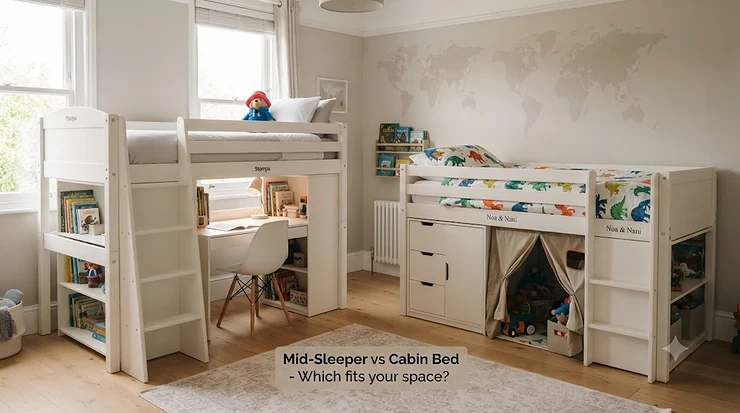
Somewhere between a normal single bed and a full-blown high sleeper sits a category of furniture that causes more parental head-scratching than almost anything else in the children’s furniture aisle: the cabin bed vs mid sleeper decision. A cabin bed is, in plain terms, a single bed raised just enough off the floor to slot in a desk, drawers or a bookcase underneath, while a mid sleeper climbs a bit higher on a ladder or staircase and hands your child a proper den, play space or storage zone beneath the mattress. The two terms get used almost interchangeably by UK retailers, which is exactly why so many parents end up ordering the wrong one.
Here’s the thing nobody tells you before you start scrolling amazon.co.uk at 11pm: the “right” answer depends less on which bed looks nicest in the product photo and more on your child’s age, your ceiling height, and what you actually need to store underneath. A five-year-old who still needs a bedtime story read at eye level has very different requirements from a ten-year-old who wants a homework desk and somewhere to hide their (extensive) Lego collection. Get the height wrong and you’ll either be climbing a ladder to tuck in a toddler or watching a teenager’s knees hit the underside of the frame within a year.
This guide breaks down the real, practical differences using seven actual products currently sold in the UK — not vague marketing copy, but genuine dimensions, weight ratings, and aggregated review sentiment. We’ll cover height differences, storage capacity, age-appropriate choices, and exactly which children’s bed types compared here are likely to suit a small terraced bedroom versus a more generous box room. By the end, you should know not just what a cabin bed and a mid sleeper are, but which elevated bed option genuinely fits your family.
Quick Comparison Table: Cabin Bed vs Mid Sleeper at a Glance
| Feature | Cabin Bed | Mid Sleeper |
|---|---|---|
| Typical height off floor | Roughly 60–90cm | Roughly 100–140cm |
| Ladder or steps | Rarely needed | Almost always included |
| Recommended minimum age | 4+ (some suitable earlier) | 6+ (per most UK retailers) |
| Underbed storage style | Built-in drawers, desk, bookcase | Open den, play tent, or freestanding storage |
| Typical price range | Around £160–£300 | Around £200–£650 |
A cabin bed sacrifices some of the “wow factor” of a raised sleeping platform in exchange for a lower centre of gravity and simpler bedtime routines, which matters enormously if your child still needs help getting in and out at night. A mid sleeper, by contrast, trades a small amount of extra climbing effort for genuinely more usable floor space underneath — often enough for a proper reading nook, a desk and a chair, or a stash of storage boxes that would otherwise clutter the room. Neither is objectively “better”; they’re solving slightly different problems, and the table above only tells half the story, which is why the product-by-product breakdown below matters more than any single spec sheet.
💬 Just one click — help others make better buying decisions too!😊
Top 7 Cabin Beds and Mid Sleepers: Expert Analysis
We’ve deliberately spread this list across budget, mid-range and premium options, plus a scattering of themed and workstation variants, so there’s a genuine like-for-like choice whatever your ceiling height or bank balance looks like.
1. Kidsaw Pilot Cabin Bed — the lowest-to-the-floor all-rounder
The Kidsaw Pilot Cabin Bed sits at just 80cm high, which instantly puts it at the low end of anything you’d realistically call a cabin bed vs mid sleeper comparison. Measuring H.80 x W.137 x D.195cm and built to take a standard UK single mattress (90 x 190cm), it packs a fitted desk and bookcase directly into the frame rather than leaving an open void underneath.
What most buyers overlook about this model is that the desk and bookcase are fixed in position — you can’t rearrange them to suit a different wall layout, so it’s worth measuring your room before you order rather than after. Based on the spec comparison with taller mid sleepers on this list, the trade-off is obvious: less “cave” space to play in, but a child of almost any age can climb in without a ladder, which makes it a genuinely sensible pick for the 4–6 age bracket where confidence on steps is still developing. Reviewers consistently report that the wipe-clean finish holds up well to daily scuffs, though a handful of buyers flagged missing fixings on delivery, which points more to quality-control variance than a design flaw.
Pros:
- ✅ Lowest height in this list — no ladder confidence required
- ✅ Built-in desk and bookcase in one compact footprint
- ✅ Durable wipe-clean finish suited to daily wear
Cons:
- ❌ Desk and bookcase positions are fixed, not reconfigurable
- ❌ Some buyers report missing or incomplete fixings on delivery
At around £180–£230 depending on the Elm, White or Grey finish, the Kidsaw Pilot Cabin Bed represents solid value for anyone prioritising safety over storage volume — it just won’t satisfy a child who’s already dreaming of a proper under-bed den.

2. STRICTLY BEDS&BUNKS Avalon Midi Sleeper — built like a tank, rated for adults too
Manufactured in England from solid Scandinavian pine, the STRICTLY BEDS&BUNKS Avalon Midi Sleeper stands out on this list for one number: its base is tested to hold 108kg (17 stone), which is unusually high for a children’s bed and means it comfortably outlasts a growing teenager or even doubles as an occasional adult guest bed. Dimensions come in at W98 x L202 x H123cm with 77cm of clearance underneath, and the ladder can be fitted to either side depending on your room layout.
Here’s what the spec sheet won’t tell you, but reviewer sentiment does: build quality consistently earns praise — “sturdy,” “solid pine,” and “excellent value” are recurring phrases — but the printed assembly instructions are a frequent source of frustration, with several reviewers noting photographs stood in for proper diagrams. That’s a real practical consideration if you’re not confident with flat-pack furniture, though most reviewers still managed it solo within a few hours. For families who want genuine longevity from a mid sleeper without paying premium prices, this is arguably the best value-for-weight-rating bed in this entire roundup.
Pros:
- ✅ Weight-tested to 108kg — genuinely built for the long term
- ✅ Solid Scandinavian pine, not particleboard
- ✅ Ladder fits either side to suit your room
Cons:
- ❌ Assembly instructions criticised as unclear in reviews
- ❌ 77cm underbed clearance is modest for larger storage furniture
Priced roughly in the £160–£290 range depending on whether you bundle a mattress, the Avalon earns its place as the pragmatic, no-nonsense mid sleeper on this list.
3. Noa & Nani Cabin Bed Mid Sleeper with Fairy Tent — best themed pick for younger dreamers
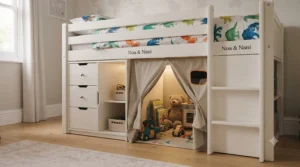
If your child is firmly in the “everything must be magical” phase, the Noa & Nani Cabin Bed Mid Sleeper with Fairy Tent, Tower and Tunnel turns the underbed space into an actual playhouse rather than just storage. At L202 x W101 x H114cm with roughly 74cm of clearance beneath, it sits comfortably in the mid-height bracket, built from solid pine wood with a reversible ladder position.
What most buyers overlook about themed beds like this one is that the play value is genuinely front-loaded — a five-year-old will get enormous use out of the tent and tunnel today, but by nine or ten, most children have outgrown fairy-castle theming entirely, so it’s worth weighing the shorter practical lifespan against the immediate imaginative payoff. Aggregated review sentiment for this range sits around 4.4 out of 5 across roughly 270 verified ratings, with parents consistently praising the “hideaway” appeal for keeping kids occupied on rainy afternoons. The main functional caveat: some accessories, including the bed pocket organiser, are sold as separate add-ons rather than bundled as standard.
Pros:
- ✅ Fairy tent, tower and tunnel create genuine underbed play value
- ✅ Solid pine frame with flexible ladder positioning
- ✅ Strong aggregated review rating (around 4.4/5)
Cons:
- ❌ Themed styling has a shorter “cool” lifespan than neutral designs
- ❌ Some accessories, like the bed pocket, are sold separately
Expect to pay somewhere in the £220–£260 range, making it a strong contender if you’re choosing primarily for a child aged roughly 4 to 7.
4. Julian Bowen Pluto Midsleeper — cosy den styling on a modest budget
The Julian Bowen Pluto Midsleeper measures 196L x 104W x 121H cm, finished in a sleek dove grey using solid pine and MDF construction, and it’s one of the more understated designs here — no cartoon graphics, just clean lines that won’t look dated in three years. Julian Bowen offers an optional pink or blue play tent add-on for younger children who still want a “hideout,” which means this bed can straddle both the playful-toddler phase and the more grown-up primary-school years without needing to be replaced.
Based on the spec comparison with the Kidsaw Pilot and Avalon, the Pluto sits in the middle of the pack on both height and footprint — tall enough to create a genuine underbed zone, but not so tall that a nervous six-year-old will hesitate on the ladder. What the marketing won’t spell out, but is worth noting: at 104cm wide, the underbed clearance is narrower than several rivals on this list, which limits how much freestanding furniture you can realistically fit beneath it. Reviewers consistently note the sturdy guardrails and secure ladder as reassuring safety features, particularly for parents nervous about a first raised bed.
Pros:
- ✅ Neutral dove grey finish that ages well with the child
- ✅ Optional play tent add-on bridges toddler and primary years
- ✅ Solid pine and MDF construction meets UK safety standards
Cons:
- ❌ Narrower 104cm underbed width limits larger storage options
- ❌ Play tent is an optional extra, not included as standard
At roughly £230–£300, the Pluto works well as a “grows with them” choice for parents who don’t want to commit to an overtly themed design.
5. Julian Bowen Jupiter Midsleeper — the all-round mid-range workhorse
Stepping up in both size and specification, the Julian Bowen Jupiter Midsleeper measures 196L x 135W x 138H cm and weighs a substantial 126.5kg, reflecting genuinely robust particleboard construction rather than a lightweight budget frame. It comes with an integrated chest of drawers, multiple shelves, and a pull-out desk on wheels, available in White, Grey Oak or Anthracite finishes — and the ladder features glow-in-the-dark strips on the treads, a small but genuinely useful safety touch for middle-of-the-night bathroom trips.
Here’s what most spec sheets skip: the Jupiter’s base supports up to 95.2kg, which comfortably covers most children through to the teenage years, and the drawers-plus-desk-plus-shelving combination means you can realistically retire a separate wardrobe of drawers from the room entirely, freeing up floor space that a simple cabin bed wouldn’t. On paper, this makes the Jupiter one of the strongest storage-capacity comparison performers on this list — you’re essentially buying a bed, a desk, and a chest of drawers in a single delivery. The trade-off is weight and footprint: at 126.5kg, repositioning this bed once assembled is a genuine two-person job, and the wider 135cm frame needs a slightly more generous bedroom to avoid feeling cramped.
Pros:
- ✅ Integrated drawers, shelves and pull-out desk in one unit
- ✅ Glow-in-the-dark ladder strips for night-time safety
- ✅ Three colourways to suit most bedroom schemes
Cons:
- ❌ Heavy 126.5kg build makes repositioning difficult once assembled
- ❌ Wider 135cm footprint needs a more generous bedroom
Prices for the Jupiter typically sit in the £400–£650 range depending on retailer and colour, positioning it firmly as a mid-to-premium investment rather than a budget pick.
6. Flair Wizard Junior Mid High Sleeper — best for growing storage needs
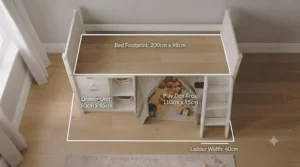
The Flair Wizard Junior Mid High Sleeper occupies an interesting middle ground between a standard mid sleeper and a full high sleeper, with shelving that wraps around both the sleeping area and the space underneath — enough, according to the manufacturer, to comfortably fit a chair, a small television or a computer setup beneath the mattress. A workstation variant adds a wheeled pull-out desk that tucks away when not needed, and the frame is rated to a maximum weight of 120kg.
What the product photos won’t show you is how the wide ladder steps and reinforced handles genuinely change the climbing experience for a nervous child — reviewers on independent retailer sites describe the ladder as “thoughtfully designed” and note that the shelving units double as a natural barrier that discourages toys tumbling off the top bunk edge. Based on the spec comparison with the lower-profile beds on this list, the trade-off here is ceiling height: because this sits closer to true “high sleeper” territory than a traditional mid sleeper, you’ll want to double-check your room’s ceiling clearance before ordering, particularly in older UK homes with lower-than-standard ceilings. The particleboard construction, while smooth and easy to keep clean, is a step down in raw material quality from the solid pine options earlier in this list.
Pros:
- ✅ Extensive shelving wraps around sleeping area and underneath
- ✅ Optional wheeled workstation desk for homework or gaming
- ✅ Sturdy frame rated to 120kg maximum weight
Cons:
- ❌ Particleboard construction less premium than solid pine rivals
- ❌ Taller frame requires generous ceiling clearance
Pricing runs from roughly £300 for the standard frame up to around £460 for the full workstation bundle, making it a genuinely flexible mid-to-premium pick.
7. happybeds Pegasus High Sleeper Storage Bed — the wardrobe-desk-bed hybrid for teens
Rounding out this list at the premium end, the happybeds Pegasus High Sleeper Storage Bed measures H178 x L196.5 x W96cm (119cm including the ladder), making it noticeably taller than every other bed on this list and firmly into high-sleeper territory. What justifies the height is the sheer storage density: five hidden step cupboards, four drawers, three shelves, a full-size desk, and a pull-out wardrobe, all built into a single frame designed for children aged six and up through the teenage years.
Reviewers consistently describe the buying and delivery process positively, and the slatted base supports a genuine range of mattress types rather than restricting you to one specific profile. On paper, this is the single best storage capacity comparison performer in this roundup — for a family in a small flat or box room where a separate wardrobe simply isn’t feasible, replacing three pieces of furniture with one delivery is a legitimate space-saving win. What the marketing understandably downplays: at 178cm tall, this needs a proper ceiling height check, and being the heaviest, most component-dense bed here, it’s also the most involved self-assembly job on this list — budget several hours and, ideally, a second pair of hands.
Pros:
- ✅ Pull-out wardrobe plus 10+ storage units in a single frame
- ✅ Slatted base supports a wide range of mattress types
- ✅ Built-in desk doubles as a study or gaming zone
Cons:
- ❌ Tallest bed on this list — needs generous ceiling clearance
- ❌ Most involved assembly, best tackled with two people
With prices ranging from around £430 for the frame alone up to roughly £780 for bundles including an orthopaedic mattress, the Pegasus is squarely aimed at parents replacing multiple pieces of furniture at once rather than shopping on a tight budget.
Top 7 Products: Full Specification Comparison
| Product | Height | Underbed Clearance | Best For |
|---|---|---|---|
| Kidsaw Pilot Cabin Bed | ~80cm | Built-in desk/bookcase | Ages 4–6, ground-level access |
| STRICTLY BEDS&BUNKS Avalon | ~123cm | ~77cm | Longevity, heavy-duty use |
| Noa & Nani Fairy Tent Cabin Bed | ~114cm | ~74cm | Ages 4–7, imaginative play |
| Julian Bowen Pluto Midsleeper | ~121cm | Moderate (104cm width) | Neutral styling, growing with child |
| Julian Bowen Jupiter Midsleeper | ~138cm | Generous (135cm width) | Storage-hungry families |
| Flair Wizard Junior Mid High Sleeper | Mid-to-high | Fits chair/desk/TV | Homework and gaming zones |
| happybeds Pegasus High Sleeper | ~178cm | Wardrobe + desk + drawers | Teens replacing multiple furniture pieces |
Looking at the table above, there’s a clear correlation between height and storage capacity: the Kidsaw Pilot trades almost all vertical clearance for safety and simplicity, while the happybeds Pegasus goes in the opposite direction entirely, using its 178cm frame to replace a wardrobe, desk and chest of drawers in one purchase. The three Julian Bowen and Flair options in the middle represent the genuine “mid sleeper” sweet spot most UK parents are actually searching for — enough height to create usable underbed space, without tipping into the ceiling-clearance concerns that come with a true high sleeper.
✨ Ready to Compare Prices?
🔍 Take the guesswork out of your child’s next bed. Click through on any of the beds above to check current availability and pricing on amazon.co.uk — these are genuinely space-saving picks your whole family will appreciate for years to come!
Practical Usage Guide: Setting Up, Maintaining and Getting the Most From Your Bed
Getting a cabin bed or mid sleeper into a bedroom is only step one — how you set it up in the first 30 days genuinely affects how long it lasts and how safely your child uses it. Start by double-checking the safety label fixed to the frame before you do anything else: every UK-compliant bed carries a sticker specifying the maximum mattress depth, and using anything thicker effectively cancels out the guardrail height, creating a real rolling-out risk. Most mid sleepers cap mattress depth at around 15–18cm, so resist the temptation to buy a plush, extra-deep mattress “for comfort” — it isn’t compatible with the safety design.
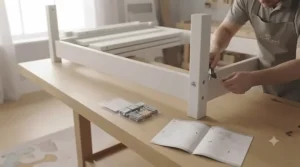
Once assembled, the single most common first-month mistake is under-tightening fixings and never checking them again. Wood settles slightly as it’s used, particularly with solid pine frames like the Avalon or Pluto, so a five-minute monthly check of every screw and bolt is genuinely worth the effort — reviewers across nearly every product in this roundup mention occasional wobble that a quick re-tightening resolves. For beds with a ladder rather than steps, teach your child from day one to always face the ladder while climbing and descending, never to jump from the top bunk, and never to use the guardrail as a climbing aid.
Changing sheets on a raised bed takes some practice for adults too. The easiest method with most mid sleepers is to climb the ladder yourself for the far corners and reach across from the floor for the near side — or, once they’re old enough, let your child help, since they can usually reach corners you can’t. If you’ve opted for a storage-heavy option like the happybeds Pegasus or Julian Bowen Jupiter, resist overloading every drawer and shelf immediately; distributing weight evenly across the storage units, rather than concentrating heavy items in one drawer, reduces long-term strain on runners and hinges.
Real-World Scenarios: Matching the Bed to Your Child
Scenario one: the box-room five-year-old. Picture a small terraced house, a child’s room barely large enough for a wardrobe and a bed, and a five-year-old who’s just moved out of a cot bed. Here, the Kidsaw Pilot Cabin Bed genuinely earns its low-to-the-ground design — no ladder confidence required, and the built-in desk means there’s no need to squeeze in a second piece of furniture. For a family in this exact situation, sacrificing underbed play space for peace of mind at bedtime is almost always the right trade-off.
Scenario two: the imaginative seven-year-old sharing a room with a younger sibling. When two children share a bedroom, floor space for actual play becomes precious, and a themed option like the Noa & Nani Fairy Tent Mid Sleeper turns the “dead” area under the bed into a legitimate second play zone, letting the younger sibling have somewhere to build and imagine without commandeering the whole room. The trade-off, as covered earlier, is that this styling won’t last much past age eight or nine — worth factoring into your budget if you’re not planning to replace the bed again soon.
Scenario three: the eleven-year-old juggling homework and a growing wardrobe. For an older child who genuinely needs a desk, storage for clothes, and somewhere private to do homework away from a shared living room, either the Julian Bowen Jupiter or the happybeds Pegasus makes more sense than a simple cabin bed. The Jupiter suits a family wanting drawers and a desk without going all the way to high-sleeper height; the Pegasus suits a family actively trying to remove a separate wardrobe from a cramped bedroom altogether.
Cabin Bed vs Mid Sleeper: Which One Is Actually Better?
There’s no single answer to whether a cabin bed or mid sleeper is better — it genuinely depends on what problem you’re trying to solve, and treating this as a straightforward upgrade path (cabin bed now, mid sleeper later) is often a more sensible framing than picking one “winner.” A cabin bed wins decisively on accessibility: with heights typically in the 60–90cm range, there’s minimal risk of falls, no ladder to master, and a parent can still lean over comfortably to say goodnight. That accessibility comes at the direct cost of storage volume — even the most cleverly designed cabin bed, like the Kidsaw Pilot, can only fit so much into a frame that’s deliberately kept low.
A mid sleeper wins on functional floor space. Once a bed climbs past the 110–140cm range, as with the Avalon, Pluto, Jupiter or Flair Wizard on this list, there’s genuinely enough clearance underneath for a desk and chair, a decent-sized storage unit, or a proper play den — something a cabin bed’s shallow underbed gap simply can’t match. The honest trade-off is the ladder itself: UK retailers broadly recommend mid sleepers for children aged six and above, since younger children may lack the coordination and confidence to climb safely, particularly during a half-asleep middle-of-the-night bathroom trip. If your child is younger than six, or if bedtime routines already involve some anxiety, a cabin bed is very likely the better starting point regardless of how much underbed storage you’re tempted by.
Children’s Bed Types Compared: Cabin, Mid, High Sleeper and Bunk
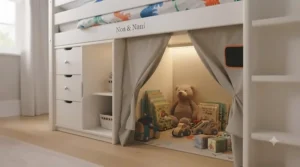
It’s worth zooming out from cabin bed vs mid sleeper specifically, because UK retailers use a genuinely confusing overlapping vocabulary, and understanding where each type sits relative to the others makes the buying decision much clearer. A standard single bed sits at the baseline — no elevation, no underbed storage beyond what you add separately. A cabin bed raises that baseline just enough (roughly 60–90cm) to slot in built-in storage or a desk without needing a ladder. A mid sleeper climbs higher again (roughly 100–140cm), almost always with a ladder or short staircase, creating a genuine underbed zone for storage, play or study.
Above that sits the high sleeper, typically 150–200cm off the ground, essentially the top half of a bunk bed without the lower bunk — the happybeds Pegasus on this list, at 178cm, technically straddles the line between a tall mid sleeper and a true high sleeper. Finally, a bunk bed simply stacks two full single beds, prioritising two sleeping spaces over underbed storage entirely. The practical takeaway: as you move up this hierarchy, you trade accessibility and lower age-suitability for increasing amounts of usable floor space — which is exactly why matching the type to your child’s age and confidence matters more than chasing the tallest, most storage-dense option on the shelf.
Elevated Bed Options: How High Is Too High?
“How high is too high” is genuinely one of the most common questions UK parents ask before buying, and the honest answer depends on three factors: your child’s age, your ceiling height, and how the bed will actually be used day to day. As a rule of thumb, most UK retailers position cabin beds as suitable from around age four, mid sleepers from age six, and high sleepers similarly from six upwards but with a stronger recommendation to wait until a child is confident and coordinated on a ladder. According to NHS-aligned children’s sleep guidance, consistent, low-anxiety bedtime routines matter significantly for sleep quality at every age — and a bed that feels genuinely intimidating to climb into at night can quietly undermine that routine even if the child never says so directly.
Ceiling height is the practical constraint people forget until delivery day. A bed like the happybeds Pegasus, at 178cm to the top of the frame, needs enough clearance above the mattress for a child to sit up comfortably without their head brushing the ceiling — generally, aim for at least 90–100cm of clear space above the top of the mattress once the bed is assembled. Measure before you order, not after; return costs on flat-packed bedroom furniture can be substantial given the size and weight of the boxes involved.
Height Differences Between Beds and Why They Matter
The centimetres genuinely matter more than most marketing copy suggests. On this list alone, heights range from roughly 80cm (the Kidsaw Pilot) up to 178cm (the happybeds Pegasus) — a difference of nearly a full metre, which fundamentally changes how the bed behaves in daily use, not just how it looks. At the lower end, a fall from a cabin bed is broadly comparable to falling out of a standard single bed; at the upper end, a fall from a high sleeper is a genuinely different order of risk, which is precisely why UK safety standard BS EN 747-1:2024 — the current British Standard governing bunk beds and high beds — mandates specific guardrail heights and structural requirements that scale with elevation. You can review the technical detail of that standard via FIRA’s summary of the revised bunk bed standard
Height also directly dictates practical daily tasks that are easy to underestimate before you buy. Changing bedding on an 80cm cabin bed takes seconds; on a 178cm high sleeper, it’s a genuine two-handed operation involving either climbing the ladder yourself or teaching your child to help with the far corners. Similarly, a lower bed lets a parent comfort a child having a bad night without needing to climb anything, while a taller bed puts a small but real barrier between parent and child at 2am — worth factoring in honestly rather than purely optimising for storage capacity.
Storage Capacity Comparison: Drawers, Desks, Shelves and Wardrobes
Storage capacity is where the products in this roundup diverge most dramatically, and it’s worth being specific rather than relying on vague “plenty of storage” marketing language. At the minimal end, the Kidsaw Pilot offers a fixed desk and bookcase built directly into the frame — useful, but not expandable. The STRICTLY BEDS&BUNKS Avalon and Noa & Nani cabin/mid sleeper both leave an open underbed void rather than built-in units, which is actually a strength for families who want to add their own storage boxes, a specific wardrobe, or simply a play area rather than being locked into a manufacturer’s fixed configuration.
At the higher end, the Julian Bowen Jupiter integrates a chest of drawers, multiple shelves and a pull-out desk directly into the frame, while the happybeds Pegasus goes further still with five hidden step cupboards, four drawers, three shelves, a full desk and a pull-out wardrobe — genuinely enough to replace several separate pieces of bedroom furniture. The trade-off, as covered in the individual product reviews above, is that fixed built-in storage can’t be reconfigured later, whereas an open-plan mid sleeper like the Avalon lets you swap in different storage solutions as your child’s needs change from toy boxes at six to a proper desk at eleven.
Age-Appropriate Bed Choices By Stage of Childhood
Matching bed type to developmental stage is arguably the single most important decision in this entire buying process, more important than colour, theme, or even budget. For children aged roughly four to six, a low cabin bed like the Kidsaw Pilot or a genuinely short-ladder mid sleeper like the Noa & Nani Fairy Tent design is the safer starting point — UK retailers broadly align on six as the recommended minimum age for a standard ladder-accessed mid sleeper, precisely because coordination and spatial awareness are still developing at younger ages.
From around age seven to ten, most children have the confidence and physical coordination to manage a standard mid sleeper ladder comfortably, making options like the Julian Bowen Pluto or Jupiter genuinely appropriate — this is also the age range where a dedicated homework desk starts becoming a practical necessity rather than a nice-to-have. From roughly eleven upwards, storage-dense options like the Flair Wizard Junior or happybeds Pegasus start making more sense, since older children and early teenagers have larger wardrobes, more school equipment, and a genuine need for private study space — while also being physically capable of handling the taller, heavier-duty ladders these beds require.
Common Mistakes When Buying a Cabin Bed or Mid Sleeper
The single most common mistake, based on recurring themes across product reviews, is skipping the mattress depth check. Every cabin bed and mid sleeper specifies a maximum safe mattress height — typically 15–18cm — and buying a thicker “premium comfort” mattress because it looks nicer online effectively defeats the guardrail’s purpose, regardless of how sturdy the rest of the frame is. A second frequent error is measuring only the bed’s footprint and ignoring ladder swing and door clearance; several beds in this roundup, including the Avalon and Pegasus, extend ladder length by 30cm or more beyond the core frame dimensions, which can eat into walkway space in a small room.
A third mistake worth flagging honestly: underestimating assembly time and manpower. Reviewers across nearly every product on this list — particularly the heavier, storage-dense options like the Jupiter and Pegasus — recommend budgeting several hours and, ideally, a second pair of hands, rather than assuming a single afternoon will comfortably cover it. Finally, many parents buy purely on theme or colour without checking the recommended age range, which risks either an anxious child on a bed that’s too tall for their confidence, or an older child who’s outgrown the styling within eighteen months.
Long-Term Cost & Maintenance: The Real Total Cost of Ownership
| Consideration | Cabin Bed | Mid/High Sleeper |
|---|---|---|
| Upfront price range | Around £160–£300 | Around £220–£780 |
| Typical usable lifespan | 3–5 years | 5–8+ years |
| Furniture it can replace | Small desk, bookcase | Desk, drawers, sometimes wardrobe |
| Reassembly if room changes | Straightforward, lighter frame | More involved, heavier components |
Looking purely at sticker price, cabin beds appear the cheaper option every time — but factoring in what a mid sleeper like the Julian Bowen Jupiter or happybeds Pegasus can replace changes that calculation considerably. If a storage-dense mid sleeper genuinely removes the need for a separate desk and chest of drawers, the effective total cost of furnishing the room can come out comparable, or even lower, than buying a basic cabin bed and three additional pieces of furniture separately. The other factor worth weighing honestly: a low cabin bed suited to a five-year-old will likely need replacing within three to five years as the child outgrows both the size and the styling, whereas a well-specified mid sleeper like the Avalon, rated to 108kg, can realistically serve a child from age six through to their mid-teens without needing an upgrade.
Safety, Regulations and Compliance Guide for UK Parents
Every bunk bed and high bed sold in the UK is expected to comply with BS EN 747-1:2024, the current British Standard covering safety, strength and durability requirements — a significant revision published in 2024 that superseded the previous 2012 standard. The standard specifically addresses guardrail height, gaps that could pose entrapment risk, ladder tread spacing, and structural load testing, and independent testing bodies such as SATRA Technology Centre offer compliance assessment services to manufacturers and retailers who want to demonstrate adherence to it.
For parents, the practical checklist is simpler than the standard itself: confirm the mattress depth doesn’t exceed the manufacturer’s stated maximum (typically 15–18cm), check that guardrails run continuously along both exposed sides of any raised sleeping platform, ensure the ladder or steps are securely fixed before first use, and re-check all fixings roughly once a month as the frame settles with regular use. It’s also worth noting that several products in this roundup, including the Avalon and Jupiter, are explicitly weight-tested well beyond a typical child’s weight, which offers useful reassurance for families with older, heavier teenagers still using the bed.
Frequently Asked Questions
❓ What is the actual difference between a cabin bed and a mid sleeper?
❓ What age is appropriate for a mid sleeper bed?
❓ How much weight can a mid sleeper bed typically hold?
❓ Do cabin beds save more space than a standard single bed?
❓ Is it cheaper to buy a cabin bed or a mid sleeper?
Conclusion
Choosing between a cabin bed and a mid sleeper ultimately comes down to an honest assessment of two things: your child’s age and confidence, and what you actually need the underbed space to do. For younger children still building confidence at bedtime, a low, ladder-free option like the Kidsaw Pilot Cabin Bed or a gentle, themed mid sleeper like the Noa & Nani Fairy Tent design offers reassurance without sacrificing every scrap of storage. For families needing genuine desk and wardrobe space in a room too small to fit them separately, storage-dense options like the Julian Bowen Jupiter or happybeds Pegasus do real, measurable work in reclaiming floor space.
What all seven beds in this roundup share is a commitment to solving the same fundamental UK housing problem — small bedrooms that need to do more than one job at once. Whichever height, storage configuration or budget you land on, the practical checklist stays the same: confirm the correct mattress depth, measure your ceiling clearance honestly, and match the ladder height to your child’s actual confidence rather than their age on paper. Get those three things right, and either a cabin bed or a mid sleeper should serve your family well for years, not just months.
✨ Found Your Perfect Bed?
🔍 Compare the full range of cabin beds and mid sleepers featured in this guide and check today’s availability on amazon.co.uk. The right elevated bed can transform a cramped bedroom into a space your child genuinely loves spending time in!
Recommended for You
- Metal vs Wooden Bunk Beds: 7 Best Picks Compared for 2026
- Bunk Bed With Storage Reviews 2026: 7 Best Space-Saving Picks
- Safe Bunk Beds for Toddlers: 7 Low-Height Picks for 2026
Disclaimer: This article contains affiliate links. As an Amazon Associate, I earn from qualifying purchases. If you purchase products through these links, we may earn a small commission at no additional cost to you.
✨ Found this helpful? Share it with your friends! 💬🤗
