
In This Article
If you’re waking up with numb arms, aching shoulders, or hip pain that wasn’t there when you went to bed, your mattress is probably working against you rather than with you. Side sleeping — the position roughly 74% of Britons prefer according to the Sleep Council — places concentrated pressure on your shoulders and hips throughout the night. Without proper support, those pressure points can lead to disrupted sleep, morning stiffness, and long-term discomfort that follows you through the day.
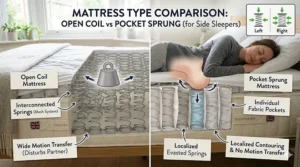
Pocket sprung mattresses offer a rather clever solution to this problem. Unlike traditional open-coil mattresses where all the springs are connected, pocket sprung designs house each spring in its own fabric pocket. This means when your shoulder presses down, only the springs directly beneath respond — the rest stay firm to support your spine. For side sleepers, this targeted response is the difference between waking refreshed or waking with that familiar ache between your shoulder blades.
The challenge is finding the right balance. Too firm, and your shoulders and hips won’t sink in enough, leaving them bearing your full weight all night. Too soft, and your spine curves unnaturally, straining your lower back. The sweet spot for most side sleepers sits in the medium to medium-firm range, typically with 1,000 to 3,000 pocket springs and a decent comfort layer on top. In the damp British climate, breathability matters too — you want those springs allowing airflow to prevent that clammy feeling that disrupts sleep on warmer nights.
Quick Comparison: Top Pocket Sprung Mattresses for Side Sleepers
| Mattress | Spring Count | Depth | Firmness | Price Range | Best For |
|---|---|---|---|---|---|
| Simba Hybrid Pro | 4,800 Aerocoil | 28cm | Medium-firm | £700-£900 | Premium cooling & motion isolation |
| Emma Original Pro | 7-zone system | 27cm | Medium | £500-£700 | Targeted shoulder/hip pressure relief |
| Silentnight Mirapocket 1000 | 1,000 pocket springs | 25cm | Medium | £300-£450 | Budget-conscious side sleepers |
| OTTY Original Hybrid | 2,000 pocket springs | 25cm | Medium | £300-£450 | Best value under £500 |
| Murcia Pillow Top | Pocket sprung + pillow top | 22cm | Medium | £300-£400 | Guest rooms & lighter sleepers |
| REM-Fit Pocket 1000 | 1,000 pocket springs | 20cm | Medium-firm | £300-£400 | Compact spaces & side sleepers on budget |
| Emma Original Lite | 3-zone pocket springs | 22cm | Medium | £400-£550 | Entry-level hybrid with decent airflow |
From this comparison, the budget bracket around £300-£450 offers surprisingly solid options for side sleepers, particularly the OTTY Original Hybrid and Silentnight Mirapocket 1000. Both provide adequate spring counts and comfort layers without the premium price tag. However, if you’re dealing with chronic shoulder pain or share your bed with a restless partner, the Simba Hybrid Pro’s 4,800 micro-springs justify the extra £400-£500 — that’s roughly 13p per night over a 10-year lifespan for genuinely undisturbed sleep. The Emma Original Pro sits in the middle ground, offering 7-zone targeted support that specifically addresses side sleeper pressure points without the premium cost of Simba.
💬 Just one click — help others make better buying decisions too! 😊
Top 7 Pocket Sprung Mattresses for Side Sleepers: Expert Analysis
1. Simba Hybrid Pro — Premium Choice for Chronic Shoulder Pain
The Simba Hybrid Pro represents what happens when British engineering meets genuine sleep science. This 28cm deep hybrid packs 4,800 Aerocoil micro-springs — significantly more than most competitors — alongside Simbatex cooling foam that delivers five times more airflow than standard memory foam. That’s not marketing fluff; independent testing in 2025 confirmed the airflow claims, which matters enormously when you’re sleeping on your side and your body heat has nowhere to escape.
What most people don’t realise about this model is how the cone-shaped Aerocoil springs specifically address side sleeper problems. Traditional pocket springs compress straight down; these micro-springs compress and slightly tilt, allowing your shoulder to nestle into the mattress whilst maintaining firm support underneath. The result is proper spinal alignment without that uncomfortable “stuck” feeling some memory foam mattresses create. The natural wool layer helps regulate temperature year-round — particularly useful during those muggy British summer nights when your bedroom feels like a sauna.
UK buyers consistently praise the motion isolation. If your partner shifts position at 3am, you won’t feel it on your side of the bed. The 200-night trial period offers genuine peace of mind, though most reviewers on Amazon.co.uk report keeping it well before that deadline expires. Worth noting: this mattress needs a few weeks to fully “break in” — the initial feel is slightly firmer than it becomes after regular use.
✅ 4,800 micro-springs provide exceptional targeted support
✅ Simbatex foam stays noticeably cooler than competitors
✅ Natural wool layer adapts to British seasonal temperature swings
❌ Premium price point (around £700-£900 for a double)
❌ Takes 2-3 weeks to reach optimal comfort level
Price range: £700-£900 (double size on Amazon.co.uk) — justifiable if shoulder pain is costing you sleep quality and daytime productivity.
2. Emma Original Pro — Best for Targeted Pressure Relief
The Emma Original Pro takes a rather sophisticated approach to side sleeping support with its 7-zone pocket spring system. Unlike basic 3-zone systems that simply separate head, torso, and legs, this mattress creates distinct support levels specifically where your shoulders and hips need them. The Halo Memory Foam layer on top contours to pressure points without that quicksand sensation some people hate about memory foam.
What sets this apart for side sleepers is the medium firmness (rated 3/5) — soft enough to cushion your shoulders and hips properly, firm enough to prevent your spine sagging into that unhealthy C-curve. The ThermoSync layer uses graphite particles to conduct heat away from your body, which testing shows runs measurably cooler than standard hybrids. During the damp British autumn and winter when your bedroom feels clammy, this makes a tangible difference to sleep quality.
The 200-night trial period is particularly generous, and Emma’s UK-based customer service actually responds promptly if issues arise. Several Amazon.co.uk reviewers specifically mention relief from shoulder pain within the first fortnight of switching to this mattress. The removable, washable cover is a practical bonus — chuck it in at 40°C whenever needed without voiding the warranty.
✅ 7-zone system specifically targets side sleeper pressure points
✅ ThermoSync cooling genuinely works in testing
✅ Washable cover suits British damp climate concerns
❌ Medium-soft feel may not suit heavier individuals (over 95kg)
❌ Slight initial foam smell (dissipates within 48 hours)
Price range: £500-£700 (double size) — excellent middle ground between budget and premium options for serious side sleepers.
3. Silentnight Mirapocket 1000 — Budget Pick Without the Compromise
Don’t let the sub-£400 price fool you — the Silentnight Mirapocket 1000 delivers where it matters for side sleepers. Silentnight’s Mirapocket technology uses a higher spring count than typical budget mattresses, and crucially, these springs extend edge-to-edge rather than stopping short with foam borders. That means better airflow through the entire mattress, which reduces heat and moisture build-up during those six-month stretches of British drizzle when everything feels perpetually damp.
The 25cm depth provides adequate cushioning for most side sleepers, though if you’re over 90kg, you might find it bottoms out slightly at the shoulders. The medium tension works well for average builds — soft enough for side sleeping comfort, firm enough to maintain decent spinal alignment. The Eco Comfort Fibre filling is 100% recyclable and genuinely breathable, which matters more in the UK than marketing suggests. Less heat retention means fewer middle-of-the-night wake-ups feeling overheated and clammy.
What you’re trading for the budget price is longevity. This mattress will comfortably last 5-6 years with regular rotation, whereas premium options stretch to 8-10 years. For guest rooms, children’s beds, or temporary accommodation, that trade-off makes perfect sense. Amazon.co.uk reviews consistently rate it 4+ stars, with most complaints coming from heavier individuals rather than average-weight side sleepers.
✅ Edge-to-edge springs improve airflow and reduce dampness
✅ Eco Comfort Fibre stays cooler than foam alternatives
✅ Silentnight’s 75+ year reputation offers reassurance
❌ May feel too soft for individuals over 90kg
❌ 5-year warranty shorter than premium competitors (10 years)
Price range: £300-£450 (double size) — unbeatable value for side sleepers who don’t need premium longevity or heavyweight support.
4. OTTY Original Hybrid — Best Value Under £500
The OTTY Original Hybrid punches well above its weight class. At 25cm deep — notably thicker than other budget mattresses that typically measure 20-23cm — this hybrid provides more cushioning where side sleepers need it. The 2,000 pocket springs hit that sweet spot where each spring can respond independently without excessive bounciness that disturbs sleep.
What makes this particularly suitable for side sleepers is the hybrid construction: pocket springs provide responsive support whilst the memory foam layer on top cushions your shoulders and hips. Unlike pure memory foam mattresses that trap heat, the spring layer allows air circulation throughout. During British summer months when bedrooms can reach uncomfortable temperatures, this airflow makes a tangible difference. The mattress arrives compressed in a box — let it expand for 24 hours before using it properly.
UK buyers on Amazon consistently mention two things: the surprisingly premium feel for the price point, and genuine relief from shoulder and hip pressure after switching from their old mattress. The 100-night trial period (shorter than some competitors’ 200 nights, but still generous) lets you test it through various seasons. Worth noting: if you’re in a rural area or Scottish Highlands, delivery might take slightly longer, but it’s still faster than traditional mattress retailers.
✅ 25cm depth provides better cushioning than thinner budget options
✅ 2,000 springs offer decent motion isolation for couples
✅ Hybrid design stays cooler than pure foam mattresses
❌ 100-night trial shorter than Emma/Simba’s 200 nights
❌ Edge support adequate but not exceptional
Price range: £300-£450 (double size) — the best balance of features, quality, and price for side sleepers on a budget.
5. Murcia Pillow Top Pocket Sprung — Ideal for Guest Rooms
The Murcia Pillow Top from Wayfair won’t win design awards, but it delivers honest comfort at an honest price. The pillow-top layer adds that initial cloud-like feeling when you first lie down, which guests particularly appreciate. Underneath, the pocket springs provide adequate support for occasional use, though daily side sleeping over years might reveal its budget construction sooner than premium alternatives.
At 22cm deep, it’s thinner than premium models but sufficient for guest rooms where mattresses see intermittent rather than nightly use. The individual pocket springs work independently to cushion shoulders and hips, which makes it genuinely comfortable for side sleepers despite the budget price point. Several Mumsnet reviewers mention buying a second one after trying the first — high praise from notoriously critical parents who know a thing or two about value for money.
What you’re not getting here is exceptional longevity or premium materials. The edge support isn’t amazing — you’ll feel the difference if you sit on the mattress edge regularly. But for £300-£400, it provides comfortable side sleeping for guests, children, or short-term accommodation without the guilt of spending £700+ on a mattress that won’t see daily use. The 100-night trial period offers reasonable protection if it doesn’t suit your needs.
✅ Pillow-top layer adds initial comfort for guests
✅ Individual pocket springs provide adequate side sleeper support
✅ Genuine value at £300-£400 for intermittent use
❌ Edge support below average
❌ May not last 8-10 years with daily use
Price range: £300-£400 (double size) — perfectly adequate for guest rooms and occasional use, but daily side sleepers should consider more durable options.
6. REM-Fit Pocket 1000 — Compact Option for Smaller Spaces
The REM-Fit Pocket 1000 at 20cm deep suits British homes where space comes at a premium. Flats with lower bed frames, loft conversions with sloped ceilings, or compact bedrooms where every centimetre of vertical space matters — this mattress fits where thicker models would look awkwardly tall. The 1,000 pocket springs provide zoned support across 12-16cm of the depth, which is adequate for side sleepers of average build.
The 5-layer construction combines open-cell comfort foam with high-density base foam, creating contouring support for shoulders and hips without excessive sinkage. What UK buyers on Amazon appreciate is the removable, washable cover — chuck it in the washing machine whenever needed, which is particularly useful in damp British weather when mattresses can develop that musty smell if not properly aired. The medium-firm feel works well for side sleepers who don’t want excessive softness.
Current discounts on Amazon.co.uk bring the double size down to around £330, making it exceptionally good value. The trade-off is the thinner profile — if you’re over 85kg or prefer a plush, deep mattress, this might feel too firm and shallow. But for average-weight side sleepers in compact living spaces, particularly in cities like London, Manchester, or Edinburgh where flat sizes lean towards cosy rather than spacious, this delivers smart value.
✅ 20cm depth suits compact bedrooms and lower bed frames
✅ Washable cover practical for British damp climate
✅ Zoned springs target pressure relief where needed
❌ Thinner profile may feel too firm for heavier individuals
❌ Less plush than premium alternatives
Price range: £300-£400 (often on offer around £330 for double) — excellent space-efficient option for side sleepers in flats and smaller bedrooms.
7. Emma Original Lite — Entry-Level Hybrid with Decent Airflow
The Emma Original Lite represents Emma’s answer to budget-conscious buyers who still want hybrid benefits. The 22cm depth and 3-zone pocket spring system provide basic but adequate support for side sleepers. The Airgocell foam layer cushions shoulders and hips reasonably well, whilst the SupportBase foam underneath maintains spinal alignment without excessive firmness.
What distinguishes this from pure foam budget mattresses is the edge-to-edge pocket spring core, which Emma redesigned to improve breathability. By removing foam from the sides, air flows more freely between the springs, reducing heat and moisture build-up. In the British climate where humidity levels regularly hover around 70-80%, this passive temperature regulation makes a noticeable difference. You won’t wake up feeling clammy on those muggy August nights or during the damp winter months.
The 200-night trial period matches Emma’s premium models, offering genuine reassurance. UK buyers on Amazon.co.uk mention the mattress suits lighter-framed side sleepers particularly well — if you’re under 75kg, the medium firmness provides adequate shoulder and hip cushioning. Heavier individuals might find it bottoms out slightly, particularly after 12-18 months of use. The 10-year warranty covers sagging and defects, though realistically, budget models typically last 6-8 years with proper care.
✅ Edge-to-edge springs improve airflow and reduce moisture
✅ 200-night trial matches premium Emma models
✅ Medium firmness suits lighter side sleepers well
❌ 3-zone system less sophisticated than 7-zone alternatives
❌ May bottom out for individuals over 85kg
Price range: £400-£550 (double size) — decent entry point into hybrid mattresses for lighter side sleepers, though the OTTY and Silentnight options offer better value.
How to Choose the Right Pocket Sprung Mattress for Side Sleeping
Choosing a pocket sprung mattress for side sleeping isn’t about finding the most expensive option or the one with the highest spring count. It’s about matching specific features to your body type, sleeping habits, and the peculiar demands of living in Britain where damp weather, compact homes, and temperature fluctuations shape what actually works long-term.
Spring Count and Zoning
Don’t fall for the marketing trap that more springs automatically equals better sleep. A 3,000-spring mattress isn’t necessarily superior to a well-designed 1,000-spring model. What matters more is zoning — how those springs are arranged and tensioned across different body regions. For side sleepers, look for mattresses with softer springs in the shoulder zone and firmer springs supporting your lower back and hips. The National Bed Federation recommends 3-zone systems as minimum for targeted support, with 5-7 zone systems providing more sophisticated pressure relief.
Budget mattresses (£300-£450) typically feature 1,000-2,000 springs with basic zoning. This works perfectly well for average-weight side sleepers who don’t have existing shoulder or hip problems. Premium mattresses (£700+) pack 2,000-5,000 springs with advanced zoning, which makes sense if chronic pain is disrupting your sleep or you share your bed with a partner whose movements wake you throughout the night.
Comfort Layer Depth
The springs provide support, but the comfort layer on top determines whether your shoulder actually sinks in enough to maintain spinal alignment. For side sleeping, you want a minimum 3-5cm comfort layer — memory foam, latex, or pillow-top padding that cushions pressure points without bottoming out onto the springs underneath. Thinner comfort layers (under 3cm) often feel too firm for side sleeping, leaving you with numb arms and aching shoulders by morning.
Memory foam comfort layers contour closely to your body but can trap heat. Latex comfort layers stay cooler but cost more. Pillow-top layers feel plush initially but may compress faster than foam alternatives. In the damp British climate, prioritise breathability — you want materials that wick moisture away rather than holding it against your skin.
Firmness Rating
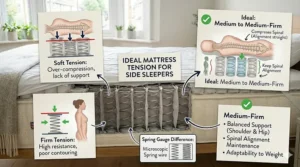
Most side sleepers need medium to medium-firm mattresses, typically rated 3-6 out of 10 where 10 is rock-solid firm. Too soft (1-2), and your hips sink excessively, straining your lower back. Too firm (7-10), and your shoulders bear too much concentrated pressure. Your body weight shifts these numbers slightly — if you’re under 70kg, medium-soft often works well; over 90kg, you’ll likely prefer medium-firm to prevent excessive sinkage.
British mattress retailers use confusing terminology — “medium” from one brand might feel like “medium-firm” from another. Ignore the labels and focus on trial periods. The 100-200 night trials offered by most reputable brands let you test firmness across different seasons. What feels perfect in January might feel too warm and soft in July, so test through at least one temperature transition.
Edge Support and Motion Isolation
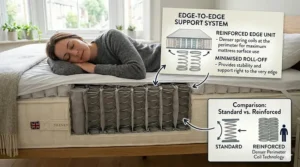
If you share your bed with a partner, edge support and motion isolation become crucial considerations. Pocket springs inherently provide better motion isolation than open-coil mattresses because each spring moves independently. But quality varies — budget models might use thinner gauge springs that transfer motion more readily. Premium models often reinforce the edge with additional springs or firmer foam, preventing that roll-off feeling when you sleep near the edge.
For couples where one partner is a restless sleeper and the other wakes easily, spending extra on better motion isolation (like the Simba Hybrid Pro’s 4,800 micro-springs) can literally pay for itself in better sleep quality. Calculate the cost per uninterrupted night over 8-10 years, and suddenly that £700 price tag looks rather reasonable compared to months of disrupted sleep.
Side Sleeper Comfort Layers: What Actually Works in British Conditions
The comfort layer sitting on top of your pocket springs determines whether you wake refreshed or wake with that familiar shoulder ache. But comfort layers behave differently in British conditions than in drier climates — humidity levels regularly sitting between 70-85% mean materials respond differently here than they would in Arizona or Southern California.
Memory Foam: The Traditional Choice
Memory foam contours beautifully to shoulders and hips, reducing pressure points effectively for side sleepers. The problem in Britain is heat retention. Pure memory foam mattresses can feel clammy during muggy summer nights or damp autumn months when bedroom temperatures hover around 16-18°C but humidity makes it feel warmer. Graphite-infused memory foam (like Emma’s ThermoSync or Simba’s Simbatex) conducts heat away more effectively — independent testing shows 2-3°C temperature differences, which genuinely matters at 2am when you’re overheating.
If you naturally run warm or share your bed with a heat-generating partner, prioritise graphite-infused or gel-infused memory foam over standard alternatives. The extra £50-100 in cost translates to fewer middle-of-the-night disruptions and better overall sleep quality. Alternatively, consider hybrid designs where memory foam sits on pocket springs — the airflow through the spring layer helps dissipate heat that memory foam would otherwise trap.
Pillow-Top Layers: Immediate Comfort
Pillow-top mattresses feature an additional padded layer sewn onto the top surface, creating that hotel-bed plushness when you first lie down. They work well for side sleepers who want immediate cushioning without the slow-response feel of memory foam. The challenge is durability — pillow-tops can compress faster than foam layers, particularly under the concentrated pressure points of side sleeping.
In the British climate, pillow-tops also require more maintenance. The extra surface area exposed to humid air can develop musty smells if not aired regularly. Rotate your mattress every 6-8 weeks and air it thoroughly whenever possible — open windows on dry days and let air circulate around the mattress rather than keeping it permanently on a solid platform base.
Natural Wool and Cotton: The Underrated Option
Natural fibres like British wool and cotton don’t get the marketing attention of memory foam, but they perform exceptionally well in UK conditions. Wool naturally regulates temperature, wicking moisture away whilst providing cushioning. It stays cooler in summer and warmer in winter — genuinely useful when British weather swings between 5°C and 25°C within the same fortnight. Wool also resists dust mites better than synthetic materials, which matters in our damp climate where mites thrive.
Premium mattresses like Vispring and Hypnos use wool and cotton extensively, commanding £1,500+ prices. But mid-range options increasingly incorporate wool comfort layers — Simba’s natural wool layer contributes significantly to its temperature regulation performance. If you suffer from allergies or find synthetic materials uncomfortable, wool and cotton hybrids deserve serious consideration despite higher initial costs.
Real-World Scenarios: Matching Mattresses to British Side Sleepers
The London Commuter (Budget: £400-£600)
Sarah works in Canary Wharf and lives in a Zone 3 flat share. Her 3×3.5 metre bedroom barely fits a double bed, wardrobe, and desk. She needs a mattress that fits a compact space, doesn’t cost a fortune, and helps with the shoulder tension from hunching over her laptop 50+ hours weekly. Budget constraints rule out premium options, but chronic shoulder pain means she can’t compromise on pressure relief.
Best match: OTTY Original Hybrid (£350-£450)
The 25cm depth provides adequate cushioning without overwhelming her compact bedroom. The 2,000 pocket springs target shoulder and hip pressure effectively, and the hybrid design stays cooler than pure foam alternatives during London’s muggy summer months. The 100-night trial lets her test it through one complete sleep cycle without risk. If shoulder pain persists, she can return it and try the Emma Original Pro, but most London flat-dwellers in similar situations report noticeable improvement within 2-3 weeks.
The Manchester Suburb Family (Budget: £500-£800)
James and Lisa share a king-size bed in their semi-detached house in Chorlton. James is a restless sleeper who shifts position frequently; Lisa is a light sleeper who wakes when he moves. Both are side sleepers dealing with early-morning stiffness that wasn’t there five years ago. They need motion isolation, adequate space for two adults, and pressure relief for ageing joints. Their budget allows mid-range options but not super-premium mattresses.
Best match: Emma Original Pro (£600-£750 for king size)
The 7-zone pocket spring system provides targeted support for both sleepers, whilst the Halo Memory Foam cushions their shoulders and hips without excessive motion transfer. The ThermoSync cooling layer helps during Manchester’s unpredictable weather when bedroom temperatures swing wildly. The 200-night trial covers an entire season, letting them test through autumn into winter when temperature regulation becomes more challenging.
The Edinburgh Retiree (Budget: £700-£1,000)
Margaret is 67, recently retired, and sleeping on a mattress she bought in 2012 that’s now causing lower back pain despite being “orthopaedic.” She’s a dedicated side sleeper with mild arthritis in her right shoulder. Living in a Victorian terrace near Leith, her bedroom feels perpetually damp despite the dehumidifier. She’s willing to invest properly this time — her sleep quality directly impacts her arthritis symptoms and overall wellbeing.
Best match: Simba Hybrid Pro (£800-£900 for double)
The 4,800 Aerocoil micro-springs provide exceptional pressure relief for arthritic joints, whilst the natural wool layer actively wicks moisture in Edinburgh’s damp climate. The superior motion isolation means she won’t be disturbed by her own position changes during the night — important when arthritis pain sometimes requires shifting position. The 200-night trial is long enough to assess whether it genuinely reduces morning stiffness and shoulder pain. At her age and with her health considerations, spending extra on sleep quality makes economic sense — better sleep reduces arthritis symptom severity, potentially reducing medication needs and healthcare costs.
Common Mistakes When Buying Pocket Sprung Mattresses for Side Sleeping
Mistake 1: Choosing Firmness Based on Back Pain Advice
The most persistent myth in mattress shopping is that firm mattresses cure back pain. This advice applies primarily to back and stomach sleepers whose spines need to stay relatively flat. Side sleepers need their shoulders and hips to sink into the mattress whilst their waist stays supported — that requires medium or medium-firm comfort, not hard-as-boards firmness.
When well-meaning friends or relatives recommend “orthopaedic” firm mattresses, they’re typically not side sleepers themselves. Orthopaedic firmness works beautifully for back sleepers but often exacerbates shoulder and hip pain in side sleepers. The NHS notes that sleeping position significantly impacts mattress requirements — don’t let generic advice override your actual sleeping habits.
Mistake 2: Ignoring UK Climate Considerations
British buyers often follow American or Australian mattress advice without accounting for our unique climate. Memory foam recommendations that work in Arizona’s dry heat trap moisture in Manchester’s humidity. Cooling gel layers marketed for Australian summers are overkill in Scotland but might be essential in London during rare heatwaves.
Factor in ventilation and breathability more heavily than you would in drier climates. Hybrid mattresses (pocket springs plus foam) generally outperform pure foam designs in British conditions because the spring layer allows airflow. If your bedroom feels damp even with windows open, prioritise wool or latex comfort layers over synthetic memory foam that can develop musty smells.
Mistake 3: Believing Higher Spring Counts Are Always Better
Marketing loves big numbers. A 3,000-spring mattress sounds inherently better than a 1,000-spring model, but that’s only true if the springs are properly zoned and tensioned. Poorly designed 3,000-spring mattresses can feel worse than well-engineered 1,500-spring alternatives.
What matters for side sleepers is spring responsiveness in the shoulder and hip zones, not total spring count. A mattress with 1,500 springs using proper zoning (softer springs under shoulders, firmer springs under waist and hips) will outperform a 2,500-spring mattress with uniform spring tension. Focus on zoning systems — 3-zone minimum, 5-7 zones ideal — rather than raw spring numbers.
Mistake 4: Overlooking Edge Support When Sharing a Bed
Single sleepers rarely care about edge support. Couples care enormously. Weak edge support means you avoid sleeping near the edge, effectively reducing your sleeping surface. If you’ve got a 135cm double bed but can only comfortably use the middle 100cm, you’ve wasted £150-300 in effective mattress space.
Quality pocket sprung mattresses reinforce edges with additional springs or firmer foam borders. When testing mattresses, sit on the edge — it should support your weight without excessive collapse. If you share a king or super king bed, strong edge support becomes crucial. The extra £100-200 for reinforced edges gives you back 15-20cm of usable sleeping width on each side.
Mistake 5: Ignoring Trial Periods and Warranty Terms
British consumer protection is robust — the Consumer Rights Act 2015 gives you strong protections for faulty goods. But mattresses need time to break in and for your body to adapt. A mattress feeling uncomfortable in week one might feel perfect by week four. Trial periods of 100-200 nights let you test through this adaptation phase plus seasonal temperature changes.
Read warranty terms carefully. Many exclude normal wear-and-tear indentations under 2.5cm — that’s normal body impression settling, not a defect. Some warranties require specific bed frames or bases. Some are pro-rated (you pay increasing percentages for replacements as time passes). Premium brands typically offer 10-year warranties; budget brands offer 5 years. If a £700 mattress lasts 10 years and a £350 mattress lasts 5 years, the lifetime cost per night is nearly identical.
Pressure Relief for Side Sleepers: Understanding the Science
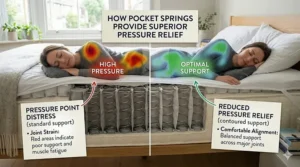
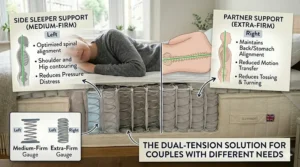
Your shoulder and hip create concentrated pressure points when side sleeping because your body weight focuses on relatively small contact areas. Unlike back sleeping where weight distributes across your entire back, or stomach sleeping where it spreads across torso and hips, side sleeping creates roughly 3-4 times more pressure per square centimetre at these joints.
How Pocket Springs Address Pressure Points
Individual pocket springs respond independently to pressure. When your shoulder presses down, only those springs compress — the springs supporting your waist and hips maintain their firmness. This creates what mattress engineers call “point elasticity” — the surface yields exactly where pressure applies without affecting surrounding areas. For side sleepers, this means your shoulder sinks into the mattress whilst your spine remains supported in neutral alignment.
Traditional open-coil mattresses can’t achieve this because all springs are interconnected. Press one area and the entire spring system responds, creating uneven support. Memory foam achieves point elasticity through material properties, but it responds slowly and can trap heat. Latex foam provides good point elasticity with better breathability but costs significantly more. Pocket springs offer the best balance of targeted response, durability, and price for most British side sleepers.
Zoning Systems Explained
Basic 3-zone systems divide the mattress into head/shoulders, torso, and legs/feet. Softer springs in the shoulder zone let your shoulder sink in; firmer springs in the torso zone support your waist; medium springs in the leg zone maintain alignment. This works adequately for standard side sleeping positions.
Advanced 5-7 zone systems add more sophisticated support. They might use different spring tensions specifically for hip zones versus shoulder zones, recognising that hip and shoulder pressure patterns differ. They might create firmer support edges for sitting on the bed edge. Premium systems even account for the slight weight difference between head and feet. For side sleepers with existing shoulder or hip problems, these advanced zoning systems can make the difference between waking pain-free or waking with familiar aches.
Body Weight and Pressure Relief
Your body weight dramatically impacts pressure point intensity. A 60kg side sleeper creates roughly half the pressure per square centimetre at their shoulder compared to a 90kg sleeper. This is why “one-size-fits-all” firmness ratings fail — a medium-firm mattress perfect for a 70kg person might feel too firm for a 55kg person and too soft for a 95kg person.
As a general guideline for pocket sprung mattresses and side sleeping:
- Under 65kg: Medium to medium-soft (comfort rating 4-5/10)
- 65-85kg: Medium to medium-firm (comfort rating 5-6/10)
- Over 85kg: Medium-firm to firm (comfort rating 6-7/10)
These are starting points, not absolute rules. Personal preference, existing joint problems, and partner weight differences all modify ideal firmness. This is why 100-200 night trial periods matter — you need weeks to determine whether a mattress genuinely suits your body weight and sleeping position.
Maintaining Your Pocket Sprung Mattress in British Weather
British weather creates unique mattress maintenance challenges. Humidity levels rarely drop below 60% even during summer, damp winters feel endless, and temperature swings between 5-25°C within single weeks affect how mattresses perform and age.
Rotation and Airing Schedule
Rotate your mattress 180° every 8-12 weeks. This distributes wear across the entire surface rather than concentrating it where your hips and shoulders create pressure points. Set calendar reminders — when clocks change for British Summer Time and again when they revert, rotate your mattress. That’s twice yearly, simple to remember.
Air your mattress monthly by removing all bedding and opening windows on dry days (admittedly harder in Manchester than Margate, but persevere). Strip back to bare mattress and let air circulate around it for 2-4 hours. This simple step reduces moisture accumulation that leads to musty smells and accelerates wear. If you’re using a solid platform bed base, consider switching to a slatted base that allows airflow underneath — this matters significantly more in Britain than in drier climates.
Protecting Against Moisture
British homes regularly experience indoor humidity above 70%. That moisture has nowhere to go except into absorbent materials like your mattress. Invest in a quality mattress protector — not the plasticky waterproof type that trap heat and moisture, but breathable protectors that allow airflow whilst preventing liquids from reaching the mattress itself.
Wool protectors work exceptionally well in UK conditions because wool naturally wicks moisture away from your body whilst remaining breathable. They cost £40-80 but extend mattress life by reducing moisture damage to internal materials. Cheaper alternatives use polyester or cotton-poly blends; these work adequately but don’t wick moisture as effectively. Whatever you choose, wash the protector every 4-6 weeks — it’s protecting your £500-900 investment.
Dealing with Mould and Odours
Damp British weather creates perfect conditions for musty smells developing in mattresses, particularly in poorly ventilated bedrooms. If your mattress develops that characteristic musty smell, strip all bedding and sprinkle bicarbonate of soda liberally across the surface. Leave for 2-4 hours, then vacuum thoroughly. This absorbs moisture and neutralises odours without harsh chemicals.
For stubborn mould spots (those green or black patches indicating moisture problems), spot-clean with diluted white vinegar (one part vinegar, three parts water). Apply with a cloth, never soak the mattress. Let it air-dry completely before replacing bedding. If mould appears regularly, you’ve got a ventilation problem — crack windows during sleep, use a dehumidifier, or check for underlying damp issues in your home. Addressing ventilation costs less than replacing mattresses every 3-4 years due to moisture damage.
Storage Considerations
If you’re storing a mattress between moves (common for students, contractors, or anyone between homes), British storage units require specific precautions. Never store mattresses directly on concrete floors — moisture wicks upward, creating ideal mould conditions. Raise the mattress on pallets or wooden frames. Cover it with breathable mattress bags designed for storage, not plastic sheeting that traps moisture inside.
Climate-controlled storage units cost 20-30% more but protect mattresses far better than standard units where temperature and humidity fluctuate wildly. If that’s not feasible, add silica gel packets inside the storage bag to absorb moisture and check monthly for signs of mould or mustiness. Prevention costs less than replacement.
Sleeping Position and Spinal Alignment: Why It Matters for Long-Term Health
Proper spinal alignment during sleep isn’t just about comfort — it’s about long-term musculoskeletal health. The British Chiropractic Association notes that poor sleeping posture contributes to chronic neck and back problems that develop gradually over years. Your spine maintains natural curves: cervical (neck), thoracic (upper back), and lumbar (lower back). Side sleeping can either maintain these curves or distort them, depending on mattress support.
Neutral Spine Alignment in Side Sleepers
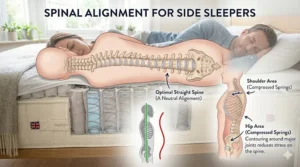
Proper side sleeping alignment means your spine forms a relatively straight line when viewed from behind, maintaining natural curves when viewed from the side. Your shoulder sinks into the mattress sufficiently that your neck stays level with your spine. Your hips sink enough to maintain lumbar curve without excessive sinkage that creates a U-shape putting pressure on your lower back.
Pocket sprung mattresses achieve this through zone-specific spring tensions. Softer springs in the shoulder zone allow sinkage; firmer springs in the lumbar zone prevent excessive hip sinkage; medium springs in the leg zone maintain alignment. Poor zoning — or mattresses lacking zoning entirely — forces your spine into unnatural positions throughout the night. Eight hours nightly in poor alignment, multiplied across years, creates cumulative damage that manifests as chronic pain by your 40s or 50s.
Pillow Height and Mattress Firmness Relationship
Your pillow height must match your mattress firmness. Firmer mattresses compress less under shoulder weight, creating a larger gap between mattress surface and your head — you need a thicker pillow. Softer mattresses let your shoulder sink more, creating a smaller gap — you need a thinner pillow. This is why changing mattresses often requires changing pillows too.
For side sleepers on medium-firm pocket sprung mattresses, pillow loft (thickness) of 12-15cm works for most people. Narrower shoulders need thinner pillows (10-12cm); broader shoulders need thicker pillows (15-18cm). Test by lying on your side — your spine should form that straight line we mentioned earlier. If your head tilts upward, your pillow is too thick; if it tilts downward toward the mattress, your pillow is too thin.
Hip and Shoulder Pain Prevention
Concentrated pressure on shoulders and hips throughout the night restricts blood flow to these areas, causing that familiar numbness and aching sensation. Over years, this repetitive pressure can contribute to joint inflammation and accelerated wear. Proper pocket sprung mattresses distribute pressure more evenly, allowing adequate blood flow whilst maintaining alignment.
If you’re waking with numb arms or hands, your shoulder isn’t sinking into the mattress sufficiently — you need a softer comfort layer or softer zoning in the shoulder area. If you’re waking with hip pain, you’re likely sinking too far into the mattress, creating lumbar curve distortion — you need firmer overall support or better zoning that maintains hip alignment whilst allowing shoulder sinkage. These aren’t problems that “break in” periods solve; they indicate fundamental mattress-to-body mismatch that requires different firmness or zoning.
Budget vs. Premium: Where to Invest Your Money
The price spectrum for pocket sprung mattresses in the UK ranges from £200 (barely adequate) to £2,000+ (luxury handmade options). For side sleepers specifically, the value sweet spots sit around £300-450 (budget), £500-700 (mid-range), and £800-1,000 (premium). Beyond £1,000, you’re paying for handcrafted details, luxury natural materials, and brand prestige rather than meaningful improvements in side sleeping comfort.
What You Get at Each Price Point
Budget (£300-450): Adequate spring counts (1,000-2,000), basic zoning (3-zone systems), synthetic comfort layers, 5-year warranties, 100-night trials. Perfect for guest rooms, children’s beds, temporary accommodation, or side sleepers without existing pain problems. Examples: OTTY Original Hybrid, Silentnight Mirapocket 1000, REM-Fit Pocket 1000.
Mid-range (£500-700): Higher spring counts (2,000-3,000), advanced zoning (5-7 zones), memory foam or hybrid comfort layers, cooling technologies, 10-year warranties, 200-night trials. Best value for most side sleepers with typical shoulder/hip pressure needs. Examples: Emma Original Pro, Emma Original Lite, mid-tier Silentnight models.
Premium (£800-1,000): Highest spring counts (3,000-5,000), advanced zoning with micro-springs, natural materials (wool, cotton), superior cooling, exceptional motion isolation, 10-year warranties, 200-night trials. Worth considering for chronic pain sufferers, couples needing maximum motion isolation, or anyone prioritising sleep quality over budget constraints. Examples: Simba Hybrid Pro, premium Hypnos models.
Long-Term Cost Analysis
A £350 mattress lasting 5 years costs £0.19 per night. A £700 mattress lasting 10 years costs £0.19 per night. Identical long-term cost, but the premium mattress likely provides better sleep quality throughout its lifespan — springs maintain tension longer, comfort layers degrade slower, materials resist moisture damage better.
Factor in indirect costs too. If poor sleep from a cheap mattress reduces your productivity 10% and you earn £35,000 yearly, that’s £3,500 in lost productivity potential over the mattress’s 5-year lifespan. If better sleep from a £700 mattress maintains your full productivity, you’ve gained £3,500 in value beyond the £350 price difference. This calculation sounds absurd until you’re lying awake at 3am with aching shoulders, knowing you’ve got a full workday ahead. Sleep quality genuinely impacts earning capacity, health outcomes, and quality of life.
Where to Compromise
If budget constrains you to £400-500, prioritise features that directly impact side sleeping comfort: adequate spring count (minimum 1,000 springs), basic zoning (3-zone minimum), and trial period (minimum 100 nights). Compromise on aesthetics, premium materials, extended warranties, or brand prestige. Function trumps form when you’re unconscious 8 hours nightly.
Avoid compromising on mattress depth (minimum 20cm for side sleepers) or trial period length (minimum 100 nights). Both directly affect whether the mattress actually works for your body. A beautiful mattress that causes shoulder pain is worthless; an ugly mattress that lets you sleep pain-free is priceless.
FAQ: Pocket Sprung Mattresses for Side Sleepers
❓ How many pocket springs do I need for comfortable side sleeping in the UK?
❓ Are pocket sprung mattresses suitable for heavier side sleepers over 90kg?
❓ Do pocket sprung mattresses stay cooler than memory foam in British summers?
❓ Can I use a pocket sprung mattress on a divan base or does it need slats?
❓ How long do pocket sprung mattresses typically last in UK conditions before needing replacement?
Conclusion: Finding Your Perfect Pocket Sprung Match
The right pocket sprung mattress transforms side sleeping from a nightly battle with shoulder pain and numb arms into genuinely restorative rest. After reviewing the seven best options available on Amazon.co.uk in 2026, three clear winners emerge across different price brackets:
For side sleepers on tight budgets (£300-450), the OTTY Original Hybrid delivers exceptional value with 2,000 pocket springs, adequate zoning, and 25cm depth that cushions shoulders and hips without breaking the bank. For mid-range buyers (£500-700) prioritising targeted pressure relief, the Emma Original Pro with its 7-zone system specifically addresses side sleeper pain points whilst maintaining temperature regulation crucial in British weather. For premium buyers (£800+) seeking maximum motion isolation and longevity, the Simba Hybrid Pro with 4,800 micro-springs represents the pinnacle of pocket sprung engineering available to UK consumers.
Your body weight, existing pain problems, bedroom size, budget constraints, and partner considerations all influence which mattress suits your specific situation. Use the trial periods — 100-200 nights depending on brand — to test across seasonal temperature changes. Your shoulders and hips will thank you every morning when you wake without that familiar ache reminding you that last night’s sleep was anything but restorative.
British weather, compact homes, and damp conditions create unique requirements that American or Australian mattress advice often overlooks. Prioritise breathability, moisture resistance, and proper zoning over raw spring counts or marketing hyperbole. Sleep quality affects your productivity, health, and overall quality of life more than most purchases you’ll make this year. Invest wisely, test thoroughly, and give your body the support it needs for 8 hours nightly over the next decade.
Recommended for You
- Pocket Sprung vs Hybrid Mattress: 7 Best UK Choices 2026
- 7 Best 2000 Pocket Sprung Mattress UK Reviews 2026
- 7 Best Pocket Sprung Mattress UK: Expert Reviews 2026
Disclaimer: This article contains affiliate links. As an Amazon Associate, I earn from qualifying purchases. If you purchase products through these links, we may earn a small commission at no additional cost to you.
✨ Found this helpful? Share it with your mates! 💬🤗
